
- Release Year: 2004
- Platforms: Windows
- Publisher: Atari, Inc.
- Developer: funkittron, Inc.
- Genre: Puzzle
- Perspective: Top-down
- Game Mode: Single-player
- Gameplay: Board game, Word construction
- Average Score: 70/100
Description
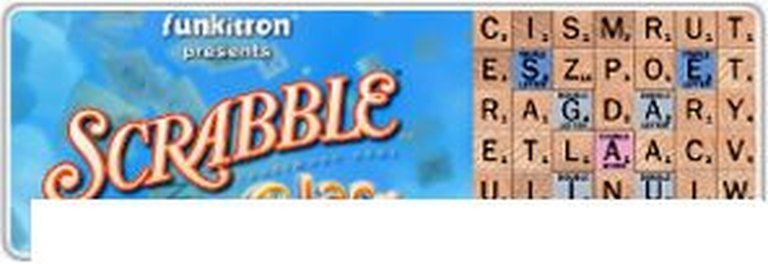
Scrabble Blast! is a puzzle game that reinvents the classic Scrabble experience by presenting players with a 7×7 grid fully populated with random letters at the start. Instead of placing tiles on an empty board, players must form words of three to 15 letters in any direction—including diagonals and combinations—causing cleared words to vanish and letters to cascade down. The game features three distinct modes: One Bag with limited letter reserves, Puzzle with falling bombs that must be defused by including them in words, and Action where bombs descend in real-time, all enhanced by score multipliers, a one-time board reset, and an AI assistant named Maven that provides hints and word explanations.
Gameplay Videos
Scrabble Blast! Guides & Walkthroughs
Scrabble Blast! Reviews & Reception
ign.com (70/100): The wordie classic gets the Tetris treatment.
Scrabble Blast! Cheats & Codes
Game Boy Advance (USA)
| Code | Effect |
|---|---|
| 9037CCA673CD | Master Codes |
| EA88A0B7D300 | Master Codes |
| F3A2146BEDC7 | End Level [Press L+R] |
| 1CFC47658A6F | End Level [Press L+R] |
| 8209FA985632 | Infinite Exchange |
| 86B9F288D312 | Infinite Hints |
| F2239CC60317 | Infinite Time |
| 8A49EA985630 | Start With Hi-Score |
| 23469AB50531 | Start With Hi-Score |
| FEDA267BDF40 | Stop Clock Bombs |
Scrabble Blast!: Review – A Lexical Labyrinth Lost in Time
Introduction: The Blast That Fizzled?
In the crowded pantheon of licensed casual games, few titles embody a fascinating contradiction quite like Scrabble Blast! Released in 2004 for Windows and subsequently for the Game Boy Advance in 2005, this title from funkotron/Visual Impact attempted to surgically graft the cerebral satisfaction of word formation onto the adrenalized, falling-block framework popularized by Tetris. Its legacy is one of profound innovation buried under layers of commercial obscurity and near-total critical neglect. This review posits that Scrabble Blast! is not merely a failed spin-off, but a bold, if flawed, experiment in systemic game design—a hybrid that masterfully recontextualizes the foundational rules of the world’s most iconic word game into a novel, high-pressure puzzle format. While its historical impact was minimal, its design DNA represents a significant, if overlooked, branch in the evolutionary tree of puzzle games, one that deserves dissection for its audacious mechanics and its poignant lesson in the perils of misjudging a franchise’s audience.
Development History & Context: A Casualchemy Experiment
The early-to-mid 2000s was the golden age of the “casual” gaming boom, a market segment being defined and exploited by publishers like PopCap Games (Bejeweled, 2001) and subsequently by mobile phone carriers and systems like the Nintendo DS. Within this landscape, licensed properties were seen as low-risk, high-potential avenues to capture an older, less tech-savvy demographic. Scrabble, owned by Hasbro and inducted into the National Toy Hall of Fame in 2004—the same year as this game’s PC release—was a prime candidate. Its core loop of tile-placement and point-scoring was instantly recognizable, yet its traditional, turn-based, board-focused format seemed antithetical to the real-time, addictive “just one more go” impulse driving the casual market.
Scrabble Blast! was developed by funkitron, Inc., a studio with a portfolio that includes other casual and puzzle titles like Slingo and Scrabble Rack Attack. Led by designer David Walls, the team’s vision was evidently to create a “Scrabble for the Tetris generation.” The technological constraints were modest: a Windows download title and a GBA cartridge demanded simple 2D graphics, efficient code, and a control scheme adaptable to mouse or portable buttons. The gaming landscape was one where Bookworm Adventures (2006) would later successfully marry words and action, and where Boggle and Word Scramble variants were ubiquitous on early mobile phones. Scrabble Blast! arrived slightly ahead of this curve, attempting to solve the “real-time word game” problem with a novel spatial mechanic: a prefilled, reactive grid rather than an empty rack and board.
Narrative & Thematic Deep Dive: The Poetry of the Grid
Scrabble Blast! possesses no narrative in the traditional sense. There is no plot, no characters with arcs, and no diegetic story. Yet, to dismiss this as a purely mechanical exercise would be to miss its profound thematic core, which is an abstract meditation on lexical entropy and creation.
The game’s premise is a world of pure linguistic potential, a 7×7 matrix of random letters—a “blast” of alphabetic chaos. The player’s sole existential purpose is to impose order upon this chaos, to carve pathways of meaning (words) from the anarchy. The thematic weight is carried entirely by the mechanics:
* Creation vs. Destruction: Forming a word causes it to “vanish.” This is not a deletion but a transmutation—effort (letters) is converted into score (points), and the void left behind is immediatelyfilled by new, random letters from the “reserve.” It’s a cycle of linguistic birth and erasure.
* The Tyranny of Time: In the Puzzle and Action modes, the Number Bombs introduce an antagonist not of story, but of pure, increasing pressure. They are literal countdowns to systemic collapse, representing the entropy that the player’s ordering act must constantly fight against. The Action mode’s real-time descent makes this conflict visceral: you are not just a wordsmith, but a linguistic firefighter.
* The Ludicrous Scale: The ability to form words up to 15 letters long on this compact grid is a deliberate fantasy. It elevates the player from a simple tile-matcher to a potential architect of sublime lexical complexity. The game implicitly asks: “Can you find order in chaos so profound it defies the grid’s geometry?”
The “narrative” is written in the player’s mind with each successful chain, each bomb defused by a serpentine word that snakes through the board. It’s a silent, personal epic of vocabulary versus volatility.
Gameplay Mechanics & Systems: A Masterclass in Constrained Design
The genius and frustration of Scrabble Blast! are inextricably linked in its core mechanical loop.
1. The Spatial Paradigm Shift: The single most revolutionary rule change is the abandonment of horizontal/vertical constraints. Letters can be connected in any direction, including diagonals and changing direction mid-word. This transforms the 7×7 grid from a crossword puzzle surface into a three-dimensional (on a 2D plane) graph. Word-finding becomes a pathfinding problem. A ‘Q’ buried in a corner is no longer dead weight if a ‘U’ is diagonally adjacent. This mechanic alone justifies the title’s existence, creating a frantic, spatial-verbal puzzle unlike any other Scrabble variant.
2. The Three-Act Structure:
* One Bag: A finite-resource endurance test. With 100 total letters (49 on board, 51 in reserve), the player must manage a slowly depleting ecosystem. The shrinking mechanic—when a full column vanishes, the grid collapses rightward—is a brilliant escalation. It reduces the playable area, increasing letter density and making future words both easier (more connections) and harder (more crowded). It’s a elegant, implicit difficulty curve.
* Puzzle: A turn-based crisis management sim. The goal is 10 words per level, but each word advances all Number Bombs. The tactical depth here is immense. Do you use a short word to stall a 3-Bomb, or gamble on a long word to clear a 7-Bomb? The bomb-defusal rule—using the bomb’s letter in a word of equal or greater length—is a perfect Scrabble-themed mechanic. It forces you to incorporate a disruptive element into a valuable word, a literal “disarming” through vocabulary.
* Action: A pure stress test. The real-time bomb fall (starting at ~7 seconds/row) vaporizes the contemplative pace of standard Scrabble. The removal of bomb length requirements is a crucial, compensatory design choice—it would be impossible to form a 7-letter word in under 7 seconds under pressure. This mode is a whirlwind of instinct and pattern recognition.
3. Support Systems & Flaws:
* Letter Exchange: Replacing the entire board is a massive, desperate power-up, limited to once per level (and only once in One Bag). It’s a “nuclear option” that resets the chaos but wastes precious letters/reserve.
* Maven, the Tutor: This is the game’s secret pedagogical weapon. The integrated AI that offers hints (gradually revealing letters) and provides definitions for every played word is revolutionary for a casual game. It transforms Scrabble Blast! from a simple score-chaser into a potential vocabulary-building tool. You can play to learn, not just to win. This feature is tragically under-discussed.
* Multipliers: Standard Scrabble bonus squares (DL, TL, DW, TW) are present, and their interaction with the free-form pathfinding can create monstrous scores. A 15-letter word snaking through multiple multipliers is the holy grail.
* The Fatal Flaw – The Grid Itself: For all its freedom, the 7×7 size is both a blessing and a curse. It’s large enough to be daunting initially but can feel cramped in late One Bag or high-level Action. The random refill mechanic, while necessary, can create long, barren stretches with no viable words, leading to frustrating stalls, especially in Action mode where time is the enemy. This randomness is the primary source of player agency erosion.
World-Building, Art & Sound: Minimalist Aesthetic, Functional Execution
Given its pedigree as a downloadable PC title and GBA game, Scrabble Blast! eschews any world-building. The “setting” is an abstract plane of colored tiles on a dark, often slightly textured background. The visual language is purely functional:
* Letter Tiles: Clear, high-contrast, using a standard sans-serif font. Colors denote point values, a direct carryover from the physical game.
* The Board: A simple grid. The most important visual cues are the colored borders of the multiplier squares (red for DW/TW, blue for DL/TL) and the stark, ominous black of the Number Bombs, which display their countdown number prominently.
* UI/HUD: Cleanly separated. Score is large and central. Reserve count (One Bag) or Bomb timer (Action) is clearly visible. Maven’s hint/definition box is a dedicated, readable pane.
The sound design is similarly utilitarian. Tile-selection and word-formation clicks are satisfying. The “explosion” of a bomb or the “clear” chime for a high-scoring word provides auditory feedback crucial to the fast-paced modes. The music is generic, upbeat electronica—inoffensive background fodder typical of the era’s casual games. There is no attempt at atmosphere because the “atmosphere” is the tension of the grid itself. The presentation serves the mechanics without distraction, which is both its strength and its forgettability.
Reception & Legacy: The Curious Case of the Critical Void
The critical reception of Scrabble Blast! is best described as a vacuum. On MobyGames, it has a paltry two user ratings averaging 3.8/5 and zero written reviews. Metacritic lists no critic reviews for any platform. IGN’s sole archived review by Levi Buchanan (likely from 2005–2006) from the provided sources is brief, positive, and primarily descriptive, awarding it a 7/10 and summarizing the modes as “The wordie classic gets the Tetris treatment.” This near-total silence speaks volumes. The game was commercially inert, a forgotten footnote in the Hasbro Interactive/Atari/Funkitron licensing pipeline.
Its legacy is one of cult obscurity and design curiosity.
* Influence: There is no direct lineage. It did not spawn sequels or clones. Its core innovation—free-form word chains on a falling grid—was not widely adopted. Later word-puzzle hybrids like Bookworm Adventures (action-oriented but turn-based) or Wordscapes (static crosswords) took different paths. Scrabble Blast! represents a dead-end branch in the puzzle-game phylogeny.
* Historical Significance: Its value is as a proof-of-concept. It demonstrated that the fundamental tension of Scrabble—optimizing point values against spatial constraints—could be re-engineered into a real-time, pressure-cooker experience. The bomb mechanic, in particular, is a inspired translation of Tetris’s escalating line-clear threat into the lexicon.
* Modern Rediscovery? Its status as abandonware (available on My Abandonware) and the existence of a Flash version on SolitaireParadise.com suggest a tiny, persistent player base of retro puzzle enthusiasts. For them, it is a hidden gem—a challenging, brain-bending oddity that rewards spatial-verbal dexterity in a way no other Scrabble product does.
Conclusion: A Brilliant Misfire
Scrabble Blast! is the definition of a brilliant misfire. Its central conceit—a Scrabble board that is already full and reacts to your words—is a stroke of genius, transforming a game of placement into a game of excavation and navigation. The three distinct modes offer varied, thoughtful challenges, and the inclusion of Maven’s educational features shows a commendable, if commercially naive, desire to add value beyond mere entertainment.
However, its mechanics are undermined by the brutal randomness of its tile refill system, which can create unwinnable-feeling stretches of bad luck, especially in the pressure-cooker Action mode. This, combined with a starkly minimal presentation and zero marketing momentum, consigned it to the dustbin of licensed game history. It was a game ahead of the casual gaming curve’s understanding of what a real-time word game could be, yet it failed to achieve the polished, addictive simplicity of its contemporaries.
In the grand museum of video game design, Scrabble Blast! deserves a small, dedicated placard. It is not a masterpiece, but it is a fascinating artifact of experimental design—a bold, system-focused reimagining of a classic that asked a tantalizing “what if?” question and provided a deeply clever, if ultimately uneven, answer. For the puzzle historian and the lexical thrill-seeker, it remains a blast from the past worth unearthing. For the broader industry, it is a cautionary tale about the fine line between innovative complexity and frustrating randomness.
Final Verdict: 7.5/10 – A flawed, fascinating, and unfairly forgotten experiment in word-game hybridization. See it, play it, and learn from its daring failures.