
- Release Year: 2014
- Platforms: Macintosh, Nintendo Switch, Windows Apps, Windows
- Publisher: Buka Entertainment, Joindots GmbH, URSE Games
- Developer: URSE Games
- Genre: Puzzle
- Perspective: Fixed / flip-screen
- Game Mode: Single-player
- Gameplay: Tile matching puzzle
- Setting: Fantasy
- Average Score: 75/100
Description
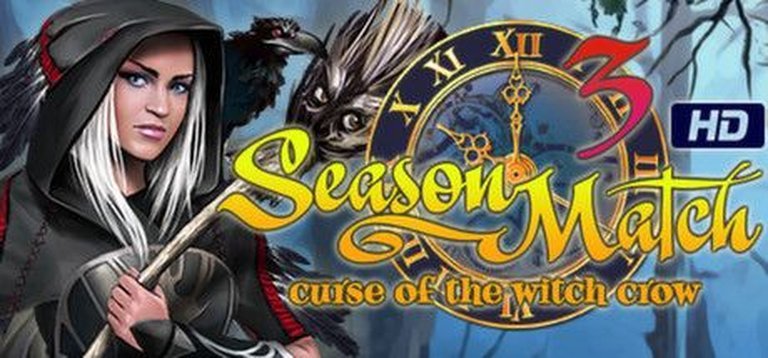
Season Match 3: Curse of the Witch Crow is a fantasy-themed tile-matching puzzle game where players embark on a quest to break a witch’s curse by solving intricate match-3 puzzles across various seasonal landscapes. Developed by URSE Games and released in 2014, the game features a point-and-select interface, vibrant visuals, and a captivating storyline that unfolds as players progress through the levels, battling the dark magic of the Witch Crow.
Gameplay Videos
Where to Buy Season Match 3: Curse of the Witch Crow
PC
Season Match 3: Curse of the Witch Crow Guides & Walkthroughs
Season Match 3: Curse of the Witch Crow Reviews & Reception
gamezebo.com (70/100): A decent title to add to the collection, even though there are a bunch like it.
steambase.io (79/100): Mostly Positive
niklasnotes.com (78/100): Overall, ‘Season Match 3 – Curse of the Witch Crow’ presents a mixed reception among players, with appreciation for its graphics and casual gameplay, but significant criticism regarding technical issues and gameplay mechanics that diverge from traditional match-3 formats.
Season Match 3: Curse of the Witch Crow – A Flawed Gem in the Match-3 Pantheon
Introduction: A Match-3 Fairy Tale with a Missing Ending
Season Match 3: Curse of the Witch Crow (2014) is a puzzle-adventure game that blends match-3 mechanics with hidden object scenes and a whimsical fairy-tale narrative. Developed by URSE Games and published by ESDigital Games, it stands as the third entry in the Season Match series, following Season Match (2007) and Season Match 2 (2008). The game tasks players with freeing the anthropomorphized Months—January, February, and so on—from the clutches of the titular Witch Crow, who has cursed the world into an eternal winter.
At its core, Season Match 3 is a competent but unremarkable match-3 title, elevated by its charming art style and atmospheric soundtrack. However, its legacy is marred by a infamous bug: the missing ending. Players who complete the game’s 175+ levels are met not with a climactic resolution, but with a blank screen and an abrupt return to the main menu. This oversight has overshadowed the game’s strengths, turning what could have been a solid casual experience into a cautionary tale about quality assurance in indie game development.
This review will dissect Season Match 3 in its entirety—its development, narrative ambitions, gameplay systems, and the cultural footprint it left behind. Despite its flaws, the game remains a fascinating artifact of the mid-2010s casual gaming boom, offering insights into the challenges of balancing storytelling with repetitive puzzle mechanics.
Development History & Context: A Russian Studio’s Fairy-Tale Vision
The Studio Behind the Game: URSE Games
URSE Games, a Russian developer, specialized in casual and puzzle games, with Season Match 3 being one of their most ambitious projects. The studio’s portfolio includes other match-3 titles like Crow (2012) and Crow Story (2021), suggesting a recurring fascination with avian antagonists. The game was built using the Unity engine, a popular choice for indie developers at the time due to its cross-platform flexibility.
The team behind Season Match 3 was small but experienced:
– Project Leads: Sergey Kuzmichev and Juriy Aliev
– Art: Nikolay Dihtyrenko and Aleksandr Lyashenko
– Programming: Dmitry Bondarev and Maxim Genev
– Music & Sound: Arthur Baryshev
Notably, Arthur Baryshev’s work on the soundtrack stands out as one of the game’s strongest elements, with a haunting, melancholic score that complements the wintry setting.
The Casual Gaming Landscape of 2014
Season Match 3 launched during the height of the casual gaming revolution, a period dominated by titles like Bejeweled, Peggle, and Plants vs. Zombies. The match-3 genre was oversaturated, forcing developers to differentiate their games through narrative hooks or hybrid mechanics. URSE Games attempted this by:
1. Integrating a Story: Unlike many match-3 games, which treated narrative as an afterthought, Season Match 3 wove its gameplay into a fairy-tale plot.
2. Adding Hidden Object Scenes: These segments, while simplistic, broke up the monotony of pure match-3 gameplay.
3. Character Abilities: Each rescued Month granted the player a unique power, adding a light RPG element.
However, the game’s Steam release in 2014 (after an initial 2010 launch) coincided with a shift in player expectations. Gamers were increasingly demanding polish, and Season Match 3’s lack of a proper ending became a glaring flaw in an era where even mobile games were expected to deliver complete experiences.
Technological Constraints and the Missing Ending
The most infamous aspect of Season Match 3 is its broken finale. Players who complete the game’s final level are met with:
– A blank screen after freeing December.
– No closing cutscene, dialogue, or resolution.
– An achievement titled “The Secret of the Witch Crow” that reveals… nothing.
Steam forum threads from 2014–2015 reveal widespread frustration:
“It’s kind of like reading a good book and the last chapter’s last three pages are missing.” – karinms
“You get the achievement ‘The Secret of the Witch Crow,’ and the secret is… NOTHING!” – Shodan
Players eventually discovered the ending’s text and artwork buried in the game’s files (Text.xml and WallPaper14.jpg), confirming that the content existed but was never triggered. Theories about the cause include:
– A coding oversight where the ending’s trigger event was never properly linked.
– A Steam-specific bug, as some players speculated that non-Steam versions (e.g., Big Fish Games) might have had a functional ending.
– Rushed development, given the game’s initial 2010 release and later Steam port.
Regardless of the cause, the missing ending became Season Match 3’s defining feature, overshadowing its other qualities.
Narrative & Thematic Deep Dive: A Fairy Tale with Untapped Potential
Plot Summary: The Curse of the Witch Crow
The game’s premise is simple yet charming:
– The Witch Crow, a mysterious sorceress, has imprisoned the Months (personified as royal figures) in a deck of tarot cards.
– The world is trapped in eternal winter, as the natural order of time has been disrupted.
– The player, as an unnamed protagonist, must free each Month by completing match-3 levels and hidden object challenges.
The narrative unfolds in a linear fashion, with each Month’s rescue advancing the plot. Key characters include:
– Princess July: Implied to be Crow’s twin sister (a revelation lost in the missing ending).
– Old October: A wise elder who hints at Crow’s origins (“from another kingdom”).
– December: The final Month to be freed, whose liberation should trigger the climax.
Themes: Time, Identity, and Redemption
Despite its simplistic presentation, Season Match 3 touches on surprisingly dark themes:
1. The Fragility of Time:
– The Months’ imprisonment symbolizes the disruption of natural cycles, a metaphor for chaos vs. order.
– The eternal winter reflects stagnation, a world frozen in place without progress.
-
The Duality of the Witch Crow:
- Clues in the dialogue suggest Crow is not inherently evil but rather a tragic figure.
- Her possible status as July’s twin sister hints at themes of identity and sibling rivalry.
- The missing ending likely revealed her redemption or reconciliation, a common fairy-tale trope.
-
The Power of Memory and Legacy:
- The tarot card motif ties into fate and destiny, with each Month representing a piece of the world’s soul.
- The game’s structure—rescuing fragments of time—mirrors the act of preserving history.
Dialogue and Character Writing: A Missed Opportunity
The game’s writing is functional but unremarkable, with dialogue that serves its purpose without depth. Key issues include:
– Repetitive Structure: Every level follows the same pattern:
“We need to find [object] to free [Month]!”
This lack of variation makes the narrative feel mechanical.
-
Underdeveloped Villain: Crow’s motivations are never explained. Is she acting out of vengeance? Grief? A curse of her own? The missing ending leaves this critical question unanswered.
-
Lost Lore: The Steam forums reveal that players pieced together theories from scattered hints:
- Crow’s connection to July.
- October’s cryptic remarks about her origins.
- The possibility of her being a exiled princess or a victim of a greater conspiracy.
Had the ending been intact, Season Match 3 could have elevated itself from a generic match-3 game to a narrative-driven puzzle adventure. Instead, it remains a tale half-told.
Gameplay Mechanics & Systems: A Hybrid of Match-3 and Hidden Objects
Core Gameplay Loop: Matching to Save the Months
Season Match 3 follows the classic match-3 formula with a few twists:
1. Basic Mechanics:
– Players click on groups of three or more identical tiles to clear them.
– Unlike Bejeweled, tiles do not swap; instead, they are clicked directly, allowing for faster gameplay.
– Chains and combos are encouraged, with bonuses for larger groups.
-
Level Objectives:
- Collect X of Y item: The most common goal, requiring players to gather specific tiles.
- Clear all tiles: Some levels task players with emptying the board.
- Hidden Object Scenes: Between match-3 levels, players search for items in static scenes.
-
Progression and Unlocks:
- Rescuing a Month grants a special ability, such as:
- January’s Ice Blast: Freezes tiles for easier matching.
- March’s Wind Gust: Shuffles the board.
- These powers add strategic depth, though they are underutilized in later levels.
- Rescuing a Month grants a special ability, such as:
Innovations and Flaws
Strengths:
✅ Fast-Paced Matching: The click-to-clear system (rather than swapping) allows for rapid gameplay, appealing to players who enjoy speed-based challenges.
✅ Variety in Minigames: The hidden object scenes and occasional puzzle diversions (e.g., memory games) break up the monotony.
✅ Atmospheric Presentation: The visual and audio design (discussed later) elevates the experience beyond typical match-3 fare.
Weaknesses:
❌ Repetitive Level Design: After 50+ levels, the objectives blend together, with little innovation in mechanics.
❌ Underwhelming Difficulty Curve: The game starts easy and stays easy, failing to challenge experienced players.
❌ Buggy Progression: Some players reported lost saves or softlocks, compounding frustration with the missing ending.
UI and Accessibility
The game’s interface is clean but dated, with:
– A point-and-click system that works well for casual play.
– Minimal tutorializing, relying on a “learn-as-you-play” approach.
– No customization options for controls or visuals, a drawback for modern players.
World-Building, Art & Sound: A Wintry Fairy Tale Brought to Life
Visual Design: A Storybook Aesthetic
Season Match 3’s art style is its strongest asset, evoking a dark fairy-tale atmosphere:
– Character Design: The Months are rendered as regal, almost tarot-like figures, with Crow standing out as a gothic, raven-haired sorceress.
– Environments: The game’s settings—frozen castles, enchanted forests, and misty glades—reinforce the wintry theme.
– Animations: While limited, the subtle movements (e.g., snowfall, flickering candles) add immersion.
Soundtrack: A Haunting Melody
Composer Arthur Baryshev crafted a score that is moody and atmospheric, blending:
– Orchestral strings for dramatic moments.
– Piano and harpsichord for a baroque, fairy-tale feel.
– Ambient wind and choral effects to emphasize the game’s eerie tone.
The music adapts dynamically to gameplay, swelling during intense matching sequences and fading during puzzles. It’s a standout feature that elevates the game’s emotional impact.
Atmosphere: A World Frozen in Time
The game’s audio-visual synergy creates a melancholic, dreamlike experience:
– The eternal winter setting mirrors the stagnation of the plot, with the world waiting to be “unfrozen.”
– The tarot card motif ties into themes of fate and mystery, reinforcing Crow’s enigmatic role.
– The lack of voice acting (outside of text) adds to the loneliness of the protagonist’s journey.
Reception & Legacy: A Game Remembered for Its Flaws
Critical and Commercial Reception
Season Match 3 received mixed reviews upon release:
– Steam User Score: 78% Positive (144 reviews), with praise for its visuals and relaxing gameplay but criticism for its repetitiveness and bugs.
– Gamezebo (70/100): Called it “a decent title to add to the collection” but noted it “doesn’t break any new ground.”
– Player Feedback: Many enjoyed the casual, stress-free experience, while others were furious about the missing ending.
The Missing Ending’s Impact on Legacy
The broken finale has defined Season Match 3’s reputation:
– Steam forums are filled with players digging through game files to find the ending’s text.
– The game became a meme in casual gaming circles, symbolizing unfinished products.
– Later entries in the series (Season Match 4, 2020) avoided similar narrative risks, focusing purely on gameplay.
Influence on the Genre
While Season Match 3 didn’t revolutionize match-3 games, it contributed to:
1. The Hybridization of Casual Genres: Its blend of match-3, hidden objects, and light RPG elements influenced later titles like Gardenscapes.
2. The Importance of Narrative in Puzzle Games: It proved that players craved story, even in simple games—though it also showed the risks of poor execution.
3. A Cautionary Tale for Indies: The missing ending serves as a reminder of the dangers of rushed QA, especially in an era where players demand completeness.
Conclusion: A Beautifully Flawed Relic of Casual Gaming
Season Match 3: Curse of the Witch Crow is a game of contradictions:
– Gorgeous art and music vs. repetitive gameplay.
– An intriguing premise vs. a narrative cut short.
– A relaxing experience vs. a frustrating bug.
Final Verdict: 6.5/10 – A Diamond in the Rough, Marred by a Fatal Flaw
– For Casual Players: If you enjoy atmospheric match-3 games and can overlook the missing ending, it’s a charming diversion.
– For Completionists: The broken finale makes it hard to recommend—unless you’re willing to dig through game files for closure.
– For Historians: A fascinating case study in how one oversight can define a game’s legacy.
Season Match 3 remains a cult curiosity—a game that could have been great but is instead remembered for what it failed to deliver. Yet, in its imperfections, it offers a unique glimpse into the challenges of indie game development in the 2010s.
Final Thought:
“What if the Witch Crow’s greatest curse wasn’t on the Months… but on the players, doomed to forever wonder how the story ended?”
Would you like a follow-up analysis on the Season Match series as a whole, or a deep dive into the ending’s hidden files? Let me know in the comments!