
- Release Year: 2013
- Platforms: Android, iPad, iPhone, Nintendo Switch, Windows
- Publisher: Koch Media GmbH
- Developer: Animation Arts Creative GmbH
- Genre: Adventure
- Perspective: Third-person
- Game Mode: Single-player
- Gameplay: Point-and-click, Puzzle
- Setting: Africa
- Average Score: 71/100
Description
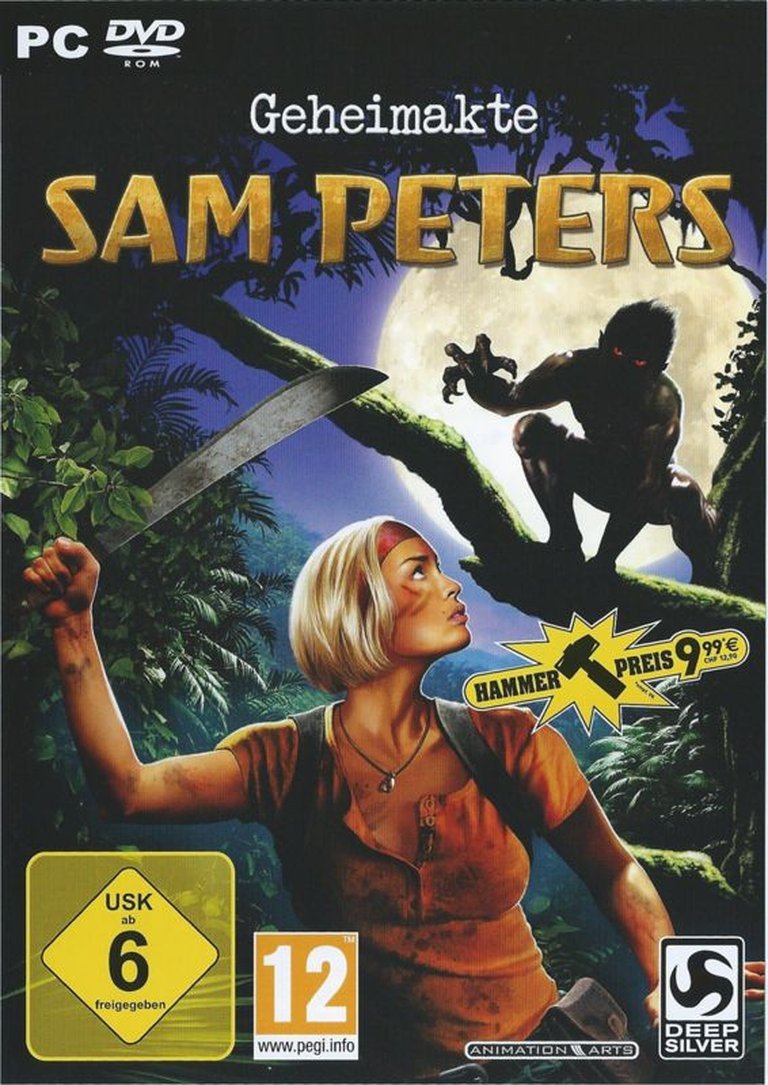
In this spin-off to the Secret Files series, players step into the shoes of Sam Peters, a blond reporter for ‘Uncharted’ magazine. Following her escape from a volcanic eruption in Indonesia, Sam is tasked with finding a sensational story. Her investigation into a German professor’s research leads her from Berlin to Ghana, where the professor and his expedition have vanished near Lake Bosumtwi. Sam must unravel the mystery, which intertwines scientific discoveries about genetic changes in aquatic life with local Ashanti legends of the blood-sucking Asanbosam. The game is a traditional point-and-click adventure with a third-person perspective, linear plot, and two possible endings.
Gameplay Videos
Where to Get Secret Files: Sam Peters
Patches & Mods
Guides & Walkthroughs
Reviews & Reception
metacritic.com (70/100): Sassy journalist Sam Peters makes the most of her moment in the sun in this neat little Secret Files spin‑off, reclaiming some of the series’ former glory by demystifying an ancient African legend.
adventuregamers.com (70/100): Sassy journalist Sam Peters makes the most of her moment in the sun in this neat little Secret Files spin‑off, reclaiming some of the series’ former glory by demystifying an ancient African legend.
Secret Files: Sam Peters: Review
As a professional game journalist and historian, it is a pleasure to delve into the archives and examine the curious case of Secret Files: Sam Peters. Released in 2013 by the German studio Animation Arts, this title represents a fascinating, if flawed, artifact from a specific era of adventure gaming. It is a spin-off, a side-story, and an attempt to recapture the magic of a series that had, by this point, begun to show its age. This review will dissect its creation, its narrative ambitions, its mechanical execution, and its ultimate place in the pantheon of point-and-click adventures.
Introduction: A Moment in the Sun for a Supporting Character
In the world of long-running game series, supporting characters rarely get their due. Secret Files: Sam Peters is an exception, a dedicated side-quel that plucks the blond reporter from the pages of Secret Files 2: Puritas Cordis and gives her a headline of her own. The thesis of this review is that the game is a competent, tightly-woven, yet ultimately unambitious adventure that serves as a pleasant diversion for series fans but fails to evolve the formula in any meaningful way. It is a game caught between its legacy and the contemporary gaming landscape, resulting in a experience that feels both comfortingly traditional and disappointingly dated upon its release. Sam Peters gets her moment in the sun, but it is a brief one, shining on a path well-trodden.
Development History & Context
The Studio and The Vision
Secret Files: Sam Peters was developed by Animation Arts Creative GmbH, a German studio with a firm foothold in the adventure genre, having created the entire Secret Files trilogy (Tunguska, Puritas Cordis, and Secret Files 3) as well as the Lost Horizon series. Published by Deep Silver (under its Koch Media arm in some regions), the game was a clear attempt to leverage existing IP. The core team, including Project Lead Marco Zeugner (who also contributed to story, design, and dialogue) and key personnel like artists Christian Fischer and Oliver Ziegler, had extensive experience with the series’ established template.
The vision for Sam Peters was not one of revolution, but of expansion. It was conceived as a spin-off, a shorter, more focused adventure that would explore a popular secondary character. This approach is common in other media but was less so in games at the time, particularly for a mid-tier European adventure series. The goal was likely to maintain fan engagement between major releases and to test the waters with a smaller-scale project.
Technological Constraints and The Gaming Landscape
Released in October 2013 for Windows (with subsequent ports to iOS, Android, and eventually Nintendo Switch in 2019), the game arrived at a pivotal moment. The indie revolution was in full swing, with titles like Gone Home redefining narrative exploration. In the adventure genre specifically, Telltale Games was hitting its stride with the cinematic, choice-driven The Walking Dead, while Daedalic Entertainment was being praised for its sharp writing and distinctive art style in games like Deponia.
Against this backdrop, Secret Files: Sam Peters looked and felt conservative. It eschewed the 3D cartoon style of Telltale and the hand-drawn beauty of Daedalic for a more traditional, pre-rendered 2.5D environment with 3D character models—a style that had been the standard for the series since 2006’s Tunguska. The technological constraints were not those of hardware, but of design philosophy. The team at Animation Arts was working within a familiar, safe framework, one that required minimal engine overhauls and played to their established strengths. As the German outlet 4Players.de pointedly noted in their review, the game felt “a decade old” compared to its contemporaries, lacking the “fine sense of humor of Daedalic [or] the cinematic presentation of Telltale.”
Narrative & Thematic Deep Dive
Plot Structure and Pacing
The narrative begins in medias res, with protagonist Sam Peters stranded on a beach in Bali, Indonesia, immediately following the volcanic eruption depicted in Secret Files 2. Her initial goal is simple: repair an inflatable boat and escape to the mainland to get help for her captured friend, Max. This prologue is brisk, serving as a tutorial and a narrative hook.
The core plot is triggered when Sam’s editor, unsatisfied with her near-death experience as a story, dispatches her to Berlin to meet with Professor Hartmann, whose research her magazine sponsors. Discovering he has already departed for an expedition in Ghana, Sam uncovers a fax hinting at a “previously unknown lifeform” near Lake Bosumtwi—a crater lake formed by a meteorite impact. The plot then shifts to Ghana, where Sam finds the expedition’s camp abandoned and must unravel a mystery involving local Ashanti legends of the Asanbosam, vampire-like creatures that lurk in the trees.
The plot is notably linear and compact, often cited as a major criticism with playtimes averaging around three hours. The story is divided into three distinct acts: the Indonesian prologue, the Berlin investigative interlude, and the Ghanaian mystery. This structure is efficient but leaves little room for narrative fat or subplots. The cast is minimal—essentially just Sam, a nun (Sister Maria), and the rescued Professor Hartmann—which contributes to a sense of isolation but also to a lack of dynamic character interaction.
Characters and Dialogue
Sam Peters is positioned as a “sassy,” competent, and determined journalist. Voiced by Farina Brock, her performance is generally well-received, bringing a sense of professionalism and wit to the character. However, the dialogue often relies on a stream of quippy one-liners as Sam comments on every interactive object. As the 4Players.de review criticized, it can feel like an attempt to emulate a certain brand of German comedy that falls flat, with Sam “trying to compete with Fips Asmussen” through an “abundance of shallow wisecracks.”
The other characters are functional but underdeveloped. Sister Maria exists primarily as an info-dump on local lore, and Professor Hartmann appears late to deliver exposition and the game’s central ethical dilemma. The members of his expedition are never seen, existing only as off-screen MacGuffins.
Themes and Ethical Dilemma
The game’s most interesting narrative element is its conclusion. The mystery of the Asanbosam is revealed not to be supernatural, but a socio-biological one. Professor Hartmann explains that a shaman, generations ago, selectively raised children in the caves, feeding them algae from the meteorite-impacted lake, which caused rapid physical mutations. These “Asanbosam” were engineered as perpetual guardians of the Ashanti land.
This revelation leads to the game’s only significant choice: whether to publish the story. The two endings present a clear, if simplified, ethical dilemma:
* Publish: Sam becomes famous and rich, but the area is flooded with tourists and military, leading to the capture of the Asanbosam. The epilogue notes one is eventually released and the area protected, but the damage is done.
* Suppress: The area remains undisturbed, but Sam is fired from her job. This ending ties directly into the series canon, as she attends the wedding of Max and Nina (the protagonists of the main trilogy), bridging the gap to Secret Files 3.
This choice elevates the narrative beyond a simple monster hunt, introducing themes of colonialism, scientific ethics, and the responsibility of journalism. However, its impact is lessened by its abruptness. The dilemma is presented and resolved in the final minutes, with no prior narrative weight given to Sam’s personal feelings about journalistic integrity, making the choice feel more mechanical than deeply moral.
Gameplay Mechanics & Systems
Core Point-and-Click Loop
Secret Files: Sam Peters is a staunchly traditional point-and-click adventure. The control scheme is simple: left-click to interact, right-click to examine. The cursor highlights in green over active hotspots. The inventory is permanently docked at the bottom of the screen, and items can be combined in a predictable, logical manner.
The game features several quality-of-life aids that were becoming standard at the time:
* A hotspot highlighter (a magnifying glass icon or the spacebar) reveals all interactive elements in a scene.
* A diary logs current objectives and story recaps.
* A hint system provides gentle nudges towards the next goal.
These features make the game highly accessible, especially for casual players, but they also contribute to the feeling that the puzzles lack significant challenge.
Puzzle Design
The puzzles are a mix of inventory-based challenges, assembly mini-games, and one central maze.
* Inventory Puzzles: These are generally logical and grounded. Fixing the boat in the prologue involves finding a patch, melting rubber to seal it, and assembling an air pump. Solutions are almost always confined to the immediate environment, preventing frustration but also reducing the sense of accomplishment. As one user review on Metacritic noted, progress often came from “persistent experimentation” rather than clever deduction.
* Assembly Mini-Games: These are among the game’s strongest elements. Players must physically construct objects like the air pump and a solar charger by dragging components into place. These puzzles are visually intuitive and satisfying to solve.
* The Cave Maze: The late-game labyrinth in the Asanbosam caves is a more traditional puzzle. It requires lighting resin-filled bowls to project symbols onto walls, which must then be replicated on a central panel to open a door. While a welcome change of pace, it can feel protracted and has been criticized for its trial-and-error nature.
A notable flaw, mentioned in the GameBoomers review, is a puzzle requiring “twitch-ability” to catch fast-moving ants with a sticky brush—a mechanic that feels out of place in a thoughtful point-and-click game.
World-Building, Art & Sound
Visual Direction and Art
The game employs a pre-rendered 2.5D background style with 3D character models. The art is competent and professional, with locations ranging from the tropical beaches of Bali and the dense jungles of Ghana to the sterile, institutional halls of a Berlin university. The environments are detailed and serve their purpose well, but they lack the distinctive flair of a Daedalic title or the atmospheric depth of a Wadjet Eye game. They are, in a word, functional. The character animations are adequate but can be stiff, further contributing to the sense of a bygone era.
Atmosphere and Sound Design
The sound design is a stronger element. Composed and implemented by Thorsten Engel (with additional music from Dynamedion), the soundtrack effectively sets the mood, from the tense, mysterious tones of the Ghanaian jungle at night to the more mundane sounds of Berlin. The ambient soundscape is well-crafted, with appropriate jungle noises and environmental effects that help with immersion. As one user review noted, the game features a “great soundtrack,” and the general consensus is that the audio components are polished and supportive of the experience.
World-Building
The game’s most successful world-building effort is its integration of real-world mythology and location. The use of the Ashanti legend of the Asanbosam and the very real Lake Bosumtwi crater in Ghana provides a compelling and culturally rich foundation for the story. The lore discovered through Father Samuel’s diary adds a layer of history and mystery that is more engaging than the main plot’s pacing sometimes allows. This grounding in a semi-plausible, cryptozoological mystery is the game’s strongest atmospheric hook.
Reception & Legacy
Critical and Commercial Reception
Upon release, Secret Files: Sam Peters received a mixed-to-average critical reception. On aggregators, it holds a 56% average from critics on MobyGames (based on two reviews) and a user score of 6.7/10 on Metacritic based on 15 ratings.
- Adventure Gamers (70%) praised its “plausible, tightly-knit plot,” “streamlined gameplay,” “superb art and animation,” and “smart, competent heroine,” while criticizing its short length and “abrupt, over-simplified conclusion.”
- 4Players.de (43%) was far harsher, calling it “uninspired” and “non-credible,” feeling it was “shockingly outdated” compared to its peers.
- Multiplayer.it (6/10) summed up the general feeling: “From a great name such as Secret Files we had expected much more than this… A honest work that could have been much better.”
Player reception, as seen in the “Mostly Positive” rating on Steam (73/100 from 219 reviews), has been more forgiving. Fans of the genre and the series appreciated it as a short, pleasant, and logically sound adventure, often noting that it was a decent purchase, especially at a discount.
Lasting Influence and Legacy
Secret Files: Sam Peters has a minimal legacy. It did not reinvigorate the series nor did it set a new standard for spin-offs. Its primary historical significance is as a footnote in the Secret Files saga—a smaller, experimental title that allowed a side character to headline her own adventure. It demonstrates the challenges faced by mid-tier European adventure studios in the early 2010s, caught between their loyal fanbase’s expectations and an rapidly evolving genre. The game did not influence subsequent titles in any discernible way; instead, it stands as a testament to a specific, fading style of adventure game design: solid, traditional, and safe.
Conclusion
Secret Files: Sam Peters is a difficult game to either passionately recommend or vehemently dismiss. It is the video game equivalent of a competently made television movie—it achieves its modest goals without aspiring to greatness. For dedicated fans of the Secret Files series or point-and-click veterans seeking a brief, undemanding palette cleanser, it offers a coherent story, logical puzzles, and a satisfying, if brief, central mystery grounded in intriguing real-world mythology.
However, its shortcomings are significant. The extreme brevity, underdeveloped characters, dated presentation, and lack of ambition prevent it from standing alongside the genre’s greats, or even the better titles in its own series. It is a relic, a charming and occasionally thoughtful one, but a relic nonetheless. In the final analysis, Secret Files: Sam Peters is a perfectly adequate adventure that, much like its protagonist’s initial assignment, delivers a story but fails to become the sensational headline it might have been.