
- Release Year: 1997
- Platforms: Macintosh, Windows
- Publisher: Purple Moon Media
- Developer: Media Concrete, Inc.
- Genre: Adventure, Puzzle
- Perspective: First-person
- Game Mode: Single-player
- Gameplay: Point and select, Puzzle-solving
- Setting: Fantasy, Forest
- Average Score: 70/100
Description
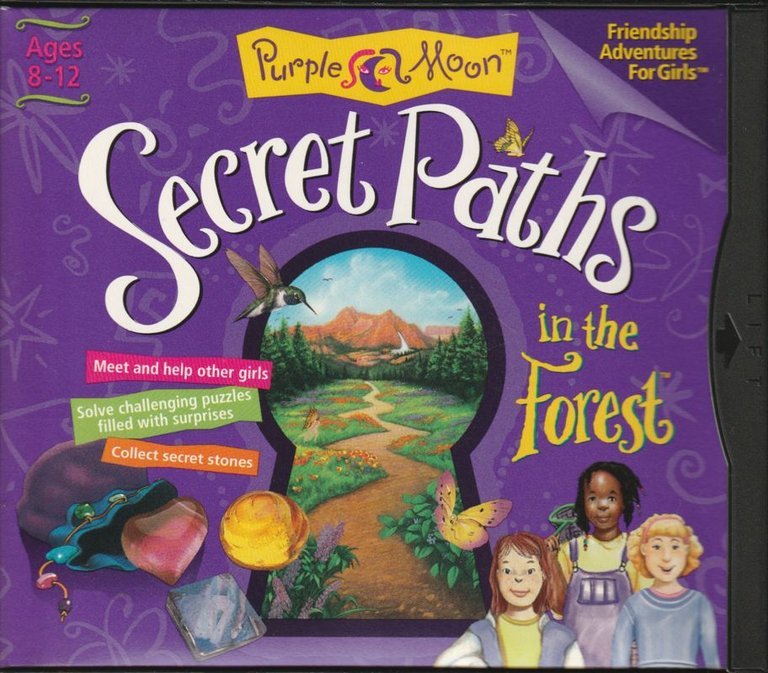
Secret Paths in the Forest is a puzzle-adventure game designed for young girls, set in a magical treehouse where the player befriends seven girls, each with personal struggles. The goal is to help each friend by exploring their ‘secret paths,’ solving puzzles, and collecting symbolic Secret Path Stones to create a magical Garland Necklace. The game emphasizes emotional storytelling, friendship, and problem-solving, with adjustable puzzle difficulty and a focus on themes like family, feelings, and self-discovery.
Gameplay Videos
Where to Buy Secret Paths in the Forest
PC
Secret Paths in the Forest Free Download
Secret Paths in the Forest Reviews & Reception
mobygames.com (60/100): Average score: 3.0 out of 5
imdb.com (80/100): Loved it
Secret Paths in the Forest: A Pioneering Journey Through Emotional Landscapes
Introduction: A Forgotten Gem of the 1990s
In the late 1990s, as the video game industry was still grappling with the notion of gender-inclusive design, Secret Paths in the Forest emerged as a quiet revolution. Developed by Purple Moon and released in 1997, this graphic adventure puzzle game was not just another title in the burgeoning “girls’ games” movement—it was a bold, empathetic experiment in interactive storytelling. Designed by Brenda Laurel, a pioneer in gender and technology studies, Secret Paths in the Forest dared to explore the emotional lives of young girls with a depth and sincerity rarely seen in mainstream gaming.
At its core, the game is a journey through the inner worlds of seven girls, each struggling with personal dilemmas that resonate with universal themes of identity, family, and self-worth. The player, invited to a magical treehouse, must navigate these “secret paths,” solving puzzles to collect stones that ultimately form a necklace—a metaphorical talisman of emotional resilience. While the game’s mechanics may seem simple by today’s standards, its narrative ambition and psychological insight were groundbreaking.
This review seeks to unpack Secret Paths in the Forest as both a historical artifact and a timeless piece of interactive art. We will delve into its development context, narrative depth, gameplay innovations, and lasting legacy, arguing that it remains one of the most underappreciated yet influential titles in the history of video games.
Development History & Context: The Birth of a Movement
The Vision of Brenda Laurel and Purple Moon
Secret Paths in the Forest was born from a radical idea: what if video games were designed not just for boys, but specifically for girls? This question was the driving force behind Purple Moon, a studio founded in 1996 by Brenda Laurel, a researcher and theorist who had spent years studying gender differences in play. Laurel’s work, particularly her 1990 book Computers as Theatre, argued that games could be more than just competitive or combat-driven experiences—they could be emotional, collaborative, and deeply personal.
Purple Moon was the culmination of Laurel’s vision. The studio was backed by Interval Research Corporation, a think tank funded by Paul Allen, and its mission was clear: to create games that spoke to the experiences of girls aged 8 to 14. Secret Paths in the Forest was one of the studio’s first major releases, alongside Rockett’s New School, and it was designed to be the antithesis of the action-heavy, male-dominated games of the era.
Technological Constraints and Creative Solutions
The game was developed using Macromedia Director, a multimedia authoring tool that was popular for CD-ROM-based interactive experiences in the 1990s. While Director was not as powerful as dedicated game engines, it allowed Purple Moon’s team to focus on storytelling and visual design without the need for complex programming. The game’s art direction, led by Grace Chen, embraced a hand-painted, storybook aesthetic that was both whimsical and immersive.
Technologically, Secret Paths in the Forest was constrained by the hardware of its time. The Windows 95/98 requirements—486DX/66 MHz processors, 16 MB of RAM, and 2X CD-ROM drives—were modest even for 1997. Yet, the team leveraged these limitations creatively. The game’s “secret paths” were not just narrative devices but also technical workarounds, using pre-rendered backgrounds and simple animations to create the illusion of vast, magical landscapes.
The Gaming Landscape of 1997
The late 1990s were a period of rapid evolution in the gaming industry. The rise of 3D graphics, exemplified by titles like Super Mario 64 and Tomb Raider, was reshaping player expectations. However, the industry was still overwhelmingly male-centric. Games marketed to girls were often relegated to “pink aisle” stereotypes—fashion simulators, babysitting games, or overly simplistic adventures.
Purple Moon sought to challenge this paradigm. Secret Paths in the Forest was not about dressing up dolls or playing house; it was about navigating complex emotions and relationships. The game’s release in 1997 coincided with a growing cultural conversation about gender and media, fueled by works like Carol Gilligan’s In a Different Voice and the rise of third-wave feminism. In this context, Secret Paths in the Forest was not just a game—it was a statement.
Marketing and Reception
Purple Moon’s marketing strategy was as innovative as its games. The studio conducted extensive market research, including focus groups with young girls, to ensure that its products resonated with their target audience. A 30-second TV spot for Secret Paths in the Forest aired in major markets like New York and Chicago, a rare move for a niche title. The game was also promoted through partnerships, such as a 1998 collaboration with SeaWorld, where it was sold as part of a “Treasure Trove” promotion.
The game’s commercial success was immediate. In December 1997 alone, it sold over 23,000 units in the United States, making it one of the top 50 entertainment titles of the holiday season. Critics praised its emotional depth and innovative design. The New York Times highlighted how young playtesters connected with the characters, seeing their own struggles reflected in the game’s narratives. The Academy of Interactive Arts & Sciences nominated it for “PC Family/Kids Title of the Year” at its inaugural D.I.C.E. Awards.
Yet, despite its acclaim, Secret Paths in the Forest remained a niche product. The gaming industry’s infrastructure—from retail shelves to magazine coverage—was not yet equipped to support games that defied traditional genres. Purple Moon’s eventual acquisition by Mattel in 1999 marked the end of its independent vision, though the studio’s influence would echo for decades.
Narrative & Thematic Deep Dive: Stories of the Heart
The Treehouse as a Safe Space
The game’s premise is deceptively simple: the player is invited to a secret treehouse, a girls-only sanctuary where seven friends gather to share their problems. This treehouse is more than a setting—it is a metaphor for the emotional safe spaces that children, particularly girls, create for themselves. The treehouse exists outside of time and schoolyard hierarchies, a place where vulnerabilities can be expressed without judgment.
The treehouse is also a hub for the game’s narrative structure. From here, the player can invite up to three girls at a time, each of whom will share fragments of their stories. These interactions are not just exposition; they are the foundation of the game’s emotional core. The treehouse’s “Friendship Box,” a drawer containing paper dolls of each girl, serves as the gateway to their individual “secret paths.”
The Seven Girls and Their Struggles
Each of the seven girls in Secret Paths in the Forest represents a distinct emotional challenge, reflecting the diverse experiences of young girls. Their stories are not just personal but also culturally and socially nuanced, a testament to Purple Moon’s commitment to authenticity.
-
Darnetta James: A creative spirit who dreams of starting a dragonfly circus but feels pressured to conform to her overachieving sister’s standards. Her path, set in overgrown ruins, culminates in the fable “The Bears Who Couldn’t Get Along,” teaching her that perfection is not the only measure of worth.
-
Dana St. Clair: A soccer player who blames herself for her team’s loss and contemplates quitting. Her path, a serene meadow, reveals the fable “A Tale of Unity,” reminding her that success is collective, not individual.
-
Whitney Weiss: A girl grappling with her parents’ divorce and her father’s new girlfriend. Her tropical path leads to the story “A Tale of Unity,” helping her accept that memories of her mother can coexist with new relationships.
-
Minh: A Vietnamese-American immigrant ashamed of her heritage. Her moonlit lake path and the fable “The Hedley Kow” teach her to embrace her cultural identity.
-
Jessie Marbella: A girl with an irrational fear of the forest, forced to attend summer camp. Her path, a deciduous forest, introduces her to “The Fearful Rabbit,” a tale that helps her confront her anxieties.
-
Miko Kajiyama: A chess prodigy discouraged by others’ resentment of her success. Her desert path and the story “Sari’s Story” encourage her to pursue her passions unapologetically.
-
Viva Cortese: A ballet dancer who feels out of place because of her appearance. Her Japanese koi garden path and the fable “The Bird Who Couldn’t Sing” celebrate her uniqueness.
These stories are not just individual vignettes; they are interconnected explorations of themes like self-acceptance, resilience, and the power of empathy. The game’s use of fables as narrative resolutions is particularly striking. Each fable is a moral compass, offering the girls—and by extension, the player—a framework for understanding their emotions.
The Power of Fables and Symbolism
The fables in Secret Paths in the Forest are more than just storytelling devices; they are the game’s emotional and philosophical backbone. Each fable is tied to a specific “Secret Path Stone,” a physical artifact that the player collects. These stones are not just rewards for solving puzzles; they are symbols of the lessons learned.
For example, Darnetta’s stones form a garland that tells the story of “The Bears Who Couldn’t Get Along,” a tale about sibling rivalry and reconciliation. The stones themselves are visually distinct, each representing a different virtue—creativity, confidence, love—reinforcing the game’s themes through both narrative and gameplay.
The use of fables also reflects Purple Moon’s broader educational philosophy. The studio believed that games could be tools for emotional literacy, helping children navigate complex feelings in a safe, interactive space. Secret Paths in the Forest embodies this philosophy, using storytelling to validate the experiences of its young audience.
The Player’s Role: Empathy as Gameplay
What sets Secret Paths in the Forest apart from other narrative-driven games is its emphasis on empathy as a core mechanic. The player’s primary action is not fighting or competing but listening, understanding, and helping. This design choice was radical in 1997, when most games still equated engagement with conflict.
The game’s structure reinforces this empathy-driven gameplay. Players must choose which girls to help, deciding whose stories to prioritize. This agency is not about power but about connection. The treehouse, with its limited capacity for three girls at a time, mirrors the real-world dynamics of friendship, where attention and support are finite resources.
The puzzles themselves are designed to reflect the girls’ emotional states. For example, Jessie’s forest path is filled with “dangerous” creatures that turn out to be harmless, mirroring her irrational fears. Solving these puzzles is not just a mechanical challenge; it is an act of emotional labor, a way for the player to participate in the girls’ journeys toward self-discovery.
Gameplay Mechanics & Systems: Puzzles with Purpose
Core Gameplay Loop: Exploration and Empathy
Secret Paths in the Forest is, at its heart, a puzzle game with adventure elements. The core gameplay loop involves selecting a girl, entering her secret path, and solving a series of puzzles to collect stones. However, the game’s brilliance lies in how it integrates these mechanics with its narrative themes.
Each path is a self-contained journey, with puzzles that are thematically tied to the girl’s story. For example, Dana’s soccer-themed puzzles involve teamwork and strategy, reinforcing her lesson about collective success. The puzzles are not just obstacles; they are extensions of the narrative, designed to make the player engage with the girl’s emotional struggle on a mechanical level.
Puzzle Design: Accessibility and Depth
The puzzles in Secret Paths in the Forest are varied, ranging from logic challenges to pattern recognition tasks. What makes them remarkable is their adaptability. The game includes a difficulty adjustment feature, represented by a purple flower in the corner of the screen. Clicking this flower allows players to toggle between easier and harder versions of the same puzzle, ensuring that the game remains accessible to a wide range of ages and skill levels.
This adaptability was a deliberate design choice. Purple Moon’s research had shown that girls often preferred games that allowed for collaboration and personalization over rigid, competitive structures. The difficulty slider was a way to honor this preference, giving players control over their experience.
Character Progression: Stones as Emotional Milestones
The game’s progression system is tied to the collection of Secret Path Stones. Each stone is a tangible representation of the player’s emotional journey with a girl. Collecting all of a girl’s stones unlocks her fable, which is presented as a garland—a necklace that the player can “give” to the girl as a symbol of support.
This system is a masterclass in integrating narrative and gameplay. The stones are not just collectibles; they are milestones in the girls’ emotional growth. The act of collecting them is framed as an act of friendship, reinforcing the game’s central theme of empathy.
UI and Interaction: A Gentle Touch
The game’s user interface is minimalist and intuitive, designed to be welcoming to young players. The point-and-click interface, a staple of 1990s adventure games, is used here to create a sense of gentle exploration. The treehouse, with its warm colors and cozy furnishings, serves as a comforting home base, while the secret paths are rendered in lush, dreamlike detail.
The UI also reflects the game’s emphasis on emotional connection. The Friendship Box, where players select which girls to help, is designed like a scrapbook, reinforcing the idea of memory and personal history. Even the inventory system, which holds the collected stones, is framed as a treasure box, making the act of progression feel like a personal achievement.
Innovations and Flaws
Secret Paths in the Forest was innovative in many ways, but it was not without its flaws. The game’s linear structure, while effective for storytelling, limited replayability. Once a girl’s path was completed, there was little incentive to revisit it. Additionally, the puzzles, while thematically rich, were not always as mechanically deep as those in other adventure games of the era.
However, these flaws are outweighed by the game’s boldness in redefining what a game could be. Its focus on empathy, its use of fables as narrative tools, and its commitment to emotional authenticity were groundbreaking. In many ways, Secret Paths in the Forest was ahead of its time, anticipating the rise of narrative-driven games like Life is Strange and Night in the Woods.
World-Building, Art & Sound: Crafting a Dreamlike Sanctuary
The Treehouse: A Haven of Imagination
The treehouse in Secret Paths in the Forest is more than a setting; it is a character in its own right. Designed as a cozy, magical space, it is filled with personal touches—a quilt, a lantern, a book of secrets—that make it feel lived-in and real. The treehouse’s design reflects Purple Moon’s philosophy of creating spaces where girls could feel safe and empowered.
The treehouse is also a liminal space, existing outside of the ordinary world. This is reinforced by the game’s lore, which suggests that the treehouse can be accessed from anywhere, a magical refuge for those in need. The idea of a secret, girls-only clubhouse was a powerful one in the 1990s, a time when girls’ spaces were often overlooked or dismissed.
The Secret Paths: Landscapes of the Mind
Each of the seven secret paths is a visual and thematic extension of the girl it represents. These paths are not just backdrops for puzzles; they are landscapes of the mind, reflecting the girls’ inner struggles and aspirations.
- Darnetta’s Ruins: Overgrown and mysterious, symbolizing her creative but chaotic ambitions.
- Dana’s Meadow: Open and sunlit, reflecting her love of soccer and teamwork.
- Whitney’s Tropical Path: Lush and vibrant, mirroring her complex emotions about family and change.
- Minh’s Moonlit Lake: Serene and reflective, embodying her journey toward self-acceptance.
- Jessie’s Forest: Dark and foreboding at first glance, but filled with gentle creatures that challenge her fears.
- Miko’s Desert: Barren and isolating, representing her feelings of being misunderstood.
- Viva’s Koi Garden: Elegant and artistic, celebrating her uniqueness.
The art direction, led by Grace Chen, blends realism with fantasy, creating spaces that feel both familiar and magical. The use of color is particularly striking—each path has its own palette, reinforcing its emotional tone. For example, Jessie’s forest is filled with deep greens and shadows, while Viva’s garden is awash in soft pinks and blues.
Sound Design: The Music of Emotion
The game’s sound design, overseen by Darren Gibbs and Lisa Kadet Kuhne, is subtle but effective. The soundtrack is a mix of gentle instrumental pieces and ambient sounds, designed to enhance the game’s dreamlike atmosphere. Each path has its own musical theme, reinforcing its emotional tone. For example, Minh’s moonlit lake is accompanied by soft, ethereal melodies, while Dana’s meadow features upbeat, rhythmic tunes.
The voice acting, though limited by the technology of the time, is warm and expressive. The girls’ voices are natural and relatable, avoiding the exaggerated tones often found in children’s media. This authenticity was crucial to the game’s emotional impact, making the girls feel like real people rather than caricatures.
Atmosphere: A Sense of Wonder
What ties the game’s art and sound together is its atmosphere—a sense of wonder and possibility. Secret Paths in the Forest is not a game about danger or conflict; it is a game about discovery and growth. The secret paths are not just places to solve puzzles; they are spaces to explore, to reflect, and to connect.
This atmosphere is reinforced by the game’s pacing. There is no timer, no score, no failure state. The player is free to move at their own pace, to linger in the treehouse, to revisit paths. This design choice was deliberate, reflecting Purple Moon’s belief that games for girls should prioritize exploration and emotional engagement over competition.
Reception & Legacy: A Quiet Revolution
Critical and Commercial Reception
Secret Paths in the Forest was met with critical acclaim upon its release. Reviewers praised its emotional depth, innovative design, and commitment to its audience. The New York Times highlighted how young players connected with the characters, seeing their own experiences reflected in the game’s narratives. The game’s commercial success was equally impressive, selling over 23,000 units in its first month and becoming one of Purple Moon’s best-selling titles.
However, the game’s reception was not universal. Some critics dismissed it as “just for girls,” a label that underscored the industry’s resistance to games that defied traditional genres. Others found the puzzles too simple or the narrative too linear. Yet, even these criticisms often acknowledged the game’s ambition and heart.
Evolution of Reputation
In the years since its release, Secret Paths in the Forest has gained a cult following among those who recognize its historical significance. Retrospective analyses, such as a 2017 Vice article, have praised it as a “primitive but powerful” tool for emotional storytelling. Scholars of game studies, particularly those focused on gender and narrative, have cited it as a landmark title in the evolution of interactive media.
The game’s reputation has also benefited from the broader cultural shift toward inclusive design. As the industry has begun to embrace games that explore emotions and relationships, Secret Paths in the Forest has been reevaluated as a pioneer. Its influence can be seen in modern titles like Gone Home, Celeste, and Night in the Woods, all of which prioritize narrative and emotional depth over traditional gameplay mechanics.
Influence on Subsequent Games
Secret Paths in the Forest was part of a larger movement in the late 1990s to create games for underserved audiences. Its success helped pave the way for other Purple Moon titles, such as Rockett’s New School and the sequels Secret Paths to Your Dreams and Secret Paths to the Sea. These games continued to explore themes of friendship, identity, and emotional resilience, building on the foundation laid by Secret Paths in the Forest.
Beyond Purple Moon, the game’s influence can be seen in the rise of narrative-driven indie games in the 2010s. Developers like Fullbright (Gone Home) and Infinite Fall (Night in the Woods) have cited Purple Moon’s work as an inspiration, particularly its focus on character-driven storytelling and emotional authenticity. The game’s use of fables and symbolic puzzles has also echoed in titles like Kentucky Route Zero, which blends surrealism with deeply personal narratives.
The End of Purple Moon and the Legacy of Empathy
Purple Moon’s acquisition by Mattel in 1999 marked the end of its independent vision. While Mattel continued to produce games under the Purple Moon brand, the studio’s original mission was diluted. Secret Paths in the Forest remains one of the last pure expressions of Brenda Laurel’s philosophy—a game that dared to treat young girls as complex, emotional beings worthy of deep, meaningful stories.
Today, Secret Paths in the Forest is more than just a relic of the 1990s; it is a testament to the power of empathy in game design. Its legacy is not just in the games it inspired but in the conversations it started about who games are for and what they can achieve. In an industry that often prioritizes spectacle over substance, Secret Paths in the Forest stands as a reminder that games can be tools for understanding, for healing, and for connection.
Conclusion: A Masterpiece of Emotional Design
Secret Paths in the Forest is a game that defies easy categorization. It is a puzzle game, an adventure game, a narrative experience, and a work of interactive art. But more than anything, it is a game about empathy—a rare and precious quality in any medium, let alone one as often maligned as video games.
In 1997, when the industry was still grappling with the idea that games could be for anyone other than young men, Secret Paths in the Forest dared to imagine something different. It created a space where girls could see their own struggles reflected, where emotions were not just acknowledged but celebrated. It was a game that understood that growing up is not just about overcoming external challenges but about navigating the complex landscapes of the heart.
The game’s mechanics, while simple, were revolutionary in their integration of narrative and gameplay. Its art and sound design crafted a world that was both magical and deeply personal. Its stories, told through the lens of fables and symbolic puzzles, offered young players tools for understanding their own emotions.
Secret Paths in the Forest is not just a product of its time; it is a timeless work that continues to resonate today. In an era where games are increasingly recognized as a legitimate form of artistic expression, it stands as a pioneer—a reminder that the most powerful games are not those with the most advanced graphics or the most complex mechanics, but those that speak to the human experience with honesty and heart.
For these reasons, Secret Paths in the Forest deserves to be remembered not just as a historical curiosity, but as a masterpiece of emotional design—a game that changed what was possible in interactive storytelling and paved the way for a more inclusive, empathetic future in gaming.
Final Verdict: 9.5/10 – A Landmark in Narrative and Emotional Game Design