
- Release Year: 2014
- Platforms: PlayStation 4, Windows
- Publisher: Switchblade Monkeys
- Developer: Switchblade Monkeys
- Genre: Action, Shooter
- Perspective: Diagonal-down
- Game Mode: Online PVP
- Gameplay: Arena shooter, Character abilities, Charging attacks, Cover System, Evasion, Skill-based aiming, Stamina management, Twin stick controls, Upgrade points
- Setting: Arena, Spaghetti Western
- Average Score: 58/100
Description
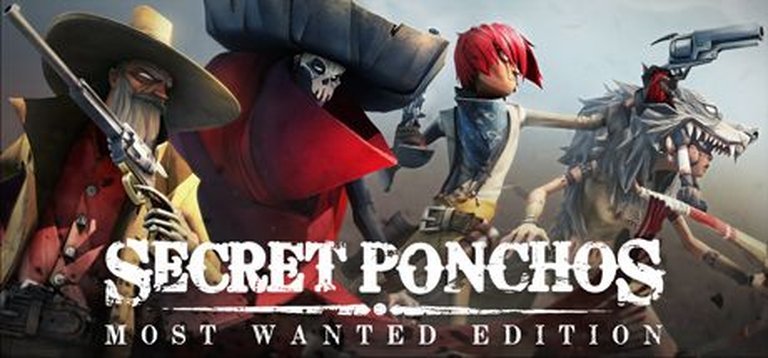
Secret Ponchos is a skill-based arena shooter set in a Spaghetti Western universe, blending elements of MOBA and team-based shooters like League of Legends and Team Fortress 2. Players choose from unique outlaws with distinct abilities, engaging in tactical combat using twin-stick controls in an elevated third-person perspective. The game emphasizes precise aiming, environmental cover, stamina management, and customizable character upgrades across multiplayer modes such as free-for-all, team deathmatch, and domination. Originally released for PS4 and later expanded on PC with additional characters, maps, and modes, it combines fast-paced action with strategic depth.
Gameplay Videos
Where to Buy Secret Ponchos
PC
Secret Ponchos Cracks & Fixes
Secret Ponchos Guides & Walkthroughs
Secret Ponchos Reviews & Reception
metacritic.com (64/100): Although the foundation for a great online twin-stick shooter has been laid with Secret Ponchos, it’s going to need more content and a meatier core mode to really keep people interested.
opencritic.com (64/100): Secret Ponchos’ seemingly simple gunplay is rewardingly deep, but its content is otherwise disappointingly shallow.
ign.com (70/100): Secret Ponchos’ seemingly simple gunplay is rewardingly deep, but its content is otherwise disappointingly shallow.
cinemotic.com : What’s unfortunate about Secret Ponchos are the outside factors and infrastructure flubs that taint an otherwise enjoyable experience.
Secret Ponchos: Review
Introduction
In the dust-choked annals of indie gaming history, Secret Ponchos stands as a bold yet cautionary tale—a Spaghetti Western-inspired multiplayer shooter that dared to fuse League of Legends’ tactical depth with Team Fortress 2’s character-driven chaos. Developed by the small but ambitious Switchblade Monkeys, the game promised a fresh take on competitive PvP through its isometric twin-stick combat and stark, graphic-novel aesthetic. Yet beneath its stylized gunfights lay a struggle for identity and longevity. This review posits that while Secret Ponchos delivered innovative mechanics and arresting artistry, its legacy is ultimately defined by untapped potential, technical missteps, and the brutal reality of sustaining a multiplayer ecosystem.
Development History & Context
Switchblade Monkeys, a Canadian indie studio founded by ex-Radical Entertainment art director Yousuf Mapara, began Secret Ponchos in 2008 as a passion project born from living-room development sessions. The team drew inspiration from Street Fighter II’s precision, Team Fortress 2’s class diversity, and League of Legends’ strategic teamplay, aiming to create a “fighting game with gangs.” A turning point came at PAX Prime 2013, where Sony, impressed by the prototype, provided PlayStation 4 dev kits and marketing support, positioning the game as a console exclusive.
Launched first on PC via Steam Early Access in June 2014, followed by a PS4 release in December 2014 (free for PlayStation Plus subscribers), Secret Ponchos faced immediate challenges. The PS4 version launched with just five characters and four maps, while the PC “Most Wanted Edition” (October 2015) expanded to ten characters and eight maps but sacrificed split-screen functionality. Updates like the “Hunting Ground” DLC added content, yet the game’s reliance on RakNet for multiplayer and the PhyreEngine’s limitations exacerbated connectivity issues. In a crowded market dominated by free-to-play giants, Secret Ponchos struggled to retain players despite its $14.99 price point—a testament to the perils of indie multiplayer ambitions in the mid-2010s.
Narrative & Thematic Deep Dive
Secret Ponchos eschews traditional storytelling for environmental lore. Set in the lawless town of Lonetree—a Wretched Hive teeming with bandits and bounty hunters—the game casts players as outlaws vying for infamy. Characters like The Killer, a scarred psychopath who pins wanted posters to victims, and Phantom Poncho, a shrouded executioner, embody Western archetypes through visual design rather than dialogue. Their narratives emerge via flavor text: Mad Trapper’s coonskin cap and skull collection hint at a feral backwoodsman, while Kid Red’s dual revolvers scream reckless bravado.
Thematically, the game explores desperation and capitalist hostility—earning a “bounty” becomes both a progression mechanic and a metaphor for survival in a cutthroat world. Yet this thematic richness remains underdeveloped, relying on players to project meaning onto its silent shootouts. As Twinfinite noted, the Western setting “brings the dusty setting to life,” but without narrative stakes, the experience leans heavily on gameplay to sustain engagement.
Gameplay Mechanics & Systems
At its core, Secret Ponchos is a skill-shot paradise. Unlike auto-attack-heavy MOBAs, every bullet, dynamite toss, or sword thrust demands manual aiming and timing, creating a high-risk, high-reward loop. Key systems include:
- Character Diversity: Each of the ten outlaws (e.g., Matador’s melee-focused pounce-and-execute combos vs. Gordo’s minigun suppression) plays like a fighting-game roster member, with unique primary/secondary weapons and tertiary abilities. The Phantom Poncho exemplifies Difficult, but Awesome design—a fragile assassin whose whip-shotgun combo devastates when mastered.
- Stamina & Cover: Dodges and rolls consume stamina, forcing tactical pauses. Line-of-sight mechanics let players vanish behind cover, enabling ambushes or retreats—a nod to Metal Gear Solid’s tactical espionage.
- Progression: Players distribute stat points (damage, health, speed) and unlock cosmetic skins via earned “bounty.” The PC-exclusive Arcade Mode offered 1v1 AI duels, but the removal of modes like Posse Leader (protect-a-leader) hinted at unbalanced design.
Flaws emerged in execution. Matchmaking was plagued by long waits and lag, as noted by Game Informer (“barren lobbies”), while the PS4 version’s lack of bots made offline play barren. Despite its fighting-game soul, Secret Ponchos lacked tutorials, alienating newcomers. As Brash Games warned, its novelty risked fading without sustained content updates.
World-Building, Art & Sound
Secret Ponchos’ stark, graphic-novel visuals—monochromatic eyes, exaggerated silhouettes, and sepia-toned maps like “Plaza” and “The Mines”—evoke a Sergio Leone film filtered through Mike Mignola’s Hellboy. The isometric perspective emphasized verticality, with cactus-strewn arenas encouraging strategic use of elevation. Sound design deepened immersion: whistling winds, ricocheting bullets, and twangy guitar riffs paid homage to Spaghetti Western scores, while character-specific audio cues (e.g., Killer’s blade swipes) provided tactical intel.
Yet the art’s minimalism divided critics. Hardcore Gamer praised its “stylish flair,” but some found environments too sparse, failing to leverage the PS4’s promised cloth physics and ambient lighting. The result was a world that felt more stage than sandbox—beautiful but static.
Reception & Legacy
Upon release, Secret Ponchos earned a 73% Metascore (7.2 MobyScore), with critics split:
– Praise: Twinfinite lauded its “great cast of varied characters” and “addictively competitive” gunplay. GamingIllustrated (86%) highlighted its “well-crafted maps.”
– Criticism: Video Chums (64%) bemoaned its “lack of content,” while Game Revolution (60%) cited “dearth of active users” as fatal.
Commercially, the game faltered. Despite Sony’s promotion, player counts dwindled by 2015, leading to abandoned modes and fractured DLC (e.g., paid skins for Kid Red). Yet its influence lingered: the emphasis on precision aiming and character asymmetry echoed in later indies like Hyper Light Drifter, while its bounty system prefigured Hunt: Showdown’s risk-reward loops.
Conclusion
Secret Ponchos is a paradox—a game of visionary mechanics shackled by reality. Its isometric duels, stamina-driven combat, and outlaw customization remain compelling blueprints for competitive design. Yet technical limitations, sparse content, and a faltering player base doomed it to cult status. For historians, it exemplifies the indie multiplayer trap: brilliant in bursts but unsustainable without community or updates. As a relic of Early Access ambition, Secret Ponchos deserves remembrance—not as a triumph, but as a poignant “what if?” in the Western canon of gaming.