
- Release Year: 1996
- Platforms: Windows
- Publisher: Lasersoft, Inc.
- Developer: SEGA Interactive Development Division
- Genre: Compilation, Ecology, Educational, logic, Math, Nature, Reading, writing
- Perspective: Side-view
- Game Mode: Co-op, Single-player
- Gameplay: Educational, Platforming, Puzzle
Description
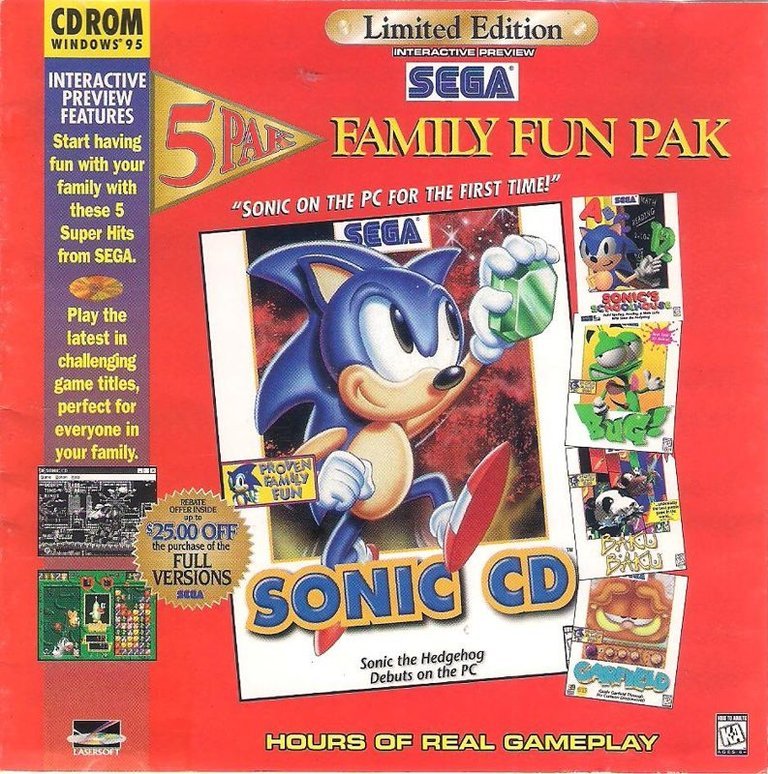
SEGA Family Fun Pak is a 1996 Windows compilation of five limited-edition Sega PC games designed for family entertainment, featuring playable previews such as the Palmtree Panic zone from Sonic CD, most of Sonic’s Schoolhouse educational mini-games, the first world of Bug!, the full Baku Baku puzzle game, and a special Alien Landscape stage from Garfield: Caught in the Act that unlocks the complete game.
SEGA Family Fun Pak: Review
Introduction
Imagine popping a CD-ROM into your mid-90s Windows 95 PC, the whir of the drive heralding a gateway to Sega’s vibrant arcade legacy repurposed for family living rooms—not as full epics, but tantalizing previews designed to hook kids and parents alike on math puzzles, speedy hedgehogs, and cartoon chaos. Released in 1996, SEGA Family Fun Pak (also known as Sega Proven Family Fun Sampler) stands as a quirky artifact from Sega’s ambitious push into the PC market, bundling limited versions of five titles: Sonic CD, Sonic’s Schoolhouse, Bug!, Baku Baku, and Garfield: Caught in the Act. In an era when Sega dominated consoles with the Genesis but eyed the burgeoning educational software boom and CD-ROM revolution, this compilation wasn’t just a demo disc—it was a clever rebate-laden sampler pitching full games while blending high-speed platforming with edutainment. My thesis: SEGA Family Fun Pak exemplifies Sega’s adaptive ingenuity during turbulent times, transforming console hits into accessible PC trials that prioritized family fun and hidden rarities, cementing its status as an underappreciated relic of 90s cross-media experimentation.
Development History & Context
Sega’s venture into SEGA Family Fun Pak emerged from the SEGA Interactive Development Division, a specialized team handling PC ports amid the company’s 1996 pivot toward software diversification. Published by Lasersoft, Inc., this CD-ROM title arrived as Windows PCs exploded in popularity—thanks to affordable CD drives and the rise of multimedia titles like The Learning Company’s Reader Rabbit (1986 onward). Sega, fresh off Genesis dominance but reeling from the Saturn’s rocky Western launch, sought to leverage its IP on PCs, where console rivals like Nintendo lagged. The pack’s “limited versions” reflect era-specific constraints: 1996 PCs grappled with DirectX infancy, windowed modes, and keyboard-only inputs, forcing adaptations like Bug!‘s perpetual windowed state or Sonic CD‘s single-zone cap to fit modest hardware.
The creators’ vision was promotional gold—a rebate offer refunded $5 per full game purchase, turning the pak into a loss-leader sampler. This mirrored Sega’s broader strategy: ports like Sonic CD doubled as audio CDs (Palmtree Panic soundtrack rip-ready), nodding to CD-ROM’s music playback trend. Technologically, it navigated Windows 95’s split-screen multiplayer quirks (e.g., Sonic’s Schoolhouse‘s WASD/arrows setup) and experimental hacks, like Garfield‘s removable patch unlocking fuller play. The gaming landscape was fierce: arcade giants like Sega’s Virtua Fighter thrived, but home PCs boomed with edutainment (ecology, math, reading genres tagged here). Sega, post-Sonic mania, targeted families amid “edgy” backlash (e.g., VRC ratings), positioning this as wholesome fun. Added June 30, 2018, to MobyGames by contributor KinopioKing, it underscores its obscurity even then—last modified September 7, 2025—yet preserves Sega’s 90s hybrid ethos.
Narrative & Thematic Deep Dive
As a compilation, SEGA Family Fun Pak eschews a unified plot, instead threading loose thematic strands through its demos: speed, learning, whimsy, and redemption. Sonic CD‘s Palmtree Panic teases Sonic’s time-travel quest to save Amy from Metal Sonic and Robotnik’s eco-desecration—lush palms polluted by factories symbolize nature’s fragility, aligning with the pak’s “Ecology / nature” tag. Sonic’s Schoolhouse pivots to edutainment purity: Sonic guides kids through math/logic/reading mini-games in a classroom hub, doors unlocking spelling bees and arithmetic races; absent field trips emphasize structured learning, with 2P mode fostering sibling rivalry over WASD vs. arrows. No deep characters, but Sonic’s cheeky quips (“Gotta go fast… to learn!”) embody motivational themes.
Bug!‘s first world drops players as a ladybug in a vibrant, squishy garden—narrative minimalism via cartoon perils (stomped foes, oozing hazards) explores survival and exploration. Baku Baku, the full puzzle trial, pits bubbly critters in chain-reaction matching; its light story of animal rescues underscores joyful chaos. Most intriguingly, Garfield: Caught in the Act‘s platforming yarn—Garfield zapped into a TV world—features the Sega Channel-exclusive “Alien Landscape” lost level, a glitchy UFO romp absent from retail. Removing an in-game patch reportedly unlocks more, hinting at developer Easter eggs critiquing cartridge limits. Collectively, themes celebrate Sega’s family pivot: ecology lessons via Sonic’s zones, logic/math/reading via schoolhouse drills, and escapist fun amid 90s moral panics. Characters shine in snippets—Sonic’s bravado, Garfield’s lasagna lust—foreshadowing edutainment’s blend of play and pedagogy, though truncated scopes limit emotional depth.
Gameplay Mechanics & Systems
SEGA Family Fun Pak‘s core loop revolves around menu-driven access to five trials, keyboard-centric (no mouse/optional controllers noted), supporting 1-2P split-screen. Innovative for demos: full Baku Baku offers endless puzzle chains—drop capsules to link colored Baku beasts for explosive clears, scoring multipliers rewarding combos; fullscreen toggle enhances immersion, indistinguishable from retail.
Sonic CD‘s Palmtree Panic delivers tight 2D platforming: loop-de-loop dashes, spin attacks, time stones for past/future shifts—eco-enemies like hovering bots demand precise jumps, culminating in boss rushes. Soundtrack-as-CD gimmick adds replay value. Sonic’s Schoolhouse excels in edutainment loops: hub navigation unlocks mini-games (word matching, subtraction relays); 2P mode splits controls brilliantly (Player 1: WASD, Player 2: arrows), all doors open sans field trip, promoting cooperative learning without grindy progression.
Bug! mirrors Sonic CD—first world’s isometric platforming has bug hero skittering across deformable blobs, avoiding crushers; windowed lock frustrates fullscreen fans, but responsive physics shine. Garfield‘s side-scrolling shines with cartoon antics: Garfield bounces on trampolines, inhales foes cartoonishly; Alien Landscape’s warped gravity innovates, and patch removal hints at proto-modding. UI is spartan—simple menus, no saves—but flaws abound: keyboard clunkiness hampers precision, windowed bugs irk. Strengths: seamless trials foster addiction, rebate incentivizes upgrades. Overall, loops prioritize bite-sized highs, flawed by limits yet pioneering PC multiplayer edutainment.
World-Building, Art & Sound
The pak’s worlds remix Sega’s Genesis/Dreamcast DNA for PC: Sonic CD‘s Palmtree Panic bursts with parallax palms, futuristic factories—vibrant sprites pop against 256-color backdrops, past/present toggles build temporal depth. Sonic’s Schoolhouse‘s classroom hub feels lived-in: lockers, chalkboards frame mini-game portals, evoking wonder. Bug!‘s garden macrocosm—gigantic fruits, oozing enemies—scales whimsy massively. Baku Baku‘s abstract arenas pulse with critter animations. Garfield‘s TV realms layer cartoon layers: circus tents to alien voids, lost level’s psychedelic hues intrigue.
Visual direction adapts console art faithfully—sprite-based, colorful, kid-friendly—though PC scaling/windowing muddies edges. Atmosphere evokes 90s optimism: sunny zones counter urban grind. Sound design triumphs: Sonic CD‘s Spencer Nilsen tracks (playable via CD) boom with rock-infused tropics; Schoolhouse‘s chiptunes pep lessons; Bug!‘s squelches amplify tactility; Baku Baku‘s pops cascade satisfyingly; Garfield‘s jazzy cues nod lasagna laze. Collectively, elements forge nostalgic immersion—art pops lessons alive, sound hooks loops—elevating demos to sensory gateways.
Reception & Legacy
Launch reception? Nonexistent—MobyGames lists zero critic/player reviews, only two collectors. No sales data, but obscurity fits 1996’s demo disc glut amid PC edutainment surge (Reader Rabbit et al.). Commercially niche, rebate targeted impulse buys; redump.org notes 1996 CD details (19 tracks, SegaFAMFUNPAK label), rerelease of Proven Sampler. Reputation evolved to cult curiosity: Sonic wiki praises previews, MobyGames specs highlight rarities like Garfield‘s lost level (Sega Channel echo).
Influence subtle: presaged PC bundles (Sega Smash Pack 1999), edutainment ports (Sonic Schoolhouse full access teases accessibility). No industry quake, but embodies Sega’s 90s flux—Genesis twilight, Saturn stumbles, PC probes—foreshadowing third-party era. In history, it’s a footnote bridging arcade roots to digital, preserving demos amid emulation rise.
Conclusion
SEGA Family Fun Pak distills Sega’s 1996 essence: promotional pluck packaging Sonic speed, edutainment smarts, and puzzle pops into PC trials laced with hacks and rebates. Exhaustive deconstruction reveals triumphs—responsive loops, rare content, dual-use CD—tempered by limits (windowed woes, keyboard gripes). No blockbuster, yet its family focus amid console wars cements a vital niche: Sega’s adaptive spark. Verdict: Essential for historians, nostalgic 7/10—play for Palmtree vibes and lost Garfield, a time capsule securing its quirky eternity in video game history.