
- Release Year: 2011
- Platforms: Linux, Macintosh, PlayStation 3, Windows, Xbox 360
- Publisher: 1C-SoftClub, Devolver Digital, Inc., Mastertronic Group Ltd., ZOO Corporation
- Developer: Croteam
- Genre: Action
- Perspective: 1st-person
- Game Mode: Co-op, LAN, Online Co-op, Online PVP, Single-player
- Gameplay: Shooter
- Setting: Futuristic, Sci-fi
- Average Score: 76/100
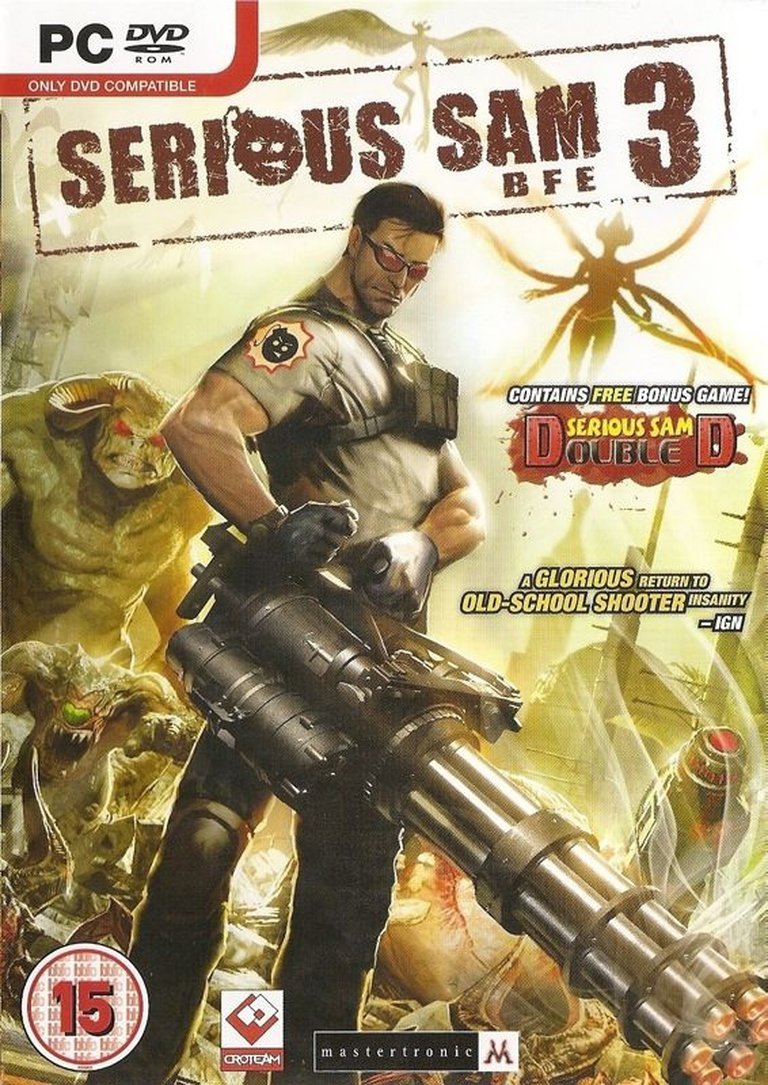
Description
Serious Sam 3: BFE is a prequel to the original Serious Sam: The First Encounter, set in the 22nd century. The game follows ‘Serious’ Sam Stone as he battles through Egypt to reclaim the Time-Lock, a powerful device stolen by the cosmic entity Notorious Mental, who uses it to unleash hordes of cloned beasts from across history. Known for its fast-paced, arcade-style shooter gameplay, the title emphasizes massive enemy waves, a variety of weapons (including the new mutilator), and both single-player and multiplayer modes, including cooperative campaigns and competitive matches.
Gameplay Videos
Where to Buy Serious Sam 3: BFE
PC
Serious Sam 3: BFE Free Download
Serious Sam 3: BFE Cracks & Fixes
Serious Sam 3: BFE Patches & Updates
Serious Sam 3: BFE Mods
Serious Sam 3: BFE Guides & Walkthroughs
Serious Sam 3: BFE Reviews & Reception
metacritic.com (72/100): A triumphant return to form for the series.
cgmagonline.com (80/100): Serious Sam 3: BFE is what your grandparents think every videogame is like. Freakish enemies, blood-soaked visuals, a heavy metal soundtrack and levels filled with colourful power-ups.
336gamereviews.com : Serious Sam 3 is the latest in the long-running FPS series and takes quite a radical turn from the second game.
hookedgamers.com (78/100): Serious Sam 3 may be the last chance for the classic uber-masculine, twitch shooter to survive the cull.
Serious Sam 3: BFE Cheats & Codes
PC
Press the console key ` and type ‘cht_bEnableCheats = 3’ to enable the developer cheats. Note that console commands are case sensitive. Cheats are accessed through the menu (Press ESC then press F3) or by typing them into the console. (Type ‘cht’ into the console and press TAB for a list of cheats.) Note that cheats invalidate your achievements and leaderboard score gained in that session. Type ‘cht_bEnableCheats = 0’ in the console to disable the cheats for the next session.
| Code | Effect |
|---|---|
| cht_bAutoAim | Auto aim cheat. |
| cht_bShowAllNetricsaMessages | Display all the messages in NETRICSA. |
| cht_bInvisible | Enemies can’t see you. |
| cht_bGhost | Fly around and pass through walls. |
| cht_bFly | Fly around. |
| chtGiveAmmo() | Gives a specified amount of ammo for a specified weapon. |
| ch_slGiveArmor | Gives a specified amount of armor. |
| cht_slGiveHealth | Gives a specified amount of health. |
| chtGiveWeapon() | Gives a specified weapon. |
| cht_bGiveAll | Gives all available weapons and maximum ammo. |
| cht_bGod | God mode. |
| cht_bTurbo | Greatly increased speed. |
| cht_bInfiniteAmmo | Infinite Ammo. |
| cht_bKillAll | Kill all enemies in line of sight except for bosses. |
| cht_bKillBoss | Kill the current boss. |
| cht_bUnlockMentalMode | Unlocks Mental Mode. |
Serious Sam 3: BFE: A Retrospective on the Modern Classic of Old-School Shooter Design
Introduction: The Legacy of Serious Sam and the Promise of a Prequel
In the annals of first-person shooter history, few franchises have embraced the chaotic, unapologetic joy of mindless violence as wholeheartedly as Serious Sam. Born in 2001 as a spiritual successor to the arena shooters of the ’90s—Doom, Quake, and Duke Nukem 3D—the series carved its niche by doubling down on what made those games fun: big guns, bigger enemies, and battles so absurdly over-the-top that they bordered on surreal comedy. Serious Sam 3: BFE, released a decade later in 2011, was a bold attempt to modernize this formula while staying true to its roots. Serving as a prequel to the original First Encounter, BFE (short for “Before First Encounter”) promised to deliver the same adrenaline-pumping, enemy-swarming action that fans loved, but with the polish and scale of a contemporary shooter.
Yet, Serious Sam 3 arrived at a crossroads for the genre. The late 2000s and early 2010s were dominated by the rise of cover-based, narrative-driven military shooters like Call of Duty and Battlefield, as well as the emergent popularity of games with deep RPG mechanics and open-world designs. In this landscape, Serious Sam 3 was a defiant throwback—a game that rejected the trends of its time in favor of unfiltered, unrepentant carnage. But could a game so rooted in the past still feel fresh in an era that had moved on? And could it recapture the magic of its predecessors while introducing enough innovation to justify its existence?
This review will dissect Serious Sam 3: BFE in exhaustive detail, exploring its development, narrative, gameplay, world-building, reception, and legacy. We will examine how it succeeded, where it faltered, and why it remains a fascinating artifact of a genre in transition.
Development History & Context: Croteam’s Vision and the Challenges of Modernization
The Studio Behind the Game: Croteam’s Journey
Serious Sam 3: BFE was developed by Croteam, a Croatian studio founded in 1993 by brothers Davor and Alen Hunski. The studio’s breakthrough came with the original Serious Sam: The First Encounter in 2001, a game that was as much a technical showcase as it was a love letter to classic shooters. Built on the Serious Engine, Croteam’s proprietary technology, the game pushed the limits of enemy counts and open-level design, creating a spectacle that felt both nostalgic and groundbreaking.
The years following The First Encounter and The Second Encounter (2002) were tumultuous for the franchise. Serious Sam II (2005) attempted to expand the series’ scope with a more cartoonish art style, vehicle sections, and a greater emphasis on humor, but it was met with mixed reception. Critics and fans alike felt that the game had lost some of the raw, unfiltered fun of the originals, despite its technical ambition. After Sam II, Croteam shifted focus to remastering the first two games in HD for modern platforms, a move that both reintroduced the series to new audiences and bought the studio time to rethink its approach.
By 2011, the gaming landscape had changed dramatically. The Serious Engine had evolved into Serious Engine 3.5, a more powerful and flexible tool capable of rendering detailed environments and supporting advanced lighting and physics. Yet, the challenge for Croteam was not just technical—it was philosophical. How could Serious Sam 3 modernize the series without betraying its core identity?
The Vision for Serious Sam 3: BFE
From the outset, Serious Sam 3 was conceived as a prequel, a decision that allowed Croteam to explore the origins of the conflict between Sam Stone and the cosmic entity Mental. Set in a ruined 22nd-century Egypt, the game’s narrative would serve as a bridge between the discovery of the Time-Lock and Sam’s time-traveling adventures in the original games. This setting also provided an opportunity to ground the game’s absurdity in a more serious, apocalyptic tone—a stark contrast to the almost comedic excess of the earlier titles.
The development team, led by Davor Hunski (Project Leader and Game Director) and Alen Ladavac (Technical Director and Lead Programmer), sought to strike a balance between nostalgia and innovation. Key design pillars included:
- Retaining the Core Gameplay Loop: The essence of Serious Sam had always been its relentless, high-octane combat. BFE would double down on this, with larger enemy hordes, more dynamic encounters, and a greater emphasis on player movement and improvisation.
- Modernizing the Presentation: While the gameplay would remain old-school, the visuals and sound design would leverage contemporary technology to create a more immersive experience. This included detailed environments, improved enemy AI, and a heavier, more atmospheric soundtrack.
- Expanding Multiplayer: Recognizing the growing importance of cooperative and competitive play, Croteam designed BFE to support up to 16 players in online co-op, as well as split-screen modes—a feature that had been absent in Serious Sam II.
- Refining the Narrative: Unlike the original games, which were light on story, BFE would attempt to weave a more cohesive narrative, with cutscenes, dialogue, and a greater sense of stakes.
Technological Constraints and Innovations
The Serious Engine 3.5 was a significant leap forward from its predecessors, but it was not without limitations. The engine’s strength lay in its ability to render vast numbers of enemies simultaneously—a critical feature for a Serious Sam game—but it struggled with some of the more advanced graphical techniques becoming standard in 2011, such as dynamic global illumination or tessellation. As a result, BFE’s visuals are a mix of impressive scale and occasional roughness, with detailed character models and environments that sometimes lack the polish of contemporaries like Battlefield 3 or Crysis 2.
One of the most notable technical achievements of BFE was its enemy AI. Unlike the original games, where enemies often charged blindly at the player, BFE introduced more sophisticated behaviors. Enemies would take cover, flank the player, and even retreat when wounded. This was a double-edged sword: while it made combat more dynamic, it also occasionally led to frustration, as enemies would exploit the environment in ways that felt unfair.
The game’s copy protection system also garnered attention. Rather than using traditional DRM, Croteam implemented a creative (and controversial) anti-piracy measure. Pirated copies of the game would spawn an invincible, hyper-aggressive arachnoid enemy that would relentlessly pursue the player, making progress nearly impossible. This approach was praised by some for its ingenuity but criticized by others for its punitive nature.
The Gaming Landscape in 2011
Serious Sam 3: BFE launched into a market that was vastly different from the one that had embraced the original games. The late 2000s had seen the rise of the “modern military shooter,” a subgenre defined by realistic graphics, cover-based mechanics, and cinematic storytelling. Games like Call of Duty: Modern Warfare and Battlefield: Bad Company dominated sales charts, while titles like Gears of War and Halo set the standard for console shooters.
In this environment, Serious Sam 3 was an outlier. It rejected cover mechanics, regenerative health, and linear level design in favor of wide-open arenas, manual health pickups, and a return to the “run-and-gun” philosophy of the ’90s. This made it a niche product, but one with a dedicated audience. The game’s marketing leaned heavily into this identity, with taglines like “No cover. All man.” and a trailer that mocked the trends of modern shooters.
The indie scene was also beginning to flourish, with games like Minecraft and Super Meat Boy proving that there was still an appetite for retro-inspired experiences. Serious Sam 3 occupied a unique space between indie sensibilities and AAA production values, offering a polished but unapologetically old-school experience.
Narrative & Thematic Deep Dive: Apocalypse, Humor, and the Weight of Legacy
Plot Summary: The Fall of Earth and the Rise of Sam
Serious Sam 3: BFE is set in the year 2107, during the final days of Earth’s resistance against the forces of Mental, a malevolent cosmic entity who has unleashed an army of cloned and mutated creatures upon the planet. The game opens with Sam “Serious” Stone, a soldier in the Earth Defense Force (EDF), leading a helicopter insertion into Cairo, Egypt. His mission: to extract Dr. Stein, a scientist who holds the key to activating the Time-Lock, an ancient Sirian device capable of sending a single person back in time to prevent Mental’s invasion.
The mission goes awry almost immediately. Sam’s helicopter is shot down, his squad is slaughtered, and he is left to fight his way through the ruins of Cairo alone. Along the way, he encounters a variety of enemies, from the familiar (Beheaded Kamikazes, Kleer Skeletons) to the new (Khnums, Scrapjacks), all while uncovering the secrets of the Sirians, the advanced civilization that once inhabited Earth.
The narrative unfolds through a series of radio transmissions, cutscenes, and environmental storytelling. Sam is guided by Quinn, a faceless mission control operator, and later by Hellfire, a helicopter pilot who becomes one of the few allies to survive the early stages of the game. As the story progresses, it becomes clear that Earth’s fate is sealed—Mental’s forces are too overwhelming, and the Time-Lock is humanity’s last hope. The game culminates in a desperate race to activate the device before Mental can destroy it, ending with Sam leaping into the past just as Mental hurls the Moon at Earth, obliterating the planet.
Themes: Apocalypse, Sacrifice, and the Burden of Heroism
At its core, Serious Sam 3 is a story about the end of the world. Unlike the original games, which treated their settings as little more than backdrops for carnage, BFE attempts to imbue its apocalyptic scenario with a sense of weight and consequence. The game’s opening minutes establish a tone of desperation, with Sam’s squad being wiped out in a matter of seconds and the player left to navigate a city in ruins. This is not the lighthearted, almost cartoonish world of Serious Sam II, but a grim, war-torn landscape where every victory is pyrrhic.
Yet, the game struggles to maintain this tone consistently. The narrative is often undercut by Sam’s one-liners, which range from genuinely funny to awkwardly out of place. The game’s attempt to balance humor and gravitas is uneven, with moments of genuine tension (such as the death of Hellfire) juxtaposed against sequences that feel tonally disjointed.
One of the most interesting thematic elements of BFE is its exploration of legacy. The Sirians, the ancient civilization whose technology humanity has uncovered, are revealed to have been wiped out by Mental in the past. Sam’s journey is not just about saving Earth, but about completing the Sirians’ unfinished battle. This adds a layer of mythic significance to the story, positioning Sam as a modern-day hero fulfilling an ancient prophecy.
However, the game’s narrative is ultimately secondary to its gameplay. The story serves as a framework for the action, but it lacks the depth and character development of contemporary shooters like Half-Life 2 or BioShock. Sam himself remains a cipher—a one-dimensional action hero whose personality is defined by his quips and his ability to mow down enemies. This is not necessarily a flaw, as Serious Sam has never been a story-driven franchise, but it does highlight the limitations of the game’s narrative ambitions.
Dialogue and Characterizations: The Struggle for Tone
The dialogue in Serious Sam 3 is a mixed bag. On one hand, the game’s writing occasionally captures the irreverent, over-the-top humor that defined the original titles. Sam’s one-liners, such as “It’s not over until I teabag every last one of you alien motherfuckers,” are delivered with the kind of swagger that fans of the series have come to expect. Similarly, the game’s supporting cast, particularly Hellfire, provides moments of levity and camaraderie.
On the other hand, much of the dialogue feels forced or out of place. The game’s attempts at seriousness often fall flat, with lines that sound more like parodies of military jargon than genuine attempts at drama. The voice acting, while competent, lacks the charisma needed to elevate the material. This is particularly evident in the game’s cutscenes, which often feel stiff and awkward.
The game’s humor is also less consistent than in previous entries. Serious Sam: The First Encounter and The Second Encounter were filled with absurd, almost surreal moments—secret areas that defied logic, enemies with ridiculous backstories, and a general sense of playful anarchy. BFE, by contrast, takes itself more seriously, and as a result, much of the charm is lost. The NETRISCA system, which provided humorous lore entries in the original games, is reduced to dry, technical descriptions in BFE, further draining the game of its personality.
Thematic Comparisons to Other Shooters
Serious Sam 3 exists in an interesting thematic space between the mindless fun of classic shooters and the more serious, narrative-driven experiences of modern games. In this regard, it can be compared to titles like Painkiller and Bulletstorm, which also attempted to blend over-the-top action with a degree of storytelling. However, where Painkiller leaned into its absurdity and Bulletstorm embraced its pulp sensibilities, Serious Sam 3 often feels caught between two identities.
The game’s apocalyptic setting also invites comparisons to Half-Life 2 and Resistance: Fall of Man, both of which explore the aftermath of alien invasions with greater narrative depth. BFE lacks the environmental storytelling of Half-Life 2 or the emotional weight of Resistance, but it makes up for this with its sheer scale and intensity. The game’s final levels, in particular, convey a sense of desperation and futility that is rare in the genre.
Gameplay Mechanics & Systems: The Art of Controlled Chaos
Core Gameplay Loop: The Dance of Destruction
At its heart, Serious Sam 3: BFE is a game about movement and destruction. The core gameplay loop is simple: enter an arena, trigger a wave of enemies, and survive by any means necessary. This is a formula that has defined the Serious Sam series since its inception, and BFE refines it with a greater emphasis on player agency and environmental interaction.
The game’s levels are designed to facilitate this loop, with wide-open spaces that allow for circle-strafing, verticality that encourages the use of explosives, and environmental hazards that can be exploited to the player’s advantage. Unlike the original games, which often relied on static arenas, BFE incorporates more dynamic elements, such as collapsing structures, moving platforms, and scripted events that force the player to adapt on the fly.
One of the most significant changes in BFE is the introduction of sprinting. This mechanic, now standard in modern shooters, allows Sam to quickly traverse the battlefield, dodge enemy attacks, and reposition himself during combat. However, sprinting cannot be used while firing, which adds a layer of strategy—players must decide when to prioritize mobility over offense.
Combat and Enemy Design: The Horde Mentality
Serious Sam 3 features a diverse roster of enemies, ranging from the familiar (Beheaded Kamikazes, Kleer Skeletons) to the new (Khnums, Scrapjacks). Each enemy type has distinct behaviors and weaknesses, requiring the player to adapt their tactics accordingly.
- Beheaded Kamikazes: These headless, screaming suicide bombers are the game’s most iconic enemies. They charge at the player in large groups, exploding on contact. Their lack of a head makes them immune to headshots, and their relentless nature forces the player to prioritize them in combat.
- Kleer Skeletons: Fast, agile melee enemies that can leap at the player from a distance. They are weak individually but deadly in groups, especially when combined with other enemy types.
- Khnums: Large, demonic creatures that serve as mini-bosses. They are immune to bullets and must be taken down with explosives or heavy weapons. Their fireball attacks are devastating, and their ability to sprint makes them difficult to evade.
- Scrapjacks: Heavy, rocket-launching enemies that resemble the Mancubus from Doom. They are slow but deal massive damage, and their rockets can be shot out of the air.
- Witch-Brides of Achriman: Telekinetic, flying enemies that can lift the player into the air and throw them around. They are among the most frustrating enemies in the game, as their attacks disrupt the player’s movement and aim.
The game’s enemy AI is a significant improvement over previous entries. Enemies now take cover, flank the player, and retreat when wounded. This makes combat more dynamic but also more unpredictable. For example, Kleer Skeletons will often attempt to circle around the player, forcing them to constantly adjust their position. Similarly, Scrapjacks will fire volleys of rockets that can be difficult to dodge in open areas.
However, the AI is not without its flaws. Enemies occasionally exhibit pathfinding issues, getting stuck on geometry or failing to navigate complex environments. Additionally, the game’s difficulty curve is inconsistent, with some levels feeling unfairly punishing due to the sheer number of enemies or the lack of adequate cover.
Weapons and Arsenal: Tools of Destruction
Serious Sam 3 features a robust arsenal of weapons, each with distinct strengths and weaknesses. The game’s weapons can be broadly categorized into three groups: starter weapons, mid-tier weapons, and heavy weapons.
-
Starter Weapons:
- Sledgehammer: A melee weapon that can be used to break obstacles and perform instant-kill executions on certain enemies.
- SOP38 Pistol: A semi-automatic handgun with a 10-round magazine. It is weak but has infinite ammo, making it a reliable fallback weapon.
- 12 Gauge Pump-Action Shotgun: A classic shotgun with a 10-round magazine. It is effective at close range but requires manual reloading.
- Double Barrel Coach Gun: A high-damage shotgun that fires both barrels simultaneously. It has a slow fire rate and heavy recoil.
-
Mid-Tier Weapons:
- M29 Infantry Assault Rifle: A fully automatic rifle with a holographic sight. It is accurate and versatile, making it one of the most useful weapons in the game.
- XPML21 Rocket Launcher: A rocket launcher that fires unguided missiles. It is effective against groups of enemies and armored foes but has limited ammo.
- C-4 Demolition Charge: A throwable explosive that can be attached to enemies or environmental objects. It is essential for taking down bosses and clearing obstacles.
-
Heavy Weapons:
- Sirian Mutilator: A wrist-mounted device that fires a beam capable of lassoing and bisecting multiple enemies. It is one of the most satisfying weapons in the game but has limited uses.
- A-24 Devastator: An automatic shotgun that fires explosive rounds. It is devastating at close range but consumes ammo quickly.
- XM214-A Minigun: A rapid-fire machine gun that excels at crowd control. It is one of the most powerful weapons in the game but is heavy and slows the player’s movement.
- SBC Cannon: A portable cannon that fires massive, high-damage projectiles. It is the most powerful weapon in the game but has a slow fire rate and limited ammo.
- RAPTOR Sniper Rifle: A semi-automatic sniper rifle that fires armor-piercing rounds. It is only found in secret areas and is essential for taking down distant enemies.
- XL2 Lasergun: An energy weapon that fires rapid, high-damage beams. It is also found only in secrets and is effective against groups of enemies.
The game’s weapon design is one of its strongest aspects. Each weapon feels distinct and impactful, with satisfying sound design and visual feedback. The Sirian Mutilator, in particular, is a standout addition, allowing the player to lasso and bisect multiple enemies in a single, gory spectacle.
However, the game’s ammo economy can be frustrating. Heavy weapons like the SBC Cannon and Devastator have limited ammo, forcing the player to conserve them for critical moments. This can lead to situations where the player is overwhelmed by enemies but lacks the firepower to deal with them effectively.
Character Progression and Scoring: The Thrill of the Hunt
Serious Sam 3 features a scoring system that rewards players for their performance in each level. Points are awarded for kills, headshots, and speed, with bonuses for higher difficulties and fewer saves. This system is a holdover from the original games and adds a layer of replayability, as players can compete for high scores on online leaderboards.
The game also includes a secret-hunting mechanic, with hidden areas containing weapons, ammo, and health pickups. Some of these secrets are well-hidden, requiring the player to explore thoroughly or solve environmental puzzles. The inclusion of secret weapons like the Sniper Rifle and Lasergun adds an extra layer of challenge, as these weapons are essential for certain encounters but are easy to miss.
However, the game’s progression system is relatively shallow compared to modern shooters. There are no RPG elements, such as skill trees or weapon upgrades, and the player’s arsenal is largely determined by what they find in the environment. This can make the game feel repetitive, especially in the later levels where the player is constantly cycling through the same weapons.
UI and HUD: Functionality Over Flourish
The game’s user interface is functional but unremarkable. The HUD displays essential information such as health, armor, ammo, and weapon selection, but it lacks the polish of contemporary games. The NETRISCA system, which provides information on enemies and environments, is accessed through a menu and is less intuitive than in previous entries.
One of the most notable UI features is the game’s health and armor system. Unlike modern shooters, which often use regenerative health, Serious Sam 3 requires the player to manually pick up health and armor pickups. This adds a layer of strategy, as the player must balance aggression with survival, but it can also lead to frustration when health pickups are scarce.
Innovations and Flaws: What Worked and What Didn’t
Serious Sam 3 introduces several innovations that set it apart from its predecessors:
- Sprinting and Movement: The addition of sprinting allows for greater mobility and tactical flexibility. However, the inability to fire while sprinting can be frustrating, especially in situations where the player needs to reposition quickly.
- Improved Enemy AI: Enemies are smarter and more aggressive, making combat more dynamic. However, the AI is not without its flaws, and enemies can occasionally exhibit unintelligent behaviors.
- Environmental Interaction: The game’s levels are more interactive, with destructible objects and environmental hazards that can be used to the player’s advantage. This adds depth to the combat but can also lead to unintended consequences, such as accidentally triggering an ambush.
- Multiplayer Modes: The inclusion of 16-player co-op and split-screen modes is a welcome addition, allowing players to experience the game’s chaos with friends. However, the competitive modes are underdeveloped and lack the depth of dedicated multiplayer shooters.
Despite these innovations, Serious Sam 3 is not without its flaws:
- Inconsistent Difficulty: The game’s difficulty curve is uneven, with some levels feeling unfairly punishing. This is exacerbated by the lack of checkpoints in some areas, forcing the player to repeat large sections after dying.
- Ammo Scarcity: Heavy weapons have limited ammo, which can make certain encounters frustrating. This is particularly evident in boss fights, where the player may run out of explosives mid-battle.
- Repetitive Level Design: While the game’s levels are visually impressive, they often lack the creativity and variety of the original games. Many levels feel like generic shooter environments, with little to distinguish them beyond their enemy placements.
- Underwhelming Multiplayer: The competitive modes are shallow and lack the depth of dedicated multiplayer games. The co-op modes are more successful but can suffer from performance issues, especially with large numbers of players.
World-Building, Art & Sound: Crafting an Apocalyptic Playground
Setting and Atmosphere: The Ruins of Earth
Serious Sam 3: BFE is set in a ruined 22nd-century Egypt, a landscape that blends ancient history with futuristic devastation. The game’s environments are a mix of crumbling cities, underground temples, and open deserts, each filled with the detritus of a civilization on the brink of extinction. The setting is one of the game’s strongest aspects, providing a visually striking backdrop for the action.
The game’s art direction is a departure from the more cartoonish style of Serious Sam II, opting instead for a grittier, more realistic aesthetic. This is evident in the character models, which are detailed and textured, as well as the environments, which feature intricate geometry and dynamic lighting. However, the game’s visuals are not without their flaws. The textures can appear muddy in places, and the color palette is often overly desaturated, giving the game a drab, monotonous look.
One of the most impressive aspects of the game’s world-building is its attention to detail. The environments are filled with environmental storytelling, from the graffiti-covered walls of Cairo to the ancient Sirian ruins hidden beneath the desert. These details help to flesh out the game’s lore and create a sense of a lived-in world, even if the narrative itself is relatively thin.
Visual Direction: The Strengths and Weaknesses of the Serious Engine 3.5
The Serious Engine 3.5 is a capable but flawed piece of technology. It excels at rendering large numbers of enemies and dynamic environments but struggles with some of the more advanced graphical techniques of its contemporaries. The engine’s lighting system is particularly impressive, with dynamic shadows and global illumination that create a sense of depth and realism. However, the textures and character models can appear dated, especially when compared to games like Battlefield 3 or Crysis 2.
One of the most notable visual features of Serious Sam 3 is its use of gore. The game’s enemies explode in a shower of blood and gibs, with limbs, organs, and other body parts flying in all directions. This is not just a visual effect—it is a core part of the game’s feedback system, providing the player with a visceral sense of impact and destruction. The gore is exaggerated to the point of absurdity, but it is also undeniably satisfying, especially when combined with the game’s over-the-top weapons.
However, the game’s visuals are not without their issues. The color palette is often overly desaturated, giving the game a drab, monotonous look. This is particularly evident in the early levels, which are set in the ruins of Cairo and feature a lot of brown and gray. The game’s later levels, which take place in more varied environments, are more visually interesting, but they still suffer from a lack of vibrancy.
Sound Design: The Symphony of Chaos
The sound design in Serious Sam 3 is a mixed bag. The game’s weapons sound powerful and impactful, with deep bass and crisp gunfire that provide a satisfying auditory feedback. The enemy sounds are also well-done, with each enemy type having distinct vocalizations that help the player identify them in the heat of battle.
However, the game’s voice acting is uneven. Sam’s one-liners are delivered with the appropriate level of swagger, but the supporting cast often sounds stiff and unnatural. The game’s cutscenes, in particular, suffer from awkward delivery and poorly written dialogue.
The game’s soundtrack, composed by Damjan Mravunac, is a standout feature. The music is a mix of heavy metal and orchestral pieces, with a driving, aggressive tone that perfectly complements the game’s action. The soundtrack is dynamic, shifting between intense battle themes and more atmospheric pieces during exploration sections. However, the music can occasionally feel repetitive, especially during the game’s longer levels.
Atmosphere and Immersion: The Weight of the Apocalypse
Serious Sam 3 attempts to create a sense of atmosphere and immersion through its setting and sound design. The game’s apocalyptic backdrop, combined with its dynamic soundtrack and environmental storytelling, helps to create a sense of desperation and urgency. However, the game’s tone is often undercut by its humor and one-liners, which can feel out of place in such a grim setting.
The game’s immersion is also hindered by its repetitive level design and lack of narrative depth. While the environments are visually impressive, they often lack the creativity and variety of the original games. This can make the game feel monotonous, especially during the later levels where the player is constantly fighting through similar-looking ruins.
Reception & Legacy: Critical Responses and the Game’s Place in History
Critical Reception: A Mixed but Generally Positive Response
Serious Sam 3: BFE received generally positive reviews upon its release, with critics praising its fast-paced gameplay, impressive enemy hordes, and faithful adherence to the series’ roots. However, the game was also criticized for its repetitive level design, inconsistent difficulty, and lack of innovation.
On Metacritic, the game holds a score of 72/100 based on 53 reviews, indicating “mixed or average” reception. Critics such as Destructoid and Game Informer praised the game for its adrenaline-pumping action and satisfying combat, while others, like GameSpot and IGN, criticized its lack of depth and underwhelming multiplayer modes.
One of the most common criticisms leveled at Serious Sam 3 was its repetitive level design. Many reviewers noted that the game’s levels often felt like generic shooter environments, with little to distinguish them beyond their enemy placements. This was seen as a step back from the original games, which featured more creative and varied level designs.
The game’s difficulty was also a point of contention. Some critics praised the game’s challenging combat, while others felt that it was unfairly punishing, especially in the later levels. The lack of checkpoints and the scarcity of health pickups were frequently cited as sources of frustration.
Despite these criticisms, Serious Sam 3 was widely praised for its core gameplay. The game’s weapons were described as satisfying and impactful, and the enemy hordes were seen as a thrilling throwback to the classic shooters of the ’90s. The game’s multiplayer modes, particularly the 16-player co-op, were also highlighted as a standout feature.
Commercial Performance: A Niche Success
Serious Sam 3: BFE was a commercial success, selling over 1 million copies within its first year of release. While it did not achieve the same level of mainstream popularity as franchises like Call of Duty or Battlefield, it found a dedicated audience among fans of classic shooters and retro-inspired games.
The game’s success was bolstered by its release on multiple platforms, including PC, Xbox 360, PlayStation 3, and later, Linux and macOS. The game’s inclusion in various bundles and sales also helped to expand its reach, making it accessible to a wider audience.
Legacy and Influence: The Last of the Old-School Shooters?
Serious Sam 3: BFE occupies a unique place in the history of first-person shooters. It is one of the last major releases to embrace the “run-and-gun” philosophy of the ’90s, a time when shooters were defined by their speed, intensity, and sheer chaos. In this regard, it can be seen as a swan song for a bygone era, a final hurrah for a genre that had largely been eclipsed by more modern, narrative-driven experiences.
The game’s influence can be seen in subsequent titles that attempted to revive the classic shooter formula, such as Dusk, Amid Evil, and Prodeus. These games, often developed by indie studios, drew inspiration from Serious Sam’s emphasis on movement, enemy hordes, and over-the-top action. Serious Sam 3 also paved the way for the eventual release of Serious Sam 4 in 2020, which continued the series’ tradition of chaotic, high-octane combat.
However, Serious Sam 3 is also a reminder of the limitations of retro-inspired design. While the game’s adherence to classic shooter mechanics is admirable, it also highlights the ways in which the genre had evolved. Modern shooters offer deeper narratives, more complex gameplay systems, and greater visual fidelity—elements that Serious Sam 3 largely eschews in favor of pure, unfiltered action.
The Game’s Place in the Serious Sam Franchise
Within the Serious Sam franchise, BFE is a pivotal entry. It represents a return to form after the mixed reception of Serious Sam II, reaffirming the series’ commitment to its core gameplay loop while attempting to modernize its presentation. The game’s narrative, while not its strongest aspect, provides a compelling backdrop for the action and sets the stage for future entries in the series.
Serious Sam 3 also serves as a bridge between the classic games and the more modern Serious Sam 4. It introduces mechanics and design philosophies that would be further refined in the sequel, such as the emphasis on player movement and environmental interaction. However, it also retains the flaws of the original games, such as repetitive level design and inconsistent difficulty.
Conclusion: A Flawed but Essential Chapter in Shooter History
Serious Sam 3: BFE is a game of contradictions. It is a modern shooter that rejects modernity, a narrative-driven experience that prioritizes action over story, and a retro-inspired throwback that struggles to escape the shadow of its predecessors. Yet, despite its flaws, it is also a triumph—a game that understands what made the classic shooters of the ’90s so beloved and attempts to recapture that magic for a new generation.
The game’s greatest strength is its combat. The sheer scale and intensity of its enemy hordes, combined with its satisfying arsenal of weapons, create a sense of chaos and excitement that is rare in modern shooters. The game’s levels, while often repetitive, are designed to facilitate this combat, providing wide-open spaces and dynamic environments that encourage experimentation and improvisation.
However, Serious Sam 3 is not without its weaknesses. The game’s narrative is underdeveloped, its level design lacks creativity, and its difficulty curve is inconsistent. The multiplayer modes, while fun, are underwhelming compared to dedicated multiplayer shooters. These flaws prevent the game from achieving true greatness, but they do not detract from its core appeal.
Ultimately, Serious Sam 3: BFE is a game that knows what it is and embraces it wholeheartedly. It is a love letter to the classic shooters of the past, a defiant rejection of modern trends, and a testament to the enduring appeal of pure, unfiltered action. For fans of the genre, it is an essential experience—a reminder of a time when shooters were defined by their speed, intensity, and sheer joy of destruction.
Final Verdict: 8/10 – A flawed but essential chapter in shooter history, Serious Sam 3: BFE is a triumph of old-school design that delivers thrilling, chaotic combat in spades. While it struggles with repetitive level design and inconsistent difficulty, its core gameplay loop is as satisfying as ever, making it a must-play for fans of classic shooters.