
- Release Year: 1995
- Platforms: Macintosh, Windows 16-bit, Windows
- Publisher: Creative Wonders LLC, Encore Software, Inc.
- Developer: Children’s Television Workshop, Musical Plan Ltd.
- Genre: art, Educational, Graphics, Pre-school, toddler
- Perspective: 3rd-person (Other)
- Game Mode: Hotseat
- Gameplay: art, Coloring, Creative, Dress-up, Sticker placement
- Setting: Fantasy
- Average Score: 76/100
Description
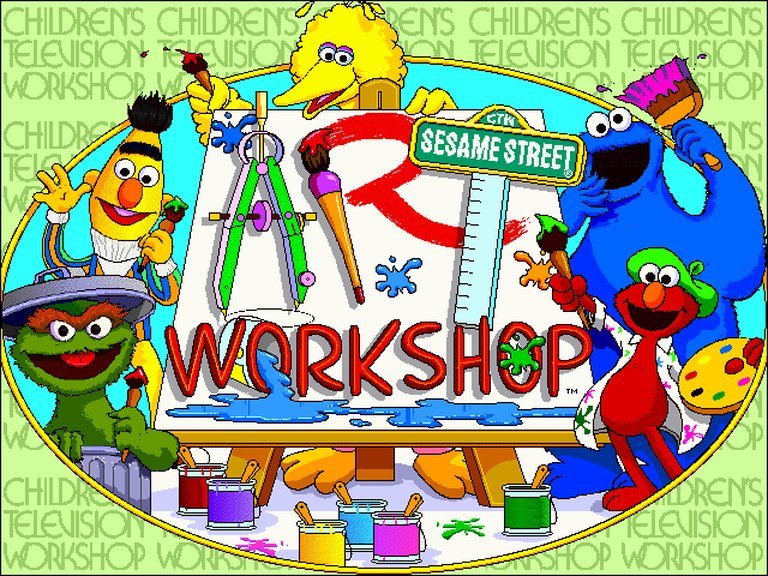
Sesame Street: Art Workshop is an educational game for children aged three and up, set in the colorful fantasy world of Sesame Street. It features four creative activities: a Coloring Book for coloring provided scenes and shapes, Costumes for dressing up characters with accessories, Painting where kids can freely draw and fill shapes on a canvas with Elmo providing voice guidance, and Stickers for decorating environments with various stickers. The game encourages creativity and learning through playful art experiences.
Gameplay Videos
Sesame Street: Art Workshop Free Download
Sesame Street: Art Workshop: Review
Introduction
In the pantheon of edutainment software, few franchises embody the symbiosis of play and pedagogy as enduringly as Sesame Street. Among its digital adaptations, Sesame Street: Art Workshop (1995) stands as a quiet masterpiece—a CD-ROM experience that transcends its era to offer a timeless exploration of creativity for preschoolers. More than a mere licensed tie-in, this title, developed by Musical Plan Ltd. and Children’s Television Workshop (CTW) and published by Creative Wonders, represents a pioneering fusion of intuitive design, educational rigor, and the beloved characters of 123 Sesame Street. Its thesis is simple yet profound: to transform the digital canvas into a playground where art, learning, and imagination coalesce without compromise. This review deconstructs how Art Workshop achieved this equilibrium, cementing its legacy as a foundational artifact of childhood digital culture.
Development History & Context
Art Workshop emerged during a transitional phase in gaming history. The mid-1990s saw CD-ROMs displacing floppy disks, enabling richer multimedia experiences than MS-DOS could accommodate. Targeted at Windows 3.x (16-bit) systems in 1995, the game later expanded to Windows and Macintosh platforms in 2002 via Encore Software—a testament to its enduring appeal. The development team, a collaboration between CTW’s educational specialists and Musical Plan Ltd., prioritized child-centric design. Research Director Erik Strommen’s involvement underscores the game’s grounding in pedagogical theory, while the 49-credit roster—including Muppet Art Director Rick Wetzel and sound designer Peter Durwood—reflects the meticulous craftsmanship expected from a Jim Henson licensee. Technologically, the game embraced the era’s constraints: fixed/flip-screen visuals, point-and-click interfaces, and compressed audio (featuring Kevin Clash’s iconic Elmo voice-over). Yet it innovated within these limits, leveraging CD-ROM space for vibrant sprites, layered backgrounds, and seamless transitions between activities. This context—pre-smartphone, pre-touchscreen, and pre-over-reliance on gamification—positions Art Workshop as a purist artifact of edutainment’s golden age.
Narrative & Thematic Deep Dive
Though devoid of traditional narrative, Art Workshop embeds thematic depth through its structure and character interactions. The game’s overarching narrative is one of creative empowerment, with Elmo serving as both guide and cheerleader. His voice-over instructions (“Let’s draw a circle! A triangle! A star!”) transform abstract concepts into tangible, playful learning moments. The four core activities subtly reinforce distinct developmental goals:
– Coloring Book: Encourages fine motor skills and color theory through pre-defined line art.
– Costumes: Fosters identity exploration by allowing children to dress Muppets (Big Bird, Grover, etc.) in whimsical combinations.
– Painting: Promotes free expression via digital brushes, shape stamps, and character insertions.
– Stickers: Cultivates spatial reasoning and storytelling by decorating dioramic environments.
The absence of failure states or penalties is deliberate, aligning with CTW’s mission of “process over product.” Elmo’s affirmations (“You’re a super artist!”) reinforce growth mindset principles, while the fantasy setting—a vibrant, non-judgmental art studio—mirrors Sesame Street’s ethos of inclusive imagination. Even subtle elements, like the “erase” or “start over” options, model resilience and experimentation themes.
Gameplay Mechanics & Systems
The genius of Art Workshop lies in its minimalist yet multifaceted gameplay. Each activity operates as a self-contained loop, united by a frictionless interface.
- Coloring Book: Children select black-and-white scenes (e.g., a playground or Big Bird’s nest) and fill them with a palette of 16 colors. The “fill” tool introduces basic shape recognition as Elmo labels geometric forms.
- Costumes: A drag-and-drop system lets users assemble outfits from hats, glasses, and accessories. The lack of constraints allows for absurd combinations (e.g., Oscar the Grouch in a tutu), sparking laughter and creativity.
- Painting: The digital canvas supports freehand drawing, pattern stamps (stripes, dots), and letter/number stamps. A “magic” paint-bucket auto-fills closed shapes, teaching cause-and-effect. Characters can be inserted as movable stickers, enabling dynamic scene-building.
- Stickers: Children populate themed backdrops (beaches, streets) with pre-cut stickers of Muppets, objects, and symbols. The “undo” feature erases individual elements, while a “scrapbook” saves creations for printing.
Systems like “eraser” tools and “start over” buttons empower agency, while the absence of time limits or scores eliminates pressure. The UI—intuitive icons, large cursors, and vocal cues—prioritizes accessibility, ensuring even toddlers navigate without parental aid. This design philosophy eschews complex mechanics in favor of open-ended play, making it a precursor to modern sandbox games.
World-Building, Art & Sound
Art Workshop’s world-building is a masterclass in environmental storytelling. The game evokes Sesame Street’s live-action-and-puppet aesthetic through stylized 2D environments: sun-drenched studios, cluttered art tables, and whimsical backdrops that feel like extensions of the TV show’s sets. Art Director Eustacia Marsales and Muppet Art Director Rick Wetzel ensured every sprite—from Elmo’s googly eyes to a dancing Cookie Monster—adhered to Henson’s character design principles, maintaining brand authenticity while adapting to digital constraints.
The visual palette bursts with primary colors, soft gradients, and bold outlines, optimized for low-resolution displays. Textures mimic crayon and watercolor, reinforcing the tactile, “analog” feel of art. Sound design similarly prioritizes clarity: Miles Ludwig’s score blends jaunty piano loops with percussive sound effects (brushstrokes, sticker placements), while Peter Durwood’s audio cues—Elmo’s giggles, paper rustling—create multisensory immersion. Even the menu’s chimes and activity transitions feel polished, turning navigation into a playful ritual. This cohesive audio-visual environment transforms the game into a digital art studio, where every click and color feels purposeful.
Reception & Legacy
Upon release, Art Workshop garnered little mainstream critical coverage, reflecting the era’s marginalization of children’s software in gaming discourse. Yet its commercial success—re-released multiple times (1995, 2002, 2005)—and enduring presence in abandonware archives suggest word-of-mouth acclaim among parents and educators. The game’s legacy is twofold:
- Educational Influence: It pioneered the “creative studio” template later adopted in titles like Math Workshop (1995) and Oscar the Balloonist’s Creative Workshop (2001). Its emphasis on process over scores foreshadowed modern STEAM games like Toca Boca titles.
- Cultural Preservation: As a digital time capsule, it preserves CTW’s 1990s pedagogical ethos—pre-Alphabet- obsessed, pre-screen-saturated—where play was synonymous with discovery. Its preservation on platforms like the Internet Archive (2021) underscores its archival value for studying children’s digital media evolution.
Though overshadowed by later Sesame Street games like Elmo’s Letter Adventure (1999), Art Workshop remains a benchmark for edutainment’s potential to prioritize creativity over rote learning.
Conclusion
Sesame Street: Art Workshop is more than a relic of CD-ROM edutainment; it is a testament to the power of design to democratize creativity. In an era of hyper-gamified learning, its unapologetic focus on open-ended play—free from metrics, levels, or pressure—feels radical. The game’s strength lies in its simplicity: a digital sandbox where a child’s brushstroke is as valid as Elmo’s affirmations. Its legacy endures not in sales figures, but in the thousands of now-adult gamers who credit it with fostering an early love for art. For historians and designers alike, Art Workshop remains a masterclass in marrying educational theory with intuitive design—a digital finger-painting canvas that proves the best “games” are those where the only goal is to create.