
- Release Year: 1999
- Platforms: Windows 16-bit, Windows
- Publisher: Learning Company, Inc., The, Mindscape SA
- Developer: Children’s Television Workshop, Frontier Media Group
- Genre: Educational, Pre-school, Reading, toddler, writing
- Perspective: 3rd-person (Other)
- Game Mode: Single-player
- Gameplay: Mini-games, Point-and-click
- Setting: Sesame Street
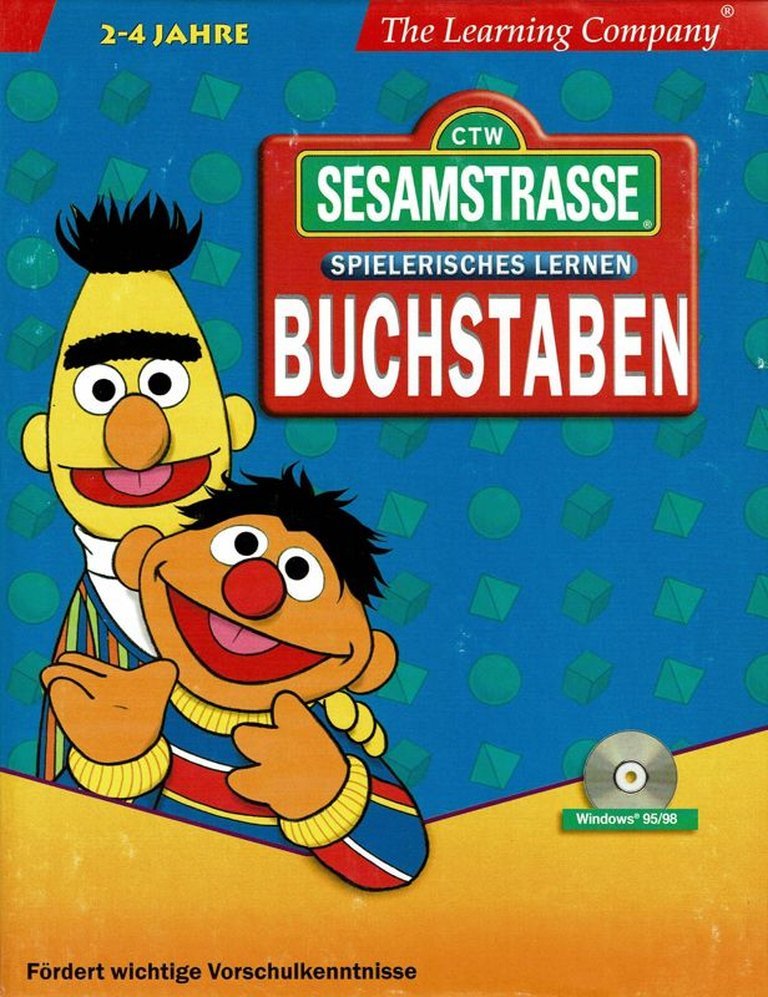
Description
Sesame Street: Letters is an educational game designed for pre-school and toddler players, set in the iconic Sesame Street neighborhood where children are greeted by characters like Telly and Oscar the Grouch. Players explore a horizontally scrolling environment filled with interactive hot spots that trigger letter-based mini-games and animations, making learning to read and write engaging. This game serves as a re-working of the earlier title ‘A Visit to Sesame Street: Letters’ and focuses on foundational literacy skills through playful, character-driven interactions.
Gameplay Videos
Sesame Street: Letters Free Download
Sesame Street: Letters Guides & Walkthroughs
Sesame Street: Letters Cheats & Codes
PlayStation 1 (PS1)
Enter codes using a GameShark or Action Replay device.
| Code | Effect |
|---|---|
| 800719C8 000C | Have All Letters |
| 800719C8 0000 | Have No Letters |
| 800719CC 0000 | Infinite Strikes |
| 8007409c000c | Have All Numbers |
| 800740a00000 | Infinite Strikes |
Nintendo 64 (N64)
Enter codes using a GameShark device.
| Code | Effect |
|---|---|
| 810A760A 0000 | Infinite Strikes |
| 810ACBA2 000C | Found All Numbers |
Sesame Street: Letters: Review
Introduction
In the pantheon of educational software, few names evoke as much nostalgic warmth and pedagogical ambition as Sesame Street: Letters. Released in 1999 by The Learning Company, this CD-ROM title represents a pivotal moment in children’s interactive media, bridging the gap between television’s beloved characters and the burgeoning potential of digital learning. Aimed at pre-schoolers and toddlers, it transforms the iconic street into a tactile, letter-filled playground. Yet, beneath its vibrant, friendly facade lies a surprisingly sophisticated design that balances entertainment with foundational literacy skills. This review argues that Sesame Street: Letters stands as a masterclass in “edutainment,” leveraging its licensed IP to create an immersive, confidence-building experience that remains influential in its approach to early-childhood education.
Development History & Context
Letters emerged from a unique collaboration between Children’s Television Workshop (CTW)—the creative force behind the Sesame Street franchise—and Frontier Media Group, with publishing handled by The Learning Company and Mindscape SA. The project was not a standalone effort but a reimagining of an earlier title, A Visit to Sesame Street: Letters (1992/1995), reflecting CTW’s iterative approach to adapting its content to new technologies. By 1999, the educational software market was burgeoning, with titles like JumpStart Pre-K and Reader Rabbit dominating. Letters distinguished itself through its direct integration of the Sesame Street universe, including Jim Henson’s final vocal performance as Ernie—a poignant detail underscoring the team’s commitment to authenticity. Technologically constrained by Windows 3.x/95 standards, the game relied on mouse-driven exploration and CD-ROM multimedia (video clips, audio) to create a responsive, non-linear environment. The extensive credits (161 personnel) reveal a meticulous production, with roles like “Lead Tester” and “Documentation Editor” highlighting the team’s focus on child-friendly usability.
Narrative & Thematic Deep Dive
The game’s narrative is deceptively simple: players arrive on Sesame Street, greeted by Telly Monster and Oscar the Grouch, and are encouraged to explore “hot spots” that trigger letter-based activities. This structure eschews traditional storytelling in favor of a “discovery loop,” where the journey itself is the reward. Characters serve as guides and motivators: Ernie provides hints in Henson’s warm, gravelly tones, while Oscar embodies playful grumpiness to encourage persistence. Dialogue is sparse but purposeful, with every interaction reinforcing the theme of “confidence-building.” The underlying narrative is one of empowerment—turning abstract concepts like phonics and rhyming into tangible, joyful experiences. For example, finding a letter “B” might reveal Bert’s love of bottle caps, subtly associating the letter with a relatable character trait. This thematic coherence—play as learning, failure as exploration—aligns with Sesame Street’s core educational philosophy: “learning through doing.”
Gameplay Mechanics & Systems
Letters’ core gameplay revolves around a horizontally scrolling, point-and-click interface. As the player’s mouse nears the screen’s edge, the street (or interior scenes like Big Bird’s nest or Bert and Ernie’s apartment) smoothly pans, revealing new interactive zones. These “hot spots” trigger mini-games and animations, such as:
– Letter Identification: Matching uppercase/lowercase pairs.
– Phonics: Associating sounds with objects (e.g., “D” for duck).
– Rhyming Games: Creating word pairs with similar endings.
– Storybook Reading: Simple narratives with highlighted vocabulary.
The UI is intentionally minimalist: no traditional menus or progress bars exist, replaced by visual feedback (e.g., a character’s clap or a letter’s glow) to guide the child. There is no combat or character progression in the traditional sense; instead, “progress” is measured through implicit skill acquisition and positive reinforcement. The game’s greatest innovation is its non-linear freedom: children can revisit activities at will, fostering self-directed learning. However, this open-endedness could occasionally overwhelm young users, as the lack of explicit structure might confuse those needing more guidance.
World-Building, Art & Sound
The game’s world is a faithful, interactive recreation of Sesame Street, rendered in bright, chunky 3D graphics that evoke the show’s stop-motion aesthetic. Character models are expressive and polished, with Big Bird’s feathers and Oscar’s trash can textures demonstrating surprisingly detailed artistry for 1999. Environments range from the sun-drenched street to cozy interiors, each packed with subtle details—Bob’s piano, Maria’s newsstand—that reward exploration. The sound design is equally meticulous: classic Sesame Street jingles accompany actions, while ambient effects (traffic, bird calls) ground the world in reality. Jim Henson’s Ernie provides vocal authenticity, and the inclusion of live-action clips from the TV series blurs the line between game and show. This multimedia approach creates a sense of continuity, making players feel like active residents of Sesame Street rather than passive observers.
Reception & Legacy
At launch, Sesame Street: Letters received limited critical attention but resonated strongly with its target audience. MyAbandonware users awarded it a 4.7/5 rating, with praise for its “endless discovery” and “charming interactivity.” Players on MobyGames gave a perfect 5.0/5, though sample sizes were small. Commercial success stemmed from The Learning Company’s aggressive marketing and the Sesame Street brand’s ubiquity. Its legacy endures in the edutainment genre: it pioneered the “exploratory learning” model later adopted in titles like Sesame Street: Elmo’s Preschool. Its influence is also seen in modern educational apps, which prioritize open-ended play over rigid lesson plans. However, its reliance on Windows 3.x/95 has rendered it a relic, preserved only by retro-gaming communities. As one MobyGames contributor noted, it “captured the magic of TV in a way few games of its era managed.”
Conclusion
Sesame Street: Letters is more than a relic of 90s edutainment; it is a testament to the potential of licensed media to transcend passive entertainment. By blending the warmth of Sesame Street with intuitive design, the game created a space where literacy felt like play. While its technological constraints and linear progression may not hold up to modern standards, its core philosophy—celebrating curiosity, rewarding effort, and making learning joyful—remains timeless. For historians and educators, it offers a blueprint for how interactive media can nurture young minds. For nostalgic gamers, it is a charming, pixelated playground that still feels as vibrant as the day it arrived. In the crowded landscape of educational games, Sesame Street: Letters stands not just for its letters, but for its heart.