
- Release Year: 2003
- Platforms: Windows
- Publisher: Vivendi Universal Games, Inc.
- Developer: Random Games, Inc.
- Genre: Action
- Perspective: First-person
- Game Mode: Single-player
- Gameplay: Collectibles, Decoration, Dress-up, Garden, Hidden object, Maze solving, Mini-games
- Setting: Fantasy, Medieval
- Average Score: 67/100
Description
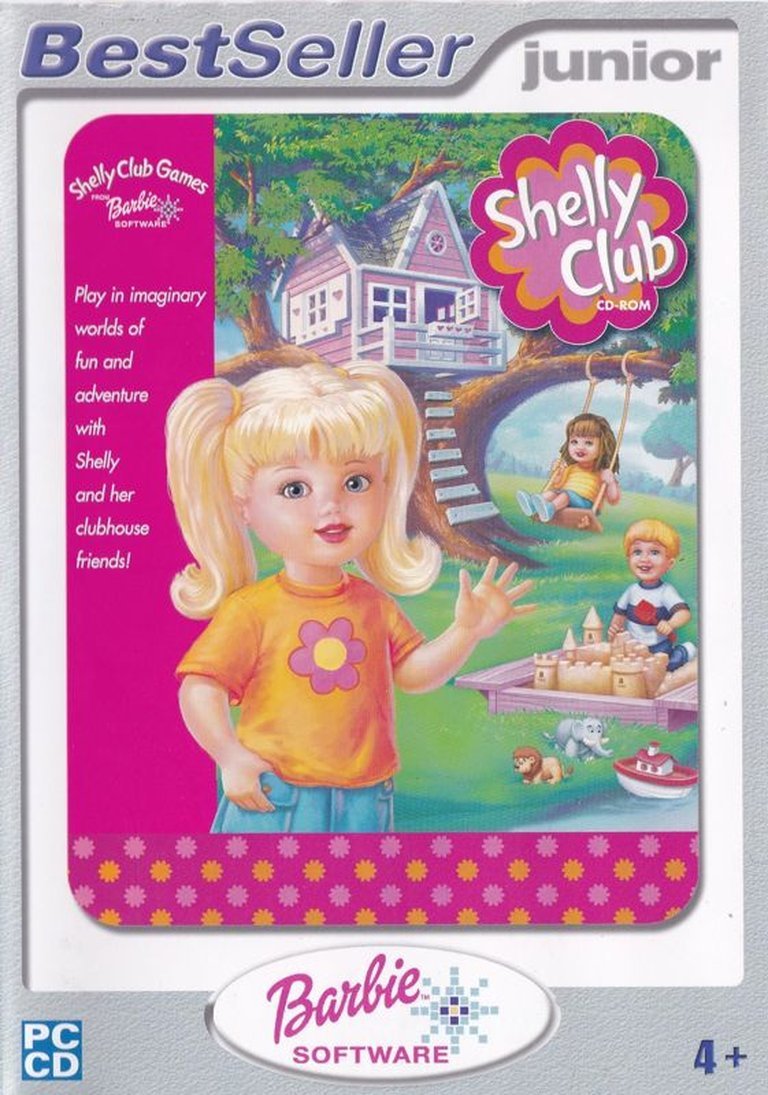
Shelly Club is a charming mini-games collection from the Barbie series, targeted at young players and starring Barbie’s younger sister Shelly (known as Kelly in the USA). Set in a whimsical fantasy world blending medieval and magical elements, the game begins in Shelly’s backyard, where players access a variety of interactive activities such as navigating jungle mazes to rescue animals, collecting flowers on horseback, catching falling stars in a unicorn forest, guiding a toboggan through winter landscapes, finding hidden objects in a mermaid lagoon, setting up tea parties, growing magical flowers, and decorating a scrapbook, all featuring customizable dress-up options for Shelly and her friends.
Gameplay Videos
Guides & Walkthroughs
Shelly Club: A Charming Time Capsule of Early 2000s Kids’ Gaming
Introduction
Imagine a digital playground where a little girl’s boundless imagination transforms a backyard into a gateway for fantastical escapades—rescuing jungle animals, catching shooting stars for unicorns, or decorating seashells in mermaid lagoons. Shelly Club (2003), a lesser-known gem in the sprawling Barbie franchise, invites young players into just such a world, centering on Barbie’s pint-sized sibling, Shelly (known as Kelly in the U.S.). Released during the heyday of licensed children’s software on PC, this mini-game collection captures the era’s emphasis on safe, creative play without the complexities of modern open-world adventures. As a game historian, I’ve pored over its mechanics and cultural context, and my thesis is clear: Shelly Club may lack narrative depth or technical sophistication, but it excels as a joyful, accessible entry point for introducing digital creativity to preschoolers, embodying the Barbie brand’s enduring focus on empowerment through play while highlighting the constraints and charms of early 2000s edutainment.
Development History & Context
Developed by the boutique studio Random Games, Inc., Shelly Club emerged from a collaborative ecosystem tailored to Mattel’s iconic doll line, with Vivendi Universal Games, Inc. handling publishing duties. Random Games specialized in family-friendly titles, often leveraging licensed IPs like Barbie to target young demographics, and this project involved a robust team of 114 credited contributors—97 developers and 17 in thanks—including key figures like producers Dana Feffer and Dyan Daglas, development director Cathy Siegel, and sound engineer Rich Seitz. Voice talent such as Amber Hood (voicing Shelly and friend Tommy) and Nicole St. John (handling Belinda, Diedre, and Chelsie) brought a lively, childlike energy to the proceedings, while QA leads like Rod Shean and Stuart Hay ensured the game’s stability for its pint-sized audience.
The game’s creation unfolded in the early 2000s, a transitional period for PC gaming dominated by the rise of broadband but still reliant on CD-ROM distribution. Technological constraints were evident: built for Windows with mouse-only input and middleware like Smacker Video for simple animations, Shelly Club prioritized accessibility over graphical fidelity. The ELSPA 3+ rating reflected its wholesome intent—no violence, just gentle exploration. This era’s gaming landscape was bifurcated; while AAA titles like Half-Life 2 (in development) pushed boundaries, the children’s market thrived on edutainment software from publishers like Vivendi (fresh off acquisitions like Sierra and Blizzard). Barbie games, part of the “BestSeller Series,” filled a niche for girl-targeted content amid a male-dominated industry, countering stereotypes by promoting creativity and social play. Shelly Club was envisioned as an extension of the doll’s real-world appeal, translating paper-doll dress-up into digital form, but it faced the era’s pitfalls: low budgets limited innovation, resulting in straightforward mini-games rather than interconnected narratives. Regional naming (Shelly in Europe, Kelly in the U.S.) underscored Mattel’s global branding strategy, though the 2010 discontinuation of the Kelly doll line foreshadowed shifting toy trends. In essence, Shelly Club was a product of its time—a low-risk, high-charm endeavor to nurture young imaginations in an increasingly digital world.
Narrative & Thematic Deep Dive
At its core, Shelly Club eschews a linear plot for a vignette-style structure, framing the experience as Shelly’s everyday adventures sparked by curiosity and friendship. The story opens in Shelly’s sunny backyard, a humble hub that serves as a narrative anchor, linking to the titular clubhouse where deeper fantasies unfold. There’s no overarching antagonist or epic quest; instead, the “plot” is a loose tapestry of mini-adventures, each tied to themes of discovery, care, and self-expression. For instance, in Jungle Adventure, Shelly pilots a boat through a verdant maze to rescue baby animals, emphasizing empathy and environmental stewardship. Castle Adventure casts friend Tommy as a flower-gathering knight for “Princess Kelly,” blending medieval whimsy with chivalric play. The clubhouse expands this into realms like Unicorn Forest (catching stars to decorate a mythical steed, symbolizing wonder and aspiration) and Mermaid Lagoon (a hidden-object puzzle unlocking a seashell for stamping, evoking underwater mystery).
Characters are archetypal yet endearing: Shelly/Kelly is the plucky protagonist, a wide-eyed explorer voiced with infectious enthusiasm by Amber Hood, often accompanied by friends like Tommy (the adventurous boy next door), Diedre (a supportive companion in the Tea Party), or Belinda and Chelsie (adding diversity to group activities). Dialogue is sparse and sugary—simple lines like “Let’s help the baby animals!” or “What a pretty flower!” reinforce positive reinforcement without overwhelming young players. Thematically, the game delves into imaginative empowerment, a hallmark of the Barbie universe. It celebrates girlhood agency through customization: every mini-game (save the scrapbook) ends with a dress-up segment, allowing players to swap outfits and colors for Shelly and her pals, mirroring real doll play. Broader motifs include nature’s magic (Magic Greenhouse, where pairing seeds and watering them grows flowers, teaching basic botany) and social bonding (Tea Party, setting tables and icing cakes for communal joy). Subtle undertones nod to growth and collection—the scrapbook, compiling decorated scenes from each activity, fosters a sense of accomplishment and memory-making.
Critically, the narrative’s simplicity is both strength and limitation. It avoids didactic lessons, letting themes emerge organically through play, but lacks emotional depth; there’s no character arc or conflict resolution beyond “success = decoration.” In a post-Frozen era, it feels quaintly optimistic, unburdened by modern complexities like identity struggles. Yet, for its audience, this purity shines: Shelly Club transforms mundane tasks into magical rituals, underscoring the franchise’s thesis that play is a portal to self-discovery.
Gameplay Mechanics & Systems
Shelly Club‘s gameplay revolves around bite-sized mini-games, forming a core loop of exploration, simple challenges, and creative rewards—ideal for short attention spans. Accessed via the backyard or clubhouse hub (navigated with mouse clicks in a first-person perspective), each activity lasts 5-10 minutes, blending action lite with puzzle elements. Controls are intuitive: direct mouse input for steering (Jungle Adventure‘s boat maze, dodging vines to collect animals) or clicking/dragging (Mermaid Lagoon‘s hidden-object search for five items to unlock a shell).
Core loops emphasize collection and customization. In Unicorn Forest, players slide Kelly left/right to snag falling stars, then stamp them onto a unicorn alongside shapes like hearts— a rhythmic catcher mechanic reminiscent of early arcade games but softened for kids. Winter Adventure introduces light platforming via toboggan steering down snowy hills, gathering dropped items (gloves, scarves) to build a snowman, with forgiving physics preventing frustration. Castle Adventure offers pseudo-racing as Tommy rides through forests, timing jumps over logs to hoard flowers, while Magic Greenhouse simplifies gardening into a matching mini-game: select a flower seed, pair with a leaf, and “water” for blooms. Tea Party shifts to organizational puzzles, arranging tableware and piping frosting on cakes, promoting fine-motor skills. The scrapbook acts as a meta-hub, letting players revisit and embellish photos from prior games with stamps, extending replayability.
Character progression is minimal but rewarding: unlocks come via completion, granting new stamps or outfit variants, with no stats or levels—purely cosmetic to encourage iteration. The UI is clean and kid-proof: large icons, bright colors, and voiced prompts minimize text, though the first-person view can feel static without camera pans. Innovative touches include the dress-up system, a digital paper-doll inventory prefiguring modern avatar creators, allowing style/color swaps that tie into themes (e.g., jungle greens or winter whites). Flaws emerge in repetition—mini-games share similar “collect-then-decorate” structures, risking monotony—and accessibility issues, like precise mouse demands that might frustrate very young users without parental help. No multiplayer or save system beyond basic progress tracking limits longevity, but adjustable difficulty (implied via simpler modes) caters to ages 3+. Overall, the systems craft a low-stakes sandbox, prioritizing fun over challenge, though it pales against contemporaries like The Sims for depth.
World-Building, Art & Sound
Shelly Club‘s world is a patchwork of pint-sized fantasies, starting from the cozy, sun-dappled backyard—a clickable diorama of swings, flowers, and a clubhouse door that whisks players to enchanted locales. This hub design fosters a sense of safe discovery, with the clubhouse as a treehouse nexus branching into diverse biomes: lush jungles teeming with vines and critters, misty forests hiding unicorns, crystalline winter slopes, and bubbly underwater lagoons. Medieval flourishes (castles, jousting hints in groups) blend with pure whimsy, creating a medieval-fantasy hybrid that’s more fairy tale than Lord of the Rings. Atmosphere thrives on transformation: everyday objects (a boat, toboggan) become adventure vehicles, reinforcing the theme that imagination expands the ordinary.
Visually, the art direction is vibrantly childlike, employing 2D sprites and basic 3D elements on CD-ROM constraints—think cel-shaded characters with exaggerated expressions and pastel palettes that pop on early-2000s monitors. Screenshots reveal detailed backdrops: starry skies in Unicorn Forest, shimmering shells in Mermaid Lagoon, evoking a dollhouse come alive. Animations are smooth via Smacker, with sparkles and confetti rewarding successes, though low poly counts and static scenes betray the budget. Sound design amplifies the charm: Rich Seitz’s engineering delivers twinkly MIDI tunes—upbeat flutes for jungles, harp glissandos for magic—paired with Foley effects like splashing water or crunching snow. Voice acting shines, with Hood’s bubbly delivery making Shelly feel like a real playmate, while ambient giggles and cheers build warmth. These elements coalesce into an immersive, nurturing experience: the world’s softness invites lingering, turning play sessions into cozy rituals that enhance emotional engagement far beyond mechanics.
Reception & Legacy
Upon its 2003 launch, Shelly Club flew under the radar, with no critic reviews archived on MobyGames and scant media coverage amid the barrage of holiday blockbusters like Prince of Persia: The Sands of Time. Commercially, as a CD-ROM title in Vivendi’s BestSeller Series (alongside hits like Barbie as the Princess and the Pauper), it likely sold modestly in the niche children’s market, bolstered by Mattel’s doll synergy but hampered by the era’s piracy issues and preference for console play. Player anecdotes from abandonware sites praise its nostalgia, with users recalling it as a “gentle intro” to gaming for siblings, though complaints about corrupt downloads highlight preservation woes. No Metacritic aggregate exists, but its 3.33/5 user rating on MyAbandonware suggests quiet appreciation rather than acclaim.
Over two decades, Shelly Club‘s reputation has evolved into cult obscurity, emblematic of the Barbie games’ uneven canon. With the Kelly doll’s 2010 retirement (replaced by Chelsea), it became a relic, yet its legacy endures in the franchise’s digital evolution—from Barbie Horse Adventures (sharing equestrian themes) to mobile apps like Barbie Dreamhouse Adventures. It influenced kid-lit software by normalizing mini-game anthologies and paper-doll mechanics, paving the way for titles like Paw Patrol games or My Little Pony creatives, emphasizing inclusivity and low-pressure fun. Industry-wide, it underscores the 2000s push for gender-balanced gaming, challenging the “boys-only” trope and inspiring modern edutainment from companies like Toca Boca. While not revolutionary, Shelly Club subtly advanced female-led narratives in youth media, its whimsical worlds a quiet testament to play’s power in an increasingly screen-saturated childhood.
Conclusion
Shelly Club distills the essence of early 2000s children’s gaming into a delightful, unpretentious package: mini-games that spark creativity, a world brimming with gentle magic, and a legacy tied to empowering young imaginations through the Barbie lens. From its backyard origins to fantastical dress-up finales, it prioritizes joy over complexity, though dated tech and repetitive loops temper its timelessness. As a historian, I place it firmly in video game history’s underbelly—a charming artifact of licensed play that reminds us gaming’s roots in simple, shared wonder. For parents seeking nostalgic, safe fun or collectors unearthing PC relics, it’s a solid 7/10: not essential, but endearingly evocative of childhood’s boundless possibilities. If only more games captured that backyard spark.