
- Release Year: 2008
- Platforms: Windows
- Publisher: SEGA Corporation
- Genre: Compilation
- Game Mode: LAN, Online PVP, Single-player
- Setting: Feudal Japan, Medieval Europe
- Average Score: 90/100
Description
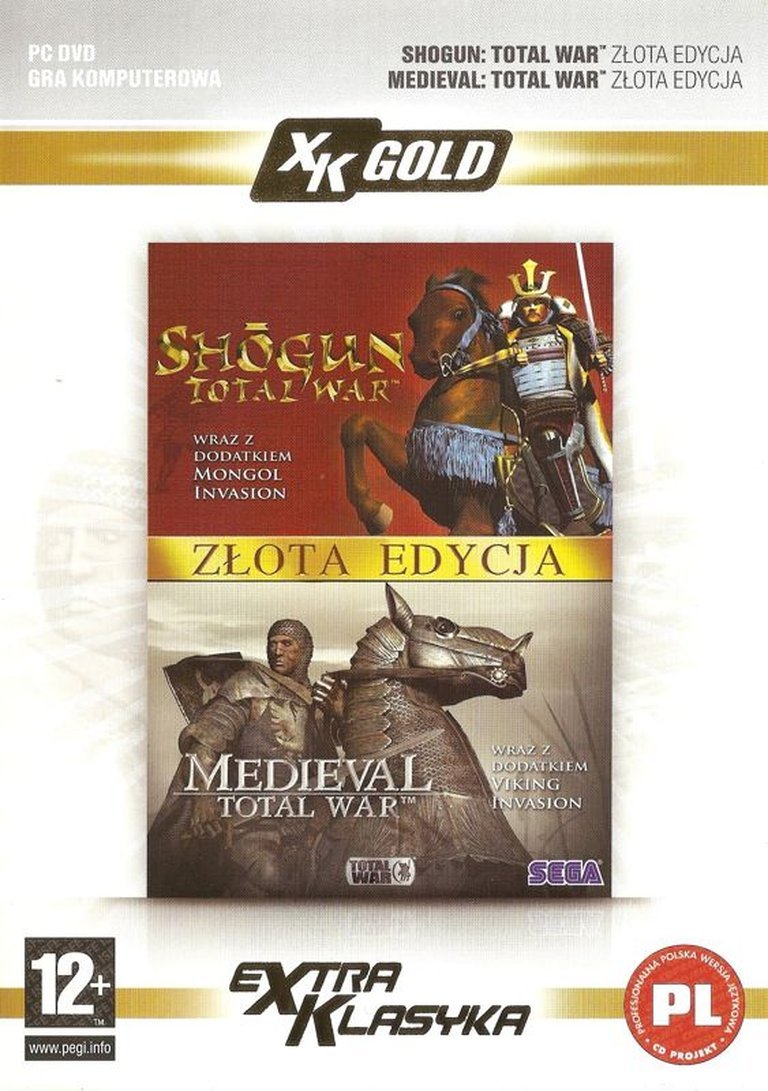
Shogun: Total War – Gold Edition + Medieval: Total War – Gold Edition is a compilation of two iconic strategy games set in different historical periods. Shogun: Total War immerses players in feudal Japan, where they must unite the country under a single banner through tactical battles and political maneuvers. Medieval: Total War transports players to medieval Europe, offering a rich experience of castle sieges, diplomatic intrigue, and large-scale warfare. Both games come with their respective expansion packs, providing an extensive and engaging gameplay experience.
Shogun: Total War – Gold Edition + Medieval: Total War – Gold Edition Patches & Updates
Shogun: Total War – Gold Edition + Medieval: Total War – Gold Edition Mods
Shogun: Total War – Gold Edition + Medieval: Total War – Gold Edition Guides & Walkthroughs
Shogun: Total War – Gold Edition + Medieval: Total War – Gold Edition Reviews & Reception
store.steampowered.com (90/100): A triumphant return to form for the series.
gog.com (88/100): A great game on its own, it is just the victim of Total War fans because it is easier to criticize than most of the other Total War games.
medieval-total-war-gold-edition-1.en.softonic.com (92/100): MEDIEVAL: Total War – Gold Edition is not one of the best-loved Total War games because it is an earlier version and doesn’t have very good graphics.
Shogun: Total War – Gold Edition + Medieval: Total War – Gold Edition Cheats & Codes
Shogun: Total War – Gold Edition
Enter the codes during gameplay by typing the full string (including the ‘.’ before and after) at the strategy screen.
| Code | Effect |
|---|---|
| .matteosartori | Full map |
| .daggins | Full map |
| .muchkoku | Unlimited KoKu |
| .prototypearmy | Unlimited army life |
| .ifoundsomecu | All provinces have copper |
| .conan | Control rebel forces and gain command of region Zero |
| .viagra | Construct armories in any territory despite iron sand deposits |
| .mefoundsomeau | Get a lot of gold |
| .mefoundsomeag | Get a lot of silver |
| .spylookahead | Kill any person without dying |
| .booyakasha | Faster unit and building construction |
Medieval: Total War – Gold Edition
Enter the codes during gameplay by typing the full string (including the ‘.’ before and after) at the strategy screen.
| Code | Effect |
|---|---|
| .matteosartori | Full map |
| .daggins | Full map |
| .muchkoku | Unlimited KoKu |
| .prototypearmy | Unlimited army life |
| .ifoundsomecu | All provinces have copper |
| .mefoundsomecu | Get a lot of copper |
| .mefoundsomeau | Get a lot of gold |
| .mefoundsomeag | Get a lot of iron |
| .viagra | Get a lot of money |
| .deadringer | Get a lot of silver |
| .badgerbunny | Makes the AI easy |
| .kidsmode | Unlocks all buildings |
| .nuttermode | Allies can’t be made |
| .worksundays | Construction is faster |
Shogun: Total War – Gold Edition + Medieval: Total War – Gold Edition: Review
Introduction
In the pantheon of strategy gaming, few franchises loom as large as Total War. At its genesis lies Shogun: Total War (2000) and Medieval: Total War (2002), titles that pioneered a revolutionary blend of turn-based grand strategy and real-time tactical combat. Compiled into the Gold Edition bundles—including expansions like The Mongol Invasion and Viking Invasion—these games represent not just historical milestones but enduring testaments to ambitious design. This review argues that while their technical edges have dulled with age, their vision, depth, and influence cement their status as foundational pillars of the strategy genre.
Development History & Context
Studio & Vision: Developed by Creative Assembly and initially published by Electronic Arts (Shogun) and Activision (Medieval), these games emerged during a transformative era for PC strategy. The studio sought to bridge the cerebral depth of Civilization-like campaigns with the visceral thrill of real-time battles—a gamble that paid off spectacularly.
Technological Constraints: Built on proprietary engines, both games pushed the limits of early-2000s hardware. Shogun’s 3D battles were groundbreaking, albeit limited by era-appropriate textures and animations. Medieval expanded scope with larger faction rosters and a sprawling map covering Europe, North Africa, and the Middle East, but retained a similar engine, relying on stylized 2D sprites for campaign maps.
Gaming Landscape: Released amidst contemporaries like Age of Empires II and Crusader Kings, the Total War series stood out by hybridizing genres. At a time when RTS games dominated, Creative Assembly’s focus on historical authenticity and strategic granularity carved a niche that would later explode into a franchise selling over 36 million copies.
Narrative & Thematic Deep Dive
Shogun: Total War: Set in 16th-century feudal Japan, Shogun plunges players into the Sengoku Jidai—the “Warring States Period.” Through interwoven vignettes (voiced by The Last Samurai’s Steven Berkoff), the game explores themes of loyalty, betrayal, and the existential weight of leadership. The arrival of European traders introduces firearms and Christianity, forcing players to balance tradition with disruptive innovation.
Medieval: Total War: Spanning 1087–1453 AD, Medieval chronicles the rise and fall of empires, from the Crusades to the Hundred Years’ War. The Viking Invasion expansion adds a bespoke campaign focusing on Norse incursions into the British Isles. Unlike Shogun’s focused narrative, Medieval embraces a sprawling, almost anthological approach, emphasizing the cyclical nature of conquest and collapse.
Shared Themes: Both games interrogate the fragility of power and the moral compromises of governance. Assassinations, rebellions, and religious schisms underscore the idea that victory is transient—a design philosophy that would define the series.
Gameplay Mechanics & Systems
Core Loop: The Total War formula remains intact: players manage economies, diplomacy, and armies on a turn-based campaign map before diving into real-time battles. Shogun’s streamlined focus on Japan reduces complexity, while Medieval layers complexity with crusades, religious tensions, and a wider array of unit types.
Innovations & Flaws:
– Battles: Terrain and morale matter profoundly. Archers rain death from hills, cavalry flanks shatter formations, and routing units can turn the tide. However, pathfinding issues and clunky unit control persist.
– Campaign Depth: Medieval introduces faction-specific victory conditions and princess marriages for diplomacy—a precursor to deeper systems in later titles. Yet the AI’s erratic diplomacy and siege behaviors frustrate.
– UI & Accessibility: Designed for 1024×768 resolutions, the interface feels cramped on modern screens. Tooltips are sparse, leaving systems like religion in Medieval under-explained.
World-Building, Art & Sound
Visual Design:
– Shogun’s aesthetic channels feudal Japan’s stark beauty: cherry blossoms drift across castles, while katana-wielding samurai clash in rain-soaked valleys.
– Medieval opts for a grittier palette, echoing the mud and blood of European battlefields. The 2D campaign map, painted in illuminated manuscript style, remains a visual triumph.
Soundscape: Jeff van Dyck’s soundtracks are legendary. Shogun’s shamisen and taiko drums evoke Hiroshige woodblocks, while Medieval’s choral arrangements and period-accurate instruments (like the hurdy-gurdy) immerse players in its world. Voice acting, though hammy at times, imbues characters with personality—whether a Shogun’s haughty declamations or a Viking warlord’s guttural threats.
Reception & Legacy
Launch Reception: Both games were critical darlings. Shogun earned praise for its ambition, while Medieval was hailed as a masterclass in scope (selling over 1 million copies). Reviewers noted their steep learning curves but celebrated their unmatched scale.
Long-Term Impact:
– Genre Influence: The hybrid model inspired titles like Mount & Blade and Crusader Kings III.
– Series Evolution: Later entries refined mechanics, but Shogun and Medieval established core tenets: asymmetric factions, morale-based combat, and emergent storytelling.
– Community Endurance: Modding communities keep these games alive. Medieval’s Stainless Steel mod remains a fan favorite, while Shogun’s tight balance is revered by purists.
Conclusion
Shogun and Medieval: Total War – Gold Edition are more than relics—they are blueprints. Their rough edges (dated UI, erratic AI) are outweighed by visionary design, atmospheric depth, and historical reverence. For modern players, they offer a window into strategy gaming’s past; for historians, a testament to Creative Assembly’s boldness. In a landscape crowded with homogenized sequels, these titles remain essential—proof that true artistry transcends technical limitations.
Verdict: A masterpiece duo, foundational to both the franchise and the genre. Play them not for polish, but for the raw genius of their ambition.