
- Release Year: 1997
- Platforms: Windows
- Publisher: Sierra On-Line, Inc.
- Developer: Dynamix, Inc., subLOGIC
- Genre: Simulation
- Perspective: 1st-person
- Game Mode: Single-player
- Gameplay: AI air traffic control, Flight planning, Flight Simulation, IFR, VFR
- Setting: North America and Europe
Description
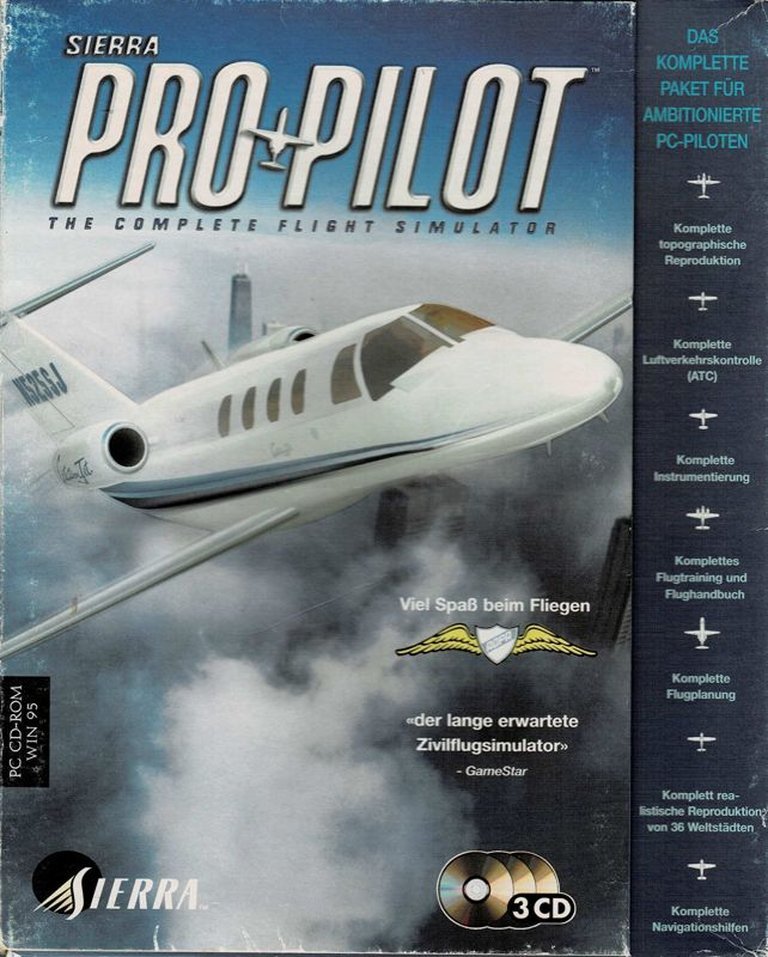
Sierra Pro Pilot 98: The Complete Flight Simulator is a civilian flight simulation game set across North America and Europe, featuring realistic aircraft like the Cessna Skyhawk and Beechcraft Bonanza. Players engage in both visual and instrument flight rules with AI air traffic control, emphasizing authentic flight dynamics, detailed cockpit interactions, and manually created flight plans for an educational yet entertaining experience akin to flight training.
Gameplay Videos
Where to Buy Sierra Pro Pilot 98: The Complete Flight Simulator
PC
Sierra Pro Pilot 98: The Complete Flight Simulator Free Download
Sierra Pro Pilot 98: The Complete Flight Simulator Patches & Updates
Sierra Pro Pilot 98: The Complete Flight Simulator Reviews & Reception
oldpcgaming.net : for a first effort this is a really good product
Sierra Pro Pilot 98: The Complete Flight Simulator: Review
Introduction
In the crowded skies of the late 1990s flight simulation market, one title dared to challenge the undisputed reign of Microsoft Flight Simulator: Sierra Pro Pilot 98: The Complete Flight Simulator. Developed by Dynamix and published by Sierra On-Line, this 1997 release promised a modern, cockpit‑centric approach to civilian aviation. With its emphasis on instrument flight rules (IFR), realistic avionics, and a selection of popular general‑aviation aircraft, Pro Pilot 98 aimed to satisfy both aspiring pilots and seasoned simulation enthusiasts. However, technical limitations, a contentious lack of 3D acceleration, and installation quirks prevented it from truly taking off. This review will dissect every aspect of Pro Pilot 98, from its ambitious development history and thematic underpinnings, to its deep but flawed gameplay mechanics, its visual and auditory presentation, and ultimately its mixed reception and lasting legacy. In the end, we will determine whether this sim was a daring step forward or a misjudged attempt to soar in Microsoft’s shadow.
Development History & Context
The Studio and Its Vision
Dynamix, the developer behind Pro Pilot 98, was already known for its work on high‑fidelity combat flight simulators such as Red Baron II. For its first foray into the civilian market, the studio partnered with subLOGIC – a company with historic roots in the Flight Simulator franchise – to create a product that prioritized cockpit realism and procedural authenticity. The project was directed by Mark R. Pechnick and overseen by a team that included programmers Caedmon Irias, Joe Legg, Carole Quattrone, Richard Rayl, and Glen Wolfram, alongside senior artist Brian Broderick and a sizable scenery development group. Their stated goal, as described in the game’s archived website, was to produce a “Civilian Flight Simulator For Everyone” that balanced accessibility with a rigorous simulation of actual flight procedures.
Technological Constraints and the 3D Acceleration Debate
Released in December 1997 for Windows 95, Pro Pilot 98 arrived at a time when 3D acceleration was becoming the industry standard. While groundbreaking titles like Flight Unlimited II leveraged hardware acceleration to render smooth, fully 3D worlds, Dynamix made the deliberate choice to rely solely on DirectDraw and a fixed 640×480 resolution. This decision was partly motivated by a desire to support lower‑end hardware (the minimum specification was a Pentium 90 MHz with 16 MB RAM), but it came at a severe visual cost. Reviewers repeatedly noted the pixelated terrain, the lack of texture‑mapped landscapes, and the overall “old‑school” look that clashed with contemporary expectations. The absence of 3D acceleration also contributed to frame‑rate issues, especially on systems without a fast enough CPU, prompting multiple patches (1.1, 1.2, 1.3a) in an attempt to improve performance.
Market Context and Competition
The late‑1990s were a golden age for flight simulation. Microsoft’s Flight Simulator 98 (FS98) dominated the genre with vast scenery, an extensive third‑party add‑on ecosystem, and full 3D acceleration support. Flight Unlimited II offered breathtaking visuals and dynamic weather, though it focused more on the joy of flying than strict realism. Pro Pilot 98 entered this arena as a third contender, attempting to carve out a niche by excelling in two areas: cockpit fidelity and instrument training. Its tagline, “The Complete Flight Simulator,” was a direct challenge to Microsoft’s Complete Flight Simulator branding. However, the competition was fierce, and Pro Pilot 98 would quickly reveal both its strengths and its shortcomings.
Narrative & Thematic Deep Dive
Pro Pilot 98 is not a scripted game with a linear plot, characters, or dialogue. Instead, its “narrative” emerges from the player’s personal journey through the world of aviation. From the moment the player sits in the virtual cockpit, they are invited to author their own story – whether it’s a quiet cross‑country VFR flight under clear skies, a nail‑biting IFR approach in a storm, or a methodical practice of engine‑failure procedures. The open‑ended sandbox, spanning over 3,000 airports across North America and parts of Europe, becomes a canvas for countless emergent adventures.
Thematically, Pro Pilot 98 explores several key ideas:
- Authenticity vs. Accessibility: The game strives to simulate real‑world flying with unprecedented cockpit detail – every switch, knob, and instrument can be manipulated with the mouse. Yet it also tries to welcome newcomers through introductory videos, an automatic copilot, and built‑in navigation aids. This tension between high‑fidelity simulation and user‑friendly design is at the heart of Pro Pilot’s identity.
- Education and Training: Many reviewers highlighted the sim’s value as a training tool for student pilots. The accurate IFR environment, real‑world radio navigation (VOR, NDB), and interactive air traffic control (ATC) provide a virtual classroom where players can learn actual aviation procedures. This educational theme pervades the experience, elevating it beyond mere entertainment.
- Freedom and Mastery: The underlying theme of flight itself – the sense of freedom and the satisfaction of mastering a complex machine – is central. Whether piloting a simple Cessna 172 or a sleek CitationJet, the player is empowered to conquer the skies, echoing humanity’s age‑old dream of flight.
In the absence of a traditional narrative, Pro Pilot 98 tells a story of ambition: the attempt to democratize aviation simulation while preserving its technical integrity. It also inadvertently narrates the story of a young development studio testing the limits of contemporary technology.
Gameplay Mechanics & Systems
Core Loops: From Planning to Execution
A typical Pro Pilot session follows a realistic workflow:
1. Pre‑flight planning: Using the in‑game flight planner, the player selects departure and destination airports, defines a route, checks weather, and configures aircraft performance (fuel, weight, balance). This stage is crucial for IFR flights and mirrors real pilot preparation.
2. C cockpit preparation: The player interacts with a fully modeled 3D (or 2D pre‑rendered) cockpit. Switches, levers, and radios must be set correctly – from mixture and propeller controls to radio frequencies. The learning curve is steep; starting the Bonanza alone requires a precise ten‑step sequence.
3. Takeoff and flight: The flight model attempts to simulate each aircraft’s unique handling characteristics. Engine vibration and control feel are meant to add immersion.
4. Navigation: Pilots rely on traditional instruments (VOR, ADF, ILS) or the pioneering built‑in GPS map. ATC can be contacted for clearances, traffic advisories, and landing instructions.
5. Landing and shutdown: Precision approaches, crosswind landings, and post‑flight checklists round out the experience.
The loop repeats with each new flight, allowing players to incrementally build skill and explore different aircraft and conditions.
Aircraft Roster and Realism
Pro Pilot 98 includes six aircraft:
| Aircraft | Type | Notable Traits |
|---|---|---|
| Cessna Skyhawk 172P/R | Single‑engine piston | Trainer, forgiving handling, ideal for beginners |
| Beechcraft Bonanza V35 | Single‑engine piston | High‑performance, complex systems |
| Beechcraft Baron B58 | Twin‑engine piston | Multi‑engine procedures, asymmetric flight |
| Beechcraft Super King Air B200 | Twin‑engine turboprop | Pressurized cabin, advanced systems |
| Cessna CitationJet 525 | Twin‑engine jet | Jet handling, speed, high‑altitude flight |
Each aircraft features a meticulously recreated cockpit with functional instruments, and the flight models aim to capture the nuances of power‑plant response, control feel, and stall characteristics. However, some reviewers noted inconsistencies, such as the Baron being too easy to fly on one engine, or the lack of perceived speed change during takeoff.
User Interface and Innovation
The user interface revolves around a mouse‑driven cockpit. While this makes the instruments accessible, it also demands precise clicking and can feel cumbersome. Notable innovations include:
– Built‑in GPS map: A modern navigation aid uncommon in earlier sims.
– Automatic Copilot: Handles routine tasks like following ATC instructions and managing navigation, making the sim more accessible to novices.
– Interactive ATC: AI controllers provide realistic radio chatter and clearances (though text‑based in the original version).
– Engine Vibration: Added for immersion, a subtle detail that enhances sense of presence.
Yet the game also exhibits flaws: the flight plan editor lacks city names, using only airport codes; the system requirements were misleading, with many users experiencing poor frame rates even on Pentium II machines; and the separate US/European installation CDs share the same registry keys, preventing both maps from being installed simultaneously. Additionally, the German version notably lacked a multiplayer mode, a shortcoming that was later addressed via patches.
Overall Assessment
The gameplay systems are deep and rewarding for those willing to climb the steep learning curve. The emphasis on procedural correctness and the richness of the cockpit experience set Pro Pilot 98 apart from more arcade‑oriented flight games. However, technical hiccups, performance issues, and occasional design oversights (like the arduous flight‑plan creation) keep it from reaching its full potential.
World‑Building, Art & Sound
Scenery and Geography
The virtual world spans the continental United States (including over 3,000 airports) and a separate European map covering major cities and landmarks. The scenery was created using subLOGIC’s extensive terrain database, which includes realistic elevation data, city “blobs” (colored patches representing urban areas), and prominent structures such as the Statue of Liberty. While the terrain resolution is low by modern standards, the sheer coverage is impressive for the era. However, at low altitudes the landscape often appears as a “pixelated quilt” (as PC Joker described), with little textural detail.
Visual Presentation
The graphics engine runs at a fixed 640×480 with no support for 3D accelerators. Cockpit panels, on the other hand, are rendered with careful attention to detail, featuring photorealistic gauges and switches that respond to mouse input. This contrast creates a situation where the interior view is highly convincing while the external world feels dated. The choice to avoid 3D acceleration was defended by the developers as a way to ensure smooth performance on a wide range of PCs, but in practice even a Pentium II could struggle during fast, low‑level flight.
Sound Design
Sound receives comparatively high marks. Reviews from Gameplay (Benelux) and Power Play praise the “excellent sound effects” and the overall audio immersion. Engine noises vary realistically between aircraft types, and the cockpit ambiance includes subtle clicks and hums. ATC communications (though likely text‑to‑speech or pre‑recorded snippets) add to the feeling of being in a live airspace. The sound design successfully complements the simulated experience without drawing negative attention.
Atmospheric Cohesion
Together, the visuals and audio create an atmosphere that is at once technically ambitious and visibly constrained. The cockpit draws you into the pilot’s role, while the blocky exterior scenery constantly reminds you of the era’s technological limits. For the patient aviator, the sense of immersion can be profound; for the casual observer, it may feel dated and uninspiring.
Reception & Legacy
Critical Reception
At launch, Sierra Pro Pilot 98 garnered a mixed‑bag of scores averaging 62% on MobyGames. The range was wide:
- Positive: Power Play (80%) hailed it as a near‑photorealistic simulator with “topographically perfect scenery” and a “fully automatic copilot,” comparing favorably to Flight Simulator 98. GameStar (Germany) (78%) praised its beginner‑friendly comfort, interactive cockpit, and extensive European coverage.
- Mixed: GameSpot (61%) acknowledged its potential but noted glaring omissions and the need for a graphics overhaul. Adrenaline Vault (60%) liked the feature set but criticized frame‑rate instability.
- Negative: Computer Gaming World (50%) bluntly stated that the product felt “kicked out of the nest a bit too soon.” Game Revolution (42%) called it “an incomplete package” with disappointing graphics and mediocre sound, advising against its purchase.
Common themes in the criticism included:
– Graphics: absence of 3D acceleration, pixelated terrain, and general ugliness.
– Performance: frame‑rate drops, even on high‑end machines of the time.
– Usability: cumbersome flight‑plan creation, insufficient documentation (especially regarding controls), and the infamous dual‑CD installation conflict.
– Missing Features: no multiplayer (in some regions), limited city detail.
Praise centered on the cockpit detail, IFR training value, AI ATC, GPS, and the copilot feature.
Commercial Performance
Despite the critical split, Pro Pilot 98 sold more than 275,000 units (per Sierra’s press release) and ranked 17th on PC Data’s top‑selling list for February 1998. This suggests a substantial, albeit niche, audience seeking an alternative to Flight Simulator. The inclusion of European scenery also helped differentiate it in the North American market.
Influence and Long‑Term Legacy
Pro Pilot 98 did not dethrone Microsoft’s franchise, nor did it spawn a lasting dynasty. However, it contributed to the genre’s evolution:
– Its emphasis on cockpit interactivity and GPS navigation foreshadowed later sims like X‑Plane and Prepar3D, which place a premium on realistic panels.
– The inclusion of an AI copilot became a staple in subsequent flight and space sims (e.g., Elite Dangerous, Star Citizen).
– The mixed reception highlighted the importance of 3D acceleration, pushing future developers to embrace hardware rendering.
Dynamix released Pro Pilot ’99 the following year, which addressed many complaints and added multiplayer support. Nevertheless, the series never gained the cultural footprint of Flight Simulator. Today, Pro Pilot 98 is remembered as a bold but flawed experiment—a cult classic among a small community of vintage flight‑sim enthusiasts who appreciate its intricate systems and educational merits.
Conclusion
Sierra Pro Pilot 98: The Complete Flight Simulator stands as a testament to ambition meeting limitation. Dynamix and Sierra On‑Line created a simulator that dazzled with its cockpit fidelity, IFR training depth, and innovative aids like built‑in GPS and automatic copilot. Yet technical compromises—most glaringly the refusal to adopt 3D acceleration—and a range of design oversights prevented it from achieving greatness. It offered a compelling alternative to Flight Simulator 98 for those who valued procedural authenticity over graphical splendor, but it ultimately failed to capture the mainstream flight‑sim audience. In the annals of video‑game history, Pro Pilot 98 occupies a poignant middle ground: a “what‑could‑have‑been” story that remains a fascinating case study in the trade‑offs between realism, performance, and accessibility. For the dedicated aviator, it remains an intriguing relic; for the casual gamer, a reminder that sometimes the sky is not the limit, but the starting point.