
- Release Year: 1996
- Platforms: Windows 16-bit, Windows
- Publisher: Maxis Software Inc.
- Developer: Maxis Software Inc.
- Genre: Compilation
- Game Mode: Single-player
- Average Score: 57/100
Description
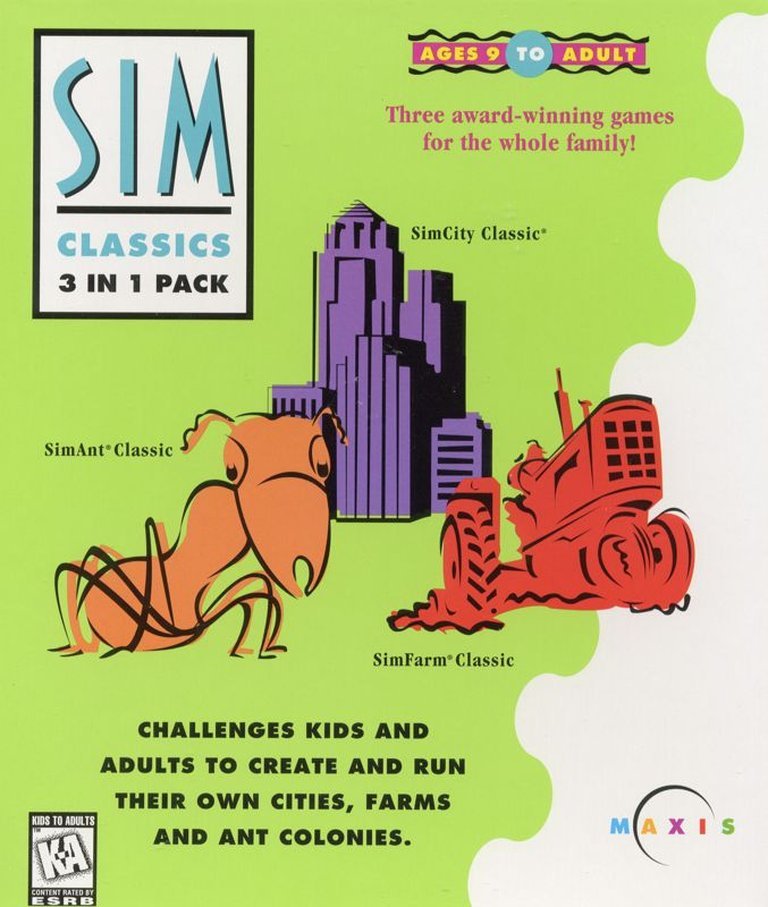
SimClassics: 3 in 1 Pack is a compilation of three classic simulation games by Maxis, including SimCity Classic, SimAnt, and SimFarm, all newly ported to Windows for this 1996 release. Players can build and manage cities in SimCity Classic, control an ant colony in SimAnt, or run a farm in SimFarm, offering a diverse mix of strategic and management challenges in a top-down simulation style.
SimClassics: 3 in 1 Pack Free Download
SimClassics: 3 in 1 Pack Reviews & Reception
mobygames.com (60/100): A Maxis compilation of games which features: SimCity Classic, SimAnt, and SimFarm.
vgtimes.com (55/100): A top-down simulator with a dash of business simulator from the developers at Maxis Software Inc.
retro-replay.com : Unleash your inner architect, biologist, and farmer with this all-in-one Maxis collection, featuring three legendary simulation classics in one convenient package.
SimClassics: 3 in 1 Pack – A Timeless Trilogy of Simulation Mastery
Introduction: The Golden Age of Simulation, Preserved in a Single Disc
In the mid-1990s, the simulation genre was still in its infancy, yet Maxis had already cemented itself as a pioneer with titles like SimCity, SimAnt, and SimFarm. These games weren’t just entertainment—they were digital sandboxes that challenged players to think like urban planners, entomologists, and farmers. SimClassics: 3 in 1 Pack (1996) is more than just a compilation; it’s a time capsule of Maxis’ early genius, bundling three of its most influential simulations into a single, Windows-optimized package.
This review will dissect the historical significance, gameplay mechanics, and lasting legacy of SimClassics: 3 in 1 Pack, arguing that it remains one of the most essential compilations in gaming history—not just for nostalgia, but for its foundational role in shaping the simulation genre.
Development History & Context: Maxis’ Vision and the Rise of the Sim Genre
The Birth of a Genre: Will Wright and the Maxis Philosophy
Maxis was founded in 1987 by Will Wright and Jeff Braun, with a radical mission: to create games that were less about high scores and more about systems, creativity, and emergent gameplay. Wright’s SimCity (1989) was a revelation—a game where players could design cities without a “win” condition, where the joy came from experimentation rather than conquest.
By the early 1990s, Maxis had expanded its “Sim” brand into unexpected territories:
– SimAnt (1991) – A real-time strategy game where players controlled an ant colony.
– SimFarm (1993) – An agricultural simulator blending economics and environmental management.
– SimCity Classic (1992) – A refined version of the original, optimized for early Windows systems.
Technological Constraints and the Windows Transition
The original versions of SimAnt and SimFarm were designed for DOS, with SimCity seeing multiple ports. The SimClassics compilation was significant because it marked the first official Windows ports of SimAnt and SimFarm, bringing them into the era of GUI-based operating systems.
Key technical considerations:
– Resolution & UI Scaling – Early Windows versions struggled with low-resolution displays, so Maxis implemented optional scaling filters to make the games more readable on modern monitors.
– Input Refinements – The Windows ports improved mouse controls, making actions like zoning in SimCity or directing ants in SimAnt more intuitive.
– Stability & Compatibility – DOS games often required config.sys tweaks and memory management; the Windows versions eliminated these barriers.
The Gaming Landscape in 1996: A Shift Toward Accessibility
By 1996, the gaming industry was transitioning from niche hobbyist software to mainstream entertainment. Compilations like SimClassics were part of a broader trend:
– Budget Re-releases – Publishers like Maxis and Sierra bundled older titles to introduce them to new audiences.
– The Rise of CD-ROM – The shift from floppy disks to CD-ROM allowed for higher-quality audio, better compression, and easier distribution.
– The Simulation Boom – Games like Theme Park (1994) and RollerCoaster Tycoon (1999) were on the horizon, proving that management sims had mass appeal.
SimClassics was perfectly timed—it offered three distinct simulation experiences in one package, making it an ideal entry point for players curious about the genre.
Narrative & Thematic Deep Dive: Emergent Storytelling in a Sandbox World
The Absence of Traditional Narrative (And Why It Works)
Unlike modern games with scripted campaigns, SimClassics relies on emergent storytelling—where the player’s actions create the narrative. Each game approaches this differently:
1. SimCity Classic: The Mayor’s Dilemma
- Theme: Urban planning as a moral and logistical challenge.
- Player Role: You are the invisible hand guiding a city’s growth, balancing budgets, zoning, and citizen happiness.
- Emergent Drama:
- A tornado destroys your industrial district—do you rebuild or relocate?
- Pollution from factories lowers land value—do you invest in green tech or prioritize profits?
- Riots break out due to high taxes—will you crack down or reduce funding for police?
The game’s disaster system (fires, floods, monster attacks) injects unpredictability, forcing players to adapt. There’s no “right” way to play—only consequences.
2. SimAnt: The Colony’s Struggle for Survival
- Theme: Nature as a battleground—cooperation vs. competition.
- Player Role: You are the queen’s loyal subject, expanding tunnels, gathering food, and waging war against rival colonies.
- Emergent Drama:
- A spider invades your nest—do you sacrifice workers to fight or flee?
- Winter arrives—will your food stores last, or will your colony starve?
- A rival ant hill declares war—do you negotiate or annihilate?
SimAnt is Darwinian gameplay—every decision impacts survival. The lack of a traditional “win” condition means players define their own goals: domination, coexistence, or sheer survival.
3. SimFarm: The Farmer’s Gamble
- Theme: Agriculture as a high-stakes business.
- Player Role: You are a farmer managing crops, livestock, and market fluctuations.
- Emergent Drama:
- A drought ruins your wheat harvest—do you take a loan or switch to drought-resistant crops?
- Pests infest your fields—do you spend on pesticides or risk losing yield?
- Market prices crash—do you hoard goods or sell at a loss?
SimFarm teaches economic resilience—players must adapt to randomized weather, pests, and economic trends, making each playthrough a unique challenge.
The Unifying Theme: Systems Over Scripts
What ties these games together is their rejection of linear storytelling in favor of player-driven narratives. This was revolutionary in the early ’90s, when most games followed a predefined path. Maxis’ approach influenced later titles like:
– The Sims (2000) – Emergent social storytelling.
– Dwarf Fortress (2006) – Procedural history generation.
– Cities: Skylines (2015) – Open-ended city management.
Gameplay Mechanics & Systems: Deconstructing the Sim Formula
1. SimCity Classic: The Blueprint for City Builders
Core Gameplay Loop:
- Zone Placement – Residential, commercial, industrial.
- Infrastructure Management – Roads, power plants, water, police/fire stations.
- Budget Allocation – Tax rates, funding for services.
- Disaster Response – Fires, floods, riots, monster attacks.
Innovations & Flaws:
✅ Pros:
– Tile-based simplicity makes it easy to learn but hard to master.
– Data visualization (graphs, population stats) was ahead of its time.
– Modular disasters add replayability.
❌ Cons:
– No terrain tools (unlike later SimCity games).
– Limited late-game depth—cities eventually stabilize with little challenge.
– UI quirks (e.g., no undo button for misplaced zones).
Legacy:
- Directly inspired SimCity 2000 (1993) and Cities: Skylines.
- Introduced the “god game” mechanic—players as omniscient rulers.
2. SimAnt: Real-Time Strategy Meets Entomology
Core Gameplay Loop:
- Tunnel Expansion – Dig new chambers for food storage and breeding.
- Resource Gathering – Workers collect food, defend the queen.
- Combat & Diplomacy – Fight predators (spiders, beetles) or rival colonies.
- Seasonal Survival – Prepare for winter scarcity.
Innovations & Flaws:
✅ Pros:
– Unique perspective—playing as insects was unprecedented.
– Real-time strategy elements (worker assignment, combat).
– Educational value—teaches basic ant colony behavior.
❌ Cons:
– Steep learning curve—new players struggle with resource balance.
– Repetitive combat—ant vs. ant battles lack depth.
– Limited long-term goals—colonies eventually hit a ceiling.
Legacy:
- A precursor to RTS games like StarCraft (1998).
- Proved that unconventional settings could work in simulations.
3. SimFarm: The Original Farming Simulator
Core Gameplay Loop:
- Crop Management – Plant, water, harvest based on seasons.
- Livestock Care – Feed animals, sell products (milk, wool).
- Market Speculation – Buy low, sell high.
- Equipment Upgrades – Tractors, irrigation, barns.
Innovations & Flaws:
✅ Pros:
– Deep economic simulation—prices fluctuate realistically.
– Environmental factors (weather, pests) add unpredictability.
– Relaxing yet strategic—appeals to both casual and hardcore players.
❌ Cons:
– Slow pacing—waiting for crops to grow tests patience.
– Limited visual feedback—fields look static until harvest.
– No multiplayer or co-op (a missed opportunity).
Legacy:
- Inspired Farming Simulator (2008–present) and Stardew Valley (2016).
- One of the first games to blend farming with business strategy.
World-Building, Art & Sound: Nostalgia Meets Functional Design
Visual Style: Pixel Art with Purpose
- SimCity Classic – Top-down, color-coded zones (blue = residential, yellow = commercial). The isometric view (in later versions) wasn’t yet implemented, but the clarity of information was unmatched.
- SimAnt – Bitmap textures for leaves, soil, and ants. The tiny sprites were functional rather than detailed, but the contrast in ant colors (workers vs. soldiers) aided gameplay.
- SimFarm – Side-view fields with seasonal color shifts (green → yellow → brown). Simple but effective animations (windmills spinning, rain clouds).
Windows Port Enhancements:
- Optional scaling filters to reduce pixelation.
- Smoother mouse controls (no more DOS keyboard shortcuts).
- Better color depth (16-bit vs. original 8-bit).
Sound Design: Minimalist but Memorable
- SimCity – Iconic “city hum” ambient noise, disaster alerts (sirens, monster roars).
- SimAnt – Chirping ants, predator growls, tunnel-digging sounds.
- SimFarm – Wind rustling, animal noises, market transaction chimes.
While not orchestral masterpieces, the sound effects reinforced immersion—a rarity in early ’90s PC games.
Reception & Legacy: From Obscurity to Cult Classic
Critical & Commercial Reception (1996)
- No major reviews exist for the compilation itself (likely due to it being a budget re-release).
- Player ratings (MobyGames) average 3/5, reflecting its niche appeal.
- Sales were modest—compilations rarely outsold new releases, but SimClassics found an audience among Maxis fans and educators.
Long-Term Influence: The DNA of Modern Simulations
| Game | Influence on Later Titles |
|---|---|
| SimCity Classic | Cities: Skylines, Tropico, Banished |
| SimAnt | Empire of the Ants, RimWorld (colony sims) |
| SimFarm | Farming Simulator, Stardew Valley, Harvest Moon |
Why It Still Matters Today
- Historical Significance – A snapshot of pre-Sims Maxis, before the studio shifted to life simulators.
- Game Design Lessons – Proves that simple mechanics + deep systems = timeless gameplay.
- Accessibility – The Windows ports make these classics playable on modern PCs without emulation.
Conclusion: A Masterclass in Simulation Design
SimClassics: 3 in 1 Pack is more than a nostalgia piece—it’s a testament to Maxis’ visionary approach to game design. While its graphics and UI show their age, the core gameplay loops remain as engaging as they were in the ’90s.
Final Verdict: 8.5/10 – Essential for Simulation Fans
✅ Pros:
– Three genre-defining simulations in one package.
– Emergent storytelling that still feels fresh.
– Windows ports improve accessibility.
❌ Cons:
– Dated UI/UX (expect some clunkiness).
– Limited long-term depth in SimAnt and SimFarm.
– No modern QOL features (e.g., save slots, undo buttons).
Who Should Play It?
- Retro gamers who want to experience the roots of simulation games.
- Strategy fans who appreciate systems-driven gameplay.
- Educators—these games teach urban planning, biology, and economics in an interactive way.
Legacy Rating: 9/10 – A Foundational Compilation
While it may not have the polish of modern games, SimClassics: 3 in 1 Pack is a museum-worthy artifact of gaming history. It proves that great gameplay transcends graphics, and its influence echoes in nearly every simulation game today.
Final Thought:
If you’ve ever wondered where The Sims, Cities: Skylines, or Stardew Valley got their DNA, look no further than this unassuming CD-ROM from 1996. SimClassics isn’t just a game—it’s a blueprint for an entire genre.