
- Release Year: 2010
- Platforms: Browser, Windows
- Developer: Simon Tatham
- Genre: Puzzle
- Game Mode: Single-player
- Gameplay: Grid-based, logic, Number puzzle
Description
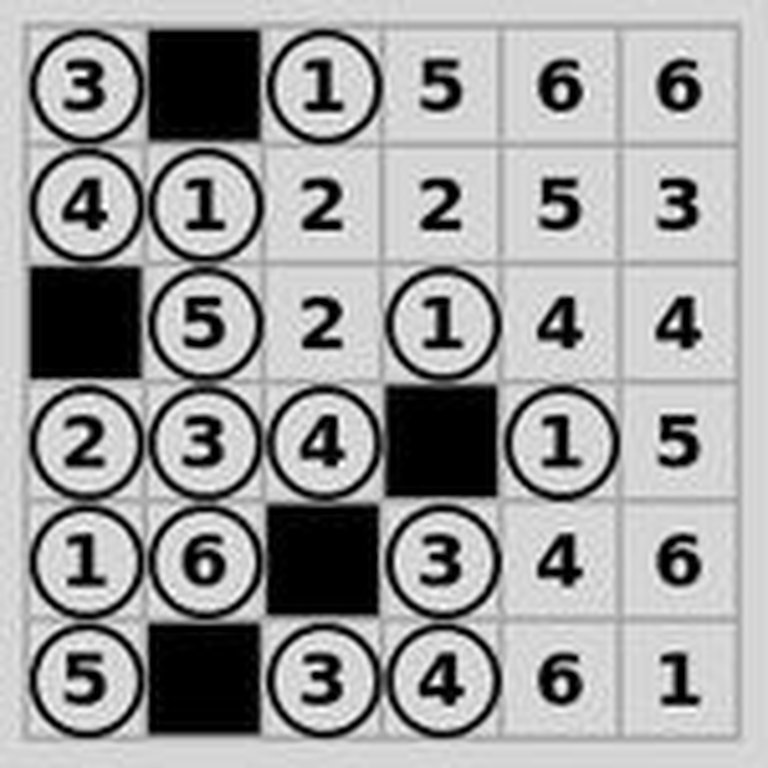
Singles is a grid-based puzzle game where players must strategically black out squares in a number-filled grid to ensure no number repeats in any row or column, while adhering to constraints that black squares cannot be adjacent and must not isolate any section of the grid. With customizable grid size and difficulty levels, it offers a flexible and engaging challenge as part of Simon Tatham’s Portable Puzzle Collection, inspired by the classic Hitori puzzle from Nikoli.
Where to Buy Singles
PC
Singles: A Micro-Review of a Macro-Trend
Introduction: The Ghost in the Machine
In the vast, crowded archives of video game history, some titles are monolithic—The Legend of Zelda, Call of Duty—while others are spectral, known only to a handful of dedicated archivists and puzzle enthusiasts. Singles is one such specter. Released in 2010 as a freeware component of Simon Tatham’s venerable Portable Puzzle Collection, this grid-based logic puzzle exists not as a commercial product but as a digital artifact, a perfect specimen of a specific design philosophy. This review argues that Singles is historically significant not for its narrative or technical prowess, but for its role as a pure, unadorned vessel for a classic brain-teaser (Hitori), representing the quiet, persistent influence of open-source puzzle curation in an era increasingly dominated by graphical spectacle, monetization, and blockbuster narratives. It is a game that asks us to consider what a video game truly is: is it the engine, the interface, the package, or simply the abstract ruleset made interactive?
Development History & Context: The Cult of the Collection
Singles was not developed by a studio in a traditional sense but was contributed by James Harvey to Simon Tatham’s Portable Puzzle Collection. Tatham, a British programmer, began this collection in the 1990s as a set of text-based puzzle games for Unix systems. By 2010, the collection had evolved into a cross-platform (Windows, browser, mobile) suite of over 40 logic puzzles, each implemented with minimalist, efficient code. The context is crucial:
- The Studio & Vision: There was no studio, only the ethos of a curator. Tatham’s project is the antithesis of the “AAA” model. Its vision is one of universal access and preservation—to create a single, portable, dependency-free executable containing the “best” implementations of classic puzzles. Singles (known as Hitori in its native Japan) was selected for this collection because it fit the criteria: elegant rules, deep logic, and a clean digital translation.
- Technological Constraints & Freedom: Freed from the constraints of commercial release—no marketing budget, no publisher demands, no need for a tutorial “experience”—the implementation is ruthlessly functional. It uses simple 2D graphics, keyboard/mouse input, and likely a few kilobytes of code. This efficiency is a direct descendant of the Unix philosophy: do one thing well. In 2010, the same year saw the releases of Mass Effect 2 and Red Dead Redemption, games with million-dollar budgets and hundreds of staff. Singles is the silent counterpoint, proving that compelling interactive logic does not require a physics engine or motion capture.
- The Gaming Landscape of 2010: The year was a pivot point. Motion control (Kinect, PlayStation Move) dominated hardware headlines. The debate over videogame violence reignited post-Call of Duty: Black Ops. Yet, beneath this noise, the seeds of the indie boom were being sown. Digital storefronts like Steam were becoming friendlier to small developers, and the concept of the “freeware puzzle collection” was a stable, respected niche. Singles existed at the intersection of this old-school curation (think of the puzzle books of Nikoli, the Japanese publisher that originated Hitori) and the new digital commons.
Narrative & Thematic Deep Dive: The Void as Canvas
To speak of narrative in Singles is to speak of its most profound design choice: the deliberate absence of any narrative scaffolding. There is no protagonist, no world, no lore. The “grid” is not a city, a dungeon, or a spaceship—it is a pure mathematical space.
- The “Plot”: The player is presented with a grid (e.g., 8×8, 10×10) filled with numbers from 1 to n. The objective is to shade (“black out”) certain cells so that three conditions are met:
- No duplicate numbers appear in any row or column.
- Black cells cannot be adjacent (horizontally or vertically; diagonal is allowed).
- The remaining white cells must form a single connected mass (you cannot isolate a group of white cells by surrounding them with black cells).
- Themes: The game’s themes are pure logic and emergent constraint. The challenge arises not from a story but from the interplay of its three simple rules. It is a digital embodiment of a systemic puzzle. The “theme” is optimization under restriction—finding the minimal (or correct) set of deletions to satisfy all conditions. This reflects a broader, timeless appeal of abstract puzzles, from Sudoku to Go. In an industry obsessed with cinematic storytelling, Singles is a refreshing, almost austere, return to gameplay as pure cerebral engagement.
- Dialogue & Character: None. The only “voice” is the silent, logical one of the ruleset itself. The player’s internal monologue is the only dialogue that matters.
Gameplay Mechanics & Systems: The Elegance of Hitori
Singles is a masterclass in minimalist game design. Its systems are its entire substance.
- Core Loop: 1) Examine grid. 2) Apply logical deductions based on rule violations (e.g., “Two 5s in a row? At least one must be black”). 3) Hypothesize a cell to shade. 4) Check for rule violations (no adjacent blacks, connectivity). 5) Iterate or backtrack. The loop is a continuous process of deduction, hypothesis, and verification.
- Combat/Challenge: The “opponent” is the puzzle itself—a static, logical construct. The challenge is intellectual, not reflexive. Difficulty scales purely with grid size (e.g., 5×5 to 15×15) and, implicitly, the initial number distribution. A larger grid with more repeated numbers presents a more complex web of constraints.
- Character Progression: There is none. The only progression is the player’s growing skill in recognizing Hitori patterns and strategies (e.g., “corner pairs,” “orthogonal pairs,” “isolated numbers”). The game offers no meta-progression, achievements, or unlocks. The reward is the “aha!” moment of solving a particularly tricky configuration.
- UI & Systems: The interface is brutally simple. Click to toggle a cell between white (number visible) and black (shaded). A right-click often marks a cell as “certainly white” (a useful note-taking feature in some implementations). The only feedback for an incorrect move is the violation of one of the three rules, which the astute player must diagnose themselves. There is no “undo” button in the strictest sense in all implementations, enforcing careful thought. This is a feature, not a bug—it creates tension and consequence within the abstract space.
- Innovation & Flaws: The innovation is its purity of implementation. The “flaw” is also its virtue: it lacks any hand-holding. A newcomer to Hitori would be utterly lost without external instructions. Within the context of the Portable Puzzle Collection, this is mitigated by a common help system, but as a standalone release, it assumes prior knowledge or a willingness to research the rules. It has no dynamic generation of puzzles (a common feature in modern puzzle apps), relying on a fixed set of handcrafted or algorithmically generated levels, the specifics of which are undocumented in the source material.
World-Building, Art & Sound: The Aesthetic of Nothingness
Singles exists in a non-place. Its world is the grid.
- Visual Direction: The default skin in Tatham’s collection is retro-terminal or simple 2D graphics. Numbers are typically rendered in a clean sans-serif (like Arial or similar) on a white or light gray background. Black cells are solid black squares. There is no visual flair, no animation, no particle effects. The aesthetic is one of * stark utility*. The “atmosphere” is one of quiet concentration, akin to working on a spreadsheet or a logic worksheet. This absence of aesthetic distraction is fundamental to its design; the entire cognitive load is reserved for the puzzle.
- Sound Design: Almost certainly none. Or, at most, a simple beep for an invalid move. Sound is irrelevant and would be an intrusion. The experience is intended to be silent, contemplative.
- Contribution to Experience: These elements combine to create an experience that feels timeless and platform-agnostic. It could have been written in 1995 or 2025. This lack of “juice” (game feel) or “presence” is a deliberate design choice that prioritizes the ruleset over the presentation. It is the video game equivalent of a well-set chessboard—the value is in the pieces and the positions, not the carving on the pawns.
Reception & Legacy: The Quiet Influence
- Critical & Commercial Reception at Launch: There is no record of critical reception for Singles. On MobyGames, as of this writing, it has only 2 player ratings averaging 3.3/5 and zero written reviews. This is not a game that was reviewed; it was downloaded and used. Its “commercial” success is measured in the millions of downloads of the entire Portable Puzzle Collection over the years, but Singles itself is anonymous within that ecosystem.
- Evolution of Reputation: Its reputation has not evolved because it had no mainstream reputation to evolve. Within the tight-knit online communities of logic puzzle fans (forums, Nikoli enthusiasts), Hitori is a respected classic. Singles is merely one of many competent digital implementations. Its reputation is stable and niche—it is known as a reliable, no-frills way to play Hitori.
- Influence on the Industry: This is where Singles finds its historical importance:
- The Preservation of Nikoli’s Legacy: Nikoli, the Japanese publisher that coined the term Hitori, is legendary for popularizing and standardizing logic puzzles. Singles is a direct, attributed digital descendant, helping to keep the puzzle alive in the English-speaking world beyond paper books.
- The Model of the Open-Source Puzzle Collection: Simon Tatham’s collection is a foundational piece of software for puzzle fans. Its success proved that a curated, free, cross-platform bundle had enduring value. This model influenced later projects and reflects a broader open-source ethos in software that contrasts with the walled-garden app stores of the 2010s.
- A Touchstone for “Pure” Game Design: In an era where “game” became synonymous with “immersive experience,” Singles stands as a reminder that interactive systems alone can be a complete game. It is cited informally in game design education as an example of ludological purity—where the rules are the game.
- Context within the 2010s: The decade saw a massive expansion of “casual” and “hyper-casual” mobile games, many of which were simple puzzles (Candy Crush Saga). Singles represents the “hardcore” pole of that spectrum: a puzzle with no cosmetic rewards, no energy systems, no in-app purchases, and no social hooks. It is a pure, un-monetized logic exercise, a relic of a pre-“freemium” mindset in puzzle gaming.
Conclusion: The Unassuming Monument
Singles is not a great game by conventional metrics. It has no story to move you, no graphics to awe you, no soundtrack to stick in your head, and no multiplayer to connect you. To dismiss it as “just a puzzle” is to miss its profound statement about the nature of interactive entertainment.
Its place in video game history is as a preserved specimen. It is a perfect digital fossil of the logic puzzle genre, a faithful translation of a Nikoli classic into the medium of software, and a testament to the power of minimalist, open distribution. In 2010, as the industry raced toward 3D immersion, motion control, and online services, Singles quietly affirmed that the most fundamental interactivity—the player’s mind grappling with a elegant system of constraints—remained not only valid but essential. It is a game that asks for nothing but your attention and rewards you with nothing but the satisfaction of a solved problem. In its utter lack of commercial pretense, it embodies a pure, unadulterated vision of what a puzzle game can be. For that, it earns a place not on a shelf of classics, but in the permanent archives of game design thought—a silent, humble, and logically perfect counterpoint to the decade’s noise.
Final Verdict: 3.5/5 (The rating is inherent to the puzzle’s difficulty curve; its value is in its existence, not its entertainment quotient.)