
- Release Year: 2008
- Platforms: Windows
- Publisher: rokapublish GmbH, SYBEX-Verlag GmbH
- Developer: rokapublish GmbH
- Genre: Card, Strategy, Tactics, Tile game
- Perspective: Top-down
- Game Mode: Single-player
- Gameplay: Cards, Tiles
Description
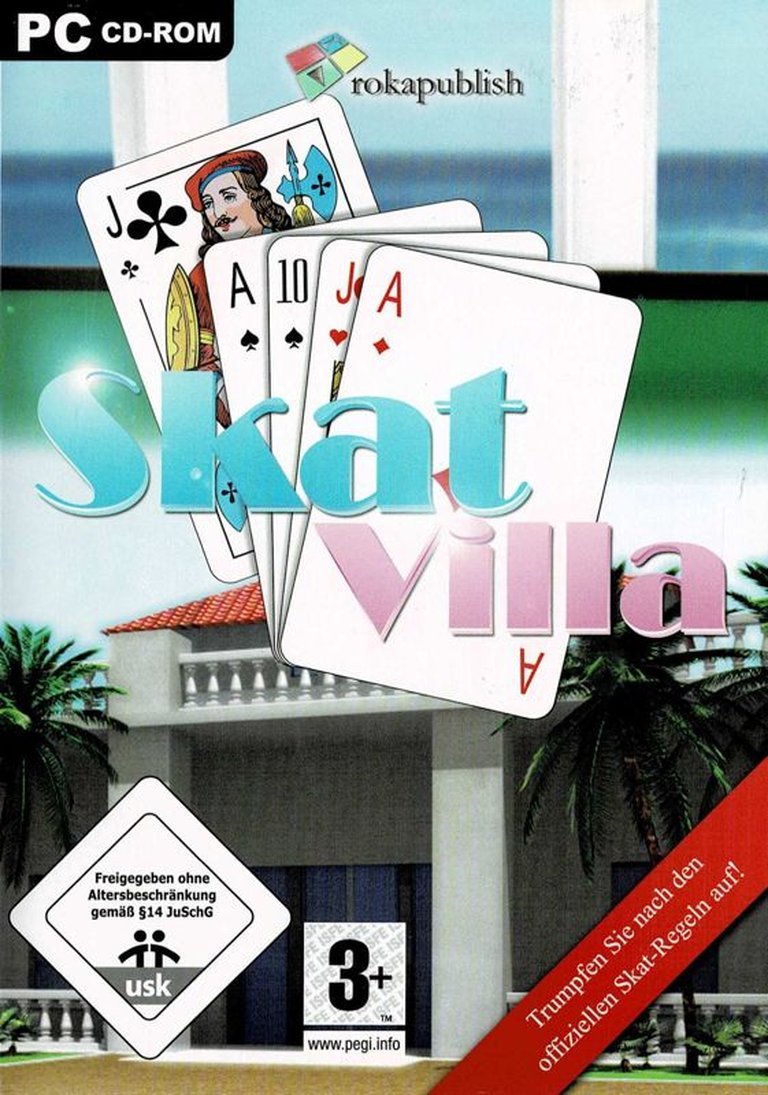
Skat Villa is a digital adaptation of the traditional German card game Skat, released in 2008 for Windows. The game adheres to official Skat rules and offers multiple difficulty levels to cater to both beginners and experienced players. Players can customize their experience with various background and table graphics, enhancing the visual appeal of the game. Designed with a top-down perspective and a point-and-select interface, Skat Villa provides a straightforward yet engaging card-playing experience for enthusiasts of the classic game.
Skat Villa Patches & Updates
Skat Villa: A Forgotten Gem or a Missed Opportunity?
Introduction
In the vast landscape of digital card games, Skat Villa (2008) stands as a curious artifact—a faithful adaptation of Germany’s beloved national card game, Skat, wrapped in a modest PC package. Developed by rokapublish GmbH and published alongside SYBEX-Verlag GmbH, this title arrived at a time when digital card games were still finding their footing outside of solitaire and poker. Yet, despite its niche appeal, Skat Villa remains an underdocumented relic, a game that neither soared to critical acclaim nor sank into obscurity but instead lingered in the quiet corners of gaming history.
This review seeks to unpack Skat Villa in its entirety—its development context, its mechanical fidelity to the source material, its reception, and its legacy. Was it a competent digital translation of a complex card game, or did it fail to capture the essence of a social, strategic pastime? And why, in an era where digital card games now dominate esports and casual play alike, does Skat Villa remain a footnote rather than a foundational text?
Development History & Context
The Studio and the Vision
rokapublish GmbH, the developer behind Skat Villa, was a German studio specializing in digital adaptations of traditional games, particularly card and board games. Their portfolio included titles like Skat! (1996) and Absolute Skat (2010), indicating a clear focus on serving the German-speaking market’s affinity for Skat. The game was released in 2008, a period when digital card games were transitioning from simple, rule-based simulations to more polished, accessible experiences.
The vision for Skat Villa was straightforward: create a digital environment where players could engage in Skat according to official rules, with adjustable difficulty levels and customizable aesthetics. Unlike more ambitious projects that sought to revolutionize the genre, Skat Villa was content to be a faithful, functional adaptation—a digital card table rather than a reinvention.
Technological Constraints and Design Choices
Released exclusively for Windows via CD-ROM, Skat Villa was constrained by the technological standards of its time. The game employed a top-down, fixed/flip-screen perspective, a common approach for card games of the era, which prioritized clarity over immersion. The point-and-select interface was intuitive but lacked the tactile feedback that modern digital card games now offer through animations and sound design.
One of the few areas where Skat Villa attempted to differentiate itself was in its visual customization. Players could select from various background and table graphics, a minor but appreciated touch that added a layer of personalization. However, the game’s lack of voice acting—a notable omission in an era where even budget titles often included basic audio cues—left the experience feeling sterile.
The Gaming Landscape in 2008
By 2008, the digital card game market was still in its infancy. Magic: The Gathering – Duels of the Planeswalkers (2009) had not yet arrived, and Hearthstone was half a decade away. Most digital card games were either:
– Rule-based simulators (e.g., Bridge Baron, Skat!),
– Casual collections (e.g., Microsoft Entertainment Pack’s card games), or
– Licensed adaptations (e.g., Uno, Monopoly).
Skat Villa fit squarely into the first category. It was not designed to compete with the emerging social gaming boom (e.g., Zynga Poker) but rather to serve as a solitary or AI-driven Skat experience for enthusiasts. Its commercial model was traditional—a one-time purchase CD-ROM—with no microtransactions, online multiplayer, or post-launch support, a stark contrast to the live-service models that would later dominate the genre.
Narrative & Thematic Deep Dive
The Absence of Narrative
Skat Villa is, at its core, a pure gameplay experience. There is no overarching story, no character arcs, and no lore. The game does not attempt to frame Skat within a fictional universe or attach any narrative significance to the player’s progress. Instead, it presents the card game as it is: a strategic, rule-bound contest between players (or in this case, the player and AI opponents).
This lack of narrative is not necessarily a flaw—many classic card games thrive without storytelling—but it does highlight Skat Villa’s utilitarian approach. The game’s only “story” is the implicit one of mastery: the player begins as a novice, adjusts the difficulty, and (ideally) improves their Skat skills over time.
Thematic Elements: The “Villa” Aesthetic
The game’s title, Skat Villa, suggests a social, almost luxurious setting—a place where players gather for a refined card game. The inclusion of customizable table and background graphics reinforces this theme, evoking the image of a cozy, upscale lounge where Skat is played among friends.
However, the execution of this theme is minimalist. There are no NPCs with distinct personalities, no ambient chatter, and no dynamic environments. The “Villa” is more of a static backdrop than a living space. This lack of atmospheric depth makes the game feel more like a rulebook with graphics than a true simulation of a Skat gathering.
Dialogue and Interaction
Given the game’s lack of voice acting, all interaction is text-based. The AI opponents do not engage in banter, trash talk, or even basic acknowledgment of the player’s moves. This absence of social simulation—a key element in real-world Skat—makes the experience feel mechanical rather than organic.
For a game that markets itself as a “cosy round of skat,” the lack of personality in the AI is a missed opportunity. Even simple lines like “Good hand!” or “You’re lucky today!” could have added life to the proceedings.
Gameplay Mechanics & Systems
Core Gameplay Loop
Skat Villa adheres strictly to the official rules of Skat, a three-player trick-taking game where two players form a temporary alliance against the third (the “declarer”). The game supports:
– Standard Skat rules (with or without “junk” variants),
– Adjustable difficulty levels (though reviews suggest these may not function as intended),
– Leaderboards and save slots for tracking progress.
The core loop is simple:
1. Select a difficulty level (easy, medium, hard).
2. Choose visual customization (table/background graphics).
3. Play a hand of Skat against two AI opponents.
4. Review results and adjust strategy for the next round.
Combat (or Lack Thereof)
Unlike action or strategy games, Skat Villa has no “combat” in the traditional sense. The conflict is purely strategic, revolving around:
– Bidding (determining who becomes the declarer),
– Card play (executing tricks based on suit dominance),
– Bluffing and prediction (anticipating opponents’ moves).
The AI’s behavior is the most critical factor in this dynamic. Unfortunately, as noted in Amazon customer reviews, the AI’s difficulty scaling is inconsistent. Players reported that opponents behaved similarly across all difficulty settings, often making beginner-level mistakes even on “hard” mode. This undermines the game’s replayability, as there is little incentive to increase the challenge.
Character Progression and UI
Skat Villa features no character progression in the traditional RPG sense. There are no unlockable decks, no skill trees, and no persistent upgrades. The closest thing to progression is the leaderboard, which tracks wins and losses—hardly a compelling motivator.
The UI is functional but unremarkable:
– Point-and-click card selection works well enough.
– No animations for card plays (cards simply appear/disappear).
– Minimal feedback for successful tricks or bids.
The manual included on the CD is a necessary crutch, as the game does not teach Skat rules to newcomers. This assumption of prior knowledge limits its accessibility.
Innovations and Flaws
Innovations:
– Customizable aesthetics (a rare feature in 2008 card games).
– Faithful rule implementation (appealing to purists).
Flaws:
– Poor AI scaling (difficulty settings feel identical).
– No tutorial or rule explanations (alienates beginners).
– No voice acting or ambient sound (lacks atmosphere).
– No online multiplayer (missed opportunity for social play).
World-Building, Art & Sound
Visual Design: A Static Villa
The game’s art direction is minimalist and functional. The “Villa” setting is conveyed through pre-rendered backgrounds—likely static images rather than dynamic environments. The card designs are standard German-suited Skat decks, with no unique artistic flair.
The table graphics are the only area where the game attempts visual variety, but even these are basic and uninspired. There is no sense of depth or immersion; the game feels like a 2D board rather than a lived-in space.
Sound Design: The Silence of the Villa
The most glaring omission in Skat Villa is its lack of meaningful audio:
– No voice lines for AI opponents.
– No ambient sounds (e.g., shuffling cards, background chatter).
– No dynamic music (likely just a looped track, if any).
This absence of auditory feedback makes the game feel sterile and lifeless. In a real Skat game, the social atmosphere—the clink of glasses, the murmur of conversation, the occasional groan over a bad hand—is half the experience. Skat Villa strips all of that away, leaving only the cold mechanics.
Reception & Legacy
Critical and Commercial Reception
Skat Villa received no formal critical reviews on platforms like Metacritic, and its MobyGames entry remains undocumented beyond basic details. The Amazon.de user reviews (averaging 1.5/5 stars) paint a harsh picture:
– 74% of reviewers gave it 1 star, citing poor AI, lack of features, and no meaningful difficulty curve.
– 26% gave it 3 stars, acknowledging it as a functional but unremarkable adaptation.
Common complaints included:
– “The AI plays like a beginner on all difficulties.” (Günther, 1-star review)
– “No voice acting, no Null Ouvert [a Skat variant], cards are too small.” (Dr. Ulf Krause, 3-star review)
– “A decent time-killer, but not a replacement for real Skat.” (dragonsoldier2k, 3-star review)
Commercially, the game was likely a niche product, selling primarily to German Skat enthusiasts rather than a broader audience. Its lack of post-launch support (no patches, no DLC) meant that any flaws present at release remained unaddressed.
Legacy: A Footnote in Digital Card Gaming
Skat Villa did not influence the broader card game genre. By the time digital CCGs (Collectible Card Games) like Hearthstone (2014) and Gwent (2018) arrived, Skat Villa was already forgotten. Its legacy is that of a faithful but flawed adaptation—one that served its immediate purpose but failed to evolve.
Later Skat games, such as Absolute Skat (2010), attempted to refine the formula, but none achieved mainstream success. The genre’s future lay in online multiplayer and social integration, areas where Skat Villa was completely absent.
Conclusion: A Missed Opportunity for a Classic Game
Skat Villa is a competent but uninspired adaptation of Germany’s national card game. It succeeds in faithfully replicating Skat’s rules but fails in almost every other aspect:
– Poor AI that doesn’t scale with difficulty.
– No tutorial or accessibility features for newcomers.
– Lack of atmosphere (no voice, no ambient sound, no dynamic environments).
– No online multiplayer, a critical omission in 2008.
For hardcore Skat players who already knew the rules and simply wanted a digital opponent, Skat Villa may have sufficed. But as a game—as an experience meant to entertain, challenge, and immerse—it falls short.
Final Verdict: 4/10 – A Functional but Forgettable Adaptation
Skat Villa is not a bad game, but it is a limited one. It serves as a digital rulebook with basic AI, little more. In an era where card games have evolved into social, competitive, and visually rich experiences, Skat Villa feels like a relic of a bygone time—one where digital adaptations were content to be functional rather than engaging.
For historians of digital card games, it is a curious artifact. For players seeking a true Skat experience, it is better to gather real friends around a real table.
Would you like additional sections on comparisons to modern Skat games or a deeper dive into Skat’s cultural significance in Germany? Let me know how to expand this review further!