
- Release Year: 2024
- Platforms: Luna, PlayStation 5, Windows, Xbox Series
- Publisher: Ubisoft Entertainment SA
- Developer: Ubisoft Singapore Pte Ltd.
- Genre: Action
- Perspective: Third-person
- Game Mode: Online Co-op, Online PVP, Single-player
- Gameplay: Crafting, Naval combat, Open World, Resource gathering, RPG elements, Sandbox, Ship Customization, Trade
- Setting: Africa, Asia, Caribbean, Sea pirates
- Average Score: 72/100
Description
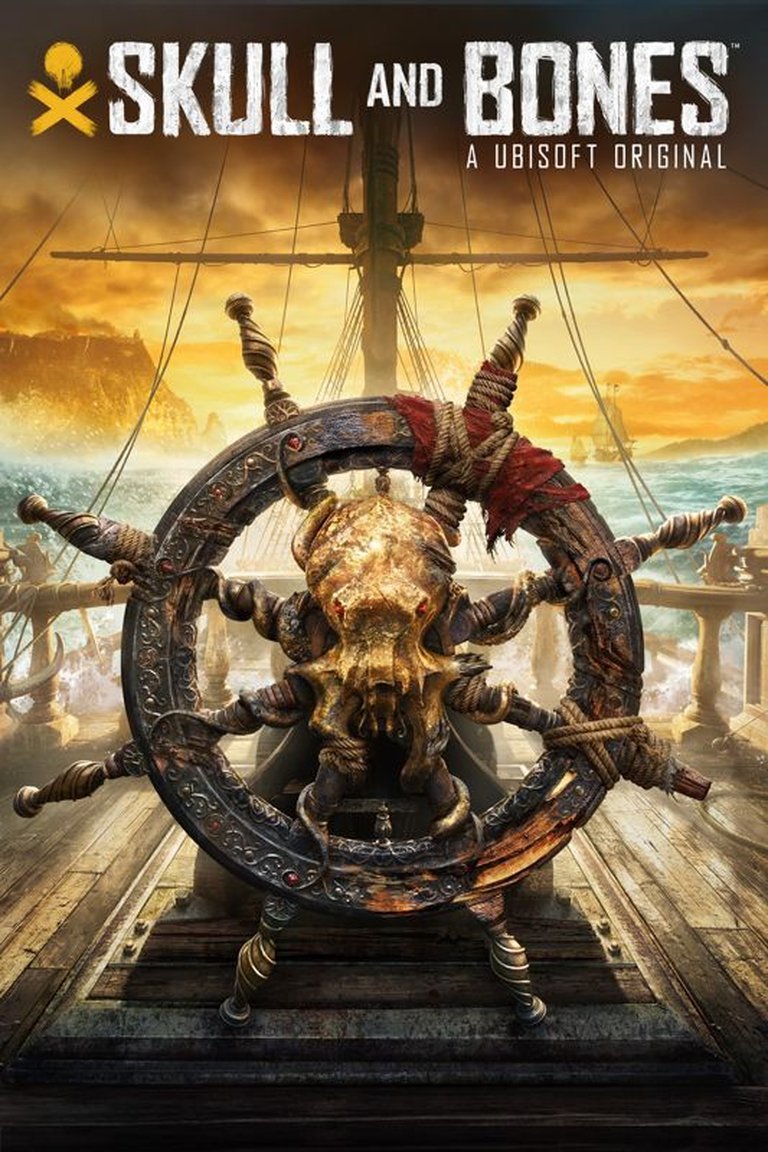
Skull and Bones is an action RPG set in a fantastical rendition of the late 17th-century Indian Ocean, spanning East Africa and Southeast Asia during the Golden Age of Piracy. Players command customizable pirate ships, engaging in strategic naval combat where wind positioning is key, while exploring an open world, completing missions like cargo deliveries and treasure hunts, and rising through the Infamy Rank in both single-player campaigns and multiplayer modes, including cooperative world events and PvP challenges.
Gameplay Videos
Where to Buy Skull and Bones
Skull and Bones Guides & Walkthroughs
Skull and Bones Reviews & Reception
metacritic.com (79/100): Skull and Bones is plainly a ‘pirate ship game’ more than it is about pirates.
ign.com : it’s already quite seaworthy.
bluntlyhonestreviews.com (80/100): Despite being delayed for over half a decade, Skull and Bones has finally set sail, and despite being not all that it could be, its honestly far better than most reviewers give it credit for.
opencritic.com (65/100): When a ten-year-old Assassin’s Creed game proves to be a superior pirate experience compared to an actual pirate game which Skull and Bones is on paper, that only raises questions about the true nature of the latter.
verticalslicegames.com (66/100): Skull and Bones feels like an online mode from Assassin’s Creed IV: Black Flag, but in a bad way. The sea battles are really fun at first and look really great, but unfortunately it remains a monotonous and dull grind.
Skull and Bones: A Shipwreck in Slow Motion – The Definitive Autopsy of Ubisoft’s Decade-Long Development Nightmare
Introduction: The Ghost Ship That Finally Docked
For over a decade, Skull and Bones existed more as a myth than a game—a spectral vessel haunting thedockyards of gaming discourse, whispered about in the same breath as Duke Nukem Forever and Cyberpunk 2077. Its name was a punchline, its delays a testament to industry hubris. When it finally crashed onto the shores of February 16, 2024, it was not with a triumphant crash of thunder, but with the pathetic, wet thud of a soggy cardboard box. This is not the pirate epic promised at E3 2017. It is not the “quadruple-A” (AAAA) titan its CEO heralded. It is, instead, a fascinating and deeply flawed case study in creative misdirection, institutional inertia, and the corrosive effect of live-service design on a singular fantasy. As a game born from the beloved naval combat of Assassin’s Creed IV: Black Flag, its ultimate failure to capture that magic—or indeed any coherent pirate fantasy at all—is not merely disappointing; it is a profound historical artifact of what happens when a project loses its soul long before it loses its budget.
Development History & Context: The Perfect Storm of Mismanagement
To understand Skull and Bones is to understand a development cycle unparalleled in its dysfunction. The story, meticulously documented by outlets like IGN and Kotaku, is one of catastrophic scope creep, leadership whiplash, and a studio ill-equipped for its own ambition.
The Genesis and Lost Identity (2013-2018): The project began not as an original IP, but as an expansion for Assassin’s Creed IV: Black Flag. When that concept proved too small, it morphed into Black Flag Infinite, an MMO spinoff. The vision was never stable. Early demos focused on a tactical 5v5 arena (“Loot Hunt”), then shifted to co-op ship takedowns. The setting leapt from the Caribbean to a mythical “Hyperborea” before settling on a fantastical Indian Ocean. Each pivot discarded valuable work and confused the team. “The particularity of Skull and Bones is that our entire world is a social hub,” explained Creative Director Elisabeth Pellen, but building such a seamless, systemic world proved a monumental challenge for a studio whose prior claim to fame was supporting other franchises.
The “New Vision” and the Reboot That Wasn’t (2019-2022): The arrival of veteran Ubisoft editor Elisabeth Pellen in 2019 was meant to be a salve. Her directive was simple: “How do you become a pirate?” Her answer—a survival-infused, live-service open world where players write their own story—was a genuine, if grandiose, vision. However, the team was never allowed to execute a true reboot. “We could not really reboot the game, because we could not run down the team. We had to continue,” Pellen admitted. With 500 developers on payroll (a number that swelled as other Ubisoft studios were co-opted), they had to graft this new vision onto a foundation of old code and abandoned prototypes. This is the core tragedy: they were building a new house on a rotting, mismatched foundation.
External Pressures and Toxic Culture: The delays were compounded by external forces. The mandatory jump to PlayStation 5 and Xbox Series X/S added significant time. More damning were the reports from Kotaku in 2021 detailing a toxic studio culture at Ubisoft Singapore, with management cited as a primary cause for the “reboots, rebrands and re-reboots.” The removal of Managing Director Hugues Ricour in 2020 following workplace misconduct investigations underscored the human cost. Furthermore, there were strong suggestions the studio was contractually obligated to launch an original title due to government subsidies, creating a “must-ship” scenario regardless of quality. The final 18 months were a frantic scramble to “double down on the things that are great,” as Senior Producer Neven Dravinski put it, but the damage to cohesion was done.
The Cost: The project is estimated to have cost $200 million. It suffered six public delays. Three creative directors departed. The game launched to a “Generally Unfavorable” user score on Metacritic (3.3/10 at time of writing) and underwhelming physical sales—a quarter of Sea of Thieves‘ UK launch, despite an 11-year head start. It is, by nearly all metrics, a commercial and critical failure.
Narrative & Thematic Deep Dive: The Pirate’s Empty Chest
A pirate game without a pirate story is an oxymoron. Skull and Bones commits this cardinal sin with breathtaking audacity.
A Story in Name Only: The “single-player campaign” is a skeletal framework. You are an anonymous, customizable captain. The narrative hinges on two NPCs: the crude Captain John Spurlock and the revolutionary Admiral Rahma. Each offers a handful of missions culminating in a boss fight against a ship, then vanishes. There is no character arc, no betrayal, no camaraderie, no motivation beyond “become infamous.” As IGN’s review starkly noted, the story is “a faintest whiff,” consisting of “a couple conversations” before skipping to the next task. Compare this to the narrative depth of Black Flag—with its intricate Assassin-Templar conflict, memorable characters like Adéwalé and Mary Read, and personal stakes for Edward Kenway—and the void is staggering.
Thematic Emptiness: The game’s central theme of “becoming a pirate kingpin” is conveyed solely through a progression bar (the Infamy Rank). The legendary, democratizing fantasy of piracy—”anyone could become a pirate” in Pellen’s words—is reduced to a grind for resources. The political intrigue of the Indian Ocean’s colonial powers, the moral ambiguity of the life, the sheer drama of the Golden Age—all are absent. The only “lore” is scattered, optional journal entries that feel like afterthoughts. The game’s world is a playground, not a living, breathing historical fantasy. This isn’t a sandbox; it’s an empty sandbox with a sign that says “Imagine Pirates Here.”
The Absence of the Self: The most glaring omission is the player character itself. You never控制 your pirate on foot outside of designated port spaces. There is no swordplay, no gunplay, no boarding actions (relegated to a cutscene or, in a late change, a grappling hook mini-game). You are a consciousness tethered to a ship’s wheel. The “pirate” is the vessel. This fundamental disconnect severs any emotional or thematic investment. As one critical user review on Metacritic astutely observed: “It feels like a game where you get to take on the role of a pirate ship, not a pirate.”
Gameplay Mechanics & Systems: A Briny, Repetitive Grind
The gameplay is a study in profound imbalance. What it does well, it does competently. What it neglects, it neglects entirely, creating a profoundly lopsided experience.
Naval Combat: The Sole Bright Star: The ship-to-ship combat is the undisputed highlight. It is tactical, weighty, and deeply satisfying. Wind positioning is not a gimmick but a core strategic layer. The weapon variety—broadside cannons, mortars, rockets, even healing guns—lends itself to meaningful buildcrafting. Tank, DPS, and support “archetypes” for ships have real impact in co-op engagements. Combat requires positioning, aim, and coordination. The feeling of landing a perfect broadside or a well-timed mortar strike is excellent. This system, salvaged from the early multiplayer prototypes, is the one legacy of the decade of work that genuinely works.
The Infamy Grind: A Hollow Core: Surrounding this solid combat is a parasitic live-service ecosystem. The core loop is: sail, fight, gather resources, craft/upgrade, repeat. The “Infamy” progression system is the primary driver, but it is a treadmill with no narrative reward. The world is populated by reskinned enemy ships (Company, Syndicate, Tribal factions) that serve no purpose other than to be sunk for resources. Mission types (cargo delivery, sink X ships, find treasure) are ubiquitously generic. The “investigation” missions are rudimentary detective work with no payoff. The game mistakes busywork for content.
The Live-Service Skeleton: Skull and Bones is live-service by design. It features a battle pass, premium currency, a store, and “seasons.” However, at launch, the endgame is anemic. There are a handful of “Kingpin” faction missions, but they are more of the same, just harder. The “Disputed Waters” PvP mode, requiring a treasure map to enter, feels disconnected and punitive. The systemic world reactions touted in early docs are minimal. The Skinner box is present but incredibly shallow—the rewards rarely justify the grind.
The Land-Based Void: The brief moments on land are anemic. You can only visit established ports, which function as social hubs and vendor markets. There is no independent exploration, no treasure hunt dungeons, no meaningful off-ship interaction. The removal of land combat and boarding (as criticized in almost every review) isn’t just a missing feature; it’s a negation of the pirate fantasy itself. As one user on the Fandom wiki quipped, it’s “More World of Warships than Black Flag.”
World-Building, Art & Sound: Beauty Without Soul
A Gorgeous, Empty Ocean: The one area of near-universal praise is the game’s aesthetic presentation. The Indian Ocean is stunning. The water technology is remarkable—waves crash realistically, storms are terrifyingly beautiful, and the sunset-lit vistas are breathtaking. The ship models are intricate and highly customizable, with a wide array of sails, hulls, figureheads, and weaponry that allow for significant personal expression. The art direction successfully differentiates regions (lush jungles, arid coasts, bustling ports) without ever feeling generic. This is a technically impressive and often beautiful sandbox.
A Hollowed-Out Hub: The beauty, however, only highlights the emptiness. The ports are visually distinct but functionally identical. The NPCs are poorly animated, with “dead eyes and robotic mouths,” as Travis Northup of IGN noted. The world lacks life. There are no bustling port towns to explore, no dynamic events that feel organic (beyond scripted world events that pop up), no sense of a living society beyond the factions you shoot at. It is a postcard without a letter inside.
Sound: A Missed Opportunity: The sound design is competent—cannons boom, wood splinters, waves crash—but unremarkable. The musical score, composed by Tom Holkenborg (Junkie XL), is serviceable but forgettable, lacking the iconic, adventurous themes of Black Flag‘s Brian Tyler. The decision to have a single, customizable “first mate” (Asnah) as a constant narrative guide, while a functional tutorial, further diminishes the world’s perceived population and your place within it.
Reception & Legacy: The Rightful Heir to Duke Nukem Forever
Skull and Bones did not launch to scathing reviews; it launched to a weary, resigned shrug. Its Metacritic scores sit in the “mixed or average” range (58-63), but the user score (3.3/10 on PS5) tells a harsher story. The critical consensus, reflected in the MobyGames aggregate of 56%, is shockingly consistent.
The Critical Verdict: Critics largely arrived at the same conclusion: excellent naval combat and deep ship customization are utterly hamstrung by a barren world, a nonexistent story, punishing repetition, and a live-service model that feels both cynical and underdeveloped. Phrases like “tedious grind,” “lifeless,” “shallow,” and “missed potential” appear in nearly every major review. The comparison to Assassin’s Creed IV: Black Flag—a 10-year-old game—is not just inevitable; it is damning and entirely fair. As GameSpot put it, the game “sinks amid boring busywork.” PC Gamer resented it, stating it “doesn’t compare favourably with the ten-year old game that inspired it.”
Commercial Underperformance: Sales data confirms the critical stance. Its UK boxed chart debut at #4 was notably weak, with physical sales less than a quarter of Sea of Thieves‘ 2018 launch. Player counts hovered under 1 million including free trials shortly after launch—a catastrophic figure for a game of this budget and scope. It is, by all accounts, a commercial disappointment that will struggle to break even.
Cultural Legacy: A Cautionary Tale: The legacy of Skull and Bones is not one of influence, but of caution. It will be studied in game design and business courses as a textbook example of:
1. The Perils of Feature Creep & Directionless Reboots: A project that couldn’t decide what it was for nine years.
2. The Live-Service Straitjacket: How the mandate to be a “games-as-a-service” product strangles a single-player fantasy and forces content to be stretched thin over a grind-based progression model.
3. The “AAAA” Fallacy: The danger of conflating budget and marketing hype with quality. Ubisoft’s insistence on the “AAAA” label, while charging a $70 full price for a live-service title, was a PR disaster that amplified player resentment.
4. Studio Mismanagement: The human cost of pushing a large support studio into leading a flagship project without the culture or leadership to sustain it.
It is the spiritual successor to Duke Nukem Forever in the 2020s—a game whose development became its defining story, and whose final product is a monument to wasted potential.
Conclusion: A Voyage That Shouldn’t Have Set Sail
Skull and Bones is not an actively bad game. Its naval combat is genuinely good. Its ship customization is satisfyingly deep. Sailing its pretty seas can be a pleasant, if unremarkable, time. But for a project with this history, this budget, and these ambitions, “pleasant” is a catastrophic failure. It promised the pirate fantasy of a lifetime and delivered a functional but soulless maritime vehicle simulator.
The tragedy is in what was lost. The passionate team at Ubisoft Singapore clearly has a talent for naval mechanics and world-building scale. But that talent was squandered by a development process that shipwrecked the narrative, the character, the very fantasy of piracy. You do not feel like a rogue, a rebel, a king of the seas. You feel like a delivery driver in a boat, grinding for Infamy points to buy a slightly bigger cannon.
In the grand canon of pirate games, Skull and Bones will not stand beside Sid Meier’s Pirates! or Assassin’s Creed IV: Black Flag. It will not be remembered for its innovation or its story. It will be remembered as the game that took a beloved formula, spent a decade and $200 million on it, and somehow emerged with less soul than its 11-year-old inspiration. It is a ghost ship, not of the high seas, but of a bygone era of game development—one where vision was continually drowned out by indecision, toxicity, and the bottomless greed of the live-service model. Its place in history is secure: as the most expensive, most delayed, and most profoundly unsatisfying pirate game ever made. A true sovereign of the seven seas of disappointment.