
- Release Year: 1996
- Platforms: Macintosh, Windows 16-bit, Windows
- Publisher: GTE Entertainment
- Developer: Cyberflix Incorporated
- Genre: Action
- Perspective: Side view
- Game Mode: Single-player
- Gameplay: Arcade, Fighting, Platform
- Setting: Horror
- Average Score: 38/100
Description
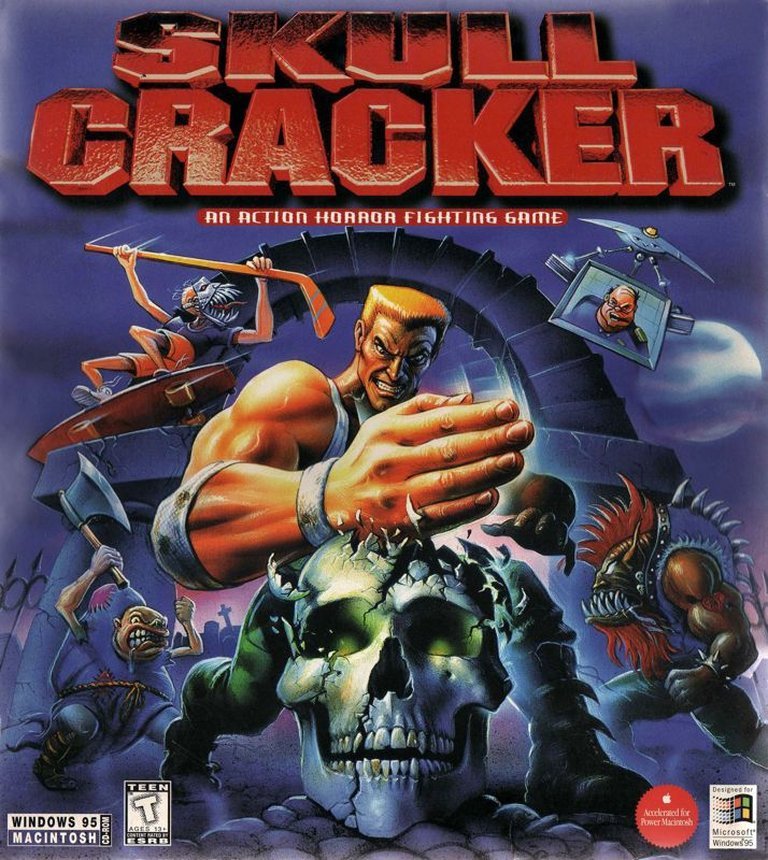
Skull Cracker is a side-scrolling arcade brawler set in an alternate world where monsters and zombies are commonplace, kept in check by the organization MEI (Mortality Enforcement, Inc.). When a mysterious substance called Goop mutates the creatures, they rise up to demand civil rights, forcing MEI to enlist freelancers Mortis ‘The Skullcracker’ Rigor and Penelope ‘Bonebreaker’ Jones to restore order. Players choose between the two characters, each with unique fighting styles, battling through 16 levels across locations like a graveyard, arcade, and MEI headquarters. Combat combines punches, kicks, and power-ups like holy-water supersoakers, while navigating hazards and replenishing health with pick-ups.
Gameplay Videos
Skull Cracker Free Download
Skull Cracker Reviews & Reception
mobygames.com (38/100): Average score: 38% (based on 2 ratings)
Skull Cracker Cheats & Codes
PC
Enter one of the following codes during gameplay.
| Code | Effect |
|---|---|
| bewitch | 5 lives |
| cthia | Level skip / Go to next level |
| eshs | Full ammo / More ammo |
| harakari | Suicide / Kill self |
| jetson’ | Additional time / More time |
| marsupial | Restore health / Add health |
| zip’ | Next checkpoint / Go to next milestone |
Skull Cracker: A Cautionary Tale of Ambition out of Time
Introduction
In the crypt of mid-90s gaming misfires, Skull Cracker (1996) remains a fascinating fossil—a once-promising beat-em-up by Cyberflix (creators of Titanic: Adventure Out of Time and Dust: A Tale of the Wired West) that arrived years too late, its bones brittle with outdated design. This review posits that Skull Cracker embodies both the creative ambition and perilous hubris of its era: a game conceptually ahead of its time in satirical storytelling, yet undone by archaic technology, clumsy execution, and a market that had moved on.
Development History & Context
A Studio at a Crossroads
Developed by Knoxville-based Cyberflix and published by GTE Entertainment, Skull Cracker began life as a passion project in 1994 but languished in development hell. Conceived as a spiritual successor to Bill Appleton’s 1991 Mac title Creepy Castle, it was demoed at the 1994 Summer CES but shelved as Cyberflix prioritized narrative-driven hits like Dust (1995) and Titanic (1996). By the time it released in late 1996, it was already a relic.
Technological Obsolescence
Built for 1994 hardware, Skull Cracker’s 256-color VGA sprites and 640×480 resolution felt antiquated against contemporaries like Killer Instinct (1994) or Street Fighter Alpha (1995). Director Rand Cabus later admitted the team used pre-rendered CGI sequences to mask technical limitations—a trademark Cyberflix flourish (see Titanic’s FMV)—but this backfired. GameSpot derided its “poor animation” and “bad art,” while the MacLedge review noted, “[It] should have come out a year and a half before it did” (Cyberflix head Scott Scheinbaum, 1999).
Narrative & Thematic Deep Dive
B-Movie Social Commentary
Set in a world where zombies and monsters demand civil rights (only to be corrupted by a mutagenic ooze called Goop), Skull Cracker follows freelancers Mortis “Skullcracker” Rigor (a trenchcoat-clad bruiser) and Penelope “Bonebreaker” Jones (a nimble acrobat) as agents of MEI (Mortality Enforcement, Inc.). The plot satirizes conformity, corporate greed, and token inclusivity—MEI weaponizes holy water supersoakers against zombified revolutionaries—but lacks tonal coherence. Writer Mark Cabus blends They Live-style satire with slapstick, yet dialogue (“Goop’s turning them into… things!”) leans into unintentional camp.
Characterization as Afterthought
Mortis and Penelope lack depth beyond archetypes, their “distinct fighting styles” (per the manual) undermined by identical plot outcomes. Voice acting oscillates between shrill (Carol Goans’ Penelope) and lifeless, draining urgency from what could have been a Men in Black-meets-Evil Dead romp.
Gameplay Mechanics & Systems
A Broken Combat Loop
Skull Cracker’s core is a side-scrolling beat-em-up with platforming elements. Players battle hordes across 16 levels (a mall, graveyard, MEI HQ), using punches, kicks, climbing, and power-ups (flare guns, flamethrowers, holy water). Theoretically novel, its mechanics falter in practice:
– Stiff Controls: Mortis moves like “a tank stuck in molasses” (GameSpot), while Penelope’s agility is hampered by floaty jumps.
– Combat Shallowness: Enemy AI relies on swarm tactics, lacking pattern diversity. Hit detection is inconsistent—roundhouse kicks often phase through foes.
– Power-Up Bloat: Weapons like the supersoaker feel underpowered, requiring excessive use against damage-sponge bosses.
Progression & UI Woes
Health pickups (fast food, inexplicably) respawn infinitely, trivializing difficulty. The UI’s tiny health bar and cluttered HUD obscure critical info during chaotic scenes. Worse, progress isn’t saved between levels on the original Win3.x release—a baffling oversight.
World-Building, Art & Sound
Uneven Aesthetic Vision
Art director Eric Whited fused 1950s monster tropes (vampires in leisure suits, atomic-age mutants) with grungy ’90s urban decay. While cutscenes boast stylized pre-rendered backdrops (a cyber-gothic MEI HQ stands out), in-game sprites are pixelated and repetitive. The manual’s cover art (Mortis crushing a zombie skull) promises horror-comedy the game never visually delivers.
Sound Design: A Lone Bright Spot
Composer Scott Scheinbaum’s soundtrack mixes surf-rock riffs with MIDI horror stings, evoking The Munsters meets DOOM. Sadly, this charm is undone by tinny sound effects (slapstick “bonks” for punches) and grating enemy vocal loops.
Reception & Legacy
Critical Dismissal
Skull Cracker bombed critically, earning a 38% aggregate score (GameSpot’s 1.6/10 deemed it “landfill-worthy”; MacLedge was kinder at 6/10). Players rated it 1.9/5, citing “repetitive,” “uninspired” design. Its commercial failure contributed to GTE Interactive’s exit from gaming by 1997.
A Legacy of Mismanaged Potential
While forgotten by mainstream audiences, Skull Cracker endures as a cautionary tale:
– Cultural Artifact: Its civil rights allegory predates Shadows Over Loathing or Disco Elysium but lacks nuance.
– Tech Time Capsule: A relic of CD-ROM-era “multimedia bloat,” prioritizing FMVs over gameplay polish.
– Studio Impact: Cyberflix pivoted back to narrative adventures (Redjack: Revenge of the Brethren) but folded in 2000.
Conclusion
Skull Cracker is neither timeless classic nor so-bad-it’s-good curio—it’s a tragically misaligned product of its moment. Its satire of institutional hypocrisy remains prescient, and Scheinbaum’s score hints at unfulfilled greatness, but its archaic systems, rushed execution, and belated launch doomed it. For historians, it exemplifies how even talented studios (Cyberflix had just released Titanic) can falter when ambition outpaces technological reality. Verdict: A fascinating footnote, best remembered for what it could have been, not what it was.
Final Rating: 2/5
(Notable only as a case study in developmental hubris and mid-90s tonal dissonance.)