
- Release Year: 1995
- Platforms: DOS, Linux, Macintosh, Windows
- Publisher: Blue Moon Red Owl, Funbox Media Ltd., Gremlin Interactive Limited, Kingstill International Software Services Ltd., U.S. Gold Ltd., ZOO Digital Publishing Ltd.
- Developer: Software Refinery, Ltd., The
- Genre: Action, Driving, Racing
- Perspective: 1st-person
- Game Mode: Hotseat, Single-player
- Gameplay: Aviation, Flight, Shooter, Upgrades, Vehicular combat, Vehicular, Weapons
- Setting: City – Chicago, City – London, Country – France, Country – Norway, Europe, Futuristic, Hawaiian, North America, Sci-fi
- Average Score: 68/100
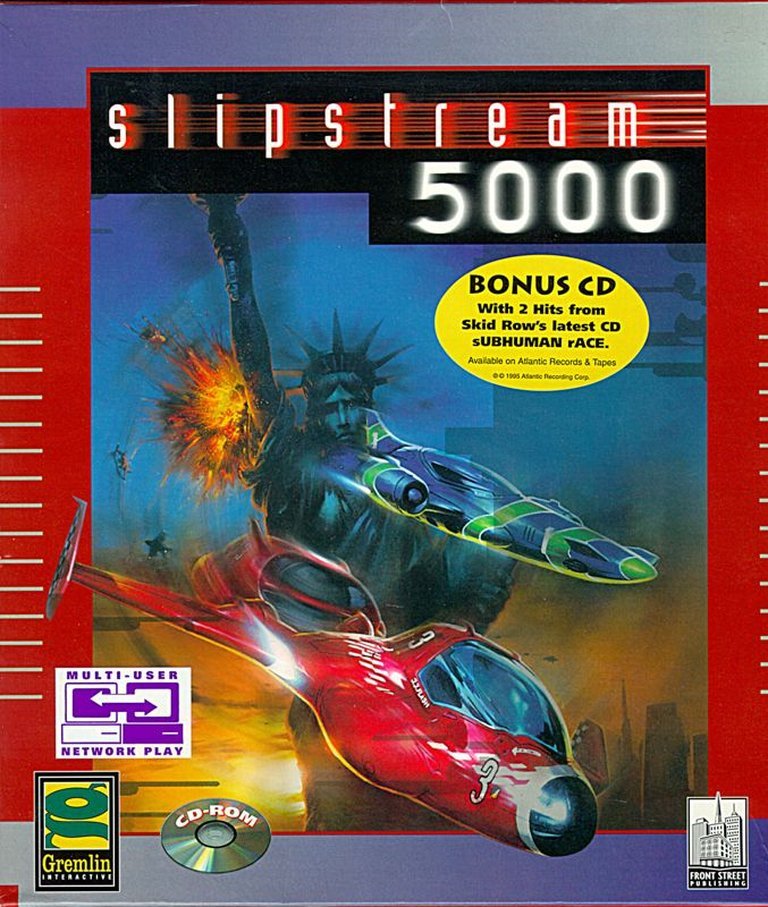
Description
Slipstream 5000 is a futuristic racing game set in a sci-fi world where players pilot high-speed, flying vehicles through intricate courses across global locations like Chicago, London, and Hawaii. The game blends fast-paced vehicular combat with strategic gameplay, allowing players to collect weapons and power-ups to hinder opponents while navigating through outdoor and indoor tracks filled with obstacles. With a variety of customizable racers, each with unique strengths and weaknesses, players can compete in individual races or championships, all rendered in the distinctive 3D graphics of the mid-1990s.
Gameplay Videos
Where to Buy Slipstream 5000
Slipstream 5000 Free Download
Slipstream 5000 Guides & Walkthroughs
Slipstream 5000 Reviews & Reception
en.wikipedia.org (89/100): A triumphant return to form for the series.
mobygames.com (76/100): Excellent game. Needs DOS based computer.
gamesreviews2010.com : Slipstream 5000 is a classic racing game that is still fun to play today.
forceforgood.co.uk (40/100): Slipstream 5000 really appealed to me when it first came out.
Slipstream 5000 Cheats & Codes
PC
Enter codes at the main menu.
| Code | Effect |
|---|---|
| REFINERY | Unlocks all tracks and grants extra money |
| refinerz | Unlocks all tracks and grants extra money |
Slipstream 5000: A Futuristic Racing Gem Lost in Time
Introduction
In the mid-1990s, the gaming landscape was a battleground of innovation and repetition. Amidst a sea of sequels and iterative upgrades, Slipstream 5000 emerged as a breath of fresh air—a futuristic racing game that dared to blend high-speed competition with vehicular combat, all wrapped in a visually striking 3D package. Developed by The Software Refinery and published by Gremlin Interactive, Slipstream 5000 was a bold experiment in merging the adrenaline of racing with the tactical depth of combat. Yet, despite its critical acclaim and technical prowess, it remains an underappreciated relic of its era, overshadowed by the rise of console racing giants like Wipeout and F-Zero.
This review aims to dissect Slipstream 5000 in exhaustive detail, exploring its development, gameplay mechanics, narrative nuances, and lasting legacy. Through a lens of historical context and modern retrospect, we’ll examine why this game was both a triumph of its time and a missed opportunity for the future of racing games.
Development History & Context
The Studio and the Vision
The Software Refinery, the studio behind Slipstream 5000, was a relatively small but ambitious developer based in the UK. Known for titles like Normality and Retribution, the studio had a knack for blending technical innovation with accessible gameplay. Slipstream 5000 was their foray into the racing genre, but with a twist: it wasn’t just about speed—it was about strategy, combat, and immersion.
The game’s development coincided with a pivotal moment in PC gaming. The mid-1990s saw the transition from 2D sprites to 3D polygons, and Slipstream 5000 was one of the early adopters of this shift. The team leveraged the power of DOS-based systems to create a fully 3D-rendered racing experience, complete with textured environments and dynamic lighting—a feat that was still novel in 1995.
Technological Constraints and Innovations
The game was built to run on mid-range PCs of the era, which meant balancing visual fidelity with performance. The developers opted for a software-rendered 3D engine, which, while not as smooth as hardware-accelerated solutions, allowed for a broader audience to experience the game without needing high-end graphics cards. This decision was both a strength and a limitation: the game’s visuals were impressive for the time but lacked the polish of later 3D-accelerated titles.
One of the most notable technical achievements of Slipstream 5000 was its support for early 3D stereoscopic glasses, specifically the LCDBIOS-based models. This feature, though niche, offered players an immersive experience that was ahead of its time. The game’s compatibility with these glasses was a testament to the developers’ forward-thinking approach, even if the technology itself was short-lived.
The Gaming Landscape of 1995
The mid-1990s were a golden age for racing games, but the market was dominated by console exclusives. Wipeout on the PlayStation and F-Zero on the SNES had set the standard for futuristic racing, leaving PC gamers with fewer options. Slipstream 5000 filled this gap, offering a PC-exclusive experience that rivaled its console counterparts in both speed and style.
However, the game’s release was met with stiff competition. The rise of 3D accelerators like the 3dfx Voodoo meant that games with hardware-accelerated graphics were beginning to overshadow software-rendered titles. Slipstream 5000, while technically impressive, was quickly eclipsed by games that could leverage these new technologies.
Narrative & Thematic Deep Dive
Plot and Setting
Slipstream 5000 is set in a near-futuristic world where traditional motor racing has been replaced by high-speed, anti-gravity craft races. The game’s premise is simple: players take on the role of a pilot competing in a global championship, racing through a variety of tracks set in iconic locations like Chicago, London, and the Grand Canyon. The narrative is minimal, focusing instead on the spectacle of the races themselves.
The game’s setting is a blend of sci-fi and realism. The tracks are designed to feel like real-world locations, albeit with a futuristic twist. For example, the Chicago track weaves through skyscrapers, while the London track takes players through a mix of urban and natural landscapes. This grounding in reality gives the game a sense of familiarity, even as it embraces its sci-fi elements.
Characters and Dialogue
One of the more controversial aspects of Slipstream 5000 is its cast of pilots, each representing a different nationality or stereotype. The game’s attempt at humor through exaggerated accents and personalities has not aged well, with some characters veering into offensive territory. For example, the German pilot, Horst, is a stereotypical “ubermensch,” while the Native American pilot, Shaman, leans heavily into clichés.
The dialogue, delivered via voiceovers, is similarly hit-or-miss. The commentators, Lyall Mint and Crystal Eyes, provide a running commentary during races, but their lines often feel forced or cringeworthy. The game’s attempt at humor and personality, while ambitious, ultimately detracts from the experience for modern players.
Themes and Underlying Messages
At its core, Slipstream 5000 is about competition and innovation. The game’s futuristic setting reflects a world where technology has pushed the boundaries of what’s possible, mirroring the real-world advancements in gaming technology at the time. The emphasis on upgrading and customizing your craft also speaks to the idea of progress—players are constantly striving to improve, much like the developers themselves were pushing the limits of what PC gaming could achieve.
However, the game’s themes are largely overshadowed by its gameplay. The lack of a deeper narrative or character development means that Slipstream 5000 is more about the experience of racing than any underlying message. This isn’t necessarily a flaw—many racing games of the era focused solely on gameplay—but it does mean that the game’s thematic depth is limited.
Gameplay Mechanics & Systems
Core Gameplay Loop
Slipstream 5000 is, at its heart, a racing game with combat elements. Players compete in races across a variety of tracks, aiming to finish first while also battling opponents with weapons and power-ups. The core gameplay loop revolves around three main modes:
- Single Race: A quick, one-off race on any unlocked track.
- Time Trial: A mode for practicing and setting record times.
- Championship: A series of races where players compete for the overall title, unlocking new tracks and upgrades as they progress.
The championship mode is the most substantial, offering a sense of progression and reward. Players earn money based on their performance, which can be used to upgrade their craft with better weapons, engines, and handling.
Combat and Weapons
What sets Slipstream 5000 apart from other racing games of its era is its combat system. During races, players can pick up weapons from drones or power-ups scattered across the track. These weapons range from simple blasters to more devastating attacks like mines and homing missiles. The combat adds a layer of strategy to the races, as players must decide when to attack opponents and when to focus on speed.
However, the combat system is not without its flaws. The AI opponents are aggressive and often target the player exclusively, which can feel unfair. Additionally, the weapons themselves are somewhat imbalanced—some are nearly useless, while others can completely disrupt a race.
Vehicle Customization and Upgrades
One of the game’s strongest features is its upgrade system. Players can customize their craft with a variety of upgrades, including:
- Engines: Improve top speed and acceleration.
- Handling: Enhance maneuverability and control.
- Weapons: Unlock new offensive and defensive options.
- Armor: Increase durability against attacks.
The upgrade system adds a sense of progression and personalization, allowing players to tailor their craft to their preferred playstyle. However, the upgrades can feel somewhat superficial, as the differences between them are not always noticeable during races.
Controls and Handling
The controls in Slipstream 5000 are straightforward but require precision. Players use the arrow keys to steer and the spacebar to accelerate. The game also supports joystick controls, which were a popular option at the time. The handling of the craft is responsive but can feel somewhat floaty, especially in open tracks where the sense of speed is less pronounced.
One notable omission is the lack of a brake function. While the game’s commentators and opponents occasionally reference braking, the player’s craft can only slow down by reducing throttle. This design choice simplifies the controls but also limits the tactical depth of the racing.
Multiplayer and Replayability
Slipstream 5000 includes a split-screen multiplayer mode, allowing two players to race head-to-head. This feature was a significant selling point at the time, as multiplayer racing games were still relatively rare on PC. The multiplayer mode is competitive and fun, though it suffers from the same AI and combat issues as the single-player mode.
The game’s replayability is somewhat limited by its lack of depth. While the championship mode offers a sense of progression, the tracks and opponents can become repetitive after a few playthroughs. The absence of a deeper narrative or more varied gameplay modes means that Slipstream 5000 is best enjoyed in short bursts rather than extended sessions.
World-Building, Art & Sound
Visual Design and Atmosphere
Slipstream 5000’s visual design is a mix of futuristic and grounded elements. The tracks are set in real-world locations but feature sci-fi touches like anti-gravity craft and high-tech obstacles. The game’s use of 3D graphics was impressive for 1995, with textured environments and dynamic lighting that gave the tracks a sense of depth and realism.
However, the visuals have not aged well. The textures are blocky, and the craft models are simplistic by modern standards. The game’s attempt at realism is also undermined by its limited draw distance, which can make tracks feel claustrophobic.
Sound Design and Music
The sound design in Slipstream 5000 is a mixed bag. The engine sounds and weapon effects are serviceable, but the voice acting is often cringeworthy. The commentators, in particular, deliver lines with an over-the-top enthusiasm that feels forced. The game’s music, composed by Chris Adams and Neil Biggin, is energetic and fits the high-speed racing theme, but it lacks the memorability of other racing game soundtracks of the era.
Atmosphere and Immersion
Despite its flaws, Slipstream 5000 manages to create a sense of immersion through its combination of speed, combat, and futuristic setting. The game’s tracks are designed to feel like real-world locations, and the sense of speed—while not always consistent—can be thrilling, especially in tight tunnels or urban environments.
The game’s support for 3D stereoscopic glasses also added to its immersive potential, though this feature was niche and short-lived. For players who experienced it, however, it was a standout feature that set Slipstream 5000 apart from its contemporaries.
Reception & Legacy
Critical Reception
Slipstream 5000 was generally well-received by critics upon its release. Publications like PC Gamer and Computer and Video Games praised its innovative blend of racing and combat, as well as its technical achievements. The game’s 3D graphics and smooth controls were highlighted as standout features, though some critics noted its repetitive gameplay and lack of depth.
However, the game’s reception was not universally positive. Some reviewers criticized its short length and lack of replayability, as well as its overly aggressive AI. The game’s attempt at humor through stereotypical characters also drew criticism, even at the time of its release.
Commercial Performance
Despite its critical acclaim, Slipstream 5000 did not achieve significant commercial success. The game’s release coincided with the rise of console racing games, which offered more polished experiences with hardware-accelerated graphics. Additionally, the PC gaming market was becoming increasingly competitive, with titles like Quake and Command & Conquer dominating the landscape.
Legacy and Influence
Slipstream 5000’s legacy is one of missed potential. The game’s blend of racing and combat was innovative for its time, and its technical achievements were impressive. However, its lack of depth and repetitive gameplay prevented it from becoming a classic.
The game’s influence can be seen in later racing titles that incorporated combat elements, such as Wipeout and F-Zero X. However, Slipstream 5000 itself remains a footnote in gaming history, remembered more for its ambition than its execution.
Conclusion
Slipstream 5000 is a fascinating artifact of its time—a game that dared to innovate in a genre dominated by console exclusives. Its blend of high-speed racing and combat was ahead of its time, and its technical achievements were impressive for 1995. However, its lack of depth, repetitive gameplay, and dated visuals have relegated it to the status of a cult classic rather than a mainstream success.
For modern players, Slipstream 5000 is a curiosity—a glimpse into a moment when PC gaming was pushing the boundaries of what was possible. It’s a game that deserves to be remembered, if not for its flaws, then for its ambition. If you’re a fan of retro gaming or futuristic racing, Slipstream 5000 is worth experiencing, if only to appreciate how far the genre has come.
Final Verdict: 7.5/10 – A bold experiment that ultimately falls short of greatness but remains a fascinating relic of its era.