
- Release Year: 2015
- Platforms: Macintosh, Windows
- Publisher: Big Fish Games, Inc., Viva Media, LLC
- Developer: Gunnar Games, Inc.
- Genre: Adventure
- Perspective: First-person
- Game Mode: Single-player
- Gameplay: Puzzle elements
- Setting: Futuristic, Sci-fi
- Average Score: 83/100
Description
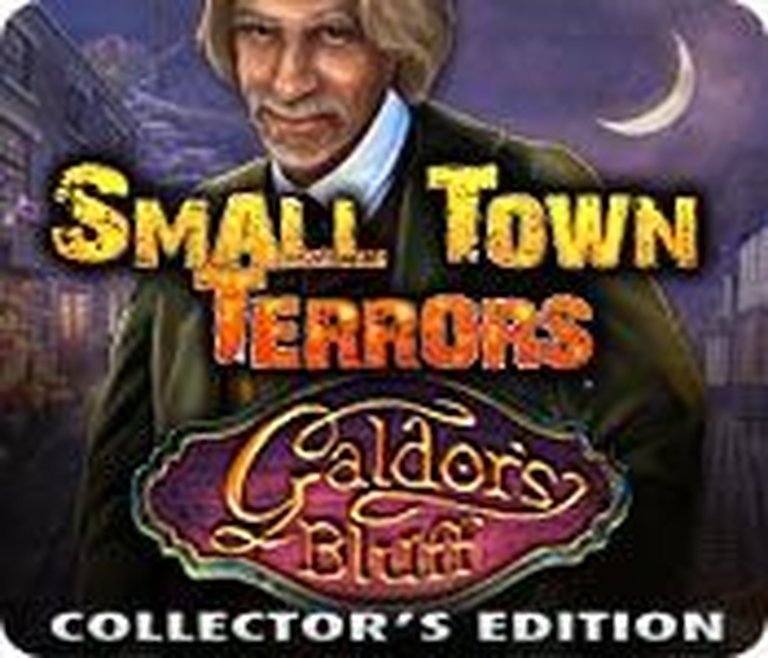
Set in the enigmatic town of Galdor’s Bluff, this adventure game immerses players in a tale of deception and illusion as they investigate the bitter rivalry between two magicians: The Magnificent Thurman and his nemesis, Roger Addington. Players will explore hand-drawn environments, solve intricate puzzles, and uncover dark secrets in this mysterious and supernatural investigation.
Gameplay Videos
Where to Buy Small Town Terrors: Galdor’s Bluff (Collector’s Edition)
PC
Small Town Terrors: Galdor’s Bluff (Collector’s Edition) Guides & Walkthroughs
Small Town Terrors: Galdor’s Bluff (Collector’s Edition) Cheats & Codes
PC
Enter the following codes by typing the numbers and pressing ‘Enter’.
| Code | Effect |
|---|---|
| 8, 6, 11 | add 500 points to your account. |
| 7, 6, 11 | take you to the next level. |
| 5, 9, 8 | unlock extra content for you to enjoy at the end of the game. |
Small Town Terrors: Galdor’s Bluff (Collector’s Edition): Review
Introduction
In the shadowed corners of interactive narrative gaming, where mystery and macabre intersect, Small Town Terrors: Galdor’s Bluff (Collector’s Edition) emerges as a curious artifact of the hidden-object adventure (HOA) genre. Released in 2015 by Gunnar Games and reissued on Steam in 2021, this title invites players into a meticulously crafted theater of deception—a small town where the line between illusion and murder blurs. As the third entry in the “Small Town Terrors” series, it builds on a legacy of atmospheric whodunits, yet stands apart through its focus on competitive magic and pyrotechnical intrigue. This review argues that while Galdor’s Bluff adheres rigidly to the HOA formula, its thematic depth and technical execution elevate it beyond mere genre fare. It is a testament to the enduring appeal of point-and-click detective work, albeit one constrained by the conventions of its time and market.
Development History & Context
Gunnar Games—a studio specializing in casual, story-driven games—developed Galdor’s Bluff under the creative direction of Jamie Nye, Andres Restrepo, and Scott Nixon. Their vision was clear: to transport players into a world where stagecraft becomes a lethal art form. The game emerged in 2015, an era dominated by the casual gaming ecosystem. Platforms like Big Fish Games and Steam’s nascent indie scene provided fertile ground for HOAs, which thrived on accessibility and narrative immersion. Technologically, Galdor’s Bluff operated within modest constraints: its 2D hand-drawn environments and DirectX-compatible graphics prioritized stability over spectacle, aligning with the genre’s ethos of broad compatibility (minimum specs required a mere 1.2 GHz processor and 256 MB RAM).
The 2015 release landscape was a period of transition. While AAA games chased photorealism, casual titles like Galdor’s Bluff embraced stylized artistry and puzzle-driven narratives. Its publisher, Big Fish Games, capitalized on this niche, distributing it as a premium “Collector’s Edition” with extras like bonus chapters and solitaire games—a marketing staple for the time. The 2021 Steam re-release, handled directly by Gunnar Games, underscored the game’s longevity, proving its appeal survived the shift toward digital storefronts. Notably, the studio’s credits listed 65 contributors, including voice talents like Erin Fitzgerald (Final Fantasy XIII) and Joe Abbati for sound design, reflecting a production scope ambitious for a mid-budget HOA.
Narrative & Thematic Deep Dive
At its core, Galdor’s Bluff is a noir-infused mystery wrapped in a magician’s cape. Players assume the role of an unnamed detective summoned to Galdor’s Bluff to oversee the career-defining performance of Thurman the Magnificent, a pyrotechnical illusionist haunted by sabotage. When Thurman perishes mid-trick—consumed by flames during his “Master of Flames” act—the town erupts into suspicion. The narrative hinges on a duality of illusion and truth: is Thurman’s death a tragic accident, the work of his rival Roger Addington, or a conspiracy orchestrated by a shadowy third party?
The plot unfolds through linear chapters, each revealing layers of backstory. The bonus chapter exclusively in the Collector’s Edition deepens the rivalry between Thurman and Addington, exposing a history of professional jealousy and stolen secrets. Dialogue, though sparse, leans into archetypal noir tropes: Thurman’s paranoia (“Watch for anyone suspicious”), Addington’s smug retorts (“Thurman always played with fire”), and the detective’s internal monologue weaving clues into a cohesive tapestry. Thematically, the game explores the fragility of reputation and the cost of obsession. Thurman’s obsession with perfection mirrors the player’s meticulous hunt for clues, while Addington’s resentment embodies the danger of unchecked ambition. The recurring motif of “playing with fire” serves as both literal (pyrotechnics) and metaphorical (retribution) warning, elevating the story beyond a simple whodunit into a cautionary tale about artistry’s dark underbelly.
Gameplay Mechanics & Systems
As a quintessential HOA, Galdor’s Bluff revolves around three core loops: hidden-object scenes, puzzle-solving, and environmental investigation.
Hidden-Object Scenes & Morphing Objects
The game features over 50 meticulously crafted hidden-object scenes, where players scour cluttered locations (e.g., Thurman’s dressing room, the theater backstage) for items. A standout innovation is the inclusion of morphing objects—static images that subtly transform into required items, adding dynamism to the genre’s static formula. For instance, a candle might melt into a wax seal, or a poster’s tear reconfigures into a key. These scenes are skippable, replaced by pyramid solitaire (a card-matching minigame), catering to players frustrated by HOA monotony.
Puzzle Design & Mini-Games
Puzzles are thematically integrated, mirroring the game’s circus-magic setting. Players decode mechanical contraptions (e.g., fixing a projector to reveal hidden clues), solve symbol-based riddles (deciphering Thurman’s spellbook), and navigate logic puzzles (rearranging props to recreate an illusion). Mini-games include pattern-matching sequences and circuit-board repairs, each offering escalating difficulty. While none are revolutionary, their consistency with the narrative—like reassembling a broken flame prop—preserves immersion.
Character Progression & UI
Progression is non-linear, driven by inventory-based exploration. Players collect keys, notes, and magical artifacts to unlock new areas. The UI is minimalist, with a bottom toolbar for inventory, hints, and a built-in strategy guide—a staple of Collector’s Editions. Hints recharge slowly, encouraging critical thinking. The game accommodates accessibility options, including adjustable text size and the ability to skip complex puzzles, though the lack of a difficulty slider limits challenge for veterans.
Combat & Systems
Combat is notably absent, aligning with the HOA genre’s emphasis on intellect over action. However, the game incorporates a “sabotage investigation” system: players analyze crime scenes for inconsistencies (e.g., misplaced wires or altered machinery), indirectly engaging with forensic logic. This subtle mechanic reinforces the detective theme without disrupting the puzzle-centric flow.
World-Building, Art & Sound
Galdor’s Bluff is a character in itself—a fictional town steeped in circus nostalgia and gothic undertones. The setting evokes a bygone era of vaudeville, with a grand theater, dusty archives, and a carnival grounds serving as primary locations. This contrasts with the series’ prior entries (e.g., the nautical Livingston), offering a fresh yet cohesive universe.
Art Direction
The 2D hand-drawn art prioritizes atmospheric storytelling. Environments are rich in detail: velvet curtains in the theater fray at the edges, Thurman’s workshop overflows with arcane tools, and carnival posters advertise illusory wonders. Color palettes shift tonally—warm golds and reds during performances give way to cold blues in crime scenes, visually reinforcing the “magic vs. murder” duality. Character designs are expressive; Thurman’s flamboyant attire and Addington’s sneer convey personality without exposition.
Sound Design
Joe Abbati’s original score blends circus calliopes with ominous strings, heightening tension during investigations. Sound effects amplify immersion: the hiss of gas flames, the click of a lock, or the distant laughter of crowds. Voice acting, led by Erin Fitzgerald (Thurman) and Joey Camen (Addington), delivers performances that balance theatricality with gravitas. Notably, the pyrotechnical sound design during the climax creates auditory chaos, mirroring the visual spectacle of Thurman’s demise.
Atmosphere
The game excels in dread-building, using lighting (shadows cast by props) and environmental storytelling (a torn poster hinting at past tragedies) to sustain unease. Even the solitaire minigames adopt a circus theme, with card decks featuring magicians and jesters, ensuring cohesion.
Reception & Legacy
At Launch (2015):
Galdor’s Bluff arrived amidst a crowded HOA market. While MobyGames records no professional reviews, player feedback on platforms like Big Fish Games was lukewarm, praising the art and puzzles but criticizing formulaic gameplay. Its average player score of 3.7/5 (based on two ratings) reflected its niche appeal. Commercially, it performed modestly, bolstered by the “Small Town Terrors” brand and Collector’s Edition extras.
Post-2015 Evolution:
The 2021 Steam re-release garnered 6 user reviews, with 5 positive and 1 negative. Positive remarks highlighted the “engaging mystery” and “gorgeous art,” while detractors cited “predictable puzzles.” Critically, it remains overlooked outside HOA circles, yet its inclusion in bundles like the “Small Town Terrors Mega Pack” attests to its enduring presence.
Legacy and Influence:
Galdor’s Bluff solidified Gunnar Games’ reputation for polished, narrative-driven HOAs. Thematically, it expanded the series beyond generic horror into meta-commentary on performance, influencing later titles like Lost Legends: The Weeping Woman (which also blends magic with mystery). Its innovation—morphing objects and solitaire alternatives—became a blueprint for HOAs seeking player flexibility. However, it did not revolutionize the genre, instead exemplifying its strengths and limitations.
Conclusion
Small Town Terrors: Galdor’s Bluff (Collector’s Edition) is a paragon of its genre: technically proficient, narratively rich, and visually arresting, yet bound by the conventions of hidden-object adventure gameplay. Its exploration of ambition and deception resonates beyond its puzzle-driven framework, offering a surprisingly poignant character study in Thurman and Addington. While it lacks the innovation of landmark titles (e.g., The Black Mirror), it delivers a cohesive experience where artistry and interactivity align. For enthusiasts of atmospheric mysteries, it remains a worthy entry in the “Small Town Terrors” saga—a spectral encore in the grand theater of interactive storytelling. As a historical artifact, it encapsulates the HOA genre’s peak: a time when hand-drawn worlds and cerebral challenges could captivate a dedicated audience, even amidst the roar of AAA blockbusters. Verdict: A meticulously crafted, if formulaic, journey into the heart of illusion’s darkness—essential for fans of the genre, but unlikely to convert skeptics.