
- Release Year: 2002
- Platforms: Windows
- Developer: Blackpencil Entertainment AG
- Genre: Action, Educational
- Perspective: Top-down
- Game Mode: Single-player
- Gameplay: Arcade, Health, Non-violent, nutrition, Shooter
- Setting: Anti-smoking campaign, Office
- Average Score: 79/100
Description
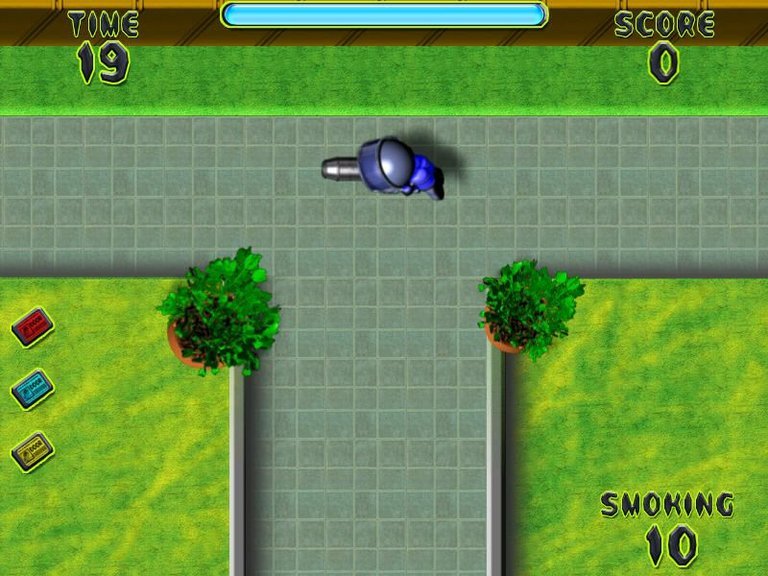
Smoke Attack is a top-down shooter game developed for the Swiss government’s anti-smoking campaign. Players control a character armed with an oxygen gun, battling against aggressive smoking balls that represent cigarettes. The goal is to progress through levels, collecting extra ammunition, secret weapons, and hidden keys while transforming the smoking balls into oxygen. The game is designed to be non-violent and educational, focusing on health and nutrition themes.
Gameplay Videos
Smoke Attack Free Download
PC
Smoke Attack Cracks & Fixes
Smoke Attack Reviews & Reception
myabandonware.com (90/100): Once again, thumbs up for a Phenomedia for this fun underdog.
Smoke Attack: Review
Introduction
In 2002, amid blockbuster titles like Grand Theft Auto III and Dungeon Siege, a peculiar top-down shooter emerged from Switzerland with an unlikely agenda: discouraging smoking. Smoke Attack, developed by Blackpencil Entertainment AG and commissioned by the Swiss Federal Office of Public Health, represents gaming’s intersection with public service—a rare example of a state-funded “ad-game” designed to entertain while delivering a health message. Though overshadowed by commercial giants, Smoke Attack became a cult curiosity, blending crisp aesthetics, arcade-inspired action, and a non-violent twist on shooter mechanics. This review examines its legacy as both a creative anti-smoking tool and a piece of early 2000s gaming ephemera, arguing that its cultural significance outweighs its simplistic design.
Development History & Context
A Public Health Experiment in Gaming
Blackpencil Entertainment AG, a subsidiary of Phenomedia (known for the Moorhuhn Jagd series), specialized in promotional games that balanced advertising with playability. Smoke Attack was part of Switzerland’s broader anti-smoking campaign, reflecting a growing trend of “serious games” in the early 2000s. With a modest budget and clear didactic goals, the team aimed to create an engaging experience that avoided the heavy-handedness typical of educational software.
Technological Constraints
Built for Windows PCs, Smoke Attack operated at 800×600 resolution—standard for its era—and used 2D sprites with detailed animations. Its lightweight design (a mere 6MB download) made it accessible, though critics noted occasional level-design claustrophobia, such as narrow corridors that bottlenecked gameplay.
The 2002 Gaming Landscape
In a year dominated by open-world innovation (GTA III) and RPG depth (Dungeon Siege), Smoke Attack occupied a niche as freeware. Its release capitalized on the rise of downloadable casual games, catering to audiences seeking quick, coffee-break diversions rather than epic narratives.
Narrative & Thematic Deep Dive
A Tale of Oxygen vs. Nicotine
The plot is minimalist: Players control “Oxy,” a wide-eyed protagonist armed with an oxygen gun, tasked with purging smoking balls and cigarettes across office complexes and abstract environments. The lack of dialogue or character arcs reinforces its utilitarian purpose, but the premise—turning enemies into oxygen—subverts traditional shooter violence.
Themes: Health as Heroism
Smoke Attack reframes heroism as public health advocacy. By “saving” smoking entities (rendered as cartoonish orbs with cigarettes) through oxygenation, it recasts defeat as rehabilitation. This non-violent approach aligns with its anti-smoking message, though some critics dismissed the narrative as overly simplistic, calling it “moralistic but harmless” (Hrej!, 2005).
Gameplay Mechanics & Systems
Core Loop: Purge and Progress
The gameplay is classic arcade shooter fare: navigate top-down levels, collect keys, unlock doors, and eliminate waves of “smoking balls.” Power-ups like secret weapons and speed boosts add variety, while hidden keys encourage exploration. Combat lacks depth—players hold down the fire button and strafe—but the satisfying poof of enemies transforming into oxygen lends novelty.
Innovations and Flaws
The oxygen mechanic distinguishes Smoke Attack from peers, but repetition sets in quickly. Critics praised its “higher-than-average difficulty” (Freegame.cz) but lamented uneven pacing, with cramped level design occasionally causing frustration. The UI is minimalist, prioritizing readability over flair, and the lack of multiplayer or procedural elements limits replayability.
World-Building, Art & Sound
A Chromatic Assault on the Senses
Smoke Attack’s visual identity is its strongest asset. Bright, cartoonish sprites and fluid animations—reminiscent of Phenomedia’s Moorhuhn Jagd—pop against stark backgrounds. Office settings are rendered with playful absurdity, from floating cigarettes to abstract smoke clouds.
Sound Design: Whimsy with a Message
The soundtrack blends upbeat electronic tracks with whimsical sound effects, like the cheerful splat of defeated enemies. While hardly groundbreaking, the audio complements the game’s lighthearted tone, masking its didactic intent.
Reception & Legacy
Mixed Reviews, Niche Appeal
Critics awarded Smoke Attack an average score of 68%, praising its “perfect graphics and excellent playability” (PlnéHry.cz) while criticizing repetitive gameplay. Player reviews were sparser but polarized—some lauded its charm (“a wonderful game,” MyAbandonware), while others dismissed it as shallow.
Influence on Ad-Games
Though not a commercial hit, Smoke Attack exemplifies the potential of ad-games to merge marketing and play. Its legacy lies in inspiring later health-focused titles and proving that even government-funded projects could achieve cult status. Sequels like Smoke Attack Vol. 2 XL (2003) extended its lifespan, while modern indie games (Smoke and Sacrifice) echo its quirky aesthetic.
Conclusion
Smoke Attack is a paradoxical artifact: a game designed to preach, yet charming enough to entertain. Its strengths—vibrant visuals, inventive premise, and earnest messaging—are tempered by repetitive design and narrow scope. While hardly a masterpiece, it remains a fascinating relic of early 2000s gaming experimentalism, bridging public health and pixelated action. For historians, it’s a case study in “serious games”; for players, a nostalgic curiosity. In the pantheon of anti-smoking media, Smoke Attack earns its place—not as a revolution, but as a whimsical footnote.
Final Verdict: A flawed but fascinating time capsule, Smoke Attack is worth revisiting as a testament to gaming’s untapped potential as a public service tool.