
- Release Year: 2006
- Platforms: PlayStation 2, PSP, Windows
- Publisher: Namco Bandai Games America Inc.
- Developer: Smart Bomb Interactive, Inc.
- Genre: Action
- Perspective: Third-person
- Game Mode: Single-player
- Gameplay: Aviation, Flight, Shooter, Vehicular
- Setting: Fantasy, World War I
- Average Score: 75/100
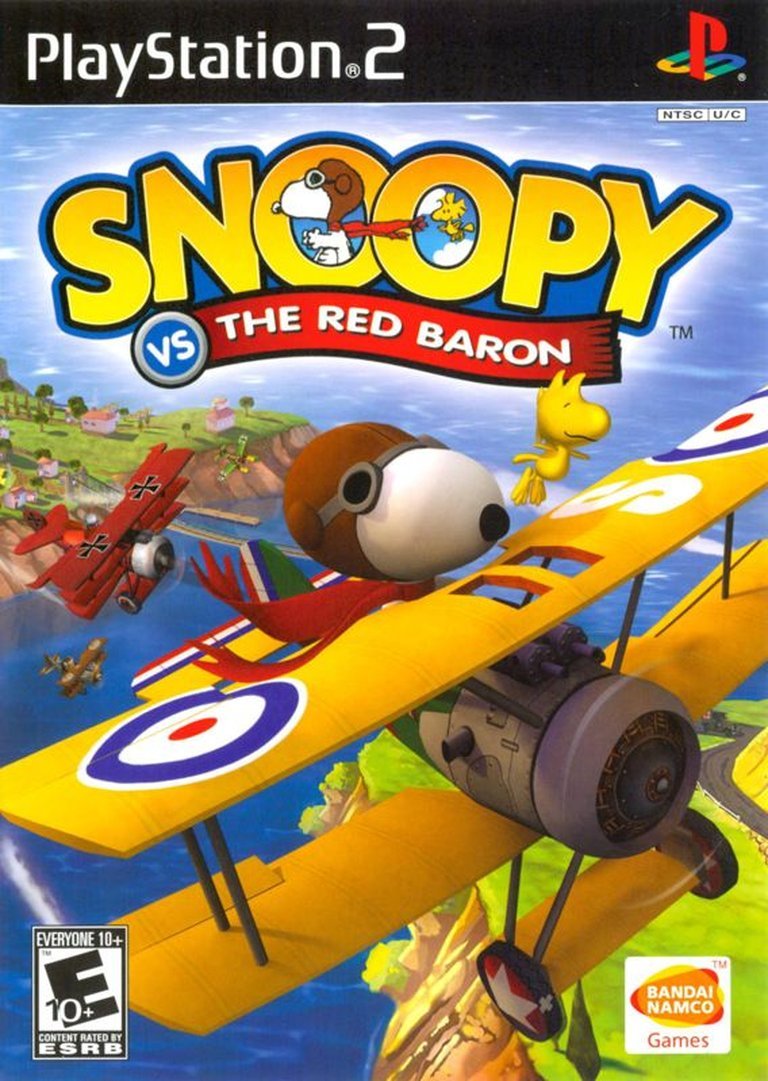
Description
In ‘Snoopy vs. the Red Baron’, players step into Snoopy’s dream as the ‘World Famous WWI Flying Ace’, where he and Woodstock embark on a mission to rescue Charlie Brown and recover stolen secret weapon plans from the Red Baron. Set in a whimsical, arcade-style flight combat world, the game features iconic Peanuts characters like Lucy as the Allied commander and Linus as an intelligence officer, blending humor with aerial dogfights, races, and exploration across seven WWI-inspired locations. With forgiving controls for younger players and advanced maneuvers for seasoned gamers, the game includes boss battles, upgrades, and a hub world in Charlie Brown’s neighborhood, all wrapped in the nostalgic charm of classic Peanuts holiday specials.
Gameplay Videos
Snoopy vs. the Red Baron Free Download
Snoopy vs. the Red Baron Cracks & Fixes
Snoopy vs. the Red Baron Guides & Walkthroughs
Snoopy vs. the Red Baron Reviews & Reception
metacritic.com (80/100): It has solid gameplay, a good presentation and a nice ranking system that makes you want to replay levels.
ign.com (70/100): The story pitting Snoopy against the Red Baron and his Flying Circus is an engaging one, and the missions are varied enough to keep your interest.
gamesreviews2010.com (75/100): Snoopy vs. The Red Baron is a charming and accessible game that’s sure to please fans of the Peanuts comic strip and WWI aviation history.
Snoopy vs. the Red Baron Cheats & Codes
PlayStation 2 (PS2) – Action Replay MAX Codes (US)
These codes require Action Replay MAX. Master Code must be on.
| Code | Effect |
|---|---|
| H6JH-PH4A-2T52N | Master Code – Must Be On |
| QW7C-KUF2-00C7J | Master Code – Must Be On |
| VT5Z-2AQF-0Q0Y1 | Infinite Funds |
| GTZ5-GRNA-PRKMU | Infinite Funds |
| QT16-VNKN-J5ARE | Infinite Turbo |
| 0WQ1-YCHD-0DN6G | Infinite Turbo |
| RWVW-Z30M-B7TB4 | Level 4 Health-Sopwith |
| U0MQ-JR32-PRC67 | Level 4 Health-Sopwith |
| KZMK-CYYN-44RN2 | Level 4 Stunts-Sopwith |
| BF0G-KJDG-1NJZ0 | Level 4 Stunts-Sopwith |
| V41E-FV6K-MBZ9Q | Level 4 Machine Gun-Sopwith |
| WUQG-NA5J-9D7MX | Level 4 Machine Gun-Sopwith |
PlayStation 2 (PS2) – CodeBreaker Codes (NTSC-U)
Enable Code (Must Be On) is required for other codes to work.
| Code | Effect |
|---|---|
| B4336FA9 4DFEFB79 | Enable Code (Must Be On) |
| D1A7A8F5 7D962C7F | Enable Code (Must Be On) |
| 9694D106 7B4B6175 | Enable Code (Must Be On) |
| AE3236ED 345F1DA4 | Enable Code (Must Be On) |
| 183CBBD1 9510B91B | Infinite Ammo |
| BBF48022 0EAF314D | Infinite Stunt Meter |
| 59E37649 C842B29B | Max Piggy Bank |
| 784C397A 83FBB625 | Max Health Upgrade |
| 205A1455 B319CBE0 | Max Machine Gun Upgrade |
| 129349BB 876A0421 | Max Stunt Upgrade |
| 8700D8F3 787C295B | Unlock All Characters |
| 4F8FFFF9 41E2CFBC | Unlock All Weapons |
| 3BA9C921 56A397EA | Infinite Lives |
| 6032D0C7 6436E6BC | Infinite Health |
| 5149B46C 198670E8 | Infinite Health |
Snoopy vs. the Red Baron: A Whimsical Dogfight Through History and Nostalgia
Introduction
In the pantheon of licensed games, few properties carry the weight of cultural nostalgia and universal appeal as Peanuts. Charles M. Schulz’s timeless comic strip, with its cast of endearing misfits and philosophical children, has transcended generations, embedding itself into the fabric of American pop culture. Among its most iconic recurring gags is Snoopy’s imaginative alter ego: the “World Famous WWI Flying Ace,” perched atop his doghouse-turned-Sopwith Camel, locked in an eternal aerial duel with the infamous Red Baron. Snoopy vs. the Red Baron, released in 2006 by Smart Bomb Interactive and published by Namco Bandai, is a rare and ambitious attempt to translate this whimsical fantasy into an interactive experience. It is a game that exists at the intersection of childhood reverie, historical fiction, and arcade-style flight combat—a delicate balance that few licensed titles dare to attempt, let alone achieve with any measure of success.
At its core, Snoopy vs. the Red Baron is a love letter to the Peanuts franchise, a playful reimagining of World War I aerial combat through the lens of a beagle’s daydream. It is a game that refuses to take itself too seriously, yet it is meticulously crafted to honor the spirit of Schulz’s work. The result is a title that is as much a celebration of imagination as it is a functional flight combat game. But does it soar as high as Snoopy’s fantasies, or does it crash and burn like one of Charlie Brown’s ill-fated kites? This review will dissect the game’s development, narrative, gameplay, aesthetics, reception, and legacy to determine its place in the annals of gaming history.
Development History & Context
The Studio and the Vision
Smart Bomb Interactive, the developer behind Snoopy vs. the Red Baron, was a relatively small studio with a portfolio that included titles like Pac-Man World Rally and Bee Movie Game. While not a household name, the studio demonstrated a knack for adapting licensed properties into accessible, family-friendly experiences. For Snoopy vs. the Red Baron, the team was tasked with a unique challenge: translating the abstract, often wordless humor of Peanuts into a cohesive, interactive narrative. The game’s executive producer, Pierre Roux, and producer Benjamin Cole, sought to create a title that would appeal to both longtime Peanuts fans and younger audiences unfamiliar with the source material.
The vision was clear from the outset: Snoopy vs. the Red Baron would not be a grim, realistic portrayal of World War I. Instead, it would embrace the fanciful, almost surreal tone of Snoopy’s imaginative adventures. The game’s art direction, soundtrack, and even its flight mechanics were designed to evoke the lightheartedness of the Peanuts holiday specials, which had been a staple of American television since the 1960s. The developers drew inspiration from classic arcade flight games like Star Fox and Crimson Skies, as well as the Peanuts comic strips themselves, where Snoopy’s dogfights were often depicted with a mix of humor and childlike wonder.
Technological Constraints and Design Choices
Released in 2006, Snoopy vs. the Red Baron arrived at a time when the gaming industry was in the midst of a generational shift. The PlayStation 2, though nearing the end of its lifecycle, remained a dominant platform, while the PSP was still finding its footing as a portable powerhouse. The PC, meanwhile, was a fragmented landscape of varying hardware capabilities. Smart Bomb Interactive faced the challenge of creating a game that would run smoothly across all three platforms while maintaining a consistent experience.
The flight model in Snoopy vs. the Red Baron was deliberately designed to be accessible. Unlike hardcore flight simulators, which often require a steep learning curve and precise control schemes, the game’s mechanics were simplified to accommodate younger players. The controls were forgiving, with collision detection that errs on the side of leniency. Advanced maneuvers, such as barrel rolls and Immelmann turns, were included but were not essential for progression, ensuring that the game remained approachable for its target audience.
The game’s technical limitations are evident in its visual presentation. While the character models and environments are colorful and vibrant, they lack the polish and detail of contemporary titles. Textures are often repetitive, and the draw distance is limited, particularly in the more expansive levels. However, these limitations are mitigated by the game’s art style, which leans heavily into the cartoonish aesthetic of the Peanuts comics. The result is a game that feels less like a technical showcase and more like an interactive storybook.
The Gaming Landscape of 2006
The mid-2000s were a peculiar time for licensed games. The market was saturated with titles tied to blockbuster films, many of which were rushed to release with little regard for quality. Snoopy vs. the Red Baron arrived in this environment as a refreshing anomaly. It was not tied to a major motion picture or a fleeting pop culture trend; instead, it drew from a property with decades of cultural relevance. The Peanuts franchise, though not as commercially dominant as it once was, still held a special place in the hearts of many, particularly those who had grown up with the comic strips and television specials.
The game’s release in October 2006 positioned it as a potential holiday season title, a time when family-friendly games often found success. Competitors in the flight combat genre were scarce, with most aerial combat games skewing toward either hyper-realistic simulations or over-the-top arcade shooters. Snoopy vs. the Red Baron occupied a unique niche: a lighthearted, accessible flight game that didn’t require a deep understanding of aviation mechanics or a tolerance for gratuitous violence.
Narrative & Thematic Deep Dive
The Plot: A Dream Within a Dream
Snoopy vs. the Red Baron begins with a simple yet effective framing device: Snoopy, the ever-dreaming beagle, is asleep atop his doghouse. As the player takes control, they are transported into Snoopy’s subconscious, where his alter ego as the “World Famous WWI Flying Ace” takes center stage. The game’s narrative is presented as a manuscript written by Snoopy himself, a meta-fictional touch that aligns perfectly with the character’s literary aspirations in the original comics.
The story unfolds across six distinct “worlds,” each representing a different theater of Snoopy’s imaginative war. The narrative is straightforward but engaging, with the Peanuts gang cast in various roles within the Allied forces. Lucy Van Pelt, ever the authoritative figure, serves as the commander of the Allied forces, barking orders with her signature bossiness. Linus and Sally take on the roles of intelligence officers, providing strategic support and comic relief. Charlie Brown, in a stroke of tragicomic genius, is relegated to the role of a janitor—a perfect encapsulation of his perpetual bad luck.
The inciting incident of the plot is the kidnapping of Charlie Brown by the Red Baron’s minions, who also steal the plans for a devastating weapon known as the “Doodlebug Bomb.” This sets Snoopy and his trusty co-pilot, Woodstock, on a mission to rescue Charlie Brown and thwart the Red Baron’s plans. The narrative is punctuated by pre-rendered cutscenes that mimic the visual style of the Peanuts holiday specials, complete with the iconic jazz soundtrack and voice acting that captures the essence of the characters.
Themes: Imagination, Camaraderie, and the Absurdity of War
At its heart, Snoopy vs. the Red Baron is a celebration of imagination. The game’s narrative is a testament to the power of fantasy as a coping mechanism, a way for Snoopy—and by extension, the player—to escape the mundanity of everyday life. The game’s setting, a whimsical interpretation of World War I, is a far cry from the grim realities of historical warfare. Instead, it is a playground where Snoopy can engage in daring dogfights, outmaneuver villainous foes, and save the day—all from the comfort of his doghouse.
The theme of camaraderie is equally prominent. The Peanuts gang, despite their individual quirks and flaws, come together as a cohesive unit to support Snoopy in his mission. Lucy’s leadership, Linus’s intelligence, Marcie’s technical expertise, and even Charlie Brown’s unwitting involvement all contribute to the Allied effort. This sense of unity is reinforced by the game’s multiplayer modes, which allow players to team up and engage in cooperative dogfights.
Perhaps the most intriguing theme in Snoopy vs. the Red Baron is its subversion of the traditional war narrative. The game’s tone is decidedly lighthearted, with an emphasis on humor and adventure rather than the horrors of combat. Enemies are defeated with a variety of absurd weapons, from pumpkin cannons to water balloon launchers, and defeated pilots eject with parachutes rather than meeting a gruesome end. This approach reflects the game’s status as a product of Snoopy’s imagination, where war is not a brutal conflict but a grand, heroic adventure.
Characters: Faithful Adaptations with a Twist
The game’s cast is a who’s who of the Peanuts universe, with each character faithfully adapted to fit the WWI setting. Snoopy, of course, is the protagonist, embodying his Flying Ace persona with gusto. Woodstock serves as his co-pilot and mechanic, adding a touch of humor and pathos to the proceedings. The supporting cast is equally well-realized:
- Lucy Van Pelt: As the commander of the Allied forces, Lucy’s bossy, no-nonsense personality is on full display. Her dialogue is peppered with her signature catchphrases, and her interactions with the other characters are a highlight of the game’s narrative.
- Linus Van Pelt: Cast as an intelligence officer, Linus provides strategic support and occasional comic relief. His reliance on his security blanket is subtly referenced, adding a layer of depth to his character.
- Charlie Brown: Poor Charlie Brown is once again the butt of the joke, cast as a janitor who is kidnapped by the Red Baron. His role in the story is largely passive, but his presence serves as a reminder of the game’s roots in the Peanuts comics.
- Marcie: As the head scientist and flight school instructor, Marcie’s bookish intelligence is put to good use. Her interactions with Peppermint Patty, whom she addresses as “Sir,” are a delightful nod to their dynamic in the original comics.
- Peppermint Patty: A bomber pilot with a penchant for action, Peppermint Patty’s role is relatively minor but memorable. Her catchphrase, “This one’s for Chuck,” is a touching reference to her friendship with Charlie Brown.
- Schroeder and Pig-Pen: These characters make brief appearances, with Schroeder serving as a PT boat captain and Pig-Pen running the in-game shop. Their inclusion is a nice touch, though their roles are largely peripheral.
The Red Baron, the game’s primary antagonist, is portrayed as a formidable but ultimately honorable foe. His interactions with Snoopy are laced with mutual respect, culminating in a final duel where he acknowledges Snoopy as a “worthy opponent.” This portrayal aligns with the game’s lighthearted tone, where even the villain is more of a rival than a true threat.
Gameplay Mechanics & Systems
Core Gameplay Loop: Aerial Combat and Exploration
Snoopy vs. the Red Baron is, at its core, a third-person flight combat game. The player takes on the role of Snoopy, piloting his Sopwith Camel through a variety of missions that include dogfights, bombing runs, escort missions, and aerial races. The game’s flight model is designed to be accessible, with controls that are easy to pick up but offer enough depth to keep experienced players engaged.
The primary weapon in Snoopy’s arsenal is his machine gun, which has unlimited ammunition but limited effectiveness against tougher enemies. To supplement this, the game features a variety of special weapons that can be unlocked by collecting balloons scattered throughout the levels. These weapons range from the conventional (homing missiles, bombs) to the absurd (pumpkin cannons, water balloon launchers, bee swarms). Each weapon has its own unique properties, encouraging players to experiment and find the loadout that best suits their playstyle.
The game’s missions are varied and well-paced, with each world introducing new challenges and objectives. Early missions focus on basic flight and combat mechanics, while later levels introduce more complex scenarios, such as multi-stage boss fights and time-sensitive objectives. The game’s difficulty curve is gentle, making it accessible to younger players, though some of the later missions can be challenging even for experienced gamers.
Progression and Upgrades
Progression in Snoopy vs. the Red Baron is tied to the completion of missions and the collection of in-game currency. Players can spend their earnings at Pig-Pen’s Shop, where they can purchase upgrades for Snoopy’s plane, including increased health, firepower, and speed. These upgrades are not essential for completing the game but provide a tangible sense of progression and allow players to tailor their experience to their preferred playstyle.
In addition to plane upgrades, the game features a variety of collectibles that unlock new content. Balloons, which are scattered throughout the levels, can be collected to unlock new weapons and upgrades. Letters, which spell out the names of Peanuts characters, can be collected to unlock new planes and characters for use in multiplayer modes. These collectibles add a layer of replayability to the game, encouraging players to revisit levels to achieve 100% completion.
Boss Fights and Unique Mechanics
One of the standout features of Snoopy vs. the Red Baron is its boss fights, which often introduce unique mechanics that deviate from the standard dogfighting formula. For example, the game’s first boss fight pits Snoopy against a massive battleship, with Woodstock manning a turret to take down the vessel’s defenses. This sequence plays out as a rail shooter, with Snoopy towing Woodstock’s glider through a predetermined path while the player focuses on targeting the battleship’s weak points.
Other boss fights include battles against giant tanks, armored trains, and even a massive airship carrying the Doodlebug Bomb. Each of these encounters requires a different approach, from precision bombing runs to high-speed chases. These sequences are a highlight of the game, offering a welcome change of pace from the standard dogfighting missions.
Multiplayer Modes
Snoopy vs. the Red Baron features a variety of multiplayer modes, including competitive dogfights and cooperative missions. The multiplayer modes are a fun diversion, though they are somewhat limited in scope. The game supports local split-screen on the PlayStation 2 and ad-hoc wireless on the PSP, as well as LAN multiplayer on the PC. While the multiplayer modes are not as robust as those found in dedicated competitive flight games, they provide a fun way for players to engage with the game’s mechanics in a social setting.
Controls and Accessibility
The game’s controls are designed to be intuitive and accessible, with a focus on ease of use rather than realism. The left analog stick (or keyboard controls on PC) is used to steer the plane, while the right analog stick (or mouse) is used to aim and fire weapons. The game features a variety of control schemes, allowing players to customize their experience to their preferred playstyle.
One of the game’s most notable accessibility features is its difficulty scaling. The game’s missions are ranked based on the player’s performance, with higher ranks unlocking additional rewards. This system allows players to tackle the game at their own pace, with the option to replay missions to improve their rank and unlock additional content.
World-Building, Art & Sound
Setting: A Whimsical Interpretation of WWI
The world of Snoopy vs. the Red Baron is a vibrant, cartoonish interpretation of World War I, filtered through the lens of Snoopy’s imagination. The game’s levels are set across a variety of locations, each inspired by real-world WWI battlefields but reimagined with a playful, almost surreal aesthetic. From the verdant forests of the Woods of Montsec to the snow-capped peaks of the Mines of the Matterhorn, each world is distinct and visually engaging.
The game’s art direction is heavily influenced by the Peanuts comics, with a focus on bold colors, simple shapes, and exaggerated proportions. The character models are faithful to their comic strip counterparts, with Snoopy’s iconic design translated seamlessly into 3D. The environments, while not particularly detailed, are colorful and varied, with a mix of natural landscapes and man-made structures that evoke the setting of a children’s storybook.
Atmosphere and Tone
The tone of Snoopy vs. the Red Baron is unmistakably lighthearted. The game’s narrative and visuals are infused with a sense of whimsy, from the absurd weapons to the cartoonish depictions of combat. Enemies are defeated with a puff of smoke, and defeated pilots eject with parachutes, reinforcing the game’s status as a product of Snoopy’s imagination rather than a realistic portrayal of war.
The game’s atmosphere is further enhanced by its soundtrack, which draws heavily from the jazz-infused music of the Peanuts holiday specials. The iconic “Linus and Lucy” theme makes frequent appearances, as do other classic Peanuts tunes. The voice acting, while not always perfect, captures the essence of the characters, with each actor delivering their lines in a style that is faithful to the original comics.
Sound Design and Music
The sound design in Snoopy vs. the Red Baron is simple but effective. The game’s sound effects are cartoonish and exaggerated, with machine guns firing with a playful “rat-a-tat-tat” and explosions sounding more like fireworks than actual ordnance. The voice acting, while limited in scope, is well-executed, with each character delivering their lines in a style that is faithful to their comic strip counterparts.
The music, however, is where the game truly shines. The soundtrack is a mix of original compositions and classic Peanuts tunes, all of which are performed in the iconic jazz style that has become synonymous with the franchise. The use of music is particularly effective in the game’s cutscenes, where it helps to set the tone and reinforce the emotional beats of the narrative.
Reception & Legacy
Critical Reception: A Mixed but Generally Positive Response
Upon its release in 2006, Snoopy vs. the Red Baron received a mixed but generally positive response from critics. The game’s aggregate scores on Metacritic reflect this divide, with the PSP version receiving a 76/100 (indicating “generally favorable reviews”), while the PlayStation 2 and PC versions received scores of 73/100 and 68/100, respectively (indicating “mixed or average reviews”).
Critics praised the game’s faithful adaptation of the Peanuts franchise, its accessible flight mechanics, and its charming visuals and soundtrack. Many reviewers noted that the game was a refreshing change of pace from the more violent and realistic flight combat games of the era. IGN, in its review, described the game as “a decent introductory flight combat title for kids and Peanuts fans,” while GameSpot commended the game for its “lighthearted air combat and Peanuts-inspired cinematics.”
However, the game was not without its detractors. Some critics found the gameplay to be too simplistic, with repetitive mission structures and a lack of depth in the combat mechanics. Others criticized the game’s technical limitations, particularly its repetitive textures and limited draw distance. Despite these criticisms, the general consensus was that Snoopy vs. the Red Baron was a solid, enjoyable title that succeeded in its goal of providing a family-friendly flight combat experience.
Commercial Performance and Cultural Impact
Snoopy vs. the Red Baron did not achieve blockbuster sales figures, but it found a niche audience among Peanuts fans and younger gamers. The game’s release during the holiday season likely helped its commercial performance, as it was positioned as a family-friendly title that could be enjoyed by players of all ages.
The game’s cultural impact is somewhat difficult to quantify. While it did not spawn a franchise or inspire a wave of imitators, it remains a beloved title among Peanuts enthusiasts and retro gaming fans. Its faithful adaptation of the source material and its lighthearted approach to flight combat have earned it a place in the hearts of those who grew up with the Peanuts comics and television specials.
Legacy: A Hidden Gem in the Peanuts Gaming Pantheon
In the years since its release, Snoopy vs. the Red Baron has gained a reputation as a hidden gem—a title that was overlooked at the time of its release but has since been rediscovered and appreciated by a new generation of gamers. The game’s unique blend of accessible flight combat, charming visuals, and faithful adaptation of the Peanuts franchise has ensured its place in the annals of gaming history.
The game’s legacy is further cemented by its influence on subsequent Peanuts titles. Snoopy Flying Ace, released in 2010, can be seen as a spiritual successor to Snoopy vs. the Red Baron, with its similar focus on aerial combat and whimsical tone. While Snoopy Flying Ace did not achieve the same level of critical or commercial success, it is a testament to the enduring appeal of Snoopy’s Flying Ace persona.
Conclusion: A Flight of Fancy Worth Taking
Snoopy vs. the Red Baron is a game that defies easy categorization. It is neither a hardcore flight simulator nor a mindless arcade shooter. Instead, it occupies a unique niche—a lighthearted, accessible flight combat game that is as much a celebration of imagination as it is a functional video game. Its faithful adaptation of the Peanuts franchise, its charming visuals and soundtrack, and its accessible gameplay mechanics make it a title that is well worth revisiting.
The game’s greatest strength is its ability to capture the spirit of Snoopy’s imaginative adventures. From the moment the player takes control of Snoopy’s Sopwith Camel, they are transported into a world where war is not a brutal conflict but a grand, heroic adventure. The game’s lighthearted tone, its absurd weapons, and its cartoonish depictions of combat all serve to reinforce this sense of whimsy.
Of course, Snoopy vs. the Red Baron is not without its flaws. Its technical limitations are evident, and its gameplay mechanics, while accessible, lack the depth and complexity of more hardcore flight combat games. However, these flaws are mitigated by the game’s charm and its faithful adaptation of the source material.
In the end, Snoopy vs. the Red Baron is a game that succeeds on its own terms. It is a title that is unapologetically lighthearted, unabashedly nostalgic, and unmistakably Peanuts. For fans of the franchise, it is a must-play experience—a chance to step into Snoopy’s imaginative world and engage in the aerial duels that have captivated readers for decades. For younger players, it is an accessible introduction to the world of flight combat games, one that emphasizes fun and adventure over realism and complexity.
Snoopy vs. the Red Baron may not be a perfect game, but it is a perfect Peanuts game. And in a world where licensed titles are often rushed, cynical cash grabs, that is no small feat.