
- Release Year: 1999
- Platforms: Windows
- Publisher: Lena Games
- Developer: Lena Games
- Genre: Puzzle
- Perspective: Top-down
- Game Mode: Single-player
- Gameplay: Direct control, Recordable replays, Turn-based
- Setting: Fixed, Flip-screen
Description
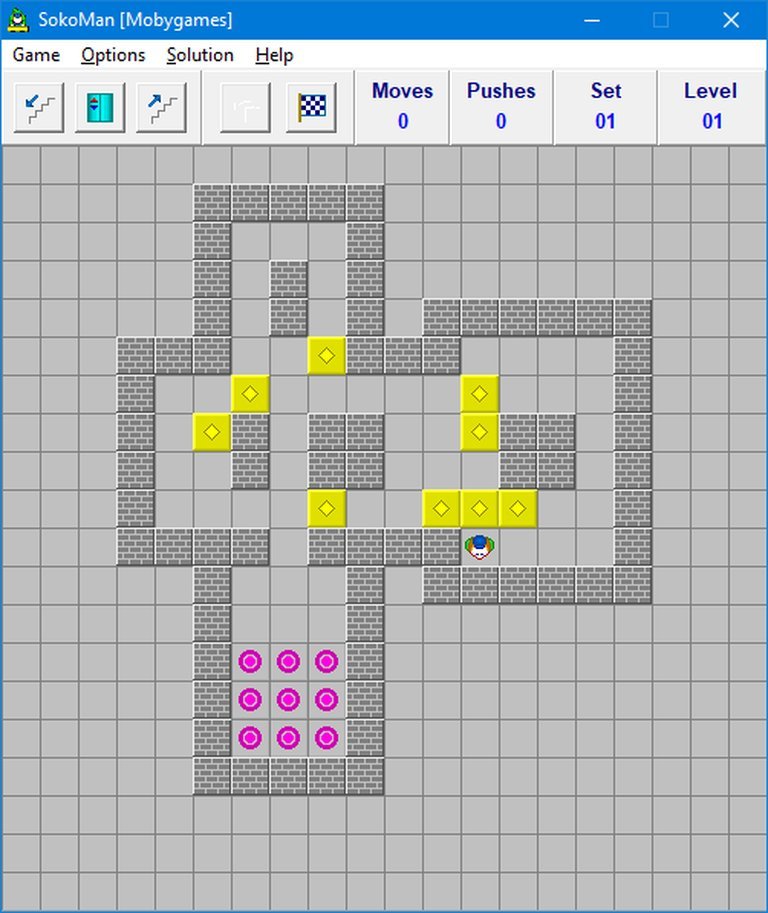
Sokoman is a classic puzzle game in the style of Sokoban, where players navigate a warehouse from a top-down perspective. The objective is to push boxes onto designated storage locations. The game features an undo function, save and replay options, and multiple levels. The shareware version includes 10 levels, while the registered version offers 50 levels and additional features like a level editor and a worldwide high score list.
Sokoman: Review
Introduction
In the pantheon of puzzle games, few genres are as deceptively simple yet intellectually demanding as Sokoban. Born in 1981 from the mind of Hiroyuki Imabayashi, this “warehouse keeper” puzzle mechanic has spawned countless iterations, clones, and homages. Among these is Sokoman, a 1999 Windows title developed by Lena Games, spearheaded by Lena Pankratova. Positioned as a faithful yet modest evolution of the Sokoban formula, Sokoman offers a refined take on box-pushing puzzles, complete with quality-of-life improvements like undo functionality and a level editor. This review argues that while Sokoman lacks the revolutionary spark of its predecessors, it stands as a competent, accessible entry in the genre—one that catered to niche puzzle enthusiasts during the late ’90s PC gaming boom.
Development History & Context
Studio and Vision
Lena Games, a small developer led by Lena Pankratova, positioned Sokoman as a shareware title during an era when indie development was still nascent. Pankratova’s vision leaned into accessibility, with features like replay recording and a level editor distinguishing it from earlier Sokoban clones. The game’s release on November 2, 1999, arrived amid a flourishing PC puzzle market, competing with titles like Crazy Machines and The Incredible Machine.
Technological Constraints
As a late ’90s title, Sokoman leveraged the simplicity of its mechanics to sidestep the need for advanced hardware. Its top-down, grid-based design mirrored the minimalism of early Sokoban games, yet its Windows compatibility ensured broader reach compared to earlier platform-specific releases. The shareware model—offering 10 free levels with an option to purchase 50 more—reflected the era’s distribution trends, catering to both casual players and dedicated enthusiasts.
Narrative & Thematic Deep Dive
Plot and Characters
Sokoman forgoes narrative ambition, embracing the genre’s traditional focus on pure puzzle-solving. There are no characters or story arcs; the player exists as an unseen force guiding boxes to their targets. This abstraction aligns with Sokoban’s legacy, where the joy derives not from storytelling but from intellectual triumph.
Themes
Thematically, Sokoman embodies the tension between order and chaos. Each level is a battle against entropy, demanding meticulous planning to avoid irreversible mistakes. The inclusion of an undo feature subtly undermines this pressure, offering mercy to players—a departure from the ruthlessness of classic Sokoban, where a single misstep could doom a run.
Gameplay Mechanics & Systems
Core Loop
The objective is straightforward: push boxes onto marked storage locations. However, Sokoman’s complexity arises from its grid-based spatial puzzles, where unintended blockades or deadlocks force players to restart. The game introduces three key innovations:
1. Undo Feature: A lifesaver for correcting errors, reducing frustration.
2. Replay System: Players can save and study their solutions, fostering iterative learning.
3. Level Editor: The registered version includes tools for creating custom puzzles, extending replayability.
UI and Progression
The UI is utilitarian, with clear menus and a top-down perspective. However, the lack of visual flair or animations feels dated even for 1999. The shareware version’s 10 levels serve as a demo, while the full game’s 50 levels—plus user-generated content—offer substantial depth. High-score tracking (local for shareware, global for registered users) adds competitive incentive.
Flaws
While functional, Sokoman suffers from predictability. Its puzzles adhere closely to Sokoban conventions, lacking the experimental twists seen in contemporaries like Sokomania 2: Cool Job (which introduced conveyor belts and dynamic boxes). The absence of difficulty scaling or thematic variety further limits its appeal beyond hardcore puzzle fans.
World-Building, Art & Sound
Visual Design
Sokoman’s aesthetics are starkly minimalist. The warehouse setting is rendered in basic tilesets, with boxes, walls, and targets differentiated by color and shape. This simplicity ensures clarity—critical for puzzle-solving—but lacks the charm of more visually ambitious Sokoban variants like Boxxle (Game Boy) or Sokoban Touch (mobile).
Sound Design
Sound effects are sparse, limited to box pushes and completion chimes. The absence of music or ambient noise reinforces the game’s austere focus, though this may feel sterile to modern players.
Reception & Legacy
Critical Reception
Documented reviews of Sokoman are scarce, reflecting its niche status. However, its MobyGames entry notes a lack of critic reviews at launch, suggesting it flew under the radar. Player reception was likely muted, as the late ’90s saw a glut of Sokoban clones competing for attention.
Commercial Performance
As a shareware title, Sokoman’s commercial success is difficult to gauge. However, its sequels—Jack’s Sokoman (2004) and Sokoman 4 (2008)—hint at a modest but enduring fanbase.
Industry Influence
While Sokoman didn’t redefine the genre, its level editor and replay system foreshadowed user-generated content trends later popularized by games like LittleBigPlanet. Its straightforward design also preserved Sokoban’s essence, ensuring the mechanics remained accessible amid increasingly complex puzzle games.
Conclusion
Sokoman is neither a genre pioneer nor a forgotten masterpiece. It is, instead, a reliable iteration of Sokoban’s timeless formula—polished enough to satisfy purists but too conservative to stand out. Lena Pankratova’s contributions, like the undo feature and level editor, demonstrate an understanding of player needs, even if the execution lacks flair. For puzzle historians, Sokoman offers a snapshot of the genre’s evolution during the shareware era. For modern players, it remains a quaint artifact, best appreciated as a stepping stone between Sokoban’s origins and today’s more inventive puzzlers. In video game history, Sokoman’s legacy is subtle but secure: a quiet custodian of the warehouse keeper’s flame.