
- Release Year: 2000
- Platforms: Windows
- Genre: Action
- Perspective: Side view
- Game Mode: Single-player
- Gameplay: Platform, Shooter
- Setting: South Park
- Average Score: 84/100
Description
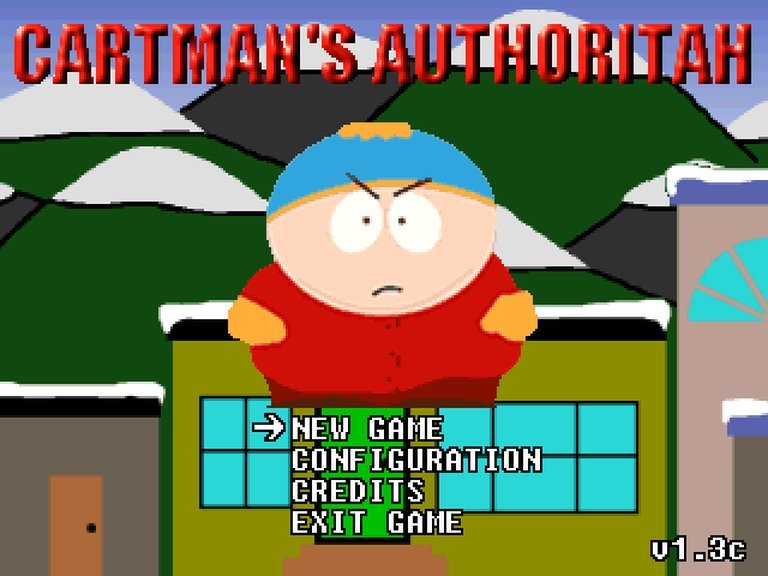
South Park: Cartman’s Authoritah is an unlicensed side-scrolling 2D platform game released in 2000, where players control Cartman from the South Park series through levels filled with enemies. Collect Cheesy Poofs to earn extra lives (100 per life), utilize various weapons for combat, and explore bonus levels for additional collectibles, all while embracing the show’s comedic style.
Gameplay Videos
South Park: Cartman’s Authoritah Guides & Walkthroughs
South Park: Cartman’s Authoritah Reviews & Reception
download.cnet.com (94/100): Serious gamers probably won’t find Cartman’s Authoritah all that impressive, but folks looking to play an occasional game and get a few chuckles should check it out.
myabandonware.com (100/100): This was kinda popular at the time as there weren’t many good South Park games coming out.
South Park: Cartman’s Authoritah Cheats & Codes
PC
To activate cheats, you can use one of two methods: 1. During gameplay, press [Esc], go to Options, click the lower-left corner of the screen, and type one of the following codes. 2. During gameplay, hold down a specific combination of keys.
| Code | Effect |
|---|---|
| SWEET | Unlimited Ammo |
| BEEFCAKE | Infinite Lives / Invincibility |
| cartmanwantsball | 100,00,00 dodge balls |
| CHEESYPOOFS | God Mode |
| BOBBY BIRD | All Cheats |
| EGOTRIP | Big Head Mode |
| FRAMERATE | Display Framerate |
| D and L (held down) | All weapons and unlimited ammo |
| G and D (held down) | God Mode |
South Park: Cartman’s Authoritah: Review
Introduction
In the turbulent landscape of early 2000s fan-made games, few titles captured the irreverent spirit of pop culture quite like South Park: Cartman’s Authoritah. Released in 2000 for Windows by developer Megaderek, this unlicensed 2D platformer/shooter transported players into the foul-mouthed, animated chaos of South Park, casting them as Eric Cartman on a quest for dominance. As a relic of a bygone era where fan creations thrived amidst limited official adaptations, Cartman’s Authoritah stands as both a nostalgic curiosity and a testament to the franchise’s enduring appeal. Its legacy, however, is as messy as its protagonist: a game that delivers raucous fan service while grappling with technical flaws and ethical controversies. This review dissects its place in gaming history, examining its development, narrative, mechanics, and cultural impact through an exhaustive lens.
Development History & Context
Cartman’s Authoritah emerged from the fertile ground of the late-1990s/early-2000s freeware scene, a period when fan-driven game development flourished due to accessible tools and minimal industry oversight. Megaderek, an independent developer with no formal studio affiliation, leveraged the burgeoning popularity of South Park—then at the height of its cultural relevance following its 1997 TV debut—without licensing. This unlicensed status immediately positioned the game in a legal gray area, a common trait for fangames of the era.
Technologically, the game was a product of its constraints. Built for Windows 95/98/2000/XP and requiring DirectX 7.0, it utilized a hybrid approach: 2D scrolling backgrounds with 3D-rendered sprites for characters and effects, a compromise typical of budget titles aiming for visual flair without advanced hardware. The tiny file size (~1.5 MB) underscored its rudimentary design, prioritizing playability over polish.
The gaming landscape of 2000 was dominated by console releases like Final Fantasy IX and Perfect Dark, with South Park’s official presence limited to titles such as South Park Rally (1999) and South Park (1998). Cartman’s Authoritah filled a void for PC fans seeking a more platform-centric experience, though its freeware status and reliance on shareware distribution channels (e.g., CNET Download) ensured it remained a niche curiosity rather than a mainstream hit. Its eventual preservation by archives like the Internet Archive highlights its status as a historical footnote, a snapshot of fan culture before the rise of digital storefronts.
Narrative & Thematic Deep Dive
The narrative is, fittingly, a bare-bones parody of South Park’s episodic chaos. Players control Eric Cartman as he embarks on a quest to “beat the enemies and finish the game,” culminating in a showdown with Mr. Garrison—the perpetually frustrated teacher. The plot serves as a thin scaffold for character-driven humor, mirroring the show’s absurdist ethos.
Characters are distilled to their iconic essences: Cartman spouts catchphrases like “Respect my Authoritah!” and “Screw you guys, I’m going home!”, while Kenny appears in levels as a neutral target, emphasizing the show’s morbid humor (“Oh my god, they killed Kenny!”). Enemies, including squirrels and generic townsfolk, function as cannon fodder, reinforcing Cartman’s delusions of grandeur. Boss battles against Garrison are predictable but thematically resonant, pitting Cartman’s egomania against an adult authority figure—a recurring South Park trope.
Underlying themes are pure Cartman: entitlement, violence as a solution, and the glorification of junk food (Cheesy Poofs). The game weaponizes its own crudeness, with pixelated blood splatters and crude insults (“chickens are butlickers!”) echoing the show’s transgressive humor. Yet, unlike the show’s satirical depth, the narrative lacks subtext, prioritizing shock value over substance. Its dialogue, though authentic to Cartman’s voice, feels repetitive, relying on audio clips that grate quickly—a flaw noted in contemporary reviews.
Gameplay Mechanics & Systems
Cartman’s Authoritah blends classic platforming with light shooter elements, a hybrid approach that defines its core loop.
Core Mechanics
- Movement & Combat: Cartman runs, jumps, and shoots across side-scrolling levels. Controls are keyboard-based, with jump and mapped to action keys. Combat is simplistic: players wield firearms (e.g., a “V-chip” weapon) or melee attacks against pixelated foes.
- Health & Lives: A standard health depletes from enemy contact, while extra lives are earned by collecting 100 Cheesy Poofs—a direct homage to Mario’s coin-collecting trope.
- Level Design: Eight main levels plus secret stages, each riddled with platforms, obstacles, and enemy ambushes. Levels lack verticality, focusing on horizontal progression with occasional bonus rooms for Cheesy Poof farming.
Systems & Flaws
- Weapon Variety: 5–6 unique guns offer tactical diversity, from rapid-fire pistols to explosive launchers, though ammunition is infinite, trivializing challenge.
- Progression: Linear and unforgiving. Checkpoints are sparse, and death often punishes players by forcing tedious replays. The absence of difficulty options amplifies frustration.
- UI & Customization: A minimalist health/ammo HUD contrasts with intrusive installer menus. Key remapping is the sole customization option, with no audio or visual toggles—crippled further by the inability to disable effects.
Innovation vs. Repetition
The game fails to innovate, borrowing heavily from Super Mario and Contra. Its “secret levels” add replay value but feel tacked on, while weapon variety is undermined by homogenous enemy designs. The result is a mechanically competent but shallow experience, as critics noted: “Serious gamers probably won’t find Cartman’s Authoritah all that impressive” (CNET). Spyware/adware bundled with the installer further degraded the experience, a stark reminder of the era’s freeware risks.
World-Building, Art & Sound
Visual Design
The art style is a faithful, if crude, recreation of South Park’s paper-cutout aesthetic. 2D backgrounds depict locales like streets and schoolhouses, while 3D-rendered sprites for Cartman and enemies add depth—though the effect is jarring. Pixelation and limited animations betray the game’s budget, yet the blood splatters and exaggerated character designs (e.g., Cartman’s rotund frame) capture the show’s grotesque charm. Colors are vibrant, and the 640×480 resolution supports full-screen play, though the visuals lack polish compared to contemporaries like Castlevania: Symphony of the Night.
Sound Design
Audio is the game’s double-edged sword. Cartman’s voice clips—delivered in his signature whine—are initially hilarious but become grating due to repetition. Sound effects (gunshots, screams) are serviceable but unremarkable. The biggest omission is music: levels are eerily silent, relying solely on ambient noise. As one Reddit user lamented, “I remember there were no music in the game. Just annoying and funny sounds of characters.” This absence undermines atmosphere, turning levels into monotonous slogs.
Atmosphere & Immersion
The world-building prioritizes fan service over coherence. Levels feel like dioramas of South Park, populated by recognizable but poorly integrated elements. The lack of environmental storytelling or dynamic interactions (e.g., no NPC dialogue beyond combat) reduces the town to a static playground. Ultimately, the game fails to evoke the show’s satirical warmth, instead offering a sterile, violence-centric playground.
Reception & Legacy
Launch Reception
Released in 2000, Cartman’s Authoritah garnered mixed reviews. Critics lauded its humor and faithfulness to the source material but panned its technical flaws. MobyGames aggregates a 60% score based on two reviews: VictoryGames.pl praised its “spora ilość krwi” (copious blood) and Cartman’s voice clips but noted the spyware caveat, while CNET deemed it “amusing” but “unimpressive” for serious gamers. Player reviews were kinder, averaging 4.0/5 on MobyGames, with nostalgia driving high scores: “This was kinda popular at the time as there weren’t many good South Park games coming out” (MyAbandonware).
Commercial Performance & Distribution
As freeware, the game avoided traditional sales metrics but achieved viral popularity via downloads. CNET reported over 600,000 downloads by 2019, fueled by its free status and South Park’s fanbase. However, its distribution was marred by malware; user reviews on CNET warn of “4 viruses” and “spyware,” cementing its reputation as a “Trojan” experience. The Internet Archive’s preservation later rescued it from obscurity, while platforms like GOG Dreamlist highlight its cult status among preservationists.
Long-Term Legacy
Cartman’s Authoritah holds a curious place in gaming history. It represents the peak of South Park fangame culture—a period when unlicensed titles offered raw, unfiltered fan passion. Its influence is negligible in gameplay terms, but its preservation underscores broader trends: the role of abandonware archives in saving niche titles, and the ethical dilemmas of freeware distribution. For South Park fans, it remains a time capsule, evoking “Oh. My. God” moments of retro gaming (MyAbandonware comment). Yet, its flaws—spyware, repetitive design—prevent it from being a classic. As a historical artifact, it’s more fascinating than playable, a testament to an era where love for a franchise often outweighed technical competence.
Conclusion
South Park: Cartman’s Authoritah is a product of its time: a flawed, freeware fangame that captures the essence of its source material while succumbing to the limitations and vices of early 2000s game development. Its strengths—authentic humor, fan service, and nostalgic value—are undeniable, yet they are overshadowed by repetitive gameplay, technical issues, and the shadow of spyware. For historians, it offers a window into the unlicensed gaming landscape; for players, it serves as a cautionary tale of retro downloads.
Ultimately, Cartman’s Authoritah is not a good game by modern standards, but it is an important one. It embodies the passion and chaos of fan creation, where “Respect my Authoritah!” rings as both a call to arms and a plea for forgiveness. Its legacy is one of infamy and affection—a digital relic that, like Kenny, may die repeatedly but refuses to stay dead. For South Park enthusiasts and gaming archivists alike, it remains an essential, if flawed, piece of interactive history.