
- Release Year: 1992
- Platforms: DOS, Macintosh, Windows
- Publisher: Knowledge Adventure, Inc.
- Developer: Knowledge Adventure, Inc.
- Genre: Educational
- Perspective: Fixed / flip-screen
- Game Mode: Single-player
- Gameplay: Point and select
- Setting: Science
Description
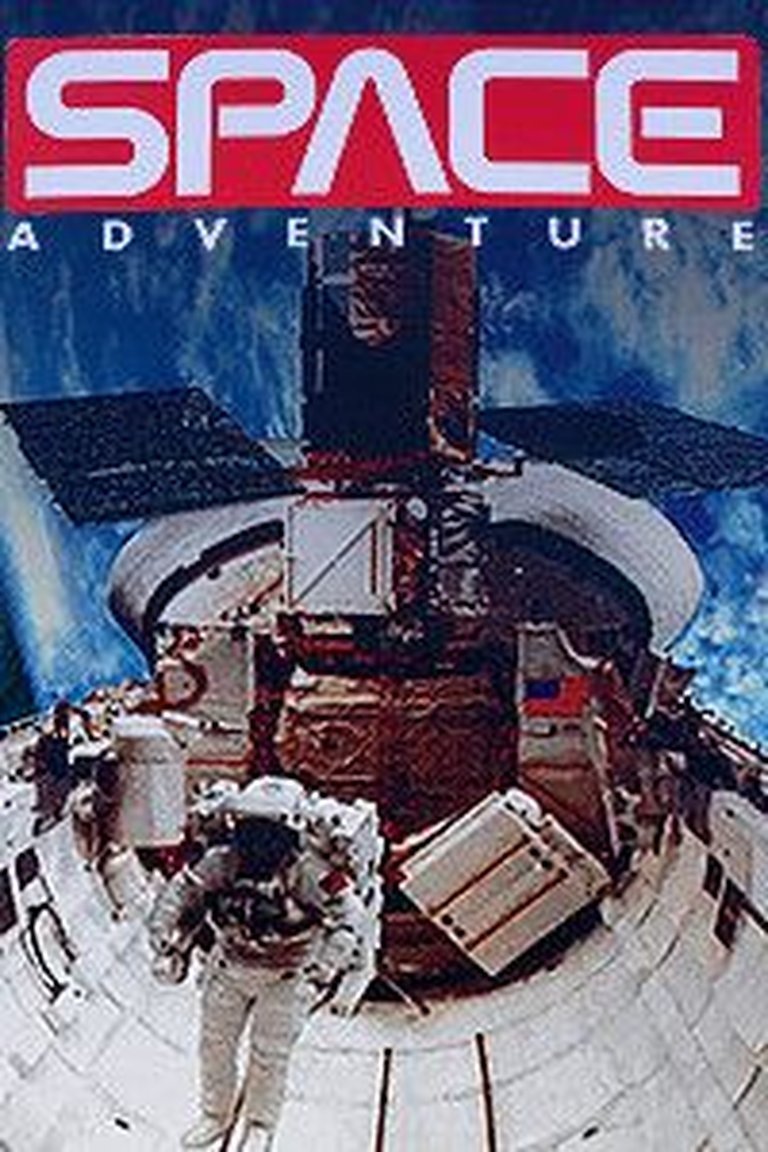
Space Adventure is an educational interactive journey through the cosmos, blending science and exploration. Players dive into topics like WWII rockets, space colonies, and celestial phenomena while watching real-world footage of Apollo launches and Voyager flybys. Featuring astronaut Buzz Aldrin and scientist Tom McDonough, the game offers a multimedia experience with hidden hyperlinks, articles, and a unique quiz system where scores increase by exploring interconnected content rather than quick answers. Designed as an encyclopedia of space, it challenges players to uncover knowledge through videos, audio clips, and dynamic navigation.
Where to Buy Space Adventure
PC
Space Adventure Free Download
Space Adventure Cheats & Codes
Commodore 16/Plus 4/C116
Enter codes into the monitor screen.
| Code | Effect |
|---|---|
| >1FAB AD | Infinite Lives |
| >13AC AD | Invincibility |
Space Adventure (1992): Forgotten Edutainment Pioneer or Digital Curiosity Cabinet?
Introduction
In the era of floppy disks and 16-color VGA graphics, a game dared to ask: What if we made Encyclopedia Britannica… fun? Knowledge Adventure’s 1992 CD-ROM oddity Space Adventure arrived not with laser blasts, but with grainy footage of Apollo launches and hyperlinked essays about quasar formations. While its name misleadingly echoes countless shooters, this digital Smithsonian became a desktop staple for Packard Bell owners—a multimedia time capsule now haunting collectors’ shelves. Beneath its clunky interface lies an audacious thesis: education could leverage gaming’s interactivity without sacrificing rigor. This review excavates one of edutainment’s forgotten Big Bangs.
Development History & Context: When CD-ROM Was Magic
Studio Ambitions
Knowledge Adventure—founded by former UCLA professor Bill Gross—pioneered the “interactive book” concept. Fresh off Dinosaur Adventure (1989), their vision crystallized: use CD-ROM’s 650MB storage (revolutionary when 5MB hard drives were standard) to merge video, text, and branching paths. Space Adventure became their space-age proof-of-concept, budgeted ambitiously enough to license NASA footage and enlist Caltech astronomer Tom McDonough alongside Apollo 11 legend Buzz Aldrin.
Technological Alchemy
In an era when Myst was still vaporware, squeezing real-world media onto PCs required sorcery. Developers compressed video into chunky 160×120 QuickTime clips at 10fps, using LucasArts’ Flic animations for motion graphics. The UI—mouse-driven but not point-and-click in the Sierra sense—required FORTRAN veterans like Fernando Echeverría to build a hyperlink engine that’d underline nothing yet still track clickable words. CD-ROM drives (then $500+) became the bottleneck; Space Adventure shipped requiring double-speed drives, alienating 1x users with unbearable load times.
Edutainment’s Golden Age
Launched amid Where in the World Is Carmen Sandiego? mania, Space Adventure eschewed puzzles for pure exploration. Competing with Microsoft Encarta, it gambled that kids would prefer Voyager probe flybys over text-heavy entries. The gamble paid off—sort of. Bundled with Packard Bell systems, it reached millions as trialware, though few paid full $49.99 retail. By 1994, its Mac port felt dated next to Magic School Bus’s slicker interactivity.
Narrative & Thematic Deep Dive: Textbook as Choose-Your-Own-Adventure
A Structural Experiment
Space Adventure has no protagonist unless you count the cursor. “Plot” unfolds via associations: click a Saturn V rocket diagram, leap to Kennedy’s 1962 “Moon Speech” video, then hyperlink “JFK” to explore Cold War politics. Unlike modern wikis, links are invisible—players “discover” them by hovering over any text, transforming passive reading into a tactile Easter egg hunt.
Edu-Fiction Tensions
The game oscillates between rigorous science (McCandlish diagrams of space colonies) and pulp sci-fi flair. One moment you’re analyzing orbital mechanics; next, you’re browsing UFO sightings with MIDI theremins warbling. Thematic whiplash? Perhaps—but intentional. Hamilton Alstatt’s sound design reinforces this duality: Holst-inspired synth drones underscore planet profiles, while a kazoo-like leitmotif greets “Alien Life” sections.
Celebrity Anchors
Aldrin’s narration lends gravitas, yet moments undercut him. Watching his moonwalk footage, you can click Armstrong’s face—only to teleport to a 1950s sci-fi comic panel declaring “MEN WILL WALK ON MARS!” McDonough’s essays ground flights of fancy, yet the modular structure invites cherry-picking. Want to skip WWII rockets for black hole theories? Space Adventure shrugs: “Follow your hyperlink.”
Gameplay Mechanics & Systems: The Serendipity Engine
Core Loop: Digital Flâneurie
At its best, Space Adventure simulates scholarly serendipity—stumbling across connections. The Space Adventure Challenge quiz mode weaponizes this. Select “What fuel powered the Saturn V?” and instead of multiple-choice, you’re dumped into the database. Track down the answer via linked terms (e.g., “rocket” → “propellants” → “kerosene”), scoring points for detours. Paradoxically, knowing the answer penalizes you; expertise is measured in clicks, not accuracy.
Interface Quirks
Navigation uses four quadrants:
– Earth Viewer: Rotate a pixelated globe to select topics
– Timeline: Drag from 10 billion BCE to 1990s
– Media Panel: Plays videos/stills
– Text Console: Scrollable essays with hidden links
It’s overwhelming—intentionally so. Designer Brad Haugaard admitted in 1993 interviews he wanted users to feel “drowning in data… learning through glorious chaos.”
Flaws as Features
Technical limitations birthed innovations. With video playback taxing CPUs, developers hid text-based animations: typing effects simulate telemetry streams, while ASCII art diagrams explain eclipse paths. The lack of a “back” button (later patched in the 2014 re-release) forced organic exploration, though players hated retracing steps.
World-Building, Art & Sound: A Collage of Cosmic Awe
Aesthetic Duality
Space Adventure straddles NASA archival pragmatism and New Age whimsy. Planet profiles feature technical illustrations by Art of Stone, but black holes pulse with neon fractals cribbed from Omni magazine covers. The clash feels deliberate—a visual metaphor for science vs. imagination.
Sound as Time Machine
The soundtrack samples mission control chatter, but its gem is Kennedy’s Rice University speech. Hearing “We choose to go to the Moon” beside Apollo blueprints remains stirring, even at 22kHz mono. Manny Wong’s artwork, though crude, channels National Geographic’s filtered grandeur—Martian landscapes rendered like Boy Scout handbook lithographs.
Atmosphere of Informal Learning
Glitches enhance charm. Trigger a hyperlink loop (e.g., clicking “moon” endlessly cycles related terms) and you’re not stuck—you’re glimpsing the database’s web-like structure. This proto-Wikipedic sprawl feels eerily modern, foreshadowing hypertext’s potential.
Reception & Legacy: The Forgotten Foundation
Launch Reception
Ignored by gaming press (IGN’s 1996 retrospective called it “Not a game, technically”), Space Adventure garnered stealth acclaim in library circles. School Library Journal praised its “non-linear curiosity cultivation,” while parents appreciated its lack of points/lives mechanics. Player reviews on MobyGames (averaging 4.1/5) highlight nostalgia: “It felt like controlling a documentary.”
Commercial Footprint
Bundling deals made it ubiquitous—yet ephemeral. Updated as Space Adventure II (1995) with VRML asteroid tours, Knowledge Adventure abandoned the format for 3D Dinosaur Adventure’s spectacle. Later edutainment borrowed its parts: Encarta added hyperlinks; Magic School Bus adopted its video snippets.
Industry Influence
Today, Space Adventure feels like a missing link between Microsoft Bookshelf and Kerbal Space Program. Its DNA lives on in games valuing systems literacy over objectives—Heaven’s Vault’s archaeological deduction, Outer Wilds’ emergent astrophysics. Yet few credit it. Why? By refusing to be a game, it dodged preservationists’ radars. MobyGames itself mislabels it “Point and Select” despite lacking traditional puzzles.
Conclusion: The Encyclopedia That Dreamed It Was a Galaxy
Space Adventure is neither masterpiece nor failure—it’s a poignant what-if. At its best, it marries Carl Sagan’s wonder with Douglas Engelbart’s interactivity. At worst, it’s a slideshow trapped in obsolete codecs. But as artifact, it matters: here lies gaming’s first attempt to simulate pure curiosity, rewarding exploration for its own sake.
For historians, it’s edutainment’s Rosetta Stone—proof that before STEM pedagogy co-opted gamification, a quirky CD-ROM dared to let kids space-junk-dive through knowledge. Play it now via abandonware sites not for fun, but awe: this is where “open worlds” first meant opening minds.
Final Verdict: A 3-star experience with 5-star historical significance—worth preserving, if not replaying. Like actual space travel, the triumph isn’t the destination, but the audacity to launch.
(Note: This review covers the 1992 Knowledge Adventure release. For Hudson Soft’s 1991 *The Space Adventure, see related MobyGames entry #23745.)*