
- Release Year: 2000
- Platforms: Windows
- Publisher: NeverSleep
- Developer: NeverSleep
- Genre: Action, Puzzle
- Perspective: Side view
- Game Mode: Single-player
- Gameplay: Arcade, Falling block puzzle
Description
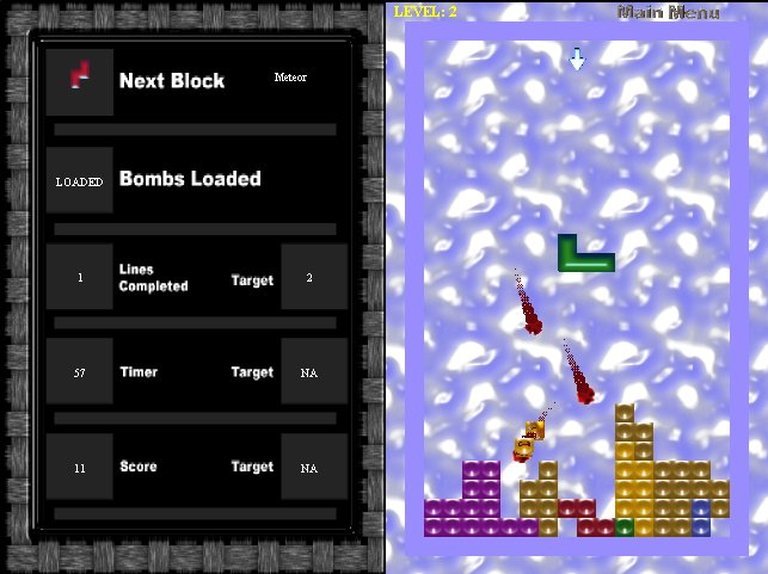
Spaz Attack is a Tetris-inspired puzzle game with a competitive twist, released in 2000 for Windows. Unlike traditional Tetris, players face off against a relentless AI opponent that disrupts their progress with attacks like invisible blocks, temporary barriers, and destructive meteors. The game blends classic falling-block mechanics with arcade-style challenges, requiring quick reflexes and strategic thinking to outmaneuver the AI and advance through levels.
Spaz Attack Reviews & Reception
retro-replay.com : Spaz Attack reinvigorates the classic block-dropping puzzle by pitting you head-to-head against a relentless computer AI.
Spaz Attack: A Forgotten Gem of Competitive Puzzle Gaming
Introduction
In the vast ocean of Tetris clones and falling-block puzzlers, Spaz Attack (2000) stands as a curious and underappreciated relic—a game that dared to transform the solitary meditation of Tetris into a high-stakes duel against a relentless artificial intelligence. Released by the obscure publisher NeverSleep, Spaz Attack is more than just another puzzle game; it is a test of adaptability, reflexes, and strategic foresight. While its legacy may be overshadowed by the titans of the genre, its innovative twist on competitive puzzle gameplay deserves recognition. This review will dissect Spaz Attack in exhaustive detail, exploring its development, mechanics, reception, and lasting influence—or lack thereof—on the puzzle genre.
Development History & Context
The Studio and the Vision
Spaz Attack emerged from the shadows of the early 2000s indie development scene, a period when digital distribution was still in its infancy and shareware models dominated the landscape for smaller titles. The game was published by NeverSleep, a studio with little documented history beyond this single release. The lack of available information about the developers suggests that Spaz Attack was likely the passion project of a small team or even a solo creator, operating under the constraints of limited resources and the technological limitations of the era.
The late 1990s and early 2000s were a golden age for puzzle games, with Tetris clones flooding the market. Titles like Columns, Dr. Mario, and Puyo Puyo had already established that the falling-block formula could be iterated upon with unique mechanics. Spaz Attack entered this crowded space not by reinventing the wheel, but by introducing a competitive AI opponent—a feature that was rare in puzzle games at the time. Most Tetris variants focused on single-player high-score chasing or local multiplayer, but Spaz Attack sought to create a dynamic, reactive experience where the player was constantly challenged by an adversarial force.
Technological Constraints
Developed for Windows with a fixed/flip-screen perspective and side-view presentation, Spaz Attack adhered to the technical standards of its time. The game was distributed as shareware, a business model that allowed players to try a limited version before purchasing the full experience. This approach was common for indie titles in the early 2000s, as it provided a low-risk way for players to engage with lesser-known games.
The visual design of Spaz Attack reflects the limitations of early 2000s hardware. The game employs a minimalist aesthetic, with brightly colored blocks set against dark backgrounds to ensure clarity. Animations for AI attacks—such as meteors crashing or barriers appearing—are simple but effective, relying on pixel-art explosions and screen shakes to convey impact. The sound design, too, is functional rather than elaborate, with chiptune-inspired music and sound cues that reinforce the game’s retro sensibilities.
The Gaming Landscape of 2000
The year 2000 was a transitional period for gaming. The PlayStation 2 had just launched, and PC gaming was dominated by titles like Diablo II, The Sims, and Counter-Strike. Puzzle games, while popular, were often relegated to casual or niche audiences. Tetris remained a cultural touchstone, but the market was saturated with clones that offered little innovation.
Spaz Attack arrived in this environment as a shareware title, competing for attention against both AAA releases and other indie puzzlers. Its direct control interface and arcade-style gameplay made it accessible, but its AI-driven competitive mechanics set it apart. Unfortunately, the game’s obscurity and lack of marketing meant that it never achieved widespread recognition. Today, it is remembered primarily by retro gaming enthusiasts and those who stumble upon it in digital archives.
Narrative & Thematic Deep Dive
The Premise: Man vs. Machine
Spaz Attack is not a narrative-driven game in the traditional sense. There are no cutscenes, no character arcs, and no grand plot. Instead, the game’s thematic framework is established through its core mechanic: a battle of wits between the player and a rogue AI.
The game’s manual and loading-screen tips provide tongue-in-cheek lore, framing the AI as an evolutionary adversary determined to prove its superiority. This premise is simple but effective, transforming what could have been a mechanical exercise into a playful rivalry. The AI is not just an obstacle; it is an active opponent, adapting its strategies to counter the player’s moves.
Themes of Adaptability and Strategy
At its heart, Spaz Attack is a game about adaptability. The AI’s attacks—invisible blocks, temporary barriers, meteors, and extra pieces—force the player to constantly reassess their strategy. Unlike traditional Tetris, where the player can settle into a rhythm, Spaz Attack demands reactive thinking and quick decision-making.
The game’s progression system reinforces this theme. As the player advances through levels, the AI’s attacks become more frequent and more devastating. This escalation creates a sense of urgency, as the player must balance offensive line-clearing with defensive maneuvering to survive.
The Absence of Storytelling
While Spaz Attack lacks a traditional narrative, its gameplay loop tells a story of its own. Each match is a micro-narrative of struggle and triumph, as the player battles against an increasingly aggressive AI. The ebb and flow of momentum—the thrill of countering a meteor strike, the frustration of an invisible block ruining a carefully planned stack—creates a dynamic experience that feels fresh with each playthrough.
For players who appreciate emergent storytelling, Spaz Attack offers a compelling example of how mechanics alone can create a sense of drama and tension.
Gameplay Mechanics & Systems
Core Gameplay Loop
Spaz Attack retains the fundamental mechanics of Tetris: blocks fall from the top of the screen, and the player must arrange them into complete horizontal lines to clear them. The game supports fast-drop and hold functions, allowing for quick maneuvers and strategic planning.
However, the game’s innovation lies in its AI opponent. Unlike traditional Tetris, where the player’s only enemy is the increasing speed of the blocks, Spaz Attack introduces a second layer of challenge: the AI’s active interference.
AI Attacks: A Breakdown
The AI employs a variety of disruptive tactics to hinder the player’s progress. These attacks are triggered based on the player’s performance, creating a dynamic difficulty curve. The most notable attacks include:
- Invisible Blocks: These blocks appear and disappear at random intervals, forcing the player to memorize their positions or react quickly when they materialize.
- Temporary Barriers: These obstacles block off entire columns, requiring the player to reconfigure their playfield on the fly.
- Meteors: These destructive projectiles crater the player’s stack, creating gaps that must be filled or worked around.
- Extra Pieces: The AI can add additional blocks to the player’s next piece, making it harder to place.
- Speed Increases: The AI can accelerate the block-falling speed, ratcheting up the pressure.
Each attack is telegraphed by an on-screen attack meter, giving the player a brief window to prepare. This mechanic ensures that the AI’s interference feels fair but unpredictable, adding to the game’s replayability.
Difficulty and Accessibility
Spaz Attack offers multiple difficulty settings, allowing players to adjust the frequency and intensity of the AI’s attacks. This makes the game accessible to casual players while still providing a challenge for veterans.
The controls are tight and responsive, echoing the precision of classic puzzle games. The fast-drop and hold functions are smooth, allowing for quick maneuvers and strategic planning.
Multiplayer and Replayability
One of Spaz Attack’s few shortcomings is its lack of multiplayer modes. While the AI-driven single-player experience is engaging, the absence of local or online multiplayer limits the game’s long-term appeal. However, the dynamic AI and varied attack patterns ensure that no two matches play out the same way, providing high replay value for solo players.
World-Building, Art & Sound
Visual Design: Minimalism with Purpose
Spaz Attack’s visual design is clean and functional, prioritizing clarity over flashiness. The block shapes are brightly colored and easily distinguishable, ensuring that players can quickly identify their next piece. The UI panels—which display the AI’s attack meter and upcoming threats—are well-integrated, providing essential information without cluttering the screen.
The game’s backgrounds are minimalist, with dark hues that contrast sharply with the vibrant blocks. This design choice ensures that the playfield remains the focal point, reducing visual distractions.
Animations and Effects
When the AI launches an attack, Spaz Attack employs stylized animations to punctuate the action. Rockets streak across the field, barriers materialize with a shimmer, and meteors crash with pixel-art explosions. These effects are simple but effective, reinforcing the high-stakes nature of each match.
The game also uses subtle screen shakes and sound cues to enhance the impact of the AI’s attacks. These tactile feedback mechanisms make the gameplay feel more dynamic and engaging.
Sound Design: Chiptune Nostalgia
The sound design of Spaz Attack leans heavily into chiptune territory, complementing the game’s retro-inspired aesthetic. The background music is upbeat and energetic, keeping the mood lighthearted despite the intense gameplay.
The sound effects—such as the crash of a meteor or the appearance of an invisible block—are clear and distinct, ensuring that players can react quickly to auditory cues.
Reception & Legacy
Critical and Commercial Reception
Spaz Attack was released into a crowded market, and its obscure publisher meant that it received little mainstream attention. There are no recorded critic reviews on platforms like MobyGames, and player reviews are scarce. The game’s shareware model likely limited its commercial success, as it competed with both free Tetris clones and more polished puzzle games.
However, among the small community of players who discovered Spaz Attack, the game was well-received for its innovative AI mechanics and addictive gameplay. The lack of multiplayer was a common criticism, but the single-player experience was praised for its depth and challenge.
Evolution of the Genre
Spaz Attack’s biggest contribution to the puzzle genre was its AI-driven competitive mechanics. While the game itself remained obscure, its core idea—pitting the player against a reactive, adversarial AI—would later be explored in other puzzle games, such as Tetris Effect’s AI opponents and Puyo Puyo Tetris’s versus modes.
The game’s minimalist aesthetic and retro-inspired design also foreshadowed the indie puzzle renaissance of the 2010s, where games like Thomas Was Alone and Super Hexagon proved that simple visuals could coexist with deep gameplay.
Influence on Subsequent Games
While Spaz Attack did not directly inspire any major releases, its design philosophy—adding a competitive layer to a solitary puzzle experience—can be seen in later titles. Games like Lumines and Bejeweled incorporated AI-driven challenges in their versus modes, though none replicated Spaz Attack’s real-time interference mechanics.
The game’s obscurity means that its direct influence is hard to trace, but its innovative approach to puzzle gameplay remains a notable experiment in the genre’s history.
Conclusion: A Hidden Gem Worth Rediscovering
Spaz Attack is a forgotten relic of early 2000s puzzle gaming—a game that dared to challenge the conventions of the Tetris formula by introducing a relentless AI opponent. While its lack of multiplayer and obscure release limited its commercial success, its innovative mechanics and addictive gameplay make it a hidden gem worth rediscovering.
For puzzle enthusiasts seeking a fresh twist on a classic formula, Spaz Attack offers a unique and engaging experience. Its dynamic difficulty, reactive AI, and minimalist aesthetic create a tense, high-stakes duel that rewards quick thinking and strategic adaptability.
Final Verdict: Spaz Attack is a cult classic that deserves a place in the puzzle game pantheon. While it may not have the polish or name recognition of Tetris or Puyo Puyo, its bold experimentation with AI-driven competition makes it a standout title in the genre’s history. 8/10.
Additional Notes
- Where to Play: Spaz Attack is available for download on various abandonware sites and retro gaming archives. Due to its shareware origins, it may be difficult to find a legal copy, but emulation and preservation efforts have kept it accessible.
- Modding and Community: The game’s small but dedicated fanbase has created mods and custom levels, though these are rare and hard to find. The Steam Community and Reddit have occasional discussions about the game, with players sharing tips and strategies.
- Sequel Potential: Given the lack of official sequels, Spaz Attack remains a one-of-a-kind experience. However, its core mechanics could easily be reimagined in a modern puzzle game, with online multiplayer and expanded AI behaviors.
For those willing to dig into gaming’s past, Spaz Attack is a rewarding discovery—a testament to the creativity of indie developers and the enduring appeal of competitive puzzle gameplay.