
- Release Year: 1996
- Platforms: Windows
- Publisher: Elzenga-Uitgeverij Zwijsen Algemeen B.V.
- Genre: Educational
- Perspective: Top-down
- Game Mode: Single-player
- Gameplay: Cards, Mental training, Tiles, Word construction
- Average Score: 80/100
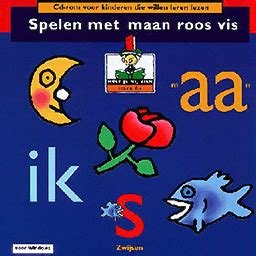
Description
Spelen met Maan Roos Vis is a Dutch edutainment game designed to teach reading and writing skills to young children. Based on Zwijsen’s ‘Veilig Leren Lezen’ method, it features six hand-drawn activities such as memory games, word-picture matching, and letter exercises, with varying difficulty levels suitable for ages four to nine.
Spelen met Maan Roos Vis Reviews & Reception
retro-replay.com : making this an essential tool for every home or classroom.
Spelen met Maan Roos Vis: A Definitive Review of a Dutch Educational Landmark
Introduction: A Quiet Pillar of Dutch Literacy
In the sprawling, globe-spanning canon of video game history, certain titles exist not as cultural megaphones but as perfectly calibrated tools for a specific time, place, and purpose. Spelen met Maan Roos Vis (translated as “Playing with Moon, Roos, Fish”) is one such title. Released in 1996 for Windows PCs, this Dutch edutainment CD-ROM is unlikely to feature in any “greatest games” list, yet for a generation of Dutch and Flemish children, it was a vital, familiar companion on the path to literacy. Based on the ubiquitous “Veilig Leren Lezen” (“Secure Learning to Read”) pedagogical method by publisher Zwijsen, the game translates a structured classroom methodology into an interactive, home-friendly experience. My thesis is this: Spelen met Maan Roos Vis represents a quintessential, nearly ideal piece of contextual edutainment. Its success is not measured in innovation that shook the industry, but in its flawless, bespoke alignment with a national curriculum, its gentle charm, and its demonstration of how games can serve as a seamless, playful bridge between institutional learning and domestic reinforcement.
Development History & Context: The Zwijsen Ecosystem
To understand Spelen met Maan Roos Vis, one must first understand “Veilig Leren Lezen.” Developed decades prior by the Dutch publishing house Elzenga-Uitgeverij Zwijsen Algemeen B.V. (often simply “Zwijsen”), this method was (and in many schools, still is) the dominant framework for teaching reading in the Netherlands and Flanders. It is a synthetic phonics approach, emphasizing a structured, step-by-step progression from letter-sound correspondence to fluent reading, using a cast of recurring characters and illustrated “reading stories.”
The game emerged in the mid-1990s, a golden era for educational CD-ROMs. The CD medium offered storage for digitized speech, vibrant graphics, and interactive content that floppy disks could not. For publishers like Zwijsen, it was a logical extension: take their trusted, paper-based method and embed it within the exciting new medium of the home computer. The development studio is not credited in the available records, a common trait for licensed educational projects of the era where the publisher’s brand and pedagogical content were foregrounded over individual developer fame. The technological constraints were those of mid-90s Windows (likely Windows 3.1/95): 256-color graphics, basic point-and-click interfaces, and the necessity of running on the modest hardware found in many homes and schools.
The gaming landscape of 1996 was dominated by 3D accelerators (3dfx Voodoo), immersive RPGs (Fallout, Diablo), and the dawn of the console wars (N64, Saturn, PS1). Against this backdrop, Spelen met Maan Roos Vis was utterly divorced from mainstream trends. Its market was not the game store’s new releases shelf, but the “educational software” aisle of department stores and school supply catalogues. It existed within a parallel universe of “serious games” or “edutainment,” a term then in its infancy, competing with titles like The Oregon Trail or Reader Rabbit, but with a laser focus on a single, national curriculum.
Narrative & Thematic Deep Dive: The Story is the Method
Spelen met Maan Roos Vis possesses no traditional narrative with a beginning, middle, and end. Instead, its “story” is the learning journey itself, framed by its titular guides: Maan (Moon), Roos (a common Dutch name, also a type of rose), and Vis (Fish). These three characters are not protagonists in a save-the-world quest but are pedagogical avatars. They appear as friendly, hand-drawn hosts who introduce activities, offer encouragement (“Goed gedaan!” – “Well done!”), and provide a consistent, reassuring presence. Their design—simple, bold, and warm—makes them instantly recognizable to young children, transforming abstract literacy tasks into interactions with friendly companions.
The thematic core is pure, unadulterated constructivism: learning through doing. Each of the six mini-games is a direct simulation of a “Veilig Leren Lezen” classroom exercise:
1. Memory (Geheugenspel): The classic concentration game. Cards are face-down; players flip two, aiming to match a picture with its corresponding written word or letter. This builds visual recognition and reinforces the bond between the concrete (image) and the symbolic (text).
2. Kleur de letters (Coloring Letters): A simple coloring activity where children fill in outlined letters or pictures associated with specific sounds (e.g., the letter ‘M’ shaped like a mountain “Mijn”). This kinaesthetic activity reinforces letter shape recognition in a low-pressure, creative context.
3. Koppel plaatje en woord (Combine Picture and Word): A matching task where a word must be dragged and dropped onto its corresponding illustrated object. This is a core decoding exercise, testing the child’s ability to map orthography (the written word) to semantics (the image’s meaning).
4. Koppel spreek- en schrijfwoord (Combine Spoken and Written Word): This introduces the auditory channel. The game plays a digitized Dutch voice saying a word (e.g., “vis”). The child must then select the correct written word from a set. This drills phonemic awareness—the crucial skill of hearing individual sounds and knowing which letters represent them.
5. Ontbrekende letters (Missing Letters): A word is shown with a blank space (e.g., “V_s”). The child must choose the correct vowel to complete the word. This targets specific, tricky phonetic patterns (short vs. long vowels, consonant combinations) that are systematically taught in the VLL method.
6. Bamboozle (Letters and Pictures Untangled): Likely a more complex scrambling task where letters and pictures are jumbled, and the child must assemble them into coherent word-image pairs. This represents a higher-order synthesis of all previous skills.
The progression between these activities mirrors the “Veilig Leren Lezen” curriculum stages: from whole-word recognition (Memory, Picture-Word) to phonetic decoding (Spoken-Written, Missing Letters) to synthesis and puzzle-solving (Bamboozle). There is no overarching “plot,” but there is a clear, psychologically sound narrative of mastery. Each completed activity is a step in the grand project of becoming a reader, with Maan, Roos, and Vis as witnesses to that achievement.
Gameplay Mechanics & Systems: Simplicity as a Virtue
The genius of Spelen met Maan Roos Vis lies in its mechanical austerity. It is a suite of six discrete, perfectly honed mini-games, not a single complex system.
- Core Loop: The loop is immediate and satisfying: Select Activity -> Engage in Mini-Game -> Receive Instant Feedback -> Celebrate Success/Retry. There is no resource management, no failure state that ends the game, and no meta-progression beyond the internal difficulty levels. The goal is not to “win” but to complete and master.
- Difficulty Scaling: This is the game’s most critical systemic feature. The source material explicitly notes “varying levels of difficulty” suitable for ages 4-9. This is not a single slider but a per-activity, built-in scaling. The word lists in “Missing Letters” would start with CVC (consonant-vowel-consonant) words like “kat” (cat) and progress to more complex vowel combinations. The image sets in “Picture-Word” would expand from simple nouns to verbs and adjectives. This allows the game to “grow” with the child, preventing boredom for older beginners and frustration for younger ones.
- Interface & Input: It is entirely point-and-select with a mouse. Buttons are large, colorful, and often labeled with icons (a paintbrush for coloring, an ear for listening). This is deliberately designed for pre-literate or early-literate fine motor skills. There is no reading required to navigate the menu system—the activities are selected by recognizable symbols and the friendly faces of Maan, Roos, and Vis.
- Feedback & Reinforcement: Positive reinforcement is constant, gentle, and multifaceted. Correct answers trigger:
- Auditory: A cheerful jingle, a voice saying “Prima!” (Great!), or applause.
- Visual: Stars appear, characters do a happy dance, the screen might sparkle.
- Progression: A simple counter or bar fills up, providing a tangible sense of completion within a session.
There are no punitive sounds or animations for errors. Instead, the item simply might not stay selected, or a soft “probeer nog eens” (try again) might appear. The philosophy is clear: mistakes are part of learning, not failures.
- Innovation & Flaws: Its “innovation” is not technical but pedagogical: the tight, unadulterated mapping of a proven curriculum to interactive exercises. Its “flaws” are by design. There is no open-ended play, no emergent narrative, no multiplayer. For a child seeking a pure game experience, it may feel like schoolwork. But for its intended purpose—reinforcing school lessons—this constraint is its greatest strength. It is a focused practice tool, not a sandbox.
World-Building, Art & Sound: The Aesthetic of the Classroom
The game’s world is the stylized, comforting universe of the “Veilig Leren Lezen” textbooks. The visual style is hand-drawn, as consistently noted across sources. This is a crucial detail. It eschews the flashy, sometimes garish clip-art of many contemporaneous edutainment titles for a cohesive, illustrated-storybook aesthetic. The lines are bold, the colors primary and warm (lots of sky blue, grass green, sunny yellow). Characters like Maan, Roos, and Vis have a simple, iconic design that makes them feel like they stepped out of a primary school’s reading primer. This hand-drawn quality provides a sense of organic unity and warmth that pre-rendered 3D or stiff computer graphics of the era often lacked. It feels crafted, not just programmed.
The interface follows this aesthetic. Buttons look like painted buttons. Progress bars might be a line of characters from the VLL method marching across. This visual consistency reduces cognitive load; the child is never jolted from the “storybook world” into a “computer menu.”
Sound design is functional and supportive. The sources mention spoken words in one activity, confirming the use of clear, likely professionally recorded Dutch voiceovers for the “Combine Spoken and Written Word” exercise. This is a significant feature—the auditory component is essential for phonetic training. The background music, if any, is probably light, melodic, and non-intrusive, designed to sit in the background. Sound effects are the aforementioned celebratory jingles and positive reinforcements.
The atmosphere is one of safe, encouraging practice. There is no tension, no time pressure (in most activities), no competition. It is the digital equivalent of a patient teacher or parent sitting beside a child, pointing at words and saying, “What’s this? Try again, you can do it.” The world is a series of clean, uncluttered screens focused entirely on the task at hand—a perfect match for the cognitive needs of a beginning reader.
Reception & Legacy: A National Treasure, Obscure Abroad
At launch in 1996/1998, Spelen met Maan Roos Vis was not reviewed in international magazines like PC Gamer or Computer Gaming World. Its critical reception existed entirely within the Dutch-language sphere. The sole cited critic review from Ouders Online (a prominent Dutch parenting resource) in February 1997 awarded it 80%. The review’s key phrases are telling: “bedoeld voor beginnende lezers” (intended for beginning readers), “sluit aan bij de leesmethode” (aligns with the reading method), and the ultimate praise: “eigenlijk mag dit spel thuis met kinderen in groep 3 niet ontbreken” (basically, this game should not be missing in homes with children in group 3 [age ~6-7]). This is the highest possible endorsement: it’s not just good; it’s essential for its target demographic. The “prijs-kwaliteit verhouding” (price-quality ratio) is called “uitstekend” (excellent).
Its commercial success is harder to quantify but can be inferred. It was published by a major educational publisher (Zwijsen), sold in retail (CD-ROM, commercial model), and its presence in the Nationaal Archief Educatieve Games (National Archive of Educational Games) and multiple cited copies on the Internet Archive attest to its widespread distribution and cultural persistence in the Netherlands. It was part of a series (“Spelen met-serie”), with titles for math (“Spelen met Tafels”), clocks (“Spelen met de Klok”), etc., indicating a successful franchise model.
Its legacy is bifurcated:
1. In the Netherlands/Flanders: It is a beloved cultural artifact for a specific generation. People in their late 20s to early 40s in the Benelux region will have vivid, fond memories of “playing” with Maan, Roos, and Vis on their family PC. It is a perfect example of a technology seamlessly integrated into a national educational ecosystem.
2. Globally: It is virtually unknown. This is not due to a lack of quality but to its profound specificity. Its language (Dutch), its pedagogical grounding in a single national method, and its lack of pretensions to universal gameplay mechanics rendered it inert outside its cultural context. It is a fascinating case study in localized edutainment versus globally exportable game design.
It influenced the Dutch edutainment space by demonstrating the viability of a direct, method-based CD-ROM. It likely paved the way for more ambitious, game-like adaptations of school methods. However, compared to the narrative-driven adventure ik, mik, Letterland (1996, also based on VLL for CD-i), which added a save-the-world plot, Spelen met Maan Roos Vis represents the more traditional, drill-and-practice end of the spectrum.
Conclusion: Verdict and Historical Placement
Spelen met Maan Roos Vis is not a game to be evaluated by the metrics of action, narrative complexity, or graphical fidelity. By those standards, it is simple, repetitive, and quaint. Its evaluation must be pedagogical and context-driven.
Final Verdict: As an educational tool, it is an unqualified success. It is a masterclass in adapting a structured curriculum into an engaging, accessible, and psychologically sound digital format. Its variety of activities covers the key components of early literacy (visual recognition, phonemic awareness, spelling patterns) without overwhelming the child. Its difficulty scaling is its masterstroke, providing longevity. Its aesthetic is charming and coherent. Its feedback is relentlessly positive, building confidence. For a Dutch or Flemish child aged 4-9 in the late 1990s, using it alongside the “Veilig Leren Lezen” books was a perfectly synergistic learning experience.
Place in History: Historically, Spelen met Maan Roos Vis belongs to the first wave of curriculum-specific educational CD-ROMs. It is a significant artifact of the Dutch digital didactic tradition and a brilliant example of localized edutainment. While it did not influence the core mechanics of the global games industry, it holds an important place in the history of educational technology in the Netherlands. It demonstrates that a game’s “greatness” can be measured in its flawless execution of a narrowly defined, socially vital purpose. It is not a titan of the medium, but it is a perfect tool—a humble, hand-drawn key that unlocked reading for countless children in its homeland. For that reason, it earns a place of respect in the annals of game history, not as an innovator, but as a consummate, caring craftsman of its tiny, vital corner of the world.