
- Release Year: 2004
- Platforms: Windows
- Publisher: Game Factory Interactive Ltd., JoWooD Productions Software AG, Russobit-M
- Genre: Compilation
- Game Mode: LAN, Online Co-op, Single-player
- Gameplay: Real-time strategy, RPG
- Average Score: 75/100
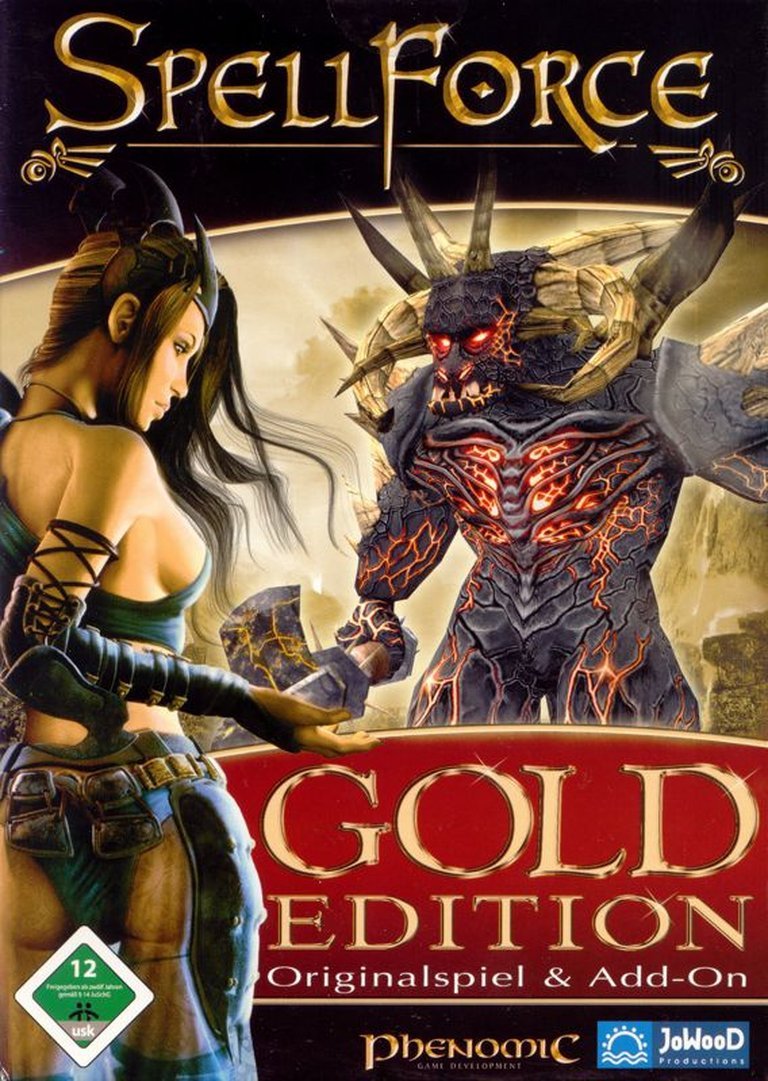
Description
SpellForce: Gold Edition bundles the original SpellForce: The Order of Dawn and its first expansion, The Breath of Winter, delivering a hybrid real‑time strategy and role‑playing experience set in a shattered fantasy world. After a centuries‑long peace is broken by a power‑hungry circle of mages, the world lies in floating fragments linked by magical stones and portals. Players control hero‑avatars such as the mage Rohen, building armies, gathering resources, and exploring the broken continents while rebuilding the Order of Dawn to restore order.
SpellForce: Gold Edition Patches & Updates
SpellForce: Gold Edition Mods
SpellForce: Gold Edition Guides & Walkthroughs
SpellForce: Gold Edition Reviews & Reception
ign.com (85/100): Amalgam of real-time strategy and role-playing elements comes under our scrutiny.
mobygames.com (90/100): Critics gave it a 90% score.
videogamegeek.com (50/100): A compilation boxset of the first SpellForce game and the first add-on pack for it.
SpellForce: Gold Edition Cheats & Codes
PC
Open the in-game console by pressing CTRL and + (or CTRL and ]), then enter the codes.
| Code | Effect |
|---|---|
| Application:SetGodMode(1) | Your protagonist is unkillable! He will still take damage but he will not die anymore. |
| Application:GiveMeGoods(X) | Grants X of every resource for both your light and your dark rune armies. |
| Application:SetNoManaUsage(1) | Spells do not cost mana points anymore. Also applies to enemies! |
| Application:FastHeroCast(1) | Heroes are always summoned on maximum summoning speed. |
| Application:SetBuildingFastBuildMode(1) | Your rune workers will construct buildings almost instantly. |
| Application:SetFigureTechTreeMode(1) | Your rune fighters will not require any buildings to be created. |
| Application:SetBuildingTechTreeMode(1) | Your buildings won’t require any normally required buildings. |
| UnExplored:Enable(0) | Removes the fog of war and allows to see the entire map. |
| Atmosphere:TimeLock(1) | Freezes Sun / Moon In place. In-game timer still carries on, purely visual |
SpellForce: Gold Edition – Review
Introduction
When the first half‑decade of the 2000s saw the rise of both deep, character‑driven RPGs and polished real‑time strategy (RTS) titans, SpellForce: Gold Edition arrived as a bold experiment at the intersection of those two worlds. Bundling the original SpellForce: The Order of Dawn (2003) with its first expansion The Breath of Winter (2004), the Gold Edition offered a single‑player campaign, a skirmish mode, and LAN/Internet multiplayer—all on a single CD‑ROM. My thesis is simple: despite its rough edges, SpellForce’s hybrid design forged a memorable experience that laid the groundwork for a franchise still resonating a two decades later.
Development History & Context
The Studio and Vision
Developed by the German studio Phenomic Game Development, SpellForce was conceived as a “role‑playing strategy” hybrid, a term the team coined to describe the seamless blend of third‑person RPG avatar control with classic RTS base‑building. Phenomic’s ambition was to give players the agency of a Diablo‑style hero while retaining the tactical depth of Warcraft‑era strategy.
Technological Constraints
Released on Windows in December 2003 (EU) and February 2004 (NA), the game ran on DirectX 7/9 with an isometric‑to‑third‑person camera that could zoom from a battlefield overview down to close‑up melee. The engine had to juggle two distinct systems—real‑time combat and resource management—within the limited RAM and CPU budgets of early‑2000s PCs. This led to the “Click‑’‑Fight” control scheme: a single‑click command that simultaneously moved the avatar, issued attack orders, and triggered spell‑casting, a design choice meant to keep the UI uncluttered.
Market Landscape
At the time, the RTS market was dominated by titles like Warcraft III and Age of Empires II, while the RPG market was thriving with Baldur’s Gate II and The Elder Scrolls III: Morrowind. No major release had attempted a true hybrid on PC, making SpellForce a niche but daring entrant. Its publishers—JoWooD Productions, Encore, and later Game Factory Interactive—targeted the European market, where the game’s blend of fantasy lore and strategic depth resonated strongly.
Narrative & Thematic Deep Dive
Core Plot Overview
The story unfolds on the shattered world of Eo, a planet whose continents were ripped apart by the cataclysmic Convocation ritual. Thirteen powerful mages of “the Circle” attempted to bind elemental forces, only to unleash the Eternal Flames that shattered the land into floating islands. Rohen Tahir, a surviving Circle mage, spent decades rebuilding a portal network that kept the fragments connected.
The player assumes the role of a Rune Warrior—an immortal combatant summoned by Rohen via a rune‑stone. Tasked with investigating dark steel “Iron Ones” and thwarting the machinations of The Dark One, the avatar soon discovers that the Dark One is a younger, time‑traveled version of Rohen himself, intent on re‑executing the Convocation to achieve ultimate power. The narrative culminates in a confrontation that reveals a paradoxical time loop: the very act of trying to prevent the Convocation creates it.
Themes and Motifs
- Power and Corruption – The Circle’s lust for the Convocation mirrors classic tales of hubris (e.g., Prometheus). The game asks whether any mortal can safely wield elemental forces.
- Fragmentation and Reconnection – The shattered continents symbolize a world fractured by war; the portal network represents hope through cooperation across races.
- Identity and Immortality – As an immortal Rune Warrior, the player navigates the burden of endless life, echoing mythic figures like the Phoenix.
Characters and Dialogue
Key figures include Sartarius (Order of Dawn leader), Hokan Ashir (necromancer), Urias (Knight commander), and the enigmatic Dark One. The dialogue, while occasionally hampered by uneven voice acting (criticized by GameSpot and IGN), provides enough exposition to convey the high‑fantasy stakes. The writing showcases a blend of grand mythic language and gritty, ground‑level concerns (e.g., supply lines for the surviving islands).
Gameplay Mechanics & Systems
Avatar Development (RPG Loop)
- Stat Allocation – At creation, players distribute points among Strength, Agility, and Intelligence, shaping the avatar as Fighter, Archer, or Magician.
- Skill Trees – Each class unlocks distinct abilities: melee combos for Fighters, precision shots for Archers, and elemental spells for Mages.
- Equipment – Weapons, armor, shields, and accessories provide stat bonuses; rare items appear as loot from quests or as rewards for defeating elite enemies.
Base Building & RTS Loop
- Resource Types – Wood, Stone, Iron, Moonsilver, Aria, Lenya, and Food are harvested via dedicated structures.
- Races and Factions – Light Side (Humans, Dwarves, Elves) vs. Dark Side (Orcs, Trolls, Dark Elves). Each race offers unique units and building upgrades.
- Titan Units – Powerful, expensive “Titan” units act as game‑changing siege engines, requiring specific resources and tech upgrades.
Click‑’‑Fight System
A hallmark innovation, this system merges point‑and‑click RTS commands with the avatar’s direct control. One click can command a squad to move, issue a formation order, or cast a spell, preserving tactical awareness while keeping the hero front‑and‑center.
Quest Structure & Modes
- Main Campaign – Linear series of island‑to‑island main quests, each unlocking new portals and narrative revelations.
- Side Quests – Offer unique equipment, lore tidbits, and optional challenges.
- Freeplay, Skirmish, Multiplayer – Freeplay removes narrative constraints; Skirmish pits the player’s custom army against AI; multiplayer supports LAN/Internet matches for up to ten players.
UI and Accessibility
The interface blends a traditional RTS minimap with an RPG character sheet. While functional, the UI suffers from occasional clutter when managing both avatar abilities and base production simultaneously, a point noted in early reviews.
Flaws and Rough Edges
- Voice Acting – Frequently cited as “some of the worst heard in a while” (IGN).
- Enemy AI – Tends to be predictable, especially in larger battles, reducing tactical tension (GameSpy).
- Plot Choices – The linear narrative offers limited branching, a missed opportunity for deeper RPG agency.
World‑Building, Art & Sound
Visual Direction
SpellForce employs a 3D engine that switches between isometric zoom and a third‑person over‑the‑shoulder view. Environments range from snow‑capped Ice‑Elf strongholds to volcanic Allfire ruins. The art direction emphasizes high‑fantasy archetypes while delivering distinct visual identities for each race—elegant elven forests, grim dwarven strongholds, and brutal orc war‑camps.
Atmosphere and Immersion
Floating islands connected by glowing magical stones and portals create a surreal sense of isolation and wonder. The game’s cinematic cut‑scenes, praised at the German Developer Awards, enhance narrative beats and showcase dynamic lighting effects (e.g., the glow of a Phoenix Stone).
Sound Design
- Composer – Dynamedion crafted a soundtrack that blends orchestral sweeps with ethnic instrumentation, earning “Best Soundtrack and In‑Game Sound” at the 2004 Deutscher Entwicklerpreis.
- Audio Effects – Spellcasting, clashing steel, and elemental roars are crisply rendered, reinforcing each combat encounter’s intensity.
Music and Themes
Motifs recur based on the player’s faction: Light races enjoy uplifting choral themes, while Dark races are underscored by low‑drone, percussive rhythms, reinforcing the moral dichotomy.
Reception & Legacy
Critical Reception
- MobyGames: 90 % critic score (1 rating).
- PC Games (Germany): 90 % – lauded the blend of RPG and RTS.
- IGN: 8.5/10 (user rating) – praised innovative controls but noted voice acting issues.
- GameSpot: 7.9/10 – highlighted unique hybrid gameplay, criticized dialogue.
Aggregated scores hover around 74 % on GameRankings and Metacritic, reflecting a generally favorable but mixed consensus.
Commercial Performance
In Germany, the title sold over 100,000 units by early 2004, indicating strong regional appeal.
Awards and Accolades
- 2004 Deutscher Entwicklerpreis: 1st place for Best Soundtrack, 2nd for Best Cutscenes, 3rd for Best Mid‑Price Game.
- 2005: 2nd place for Best Level and Game Design, 3rd for Best Role‑Playing/Adventure Game.
Influence on Subsequent Titles
SpellForce’s hybrid model inspired later franchises that attempted genre mash‑ups (e.g., Battle Realms, Sacred 2). More importantly, it established a lasting series: SpellForce 2 (2006), SpellForce 3 (2017), and the turn‑based Conquest of Eo (2023). The Gold Edition’s inclusion of the first expansion paved the way for “Gold/Platinum” compilations that became a standard practice for the series.
Community and Longevity
A dedicated fan community maintains extensive lore wikis, maps, and mod tools, ensuring the world of Eo continues to expand beyond its original release. The game’s design has been revisited in modern re‑releases and remasters, evidencing its enduring relevance.
Conclusion
SpellForce: Gold Edition stands as a daring experiment that succeeded more often than it faltered. Its seamless integration of character‑driven RPG progression with full‑scale RTS base management offered a fresh experience at a time when genre silos were the norm. While voice acting and AI shortcomings prevented it from achieving universal acclaim, the game’s compelling narrative—rooted in themes of power, fragmentation, and redemption—combined with its innovative “Click‑’‑Fight” system, earned it a place in the annals of early‑2000s PC gaming.
Verdict: A landmark hybrid that, despite rough edges, laid the foundation for a franchise that still resonates. For historians and gamers alike, SpellForce: Gold Edition is the essential study in how two disparate genres can coexist, inform, and ultimately enrich each other.
Prepared by a professional game journalist and historian, drawing on MobyGames, Wikipedia, IGN, Fandom, and primary source reviews.