
- Release Year: 2004
- Platforms: Macintosh, Windows
- Publisher: 1C Company, Activision Publishing, Inc., Aspyr Media, Inc., MEGA Enterprise Co., Ltd.
- Developer: Fizz Factor, The
- Genre: Action
- Perspective: 3rd-person
- Game Mode: Single-player
- Gameplay: Linear, Melee Combat, Point-and-click, Web traversal
- Setting: City, New York
- Average Score: 76/100
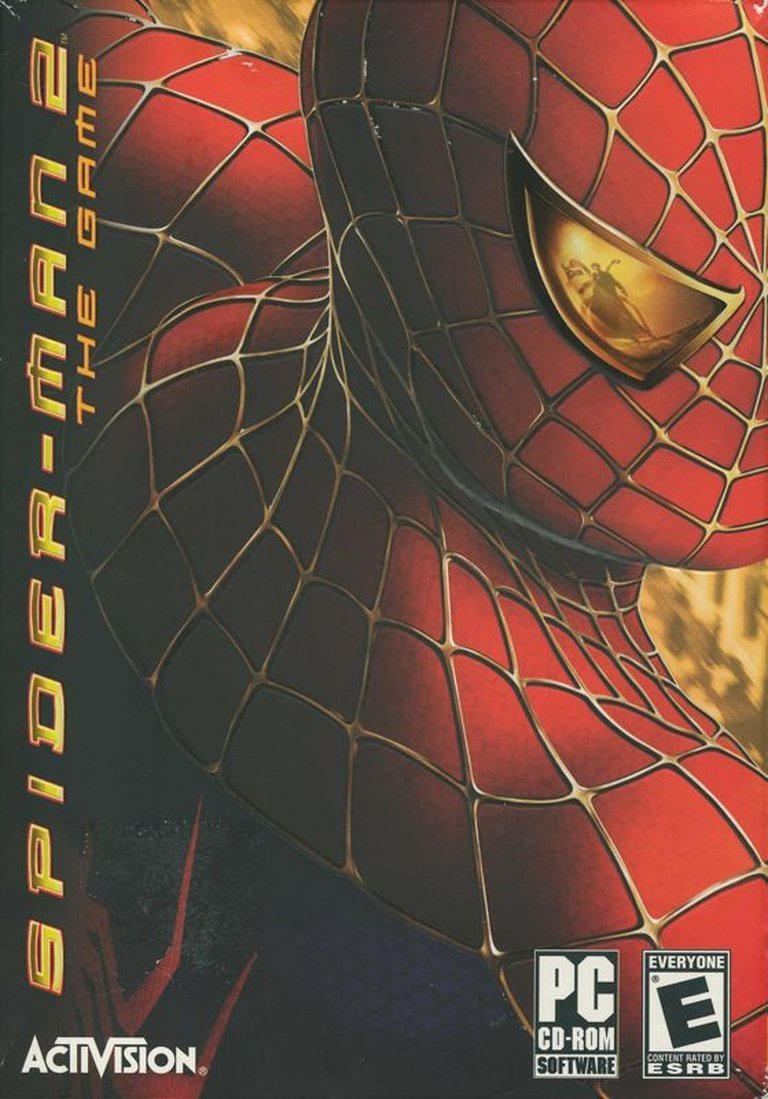
Description
Spider-Man 2: The Game for PC is a distinct, kid-oriented action title set in New York City, where players control Spider-Man across eight chapters of mayhem, battling villains like Rhino, Mysterio, and Doc Ock through a simplified point-and-click interface with web-based attacks and basic combat, diverging from the console version’s free-swinging gameplay.
Gameplay Videos
Spider-Man 2: The Game Free Download
Spider-Man 2: The Game Guides & Walkthroughs
Spider-Man 2: The Game Reviews & Reception
metacritic.com (92/100): Using a masterful combination of web shoot and D-pad combinations you can swing, or zip line vertically or horizontally across rooms. Everything feels so natural, just like a full-size console.
imdb.com (80/100): Vastly improved web swinging, but the fighting is lackluster.
opencritic.com (57/100): Toothless writing, old-fashioned open world design, and ropey port work undermine what should be a thrilling cinematic adventure.
Spider-Man 2: The Game Cheats & Codes
PlayStation 2
Enter codes via the cheats menu in the main menu or as a name when starting a new game.
| Code | Effect |
|---|---|
| HCRAYERT | Start game with over 40% completion, 201,000 Hero points, Swing Speed and Web Zip upgrades, and ranks Big Game Hunter, Alien Buster, Shock Absorber, Tentacle Wrangler. |
| stickyrice | Play as Stickyrice, the thug that killed Spider-Man’s grandfather. |
| CEREBRA | Skip training. |
PC
Type codes in the main menu or during gameplay.
| Code | Effect |
|---|---|
| valgium | Grants 1000 health points. |
| tokesta | Grants 1000 web ammunition. |
| estrotr | Enables double jump ability. |
| putfull | Makes Spider-Man invisible. |
| iwontlikecriminels | Enemies die instantly. |
| flashspidermotor | Completes all levels in the game. |
Xbox
Enter HCRAYERT as a name when starting a new game.
| Code | Effect |
|---|---|
| HCRAYERT | Start game with 40% completion, 200,000 hero points, and upgrades. |
GameCube
Enter codes as a name when starting a new game.
| Code | Effect |
|---|---|
| HCRAYERT | Start with no intro, 20,100 Hero points, Swing Speed 6/8, Web Zip acquired, awards Big Game Hunter, Alien Buster, Shock Absorber, Tentacle Wrangler, and 44.38% completion. |
| SUIVATCO OTTO | Play as Doctor Octopus. |
Spider-Man 2: The Game: A Tale of Two Superheroes
In the annals of licensed video games, few titles embody a schism as profound as Spider-Man 2: The Game. Released in the summer of 2004 to coincide with Sam Raimi’s blockbuster film, it stands not as a single game but as a bifurcated legend: one, a revolutionary open-world masterpiece that redefined superhero gaming; the other, a simplistic, disjointed afterthought that became a archetype of cynical, low-effort PC ports. To analyze this title is to tell two parallel stories—one of ambitious innovation and triumphant fidelity, the other of rushed development and audience alienation. This review will dissect both, exploring how a single license could yield such divergent experiences and solidify a legacy that is simultaneously celebrated and condemned.
Development History & Context: Two Studios, Two Visions
The genesis of Spider-Man 2 is a story of divergent development paths under one publisher, Activision. The console versions (PlayStation 2, Xbox, GameCube) were crafted by Treyarch, a studio buoyed by the commercial success of their 2002 Spider-Man tie-in. Tasked with surpassing their predecessor, Treyarch’s team, led by designer Jamie Fristrom and programmer Andrei Pokrovsky, pursued a singular, groundbreaking goal: a physics-based web-swinging system that felt authentic. Inspired by Rocket Jockey and the open-world freedom of Grand Theft Auto III, they pioneered a mechanic where Spider-Man’s webs attached to actual geometry on buildings, creating momentum-driven, pendulum-like motion. This was a monumental technical challenge solved through ray casting, allowing infinite attachment points without manual placement.
Simultaneously, the PC version was assigned to The Fizz Factor, a smaller studio with a different mandate. Early reports and the final product reveal a game explicitly designed for a younger audience (E for Everyone rating vs. the console’s T for Teen). This decision, likely driven by market perceptions of PC gaming demographics at the time, resulted in a completely different game engine (Unreal Engine 2), a linear level-based structure, and point-and-click controls stripped of analog precision. Where Treyarch built a living city, The Fizz Factor built a series of disconnected stages. The contrast was so stark that Activision’s own packaging for the PC version used nearly identical box art to the console editions, leading to widespread consumer confusion—a fact noted in MobyGames trivia and cited as the basis for GameSpy’s infamous “Bait and Switch Award.”
The development context was a high-stakes Hollywood synergy. The game had to launch simultaneously with the film, imposing a brutal deadline. Treyarch, as documented in oral histories, was forced to cut expansive content—including villains like Lizard, Scorpion, Kraven, and a giant sewer system—to meet this date. The PC version, developed in parallel, seems to have suffered from resource constraints and a prioritization of speed over depth, utilizing recycled assets from prior Spider-Man titles, as bitterly noted by Absolute Games.
Narrative & Thematic Deep Dive: Expansion vs. Truncation
The narrative core, adapted from the film’s script, follows Peter Parker’s struggle to balance his dual life two years after the first film, culminating in his climactic battle with the tragic Doctor Octopus. However, the execution diverges dramatically.
Console Version (Treyarch): This is where the license truly sings. While following the film’s plot beats—Octavius’s fusion accident, the bank heist, the subway train fight, the waterfront lair—Treyarch expanded the world with “side” villains that felt organic to Spider-Man’s rogues’ gallery. Mysterio’s inclusion is particularly brilliant; his “funhouse” level, a direct homage to Spider-Man vs. The Kingpin, provides a spectacular, illusion-filled detour that the film lacked. Black Cat is woven in as a flirtatious rival/ally, exploring themes of identity and responsibility through her urgings for Peter to embrace being Spider-Man full-time. The narrative is delivered through mission-based chapters, with the iconic Bruce Campbell narrating as a sarcastic tour guide, adding a layer of meta-humor that permeates the experience. The story’s conclusion is dynamic, hinging on a “Hero Points” system: a low score yields a somber ending where Peter contemplates quitting, while a high score (50,000 points) unlocks an epilogue affirming his dedication. This system mechanically reinforces the theme: being Spider-Man is a cumulative act of heroism, not just a series of scripted set-pieces.
PC Version (The Fizz Factor): The PC plot is a skeletal, linear outline of the film’s events, awkwardly grafted with villains like Puma in place of Black Cat and Mysterio. Key emotional beats are rushed or absent. The nuanced relationship with Harry Osborn, the tension with J. Jonah Jameson, and the depth of Peter’s internal conflict are largely excised. The story is told through brief, poorly-paced cutscenes and a tutorial narrated by Campbell that feels tacked-on. The inclusion of Mysterio and a floating-city illusion sequence feels like a direct lift from the console version but lacks the build-up or thematic weight. The ending is a single, fixed cutscene mirroring the film’s resolution, with no player agency or reflection of performance. The narrative becomes a disjointed checklist of boss fights—Rhino, Puma, Mysterio, Doc Ock—stripped of the connective tissue that made the console version feel like a living, breathing adventure.
Gameplay Mechanics & Systems: Freedom vs. Futility
This is the definitive chasm between the two versions.
Console Version (Treyarch): The gameplay is a masterclass in open-world design. The physics-based web-swinging is the star. Using the analog stick, players aim and fire webs at real buildings; momentum is conserved, allowing for breathtaking, fluid traversal. The feeling of building speed through a chain of swings, letting go at the apex to soar, and using wall-crawling to change direction is intoxicating and, at the time, revolutionary. Combat, while sometimes criticized as simplistic, is a satisfying 3D brawler with combos, aerial kicks, and the crucial Spider-Sense mechanic (a bullet-time dodge). Progression is tied to Hero Points, earned by stopping random crimes, completing races, delivering pizza, and finding collectibles. This system brilliantly makes the open world meaningful; every intervention feels like a contribution to Peter’s heroic tally. Post-game, earning enough points unlocks an epilogue and a challenging bonus “Warehouse” mode with waves of villains. The design philosophy is one of player agency and emergent gameplay—you are Spider-Man in a city that needs saving, and how you do it is largely up to you.
PC Version (The Fizz Factor): The gameplay is a regression to a simpler, clunkier era. Swinging is relegated to pre-defined glowing orbs in the sky, removing all environmental interaction and momentum. Movement feels robotic and constrained. Combat is a primitive beat-’em-up with one punch, one kick, and a charged “power punch.” There is no combo system, no Spider-Sense, no wall-crawling integrated into fights. Levels are linear corridors from point A to B, a stark departure from the console’s sandbox. The “Hero Points” system exists but is tied purely to linear mission completion, losing its meaning. The interface is point-and-click, with contextual icons (Attack, Swing, Pull) often appearing obscurely or failing to register, as the user review from MobyGames忍耐ly details with the fire hydrant puzzle. The game is extremely short (2-5 hours), with no incentive for replay beyond brute force. The design philosophy is one of minimalist, kiddie-oriented action, where challenge is absent and spectacle is muted.
World-Building, Art & Sound: A Living City vs. A Desolate Stage
Console Version: Manhattan is the game’s other protagonist. It’s a vibrant, living open world with a day-night cycle, traffic, pedestrians who react to Spider-Man, and distinct boroughs. The art direction captures the film’s slightly gritty, realistic aesthetic with a comic-book sheen. The scale is impressive; looking down from the Empire State Building and seeing the city sprawl is a core part of the fantasy. Sound design is a highlight: web-thwips, impactful punches, the creak of buildings during swings, and a dynamic soundtrack that swells during chases and battles. Tobey Maguire, Kirsten Dunst, and Alfred Molina reprise their roles, lending crucial cinematic authenticity. Bruce Campbell’s narration is a constant, witty companion.
PC Version: The world is a series of repetitive, flat textures and empty city streets. As Computer Bild Spiele noted, Manhattan is a “tristes Pflaster aus monotonen Hochhäusern und ausgestorbenen Straßen” (a sad paving of monotonous skyscrapers and deserted streets). There are almost no pedestrians or cars, killing any sense of life. The visual style is drab and dated even for 2004, with heavy reliance on recycled assets. Sound is universally panned: tacky effects, an almost nonexistent soundtrack, and voice work that ranges from passable (Spider-Man) to dreadful, with an extremely limited pool of enemy taunts. The iconic film score is absent, replaced by silence or generic tunes. The game feels like a hollow shell of its cinematic counterpart.
Reception & Legacy: A Chasm of Critical Opinion
The critical reception was a study in contrasts, perfectly mapped by Metacritic scores:
* PS2/Xbox/GameCube: 80-83/100 (Universal acclaim)
* PC: 42-77/100 (Generally unfavorable, with most outlets scoring in the 30-50% range)
* Handhelds (GBA/DS/PSP): 61-67/100 (Mixed/average)
Console Legacy: The Treyarch version is enshrined as one of the greatest superhero games ever made. It pioneered the open-world superhero genre, with its swinging mechanic remaining the gold standard for over a decade (a legacy directly cited by Insomniac’s Marvel’s Spider-Man). It won numerous “Best of 2004” awards, received IGN’s Editor’s Choice, and is frequently listed in “Top 100” rankings. Its influence is undeniable, proving that a movie license could be the foundation for a deep, engaging game rather than a shallow cash-grab.
PC Legacy: The Fizz Factor version is remembered as one of the worst major PC ports in history. It received awards like Computer Games Magazine’s “Worst Game of the Year” and GameSpy’s “Bait and Switch Award.” It is a permanent fixture on “worst ports” lists (like PC Gamer’s) and a cautionary tale about platform-specific development. Its reputation has only worsened with time; the gap between its promise (the box art) and its reality is legendary. The modding community has kept it alive with patches, but this is a testament to the搪塞 of its original state, not its quality.
Commercially, the console versions were massive hits, shipping over 2 million units in North America within weeks and driving significant revenue for Activision. The PC version’s sales figures are obscure but were clearly dwarfed by its console siblings.
Conclusion: The Definitive Verdict
Spider-Man 2: The Game cannot be reviewed as a monolith. To do so is a disservice to the brilliance of Treyarch’s work and the injustice done by The Fizz Factor.
The Console Version (PS2, Xbox, GameCube) is a landmark achievement. It captured the exhilarating fantasy of being Spider-Man with unprecedented freedom. Its open-world design, physics-based swinging, and integration of side-content created a systemic playground that respected the player’s intelligence and desire for heroic expression. While its combat and mission variety could be repetitive, the core loop of swinging through a vibrant, reactive Manhattan was—and for many, still is—magic. It set the template for a generation of superhero games and stands as a high-water mark for movie adaptations.
The PC Version is a profound failure. It takes the elements that made the console version great—the open world, the fluid movement, the rich side content—and systematically dismantles them, replacing them with a shallow, linear, and frustrating experience. Its controls are unresponsive, its world is dead, its story is truncated, and its combat is brain-dead. It is not merely a “bad port”; it is a fundamentally different, inferior game that betrays the spirit of its license and the expectations of consumers misled by its packaging.
Final Verdict: There are two Spider-Man 2 games from 2004. One is an essential classic, a 9/10 masterpiece of design that belongs in the conversation of the greatest superhero games ever made. The other is a detailed case study in development negligence, a 2/10 embarrassment that serves as a stark warning about platform complacency and audience cynicism. The legacy of Spider-Man 2: The Game is this breathtaking duality: the towering success of one vision, and the ignominious failure of another, forever intertwined by a shared name and release date.