
- Release Year: 2009
- Platforms: Windows
- Publisher: media Verlagsgesellschaft mbH
- Genre: Compilation
- Game Mode: Single-player
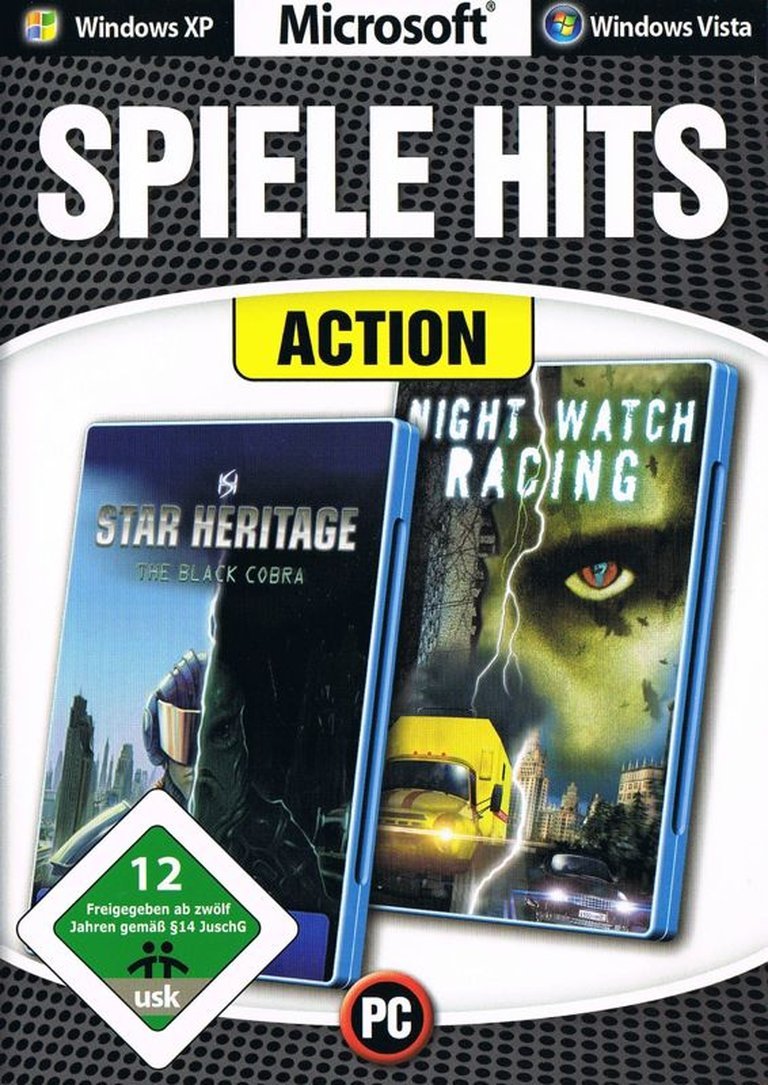
Description
Spiele Hits: Action is a retail compilation released in 2009 for Windows, featuring two action-packed games: Mafia Racing, a high-speed racing game with a criminal twist, and Star Heritage 1: The Black Cobra, an adventure game with a mix of strategy and action elements. This collection offers a diverse gaming experience, blending fast-paced driving with immersive storytelling, all packaged in a single DVD-ROM for fans of action and adventure genres.
Spiele Hits: Action: A Forgotten Relic of the Budget Compilation Era
Introduction
In the annals of video game history, Spiele Hits: Action (2009) stands as a curious artifact—a budget compilation that encapsulates the late 2000s era of German gaming culture, where physical media still reigned supreme and publishers sought to capitalize on the thriving market for affordable, bundled experiences. Released on April 10, 2009, by media Verlagsgesellschaft mbH, this unassuming DVD-ROM title is a time capsule of an industry in transition, offering a glimpse into the kinds of games that filled the shelves of European electronics stores during a year otherwise dominated by blockbuster franchises like Call of Duty: Modern Warfare 2, Uncharted 2: Among Thieves, and Dragon Age: Origins. While Spiele Hits: Action may lack the prestige or innovation of its contemporaries, its existence is a testament to the diversity of the gaming landscape—a reminder that not every release was a AAA spectacle, and that there was (and still is) a market for humble, no-frills entertainment.
This review will dissect Spiele Hits: Action in exhaustive detail, exploring its development context, the games it bundles, its reception (or lack thereof), and its place in the broader history of video game compilations. By the end, we will determine whether this title is a hidden gem, a forgettable footnote, or something more complex—a symbol of an era when gaming was as much about accessibility as it was about ambition.
Development History & Context
The Publisher: media Verlagsgesellschaft mbH
Spiele Hits: Action was published by media Verlagsgesellschaft mbH, a German company with a long history of distributing budget software, including games, educational titles, and productivity tools. Founded in 1986, media Verlagsgesellschaft (often abbreviated as MVG) was a key player in the European market, particularly in Germany, where it specialized in compiling and repackaging existing software into affordable collections. The company’s business model thrived on the idea of bundling multiple titles—often older or lesser-known games—into single, low-cost packages, making them appealing to casual gamers, families, or anyone looking for a quick, inexpensive way to expand their library.
MVG’s Spiele Hits (German for “Game Hits”) series was one of its most recognizable brands. The series dated back to the late 1990s, with earlier entries like Spiele-Hits (1997) and 10 Spiele-Hits Vol. 1 (2003) targeting DOS and early Windows platforms. By the late 2000s, the series had evolved to focus on Windows-based titles, reflecting the shift away from DOS and the growing dominance of CD-ROM and DVD-ROM media. Spiele Hits: Action was part of this lineage, positioned as an “action”-themed entry in a broader catalog of compilations that included strategy, puzzle, and family-oriented collections.
The Gaming Landscape of 2009
To understand Spiele Hits: Action, it’s essential to contextualize the gaming industry in 2009. This was a year of monumental releases, with titles like Batman: Arkham Asylum, Demon’s Souls, Borderlands, and Minecraft (in its alpha stage) redefining their respective genres. The console market was dominated by the PlayStation 3, Xbox 360, and Wii, while PC gaming was experiencing a renaissance thanks to digital distribution platforms like Steam, which had launched in 2003 but was only beginning to gain mainstream traction.
Yet, despite the rise of digital storefronts, physical media remained a significant force, particularly in regions like Germany, where retail sales were still robust. Budget compilations like Spiele Hits: Action catered to a demographic that may not have had reliable internet access or the inclination to purchase games digitally. These compilations were often sold in electronics stores, supermarkets, or even gas stations, targeting impulse buyers or parents looking for affordable gifts.
The year 2009 also saw the release of several other notable compilations, such as The Orange Box (2007, but still widely available), Grand Theft Auto Double Pack, and Metroid Prime Trilogy. However, these were premium products, often bundling critically acclaimed titles. Spiele Hits: Action, by contrast, was a budget offering, aimed at a different audience entirely.
Technological Constraints and Design Philosophy
Spiele Hits: Action was released on DVD-ROM, a format that was standard for PC games at the time but was already showing signs of obsolescence as digital downloads became more prevalent. The compilation’s technical requirements were modest, reflecting the games it bundled—Mafia Racing (2005) and Star Heritage 1: The Black Cobra (2005)—both of which were several years old by 2009. This was a common practice in budget compilations: publishers would license older titles, often from smaller developers, and repackage them under a new brand.
The design philosophy behind Spiele Hits: Action was straightforward: provide two distinct action games in a single, affordable package. There was no unified launcher, no additional content, and no attempt to integrate the games into a cohesive experience. Instead, the compilation relied on the individual merits of its included titles, banking on the idea that the sum of its parts would justify its price point.
Narrative & Thematic Deep Dive
The Games: Mafia Racing and Star Heritage 1: The Black Cobra
Spiele Hits: Action is, at its core, a vessel for two games: Mafia Racing and Star Heritage 1: The Black Cobra. To understand the compilation’s narrative and thematic elements, we must examine each title individually, as the compilation itself does not impose any overarching story or unifying theme beyond the loose “action” label.
Mafia Racing (2005)
Mafia Racing is a street racing game developed by an unknown studio (credits are not readily available, a common issue with budget titles). The game’s premise is simple: players take on the role of an up-and-coming street racer in a city controlled by the mafia. The narrative, such as it is, revolves around climbing the ranks of the underground racing scene, earning respect, and ultimately taking down the mafia’s control over the city’s streets.
Themes and Storytelling:
– Crime and Redemption: The game’s mafia-centric plot is a familiar trope in action games, drawing inspiration from films like The Fast and the Furious and Gone in 60 Seconds. The protagonist is not a hero but an antihero, navigating a morally gray world where success is measured in speed and ruthlessness.
– Underdog Narrative: The story follows a classic underdog arc, with the player starting as a nobody and working their way up to challenge the mafia’s top racers. This theme is reinforced through the game’s progression system, where winning races unlocks new cars and upgrades.
– Minimal Dialogue and Cutscenes: Like many budget titles, Mafia Racing relies more on gameplay than narrative depth. Cutscenes are sparse, and dialogue is often limited to pre-race taunts and post-race congratulations. The story is secondary to the racing mechanics, serving as little more than a backdrop for the action.
Characters:
– The Protagonist: A silent, customizable racer whose personality is defined by the player’s choices in car customization and racing style.
– Mafia Bosses: Generic antagonists who serve as the final bosses in each racing tier. Their designs and personalities are archetypal, drawing from mobster stereotypes.
– Rival Racers: A rotating cast of opponents, each with their own car and racing style, but little in the way of distinct personalities or backstories.
Dialogue and Localization:
Given that Mafia Racing was originally released in 2005, it’s likely that the game was developed with an international audience in mind. The dialogue is simple and direct, avoiding complex cultural references that might not translate well. The German localization in Spiele Hits: Action would have been straightforward, as the game’s narrative is not heavily text-dependent.
Star Heritage 1: The Black Cobra (2005)
Star Heritage 1: The Black Cobra is a space combat and trading simulation game, blending elements of Elite and Wing Commander. Players take on the role of a starship pilot in a galaxy on the brink of war, navigating a complex web of political intrigue, piracy, and interstellar conflict.
Themes and Storytelling:
– Space Opera and Political Intrigue: The game’s narrative is steeped in classic space opera tropes, with a galaxy divided between warring factions, each vying for control of valuable resources and strategic territories. The player’s actions can influence the balance of power, though the game’s branching narrative is limited compared to more ambitious titles like Mass Effect.
– Exploration and Discovery: A core theme of Star Heritage is the thrill of exploration. The game features a vast, procedurally generated galaxy, encouraging players to venture into uncharted systems, discover hidden bases, and uncover the secrets of the “Black Cobra,” a mysterious ship tied to the game’s central conflict.
– Moral Ambiguity: Unlike Mafia Racing, which has a clear (if simplistic) narrative arc, Star Heritage allows for more player agency. Players can align with different factions, engage in piracy, or remain neutral, with each choice affecting their reputation and the story’s outcome. This moral flexibility is a hallmark of the space sim genre.
Characters:
– The Protagonist: A customizable pilot whose backstory is minimal, allowing players to project their own motivations onto the character. The protagonist’s alignment (e.g., mercenary, rebel, or loyalist) is determined by in-game choices.
– Faction Leaders: Each major faction has a leader with distinct personalities and agendas. These characters are more developed than those in Mafia Racing, with unique dialogue trees and questlines.
– The Black Cobra: The eponymous ship is both a MacGuffin and a symbol of the game’s central mystery. Its origins and purpose are gradually revealed through side missions and exploration.
Dialogue and Localization:
Star Heritage features more text and dialogue than Mafia Racing, with mission briefings, faction interactions, and in-game emails providing context for the player’s actions. The German localization in Spiele Hits: Action would have required careful translation to preserve the game’s political and scientific terminology, though budget constraints may have limited the depth of localization.
The Compilation’s Thematic Cohesion (or Lack Thereof)
Spiele Hits: Action does not attempt to unify Mafia Racing and Star Heritage under a single theme. The two games are thematically disparate—one is a grounded, street-level racing game, while the other is a high-concept space opera. The only common thread is their classification as “action” games, a broad genre that encompasses everything from racing to combat simulators.
This lack of cohesion is not a flaw but a reflection of the compilation’s purpose: to offer variety. Budget compilations like Spiele Hits: Action were not designed to tell a single story or explore a unified theme. Instead, they were meant to provide a sampling of different experiences, appealing to a wide range of tastes. In this sense, the compilation’s thematic diversity is its strength, offering something for both fans of fast-paced racing and strategic space combat.
Gameplay Mechanics & Systems
Mafia Racing: Street Racing with a Criminal Edge
Core Gameplay Loop:
Mafia Racing follows the standard street racing formula: players compete in a series of races, earning money and reputation to unlock new cars, upgrades, and racing tiers. The game’s progression is linear, with each race serving as a gateway to the next.
Racing Mechanics:
– Arcade-Style Handling: The game’s physics are arcade-like, prioritizing accessibility over realism. Cars handle loosely, with exaggerated drifts and minimal consequences for collisions.
– Nitro Boosts: A staple of the genre, nitro boosts allow players to gain temporary speed advantages, adding a tactical element to races.
– Police Chases: Some races trigger police pursuits, requiring players to evade law enforcement while maintaining their lead. These segments are simplistic, with police AI that is easy to outmaneuver.
Progression and Customization:
– Car Upgrades: Players can upgrade their vehicles with better engines, tires, and nitro systems. The upgrade system is straightforward, with no complex tuning mechanics.
– Visual Customization: The game offers basic visual customization options, such as paint jobs and decals, though the selection is limited compared to more polished titles like Need for Speed: Underground.
UI and Presentation:
The game’s UI is functional but unremarkable, with menus that are easy to navigate but lack polish. The HUD during races displays essential information (speed, position, nitro meter) without cluttering the screen.
Innovations and Flaws:
– Innovations: Mafia Racing does not introduce any groundbreaking mechanics. Its appeal lies in its simplicity and the mafia-themed setting, which adds a thin layer of narrative context to the racing.
– Flaws: The game’s biggest weaknesses are its repetitive structure and lack of depth. Races follow the same formula, and the mafia narrative does little to differentiate the experience from other street racing games. The AI is also predictable, with opponents that rarely pose a serious challenge.
Star Heritage 1: The Black Cobra: A Space Sim with Ambition
Core Gameplay Loop:
Star Heritage is a hybrid of space combat and trading simulation, with players balancing missions, exploration, and economic management. The core loop involves accepting missions from factions, traveling between star systems, engaging in combat or trade, and using the proceeds to upgrade their ship.
Combat Mechanics:
– Ship Customization: Players can outfit their ship with a variety of weapons, shields, and engines, allowing for different playstyles (e.g., heavy combat, stealth, or speed).
– Tactical Combat: Combat is real-time but tactical, with players needing to manage energy distribution between weapons, shields, and engines. The game lacks the twitch reflexes of a dogfighting sim, instead emphasizing strategy and positioning.
– Faction Allegiances: Combat encounters are influenced by the player’s reputation with different factions. Attacking a faction’s ships will lower your standing, potentially locking you out of missions or trade opportunities.
Exploration and Trading:
– Procedurally Generated Galaxy: The game features a large, procedurally generated galaxy with hundreds of star systems to explore. Each system has its own economy, with prices for goods fluctuating based on supply and demand.
– Trading Mechanics: Players can buy low and sell high, transporting goods between systems to turn a profit. The trading system is simplified compared to deeper sims like EVE Online, but it adds a layer of strategy to the gameplay.
– Side Missions and Secrets: Exploration is rewarded with hidden missions, derelict ships, and the occasional Easter egg. The “Black Cobra” mystery is tied to these exploration elements, encouraging players to venture off the beaten path.
UI and Presentation:
The UI is more complex than Mafia Racing’s, reflecting the game’s deeper mechanics. The galaxy map, trading interface, and ship customization screens are functional but can be overwhelming for newcomers. The HUD during combat is clear, displaying shield status, weapon energy, and target information.
Innovations and Flaws:
– Innovations: Star Heritage stands out for its ambition, attempting to blend combat, trading, and exploration into a single package. The procedurally generated galaxy and faction system add replayability, while the “Black Cobra” mystery provides a narrative hook.
– Flaws: The game’s biggest issue is its lack of polish. The combat can feel sluggish, the trading mechanics are shallow compared to dedicated trading sims, and the procedural generation lacks the handcrafted detail of games like Elite Dangerous. The mission structure is also repetitive, with many quests boiling down to “go here, shoot this, return.”
The Compilation’s Gameplay Experience
Spiele Hits: Action does not integrate the two games in any meaningful way. There is no shared progression, no cross-game unlocks, and no attempt to create a unified experience. Instead, the compilation serves as a delivery mechanism, allowing players to install and play each game independently.
This approach has its advantages:
– Variety: Players get two distinct gameplay experiences in one package.
– Accessibility: The lack of integration means that players can jump into either game without needing to engage with the other.
– Value: For the price of a single premium game, players get two full (if older) titles.
However, it also has drawbacks:
– No Synergy: The games do not complement each other, making the compilation feel like a hodgepodge rather than a curated experience.
– Aging Designs: Both Mafia Racing and Star Heritage show their age, with mechanics and presentation that feel dated compared to 2009’s newer releases.
– Lack of Innovation: Neither game introduces mechanics that were groundbreaking in 2005, let alone 2009. The compilation is a snapshot of mid-2000s budget gaming, not a showcase of innovation.
World-Building, Art & Sound
Mafia Racing: Gritty Streets and Generic Aesthetics
Setting and Atmosphere:
Mafia Racing is set in a generic urban environment, with races taking place in city streets, industrial zones, and highway systems. The game’s world is not particularly immersive, with repetitive environments and a lack of distinctive landmarks. The mafia theme is more of a narrative device than a world-building element, with the game’s aesthetic leaning more toward Fast & Furious than The Godfather.
Visual Direction:
– Car Models: The cars are detailed enough to be recognizable, but the models lack the polish of higher-budget racing games. Textures are low-resolution, and damage modeling is minimal.
– Environments: The tracks are functional but uninspired, with little variation between races. The cityscape is generic, with buildings and props that repeat frequently.
– Lighting and Effects: The game’s lighting is basic, with no dynamic effects. Particle effects for smoke, sparks, and nitro boosts are serviceable but not impressive.
Sound Design:
– Engine Sounds: The car engines sound adequate, though they lack the depth and variation of more realistic racing sims.
– Music: The soundtrack consists of generic rock and electronic tracks, designed to pump up the player but lacking memorability.
– Voice Acting: The voice acting is minimal, with most dialogue limited to race announcements and mafia boss taunts. The performances are competent but not standout.
Contribution to Experience:
The art and sound in Mafia Racing are functional but forgettable. The game’s world is not immersive, and the presentation does little to elevate the racing mechanics. The mafia theme is underutilized, serving as little more than window dressing.
Star Heritage 1: The Black Cobra: A Galaxy of Missed Potential
Setting and Atmosphere:
Star Heritage takes place in a sprawling, procedurally generated galaxy, with players traveling between star systems that range from bustling trade hubs to lawless pirate dens. The game’s world is more ambitious than Mafia Racing’s, with a greater emphasis on exploration and discovery. However, the procedural generation lacks the handcrafted detail that makes games like No Man’s Sky or Elite Dangerous feel alive.
Visual Direction:
– Ship Designs: The ships are functional but lack personality. Each faction has a distinct design language, but the models are simplistic, with low-poly counts and basic textures.
– Star Systems: The star systems are procedurally generated, with planets, asteroids, and space stations that vary in layout but not in detail. The lack of handcrafted landmarks makes the galaxy feel samey after a few hours.
– Lighting and Effects: The game’s lighting is basic, with no dynamic effects. Space combat lacks the visual spectacle of games like Freelancer or X-Wing vs. TIE Fighter, with explosions and weapon effects that are underwhelming.
Sound Design:
– Ship Sounds: The ship engines and weapons sound adequate, though they lack the punch of more polished space sims.
– Music: The soundtrack is atmospheric, with ambient tracks that suit the game’s exploration themes. However, the music is repetitive, with only a handful of tracks that loop frequently.
– Voice Acting: The voice acting is more extensive than in Mafia Racing, with mission briefings and faction interactions featuring fully voiced dialogue. The performances are competent but not exceptional, with some lines delivered in a stiff, unnatural manner.
Contribution to Experience:
The art and sound in Star Heritage are more ambitious than those in Mafia Racing, but they suffer from the same issues: a lack of polish and depth. The procedurally generated galaxy is impressive in scope but lacks the detail and personality to make it feel alive. The sound design is functional but unmemorable, with music and voice acting that serve their purpose without standing out.
The Compilation’s Aesthetic Identity
Spiele Hits: Action does not have a unified aesthetic identity. The two games are visually and aurally distinct, with Mafia Racing’s gritty street racing contrasting sharply with Star Heritage’s sci-fi exploration. The compilation’s cover art (which is not widely available but likely featured generic action imagery) would have been the only attempt to tie the two games together visually.
This lack of cohesion is not necessarily a negative. The compilation’s appeal lies in its variety, and the contrasting aesthetics of the two games ensure that players get two distinct experiences. However, it also means that Spiele Hits: Action lacks the curated feel of more premium compilations like The Orange Box or Metroid Prime Trilogy, where the included games share a common visual and thematic language.
Reception & Legacy
Critical Reception: The Silence of the Budget Title
Spiele Hits: Action received no critical reviews upon its release, a common fate for budget compilations. Major gaming outlets like IGN, GameSpot, and Metacritic did not cover the title, and there are no user reviews on platforms like Steam or MobyGames. This lack of coverage is not surprising—budget compilations were rarely reviewed, as they were seen as disposable products rather than serious gaming experiences.
The absence of reviews does not necessarily indicate that Spiele Hits: Action was poorly received. Instead, it reflects the compilation’s target audience: casual gamers, families, or bargain hunters who were not engaged with gaming media. For these players, the appeal of Spiele Hits: Action lay in its affordability and the simple pleasure of having two games in one package.
Commercial Performance: A Niche Product
Spiele Hits: Action was likely a modest commercial success, selling enough copies to justify its existence but not enough to make a significant impact on the market. Budget compilations like this were not designed to be blockbusters; they were meant to be steady sellers, appealing to a niche audience that valued quantity over quality.
The compilation’s commercial performance would have been tied to its distribution. In Germany, where MVG had a strong retail presence, Spiele Hits: Action would have been available in electronics stores, supermarkets, and other outlets that catered to casual gamers. Its DVD-ROM format made it easy to stock and sell, and its low price point made it an impulse buy for many consumers.
Legacy: A Footnote in Gaming History
Spiele Hits: Action has no lasting legacy in the gaming industry. It is not remembered as a classic, nor did it influence the development of future games. Instead, it is a footnote—a relic of an era when physical media and budget compilations were still viable business models.
However, the compilation’s obscurity does not diminish its historical significance. Spiele Hits: Action is a snapshot of the late 2000s gaming landscape, a time when digital distribution was on the rise but physical media still dominated. It represents the kind of product that filled the gaps between major releases, catering to an audience that was often overlooked by mainstream gaming media.
In this sense, Spiele Hits: Action is a valuable artifact for game historians. It reminds us that not every game was a AAA blockbuster, and that the industry’s diversity extended far beyond the titles that dominated headlines and award ceremonies.
Conclusion: The Verdict on Spiele Hits: Action
Spiele Hits: Action is not a great game—it is not even a particularly good one. It is, however, an important one, at least in the context of gaming history. As a budget compilation, it serves as a time capsule of an era when physical media was king, when casual gamers and bargain hunters were a significant market, and when not every release needed to be a polished, critically acclaimed masterpiece.
The compilation’s strengths lie in its simplicity and variety. Mafia Racing and Star Heritage 1: The Black Cobra are not groundbreaking titles, but they offer distinct experiences that would have appealed to different kinds of players. For the price of a single premium game, Spiele Hits: Action delivered two full (if older) titles, making it a compelling value proposition for its target audience.
Its weaknesses are equally clear. Neither game is particularly innovative or polished, and the compilation itself lacks the cohesion and curation of more premium offerings. The presentation is dated, the mechanics are simplistic, and the narrative depth is minimal. For players accustomed to the high production values of 2009’s major releases, Spiele Hits: Action would have felt like a step backward.
Yet, to dismiss Spiele Hits: Action as a forgettable relic would be to overlook its cultural significance. It is a product of its time—a time when gaming was more diverse, more accessible, and more willing to cater to niche audiences. In an industry that increasingly prioritizes blockbuster releases and digital distribution, Spiele Hits: Action is a reminder of a different era, one where budget compilations and physical media played a vital role in shaping the gaming landscape.
Final Verdict:
Spiele Hits: Action is a historically significant but ultimately forgettable compilation. It is not a game that will be remembered for its innovation, its storytelling, or its gameplay. Instead, it will be remembered as a symbol of an era—a time when gaming was as much about accessibility and variety as it was about ambition and polish. For historians and collectors, it is a valuable artifact. For everyone else, it is a curiosity—a glimpse into a world that no longer exists.
Score: 5/10 – A Nostalgic Curiosity, But Little More
Spiele Hits: Action is not a game that will change your life, but it is a game that tells a story—a story about the diversity of the gaming industry, the importance of budget titles, and the enduring appeal of physical media. In that sense, it is worth remembering, even if it is not worth playing.