
- Release Year: 1995
- Platforms: DOS, Game Boy, Genesis, SNES, Windows
- Publisher: Infogrames Europe SA, Infogrames, Inc.
- Developer: Bit Managers S.L., Infogrames Europe SA
- Genre: Action
- Perspective: Side view
- Game Mode: Single-player
- Gameplay: Platforming, Shooting
- Setting: City Streets, Jungle, Rooftops, Subway, Swamp, Toy Store
- Average Score: 66/100
Description
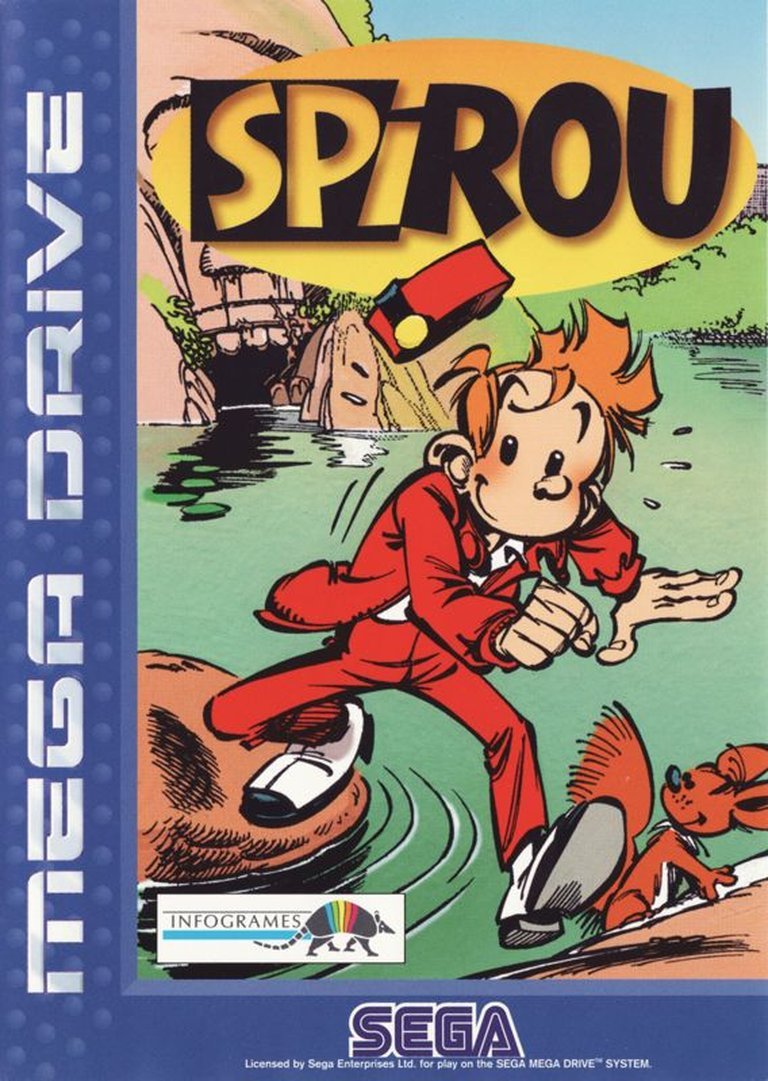
Spirou is a platform side-scroller based on the popular Franco-Belgian comic Spirou et Fantasio, where journalist Spirou and his pet squirrel Spip rush to rescue the abducted inventor Count of Champignac from the evil robot woman Cyanida. Players navigate over 12 diverse levels set in locations like city streets, rooftops, a toy store, subway, swamp, and jungle, using jumps, climbs, and a gun acquired later to overcome obstacles, enemies, and harsh difficulty with limited lives and no continues.
Gameplay Videos
Spirou Free Download
Spirou Reviews & Reception
mobygames.com (78/100): Awesome and fun!
Spirou Cheats & Codes
Super Nintendo
Passwords: Enter at main menu. Pro Action Replay and Game Genie codes: Enter via cheat device or emulator.
| Code | Effect |
|---|---|
| Cyanida, Fantasio, Count Champignac, Spip | Access to The Chase level |
| 7E0476:BE | Invulnerability |
| 7E0640:05 | Unlimited Health |
| 7E064C:09 | Unlimited Lives |
| 7E0642:9C | Unlimited Piccolo Hats |
| 7E0EF4:01 | Debug Menu (Press Select during gameplay) |
| DD64-1DA4 | Debug Menu (Press Select during gameplay) |
| 7DA4-14A5 | High Jump |
| F0A4-14A5 | Super High Jump |
| DAA4-14A5 | Ultra High Jump |
Game Boy
On the main menu, select Password and enter the sequence.
| Code | Effect |
|---|---|
| Spirou, Cyanida, Fantasio | Roofs (Easy) |
| Cyanida, Count Champignac, Fantasio | Roofs (Hard) |
| Count Champignac, Spip, Spirou | Roofs (Normal) |
| Cyanida, Spirou, Spip | The Swamp (Easy) |
| Fantasio, Cyanida, Count Champignac | The Swamp (Hard) |
| Spip, Count Champignac, Fantasio | The Swamp (Normal) |
PC
On the main menu, select Password and enter the sequence.
| Code | Effect |
|---|---|
| Count de Champignac – Spip – Cyanure – Spirou |
Spirou: A Flawed Gem of 16-Bit Platforming
Introduction: The Promise of a Franco-Belgian Icon
In the mid-1990s, the European video game industry, particularly French publisher Infogrames, was in a golden age of comic book adaptations. Following the successful trajectories of The Smurfs and The Adventures of Tintin, the house of Infogrames turned its gaze to another pillar of Belgian comics: Spirou et Fantasio. The promise was immense: a vibrant, action-packed platformer starring the iconic red-uniformed journalist, his friend Fantasio, and his pet squirrel Spip, with art that would make the pages of the Spirou magazine leap onto the screen. Released in 1995 for the Sega Mega Drive/Genesis and subsequently ported to the Super Nintendo, Game Boy, DOS, and Windows, Spirou arrived with a swell of anticipation from fans of the series. Yet, what emerged was one of the most polarizing titles of the 16-bit era—a game whose soaring artistic ambitions were tragically grounded by a cascade of punishing design decisions. This review will argue that Spirou stands as a fascinating, deeply flawed artifact: a technically impressive showcase of sprite work and animation that is ultimately crippled by archaic, often cruel, game design philosophies. It is a game that deserves analysis not necessarily for its quality as a playable experience, but for what it reveals about the design priorities and technological constraints of its time and studio.
Development History & Context: Infogrames and the Engine of Adaptation
Spirou was developed by Infogrames Europe SA, with the Game Boy version handled by Spanish studio Bit Managers S.L. The project was helmed by producer Bruno Bonnell—a name synonymous with Infogrames’ output during this period—and designed by Rodolphe Furykiewicz (credited as Rudolphe Furykiewicz in some sources). The development team was sizable, with 24 credited individuals on the SNES version alone, spanning programming, graphics, sound, and production.
Infogrames in the mid-90s operated on a familiar formula: secure a major European comic license, task a team with creating a vibrant, faithful-looking game, and prioritize a certain level of challenge that, at the time, was often conflated with “replay value” and “hardcore credentials.” The studio was prolific, having recently released Tintin in Tibet (1994) and The Smurfs (1993), and would soon follow with Prisoners of the Sun (1996). Spirou fits squarely within this lineage, sharing many team members and a common design DNA. The vision was clearly to capture the energetic, cartoonish spirit of the source material, which, according to trivia, was primarily inspired by the 1992 Spirou animated series rather than the original comics—explaining the specific “tomboy” design of the villainess Cyanida (Cyanure in French).
Technologically, the game was developed for the tail end of the 16-bit lifecycle. The Mega Drive/Genesis and SNES were well-understood platforms, but their limitations were stark compared to the looming 3D revolution. The focus, therefore, was on maximizing 2D sprite capabilities: parallax scrolling, large character sprites with numerous animation frames, and colorful, varied backgrounds. The simultaneous release on multiple platforms (with the Mega Drive version preceding the SNES version by a year) speaks to the commercial strategy of covering all major Western markets. A planned Game Gear version by Bit Managers was cancelled, though a prototype later leaked—a common fate for many licensed games of the era where handheld versions were often simplified ports.
The gaming landscape of 1995 was transitioning. Platformers were no longer the undisputed kings of the market, with 3D franchises like Super Mario 64 on the horizon. Yet, in Europe, 2D platformers, especially those based on familiar properties, remained commercially viable. Spirou was competing not just with other Infogrames titles, but with Capcom’s Mega Man series, Nintendo’s Donkey Kong Country, and the relentless difficulty of games like Battletoads. Its design choices must be viewed through this lens: an attempt to carve out a niche with a beloved character, using state-of-the-art (for the time) visuals to mask, or perhaps justify, a punishingly old-school difficulty curve.
Narrative & Thematic Deep Dive: A Standard Rescue with Comic Flair
The plot of Spirou is a straightforward, almost archetypal, comic book adventure. It begins in New York City, where journalist Spirou and his friend Fantasio have arrived for an international scientific conference. Their benefactor, the eccentric inventor Count of Champignac, has been abducted by the villainous robot Cyanida. Her motivation is world domination: she intends to use the Count’s inventions to enslave humanity under a robot regime.
Narratively, the game is simple but effective. Cyanida is lifted directly from the comics and the 1992 cartoon, a recurring antagonist with a clear, grandiose goal. The separation of the duo—Spirou pursuing while Fantasio gathers intelligence—provides a canonical excuse for the solo gameplay, with Fantasio occasionally appearing in brief cutscenes or providing items (like the Micropulser gun). The settings are a greatest-hits tour of Spirou comic locales: the streets and rooftops of New York, a chaotic toy store, the claustrophobic subway, the Palombian swamp, and dense jungles. This globe-trotting adventure aligns perfectly with the serialized nature of the comics.
Thematically, the game touches on classic Spirou concerns: the conflict between chaotic human ingenuity (embodied by Champignac) and cold, logical robotic tyranny (Cyanida). It’s a battle of heart versus machine, a theme resonant with the series’ history. However, the narrative is entirely serviceable, delivered through sparse text screens between levels and minimal in-game dialogue. The story exists primarily to justify the action and the globetrotting level design. There is no deeper subversion or complexity; it is a pure, unadulterated rescue mission. The presence of Spip, Spirou’s pet squirrel, is a nice touch of comic relief, though his in-game utility is questionable at best, as noted by player reviews. The narrative’s strength lies entirely in its faithfulness to the source material’s tone andlocations, which will delight fans, but it offers no innovation for those unfamiliar with the comics.
Gameplay Mechanics & Systems: The Crucible of Frustration
This is where Spirou‘s legacy is most bitterly contested. The core gameplay is that of a side-scrolling platformer with light shooting elements. Spirou can walk, run (by holding the action button), jump, duck, climb ladders and cliffs, and perform a ground slide/dive to access low areas. The controls, however, are the epicenter of the game’s most divisive element.
- Movement and Momentum: Running introduces a significant acceleration and momentum. This is a double-edged sword. On one hand, it allows for satisfying long strides across wide platforms. On the other, it makes precision platforming a nightmare. Players consistently report that the momentum is uncontrollable, leading to countless instant-death falls from platforms or into bottomless pits. The walking speed is agonizingly slow, creating a painful trade-off: move slowly and take forever, or run and risk catastrophic slips. This fundamental friction in the movement model is the game’s greatest mechanical flaw.
- Combat and the Micropulser: For the first third of the game (~level 3 or 4), Spirou is entirely defenseless, forced to avoid all enemies. This is a brutal introduction. Once he acquires the Micropulser gun, the gameplay shifts slightly. However, firing is plagued by a lengthy, un-cancelable animation. Spirou will often choose to duck instead of shoot when aiming diagonally, and the recovery time after firing leaves him utterly vulnerable. Enemy hitboxes can be unforgiving, and the bullet speed is slow. Combat feels less like a dynamic engagement and more like a dangerous, interruptible chore.
- Resources and Progression: The health system uses a bar (reportedly allowing six hits, though player reviews mention “about 5 hits each” for 3 lives), refilled by collecting hearts scattered in levels. Extra lives are earned by gathering 50 Spirou hats, a common collectible in the stages. The scarcity of resources is extreme. There are no checkpoints within levels—dying sends you back to the start of the entire stage. Combined with a ruthless level design full of bottomless pits, instant-kill hazards, and “leaps of faith” (jumps where the landing platform is not visible until mid-air), the game demands near-perfect, memorized runs from the very beginning. The “3 lives and no continues” rule is archaic even for 1995, and the single password granted after the first half of the game is universally mocked as a cruel joke, forcing players to replay the entire brutal first half just to make meaningful progress.
- Level Design and Bosses: The over 12 levels (sources vary between “over 12” and “eight levels”) are varied in theme, which is a plus. However, the design philosophy seems tuned for a character with more reliable controls. Platforming sequences are tight, often requiring pixel-perfect jumps amidst moving enemies and hazards. The two boss fights are particularly reviled. They are described as simplistic “bullet sponge” affairs where the optimal strategy is to spray bullets and hope your health outlasts the boss’s, with little tactical nuance. The difficulty is not of the strategic, pattern-based “Souls-like” variety, but one born from clunky controls, unforgiving physics, and a lack of mercy.
In essence, Spirou‘s gameplay is a masterclass in punitive, trial-and-error design. It tests not skill in a satisfying way, but the player’s tolerance for repetition and frustration. The inclusion of three difficulty levels (Easy, Medium, Hard) suggests the developers knew it was hard, but the base “Medium” (likely the default) remains insurmountable for many.
World-Building, Art & Sound: Where the Game Shines
If the gameplay is its Achilles’ heel, Spirou‘s presentation is its saving grace—the primary reason for its generally positive critical scores (average 78%). This is where Infogrames’ expertise with licensed properties is undeniable.
- Visuals and Animation: The graphics are repeatedly praised as colorful, varied, and exceptionally faithful to the Spirou aesthetic. The use of parallax scrolling, especially on the SNES, creates a wonderful sense of depth and life in backgrounds—cityscapes, jungle canopies, and cavernous depths scroll at different rates. The sprite work is lavish. Spirou, Cyanida, and even Spip are animated with a remarkable number of frames, giving them a smooth, cartoon-like quality that bursts with personality. The animation for running, jumping, and especially the shooting pose, is detailed. The different environments are visually distinct and atmospheric: the neon-drenched nights of New York, the murky greens of the Palombian swamp, the cluttered playfulness of the toy store. The SNES version is consistently noted as having superior backgrounds and more pronounced parallax effects compared to the Mega Drive.
- Sound Design and Music: Here, the reception is brutally split and largely negative. The Mega Drive/Genesis soundscape is panned by several reviewers as some of the worst of the era, characterized by tinny, poorly arranged tracks with a lack of percussion and memorable melodies—a common if unfair stereotype of certain European developers’ work on the Yamaha FM chip. The SNES and Game Boy versions, however, receive more praise. The Game Boy review from 2020 calls its music “some of the best I heard on the whole system,” with tracks that are “stuck in your head for days.” This suggests significant, platform-specific effort in the sound design, with the handheld’s simpler sound hardware perhaps allowing for more focused, melodic compositions. The sound effects are generally functional but unremarkable.
The artistic achievement of Spirou cannot be overstated. For fans of the comics, seeing the world rendered in such lush, animated detail is a treat. The game successfully captures the look and feel of the series. It is a game you want to look at, even as you despise playing it.
Reception & Legacy: A Divided Legacy Cemented in Infamy
Spirou‘s reception is a study in stark contrasts, reflecting its dual nature.
- Contemporary Critical Reception (1995-1997): Scores ranged wildly from 100% (PC Junior, Top Secret) to 57% (MAN!AC), with a cluster in the 70-90% range. The praise was uniform for the graphics, animation, and faithfulness to the license. French magazines like Joypad (90%) and Super Power (86% on SNES) and German Gamers (83% on Genesis) highlighted the varied levels, good controls for a platformer, and addictive gameplay. The criticisms were equally focused: the difficulty was “too high,” the single password system was “sadistic,” and the lack of checkpoints was frustrating.
The split became more pronounced on the Game Boy, where Nintendo Acción (90%) and Joypad (86%) lauded it as a “jewel” and praised the stunning animation on the small screen, even noting it improved on the SNES original in some ways. Conversely, German Total! (2/5) called it unenjoyable and monotonous. - The Modern Player Perspective: The two user reviews on MobyGames epitomize the lasting divide. The 2020 Game Boy review calls it “awesome and fun,” dismissing difficulty as an issue for beginners that can be “overlooked.” The 2011 Genesis review, however, is a venomous masterpiece of condemnation, dubbing Spirou “the zerou – world’s most lame herou.” It declares the controls “unbelievably broken,” the difficulty “nearly impossible,” the sound “typical late Mega Drive European sound crap,” and concludes it’s “one of the worst games I’ve ever played.” The fact that this review exists and is rated helpful by other users signifies the enduring power of this negative experience.
- Legacy and Influence: Spirou had no discernible influence on the game industry’s design trends. Its punishing mechanics were already becoming passé even in 1995. Instead, its legacy is twofold:
- As a Cautionary Tale: It stands as a prime example of how strong art and a beloved license cannot compensate for core gameplay flaws, particularly unresponsive controls and unfair difficulty spikes. It is frequently cited in “worst of” lists for the Genesis/SNES era, often alongside other Infogrames titles.
- As a Collector’s Curio: For historians and collectors of European 16-bit games, Spirou is a fascinating artifact. It represents the height of Infogrames’ technical prowess in sprite animation and parallax on the consoles, and its various regional versions (with different titles: Piko, Robbedoes, Splint, Sprint) are a study in localization. The existence of a nearly-finished, leaked Game Gear prototype adds to its mythological status as an unfinished, forgotten chapter in the handheld’s library.
Its reputation has not softened with time. While some contemporary reviews recommended it for “hardcore fans of the genre,” modern retrospectives largely agree with the harsher voices. It is remembered more for its infuriating design than its artistic merits.
Conclusion: A Beautiful, Broken Relic
Spirou is a game of profound contradictions. It is a visually sumptuous, lovingly crafted tribute to a European comic institution, built by a team that clearly understood the source material’s aesthetic. Its world is bright, alive, and bursting with character. Yet, to play it is to engage with a gauntlet of archaic, often cruel design choices that prioritize masochistic repetition over player agency or enjoyment. The controls are unresponsive, the momentum physics are treacherous, the checkpoint system is non-existent, and the balancing is brutally skewed against the player.
It is not a “hard” game in the rewarding sense of Dark Souls or even the precision-demanding Battletoads (which the player review boasts of beating). Its difficulty stems from friction and unfairness, not from requiring the player to master a deep system. This makes it a frustrating, often barren experience.
In the pantheon of video game history, Spirou does not belong among the classics. It does not belong among the so-bad-it’s-good cult phenomena either. Instead, it occupies a unique space as a flawed artifact of commercial license exploitation. It demonstrates that even with significant technical skill and genuine affection for the source material, a game can be fundamentally broken by design decisions rooted in a bygone era’s misconceptions about challenge and value. For the historian, it is an essential case study in the pitfalls of 90s European game development. For the player, it is a stark warning: a beautiful shell can hide a deeply rotten core. It is a game best appreciated through screenshots and video, a museum piece of what could have been with a more player-friendly design philosophy. Its final verdict is one of missed potential—a ghost of a great platformer, haunting the peripherals of gaming memory.