
- Release Year: 1998
- Platforms: Linux, Macintosh, Windows 16-bit, Windows
- Publisher: Humongous Entertainment, Inc., Night Dive Studios, LLC
- Developer: Humongous Entertainment, Inc.
- Genre: Action
- Perspective: Side view, Top-down
- Game Mode: Single-player
- Gameplay: Arcade, Level editor, Shooting, Top-down runner, Vehicle-based
- Setting: espionage, Spy
Description
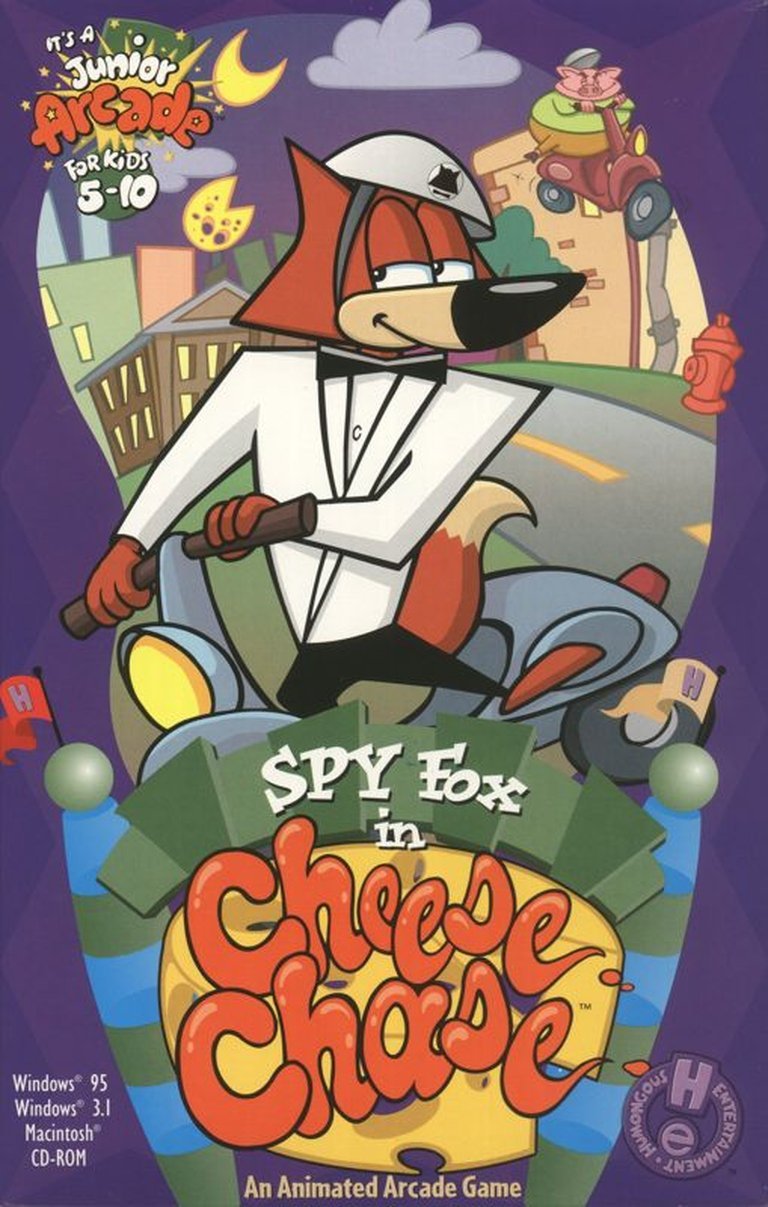
In ‘Spy Fox in Cheese Chase’, the suave secret agent Spy Fox pursues villainous Russian Blue across dynamic environments to recover the kidnapped Limburger Cheese. Players control Spy Fox through a vertical side-scrolling escapade using spy scooters, jet-skis, and ultralights—dodging henchmen, collecting gadgets from crates, and avoiding obstacles with lighthearted antics like banana shooters and pies. Featuring 100 action-packed levels and a Kid Editor for custom creations, this non-violent Junior Arcade game blends family-friendly espionage thrills across air, water, and snow settings.
Gameplay Videos
Where to Buy Spy Fox in Cheese Chase
PC
Spy Fox in Cheese Chase Free Download
Spy Fox in Cheese Chase Guides & Walkthroughs
Spy Fox in Cheese Chase: Review
Introduction
In the golden age of edutainment, Humongous Entertainment carved its niche with beloved franchises like Pajama Sam, Freddi Fish, and Spy Fox. Released in 1998 as part of the underappreciated Junior Arcade line, Spy Fox in Cheese Chase attempted to translate the witty espionage appeal of its point-and-click predecessor (Dry Cereal) into a frenetic action format. Yet, beneath its charming veneer lies a game caught between ambition and austerity—a product of its studio’s experimental phase but hobbled by budgetary constraints and design compromises. This review argues that Cheese Chase remains a fascinating, albeit uneven, relic of Humongous’ diversification efforts: a flawed arcade spinoff that encapsulates both the studio’s creative strengths and the limitations of its secondary projects.
Development History & Context
The Humongous Paradox: Innovation vs. Expansion
By 1998, Humongous Entertainment had cemented its reputation as a titan of children’s gaming, leveraging SCUMM engine adaptations to deliver narrative-rich adventures with gentle puzzles and humor. However, the Junior Arcade series—a lineup of action-oriented spinoffs—represented a departure from this formula. Conceived as lower-budget titles to broaden the studio’s market reach, games like Pajama Sam’s Sock Works and Cheese Chase prioritized accessibility over depth, targeting younger audiences with simpler mechanics.
Cheese Chase emerged during a transitional era for Humongous. Co-founder Ron Gilbert had departed years earlier, yet key veterans like Brad Carlton (project lead) and Brad P. Taylor (programming) carried forward the studio’s ethos. Despite their pedigree, the game’s development was visibly constrained: MobyGames’ credits list only 58 contributors (compared to 90+ for Dry Cereal), and recycled assets—including music from Dry Cereal—speak to tighter resources. Technologically, the game clung to SCUMM’s framework even as competitors embraced 3D acceleration, resulting in a side-scroller that felt dated alongside contemporaries like Spyro the Dragon.
The 1998 Landscape: A Genre in Flux
Children’s gaming in the late ’90s was bifurcated: Sony and Nintendo dominated the console market with polished platformers, while PC developers like Humongous and Scholastic relied on mouse-driven interactivity. Cheese Chase’s arcade aspirations placed it in direct conversation with Spy Hunter and Road Rash, but its lack of multiplayer or progressive difficulty limited its appeal. Critics praised its nonviolent approach (“a pie in the face is as violent as it gets”), yet the game’s simplistic design struggled to resonate beyond its preschool demographic.
Narrative & Thematic Deep Dive
A Parody of Espionage Tropes
Cheese Chase adopts the campy spy pastiche established in Dry Cereal. The plot thrusts the suave Spy Fox into pursuit of Russian Blue, a feline villain who has kidnapped the world’s rarest cheese: Limburger. While the premise leans into absurdity—kidnapped dairy as a MacGuffin—the writing retains the series’ trademark wit. Dialogue revels in double entendres (“Something sure smells funny”) and caricatured villainy, mimicking Bond films with a G-rated smirk.
Characters as Cartoon Catalysts
Spy Fox’s charisma anchors the experience, though his role is reduced to a silent protagonist during gameplay. Russian Blue’s henchmen—generic goons wielding banana shooters and pies—lack the personality of antagonists from the main series, functioning purely as obstacles. The narrative’s pacing suffers from repetitive cutscenes, which reuse footage and dialogue across 100 levels, undermining any sense of progression. Humorously, the finale subverts expectations with a gag involving radioactive cheese, but this resolution feels unearned after hours of minimal storytelling.
Gameplay Mechanics & Systems
Core Loop: Chasing the Dragon (Cheese)
Cheese Chase is a vertical-scrolling arcade game with three vehicle types: scooters, jet skis, and ultralights. Players control Spy Fox’s movement with the mouse, dodging obstacles (potholes, streetlights) while collecting gadgets (e.g., speed boosts, ink traps) and fuel pellets. Enemies can be temporarily disabled with limited ammo or nudged into hazards, evoking Spy Hunter’s vehicular combat.
Strengths and Systemic Flaws
The game’s simplicity is both its virtue and downfall. Early levels offer accessible fun, with responsive controls and a forgiving lives system. However, as critiqued in MobyGames’ player reviews, the experience quickly unravels:
– Erratic Controls: Spy Fox occasionally “loses control,” veering uncontrollably into obstacles due to unclear physics.
– Collision Confusion: Hitboxes are inconsistent—some barriers permit clipping, while others punish near-misses.
– Repetition Overload: With 100 near-identical levels, novelty evaporates after the first hour. New hazards (e.g., airborne icebergs) are introduced sluggishly, exacerbating fatigue.
– Editorial Shallowness: The level editor restricts players to placing items on 15 predefined templates, stifling creativity.
The Fuel Gauge Dilemma
A fuel mechanic ostensibly adds tension, but its impact is negligible. Collecting cheese wheels refills the gauge, yet many obstacles allegedly depleting it (per the manual) do so imperceptibly, rendering the system toothless.
World-Building, Art & Sound
Visuals: Cluttered Charm
Cheese Chase’s aesthetic mirrors Dry Cereal’s anthropomorphic whimsy, with vibrant backdrops spanning urban streets, snowy slopes, and tropical seas. However, the art direction falters under scrutiny:
– Obstacle Overload: Levels drown in superfluous scenery (benches, shrubs), obscuring genuine threats. Airborne stages suffer most, with cluttered skies making split-second navigation frustrating.
– Cutscene Austerity: Story sequences occupy a fraction of the screen, lacking the fluidity of Humongous’ adventure titles.
Sound Design: A Recycled Soundtrack
Julian Soule’s jazz-inspired Dry Cereal score is repurposed wholesale, save for one unused track excavated from the original’s files. While catchy, the music feels dissonant during high-speed chases—lounge jazz clashes with kinetic action. Voice acting is sparse, reserved for cutscenes, further divorcing gameplay from narrative.
Reception & Legacy
1998–2000: Tepid Praise, Faint Impact
Critics greeted Cheese Chase with measured approval. FamilyPC Magazine awarded it 87%, praising its accessibility but noting it was “just another video game” to parents. Commercially, it underperformed against Humongous’ flagship titles, fading into obscurity after its sequel (Some Assembly Required) shifted back to adventure gameplay.
Retrospective: A Footnote in Two Histories
Today, Cheese Chase is remembered less for its design than its context. It exemplifies Humongous’ struggle to branch beyond narrative adventures—a misfire that foreshadowed the Junior Arcade line’s discontinuation. While modders have preserved its SCUMM-based files, the game’s legacy pales against Dry Cereal’s enduring cult following. Its sole innovation—nonviolent arcade action for preschoolers—remains commendable but underdeveloped.
Conclusion
Spy Fox in Cheese Chase is a curious anomaly: a game caught between Humongous Entertainment’s legacy of storytelling and its desire to conquer new genres. Its flashes of humor and accessible gameplay hint at potential, but these are smothered by repetitive design, technical shortcomings, and a palpable lack of budget. For collectors and series completists, it offers nostalgic curiosity; for historians, it underscores the risks of studios stretching thin across genres. In the pantheon of Humongous’ work, Cheese Chase is neither a crown jewel nor a disaster—it is a humble, unpolished diversion, forever chasing the shadow of its superior predecessors.
Final Verdict: A forgettable detour in Spy Fox’s career, best reserved for archaeologists of ’90s children’s gaming.