
- Release Year: 2011
- Platforms: Linux, Macintosh, PlayStation 3, Windows, Xbox 360, Xbox One, Xbox Series
- Publisher: Double Fine Productions, Inc., Nordic Games GmbH, THQ Inc.
- Developer: Double Fine Productions, Inc.
- Genre: Adventure, Puzzle
- Perspective: Behind view
- Game Mode: Single-player
- Gameplay: Adventure, Collectathon, Platformer, Puzzle, Stacking
- Setting: Interwar
- Average Score: 84/100
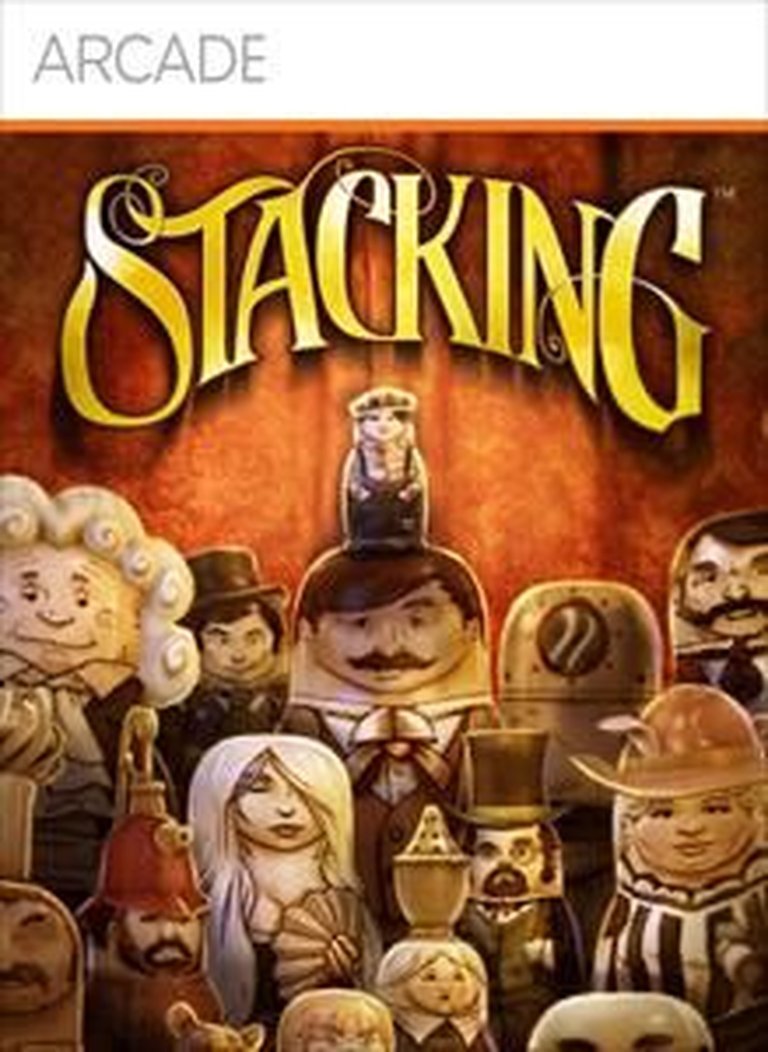
Description
Set in the 1920s depression era, Stacking follows Charlie Blackmore, a tiny Russian doll whose family is kidnapped by the industrialist Baron. Players navigate whimsical levels by ‘stacking’ into larger dolls to utilize their unique abilities, solve puzzles through multiple creative solutions, and complete bonus objectives while rescuing Charlie’s relatives.
Gameplay Videos
Where to Buy Stacking
Stacking Patches & Updates
Stacking Guides & Walkthroughs
Stacking Reviews & Reception
metacritic.com (84/100): It’s the most unique, charming take on the common puzzler since Portal – a must buy.
calitreview.com (80/100): Stacking’s charm nests itself into multiple layers, permeating the production with a warm, feel-good positivity that contrasts well with the grim, serious undertones of the modern, ‘adult’-targeted video game.
imdb.com (90/100): Stacking is a very underrated platform game that experiments the gaming greatly. It is a game that matches the setting well.
Stacking: Review
Introduction
In the landscape of video games, few titles possess the sheer audacity to build an entire world around a single, deceptively simple mechanic. Stacking, developed by Double Fine Productions and released in 2011, is one such masterpiece. This puzzle-adventure game, centered on the concept of Russian nesting dolls, transcends its whimsical premise to deliver a profound, satirical, and mechanically inventive experience. From its charming stop-motion aesthetic to its deeply layered critiques of industrial capitalism, Stacking stands as a testament to Tim Schafer’s studio ethos: innovation born from constraint, and storytelling woven into gameplay. Its legacy, though modest in commercial terms, endures as a benchmark for creative problem-solving and narrative ingenuity. This thesis argues that Stacking’s enduring appeal lies in its seamless fusion of emergent gameplay mechanics with a poignant, doll-sized allegory for labor, family, and rebellion—an experience that remains as unique and captivating as the matryoshka dolls that populate its world.
Development History & Context
Stacking emerged from Double Fine Productions’ first Amnesia Fortnight in 2009, a biannual game jam designed to foster experimental ideas amid larger projects like Brütal Legend. Conceived by project lead Lee Petty—who also served as writer, designer, and art director—the prototype centered on a radical premise: using Russian nesting dolls (matryoshkas) as vessels for a puzzle-based adventure. This concept, validated internally, secured publisher THQ’s approval for a full production, targeting digital distribution on Xbox Live Arcade and PlayStation Network.
The team faced significant technical constraints, particularly in simulating the physics of doll stacking. They integrated the Bullet physics engine with custom adjustments to enforce strict size-based nesting rules (dolls could only stack into those one size larger) and ensure stability during complex interactions. Lee Petty emphasized the challenge of designing puzzles with multiple solutions: “Designing challenges for Stacking is very strange, because of the multiple solutions structure.” This philosophy demanded rigorous playtesting to remove redundant paths and mitigate confusion from overlapping mechanics. Artistically, the team adopted a stop-motion aesthetic inspired by 1920s silent films, with Freddie Lee’s team crafting over 100 unique dolls with bespoke animations. Peter McConnell’s orchestral score, featuring works by Chopin and Brahms, underscored the melancholic, alternate-history setting.
Released digitally in February 2011 for Xbox 360 and PS3 (priced at 1200 Microsoft Points/$15), Stacking arrived during an era dominated by AAA blockbusters. Its niche positioning as a downloadable title—without physical retail—reflected Double Fine’s pivot toward scalable, innovative projects. The PC port in 2012, self-published after THQ’s bankruptcy, extended its reach but lacked significant enhancements. This context highlights Stacking as both a product of Double Fine’s experimental spirit and a response to industry trends, proving that depth could thrive within compact digital frameworks.
Narrative & Thematic Deep Dive
Set in a stylized 1930s European world populated entirely by sentient matryoshka dolls, Stacking’s narrative unfolds as a miniature epic. The protagonist, Charlie Blackmore, the tiniest chimney-sweep doll, witnesses his family abducted by the Baron, an industrial tyrant enforcing conscription to settle fabricated debts. Evading capture, Charlie embarks on a quest across a multi-car train—a microcosm of the Baron’s oppressive regime—to rescue his kin and dismantle the authoritarian machinery.
The plot is a masterclass in environmental storytelling. Each train car represents a facet of the Baron’s dystopia: labor yards choked with exploited workers, opulent steamships for the elite, and factories spewing propaganda. The narrative unfolds through vignettes and Charlie’s silent observations, with dialogue conveyed through text snippets and expressive doll animations. Characters are archetypes reimagined as dolls: the Baron embodies unchecked industrial authority, his enforcers as rigidly programmed automatons, and workers as weary, interchangeable cogs.
Beneath its whimsical surface, Stacking delivers sharp satire of early 20th-century industrialism. The Baron’s regime mirrors real-world labor exploitation, with conscription quotas and child labor reflecting historical atrocities like Fordism. Puzzles become acts of subversion: Charlie’s ability to “possess” larger dolls symbolizes the reclamation of agency from oppressive hierarchies. By orchestrating voluntary alliances among diverse dolls—each representing a skill or social role—the player critiques top-down mandates that stifle creativity. The absence of spoken dialogue amplifies this universality, allowing themes of solidarity and rebellion to resonate across cultural contexts. The game’s humor, derived from absurd bureaucratic contrivances (e.g., billboards glorifying toil amidst decay), tempers its gravity, ensuring the satire never feels preachy. Ultimately, Charlie’s triumph is not just familial reunion but a testament to emergent cooperation over enforced uniformity—a quiet revolution in doll-sized form.
Gameplay Mechanics & Systems
Stacking’s brilliance lies in its core mechanic: possession and stacking. As Charlie, players inhabit increasingly larger dolls, each granting unique abilities—such as a photographer’s flash to stun guards, a wrestler’s strength to smash obstacles, or a hobo’s harmonica to lull opponents. Dolls must stack sequentially by size (max five tiers), creating emergent solutions: layering a doll with a “tap dance” ability atop one with “fart flowers” creates a diversionary combo. This system transforms puzzle-solving into a dynamic sandbox of experimentation.
Puzzles are meticulously designed around multiple solutions, rewarding lateral thinking. Early levels introduce basic abilities (e.g., using a doll’s small size to slip under doors), while later challenges demand intricate stacks (e.g., synchronizing a hypnotist’s gaze with a strongman’s lift to access high areas). Non-linearity prevails; players can tackle objectives in varied orders, encouraged by collectibles like “Unique Dolls” (over 100 unlockable characters) and “Matched Sets” (family groups). Optional “Hi-Jinks”—chaotic challenges like slapping dolls with a white glove—add replayability.
The UI is minimalist, highlighting compatible dolls with a reticle for possession. However, the game’s physics can lead to frustrating glitches, such as stacks toppling or dolls becoming unresponsive, occasionally halting progress. A robust hint system aids accessibility but risks trivializing puzzles for purists. Combat is absent; conflict resolves through social engineering, emphasizing strategy over violence.
Progression is tied to completion percentage, incentivizing exploration of every nook. Yet, the main narrative concludes in 5–6 hours, with post-game content feeling padded. Despite this, Stacking’s mechanics—rooted in cause-and-effect—foster a rare sense of empowerment: players aren’t just solving puzzles but authoring them through playful, creative chaos.
World-Building, Art & Sound
Double Fine’s world-building in Stacking is a triumph of constrained imagination. The train-car environments function as intricate dioramas, each a self-contained society: a decrepid labor yard, a gilded steamship, a zeppelin factory. Settings evoke the Great Depression’s industrial decay, with sepia-toned textures and period-accurate details (e.g., brass fixtures, steam pipes). These spaces are not mere backdrops but puzzle elements—levers to pull, doors to unlock, crowds to navigate—reinforcing the game’s theme of environment as antagonist.
Art direction, led by Freddie Lee, blends stop-motion aesthetics with exaggerated doll proportions. Characters, crafted from wood and fabric, feature expressive animations: a doll startled “pops” like a champagne cork, while a flirtatious one sways. Over 100 unique dolls ensure visual diversity, from child laborers to aristocrats, each silhouette communicating function and social status. The art’s deliberate imperfection—visible seams, hand-painted faces—enhances the tactile, storybook feel.
Peter McConnell’s score, performed live by musicians, is anachronistically elegant. Classical pieces (Chopin, Brahms) underscore melancholy moments, while jaunty jazz tracks accompany hi-jinks. Sound design complements the visuals: stacking emits satisfying clicks, and doll interactions—from farts to piano playing—playfully punctuate the orchestral backdrop. Silence is used effectively in tense moments, emphasizing Charlie’s vulnerability.
This synergy of art and sound creates a cohesive, immersive world. The stop-motion style, reminiscent of the Brothers Quay, transforms dolls into sentient beings with depth, while the score elevates mundane tasks into cinematic moments. Together, they craft a universe that feels both fantastical and deeply human, proving that even the smallest characters can hold the weight of a grand narrative.
Reception & Legacy
Upon release, Stacking garnered critical acclaim, with Metacritic aggregating scores of 84/100 across platforms. Critics lauded its innovation: IGN praised its “charm, humor, and puzzle ingenuity,” while Giant Bomb commended its “well-crafted, satirical puzzle design.” The art direction and emergent gameplay were universally celebrated, with Wired hailing its “engaging, thought-provoking experience.” However, critiques emerged: GameSpot noted repetitive trial-and-error in puzzles, and IGN criticized the hint system for undermining challenge.
Commercially, Stacking underperformed as a niche digital title, with undisclosed sales figures reflecting its specialized appeal. Post-THQ bankruptcy, Double Fine reacquired rights, sustaining revenue through PC ports and bundles like the Humble Double Fine Bundle. Its legacy, though modest, endures in three key ways. First, it redefined puzzle design by prioritizing emergent solutions over linearity, influencing indie titles like Tunic. Second, it cemented Double Fine’s reputation for quirky, mechanics-driven storytelling. Third, its satirical lens—using dolls as metaphors for labor—resonated in discussions of game as social commentary.
Players cherish Stacking for its creativity, yet lament technical flaws and short length. Community retrospectives, such as those on Grokipedia, highlight its “benchmark for whimsical, ability-swapping designs.” Though no direct sequel emerged, Stacking remains a cult classic, its DNA visible in games embracing experimental mechanics. Its true legacy lies in its proof that a game’s soul isn’t measured in scope, but in the magic of its smallest parts.
Conclusion
Stacking stands as a paragon of inventive game design, where a single mechanic—nesting dolls—unfurls into a symphony of satire, artistry, and player agency. Its development, born from Double Fine’s experimental spirit, resulted in a game that defies easy categorization: a puzzle-adventure with the heart of a fable and the soul of a revolution. The narrative, though told through silent dolls, delivers a potent critique of industrial oppression, while its gameplay transforms problem-solving into a joyful act of creation.
Flaws persist—occasional repetition, technical hiccups, and a brevity that feels abrupt—but these are minor blemishes on an otherwise polished gem. Stacking’s art and sound craft a world both inviting and profound, where each click of a stacking doll resonates with thematic weight. Its legacy, though not etched in blockbuster sales, is etched in the annals of innovative indie games—a reminder that the most memorable experiences often come from the unlikeliest of premises.
In the pantheon of video game history, Stacking earns its place as a unique, enduring masterpiece. It is a game that asks players to think small, act big, and in doing so, discover that the smallest rebellion can echo the loudest. For those who cherish creativity over convention, Stacking is not just a game—it’s a dollhouse revolution, waiting to be explored.