
- Release Year: 2002
- Platforms: Windows
- Publisher: Activision Publishing, Inc.
- Genre: Compilation
- Game Mode: Online PVP, Single-player
- Average Score: 86/100
Description
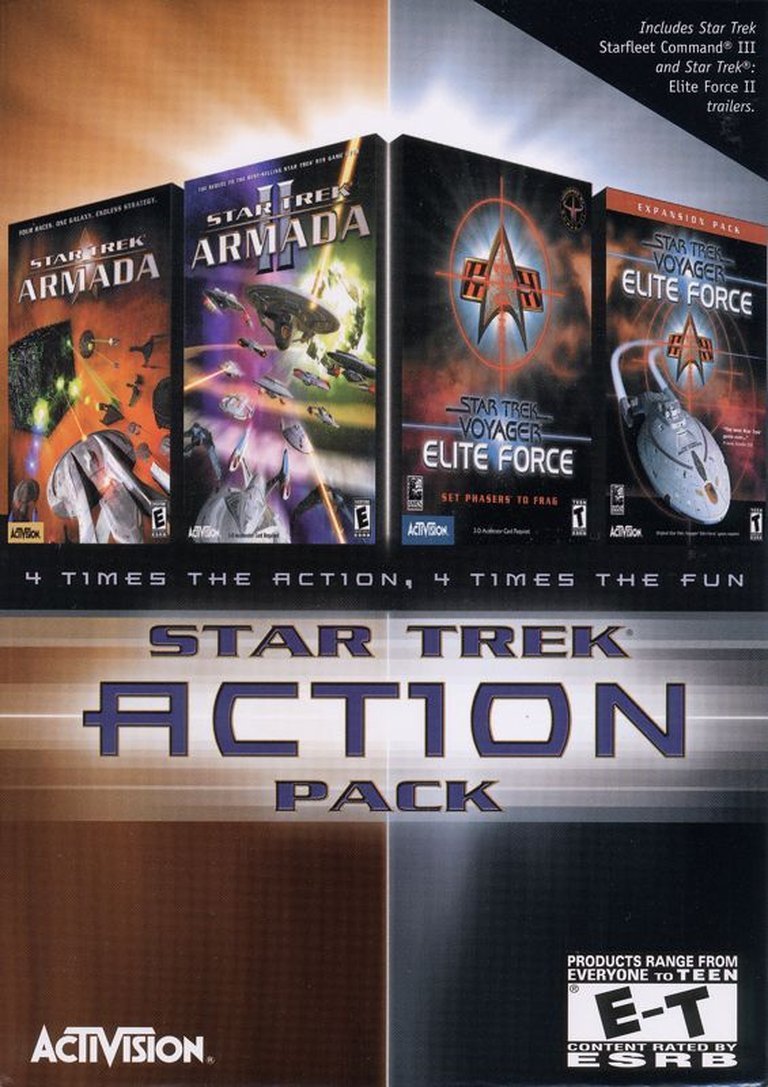
Star Trek Action Pack is a compilation of four Star Trek games released in 2002, featuring the real-time strategy titles Star Trek: Armada and Star Trek: Armada II, along with the first-person shooter Star Trek: Voyager – Elite Force and its expansion pack. Set in the Star Trek universe, the games offer a mix of strategic fleet battles and immersive action, allowing players to command starships or engage in ground combat aboard iconic locations like the USS Voyager and Borg vessels. The pack also includes trailers for upcoming Star Trek titles, making it a comprehensive collection for fans of the franchise.
Star Trek Action Pack Reviews & Reception
ebay.com (100/100): The best games
mobygames.com (72/100): Average score: 72%
retro-replay.com : The Star Trek Action Pack delivers a diverse suite of gameplay experiences, seamlessly blending real-time strategy with first-person shooter action.
Star Trek Action Pack Cheats & Codes
PlayStation 2 (NTSC-U)
Hold Select + Start In Game For Debug Menu
| Code | Effect |
|---|---|
| F8TM-487M-FYF3U YT9C-PVBT-GBEFK |
Master Codes (Must Be On) |
| B4336FA9 4DFEFB79 FEF18FA9 520A0A53 CB8A2F2D 9EE3B50A 795E6A09 A608C818 |
Enable Cheat Codes |
| D0344542 0000FFF6 0011E65C 00000002 D0344542 0000FFFF 0011E65C 00000001 |
Unlock Levels |
| BQ15-K0YU-0U6YD B1ZE-KQVH-0U7UX |
Infinite Mines |
| 967W-XNGP-R04CF B8G6-2MBJ-2HH6H |
Infinite Torpedoes |
| AD00-TM70-94HZ8 QEJE-BKF8-FWED5 |
Turn Off On Screen Display |
| 7ZRB-45R8-R1UVK 0M96-2C51-QA37D |
Unlock All Cards |
| KWRU-N9DM-X0QAU 0C5A-AQRM-09UUV NRDA-QTF1-J15GC WZKQ-A0B5-1A3YW M2PT-M082-1T67F JUXH-U19Z-6419X |
Enable Code (Must Be On) |
Star Trek Action Pack: A Comprehensive Retrospective
Introduction
The Star Trek Action Pack, released in 2002 by Activision, stands as a fascinating artifact in the history of Star Trek gaming—a compilation that encapsulates the franchise’s golden age in interactive entertainment. This collection bundles four critically acclaimed titles: Star Trek: Armada, Star Trek: Armada II, Star Trek: Voyager – Elite Force, and its expansion pack. At a time when Star Trek was a dominant force in television and film, this compilation offered fans a chance to relive the franchise’s most thrilling moments across multiple genres: real-time strategy (RTS), first-person shooters (FPS), and tactical combat.
This review will dissect the Action Pack in exhaustive detail, exploring its development context, narrative depth, gameplay mechanics, and lasting legacy. By examining each component game, we can better understand how this compilation reflects the strengths and limitations of Star Trek gaming during the early 2000s.
Development History & Context
The Studio and the License
The Star Trek Action Pack was published by Activision, a company that had secured the Star Trek gaming license in the late 1990s. By 2002, Activision had already established itself as a major player in the industry, thanks to franchises like Call of Duty and Tony Hawk’s Pro Skater. However, its handling of the Star Trek license was met with mixed reactions. The Action Pack was not a new game but a repackaging of existing titles, a common practice in the early 2000s to capitalize on the success of individual games.
The compilation included:
1. Star Trek: Armada (2000) – Developed by Mad Doc Software.
2. Star Trek: Armada II (2001) – Also by Mad Doc Software.
3. Star Trek: Voyager – Elite Force (2000) – Developed by Raven Software.
4. Star Trek: Voyager – Elite Force Expansion Pack (2001) – Also by Raven Software.
Technological Constraints
The early 2000s were a transitional period for PC gaming. The Armada series utilized 3D graphics engines that were cutting-edge for their time, offering real-time strategy gameplay in a fully 3D space environment—a rarity in RTS games, which were predominantly 2D. Elite Force, built on the Quake III Arena engine, delivered a polished FPS experience with advanced lighting and physics for its era.
However, these games were constrained by the hardware limitations of the time. Multiplayer functionality relied on services like GameSpy and the World Opponent Network (WON), which were later discontinued, leaving many players stranded. The Action Pack itself was released on CD-ROM, a medium that was rapidly being replaced by DVDs and digital distribution.
The Gaming Landscape
In 2002, the Star Trek franchise was at a crossroads. Star Trek: Voyager had just concluded its seven-season run, and Star Trek: Enterprise was in its second season. The film Star Trek: Nemesis was released the same year, marking the end of the Next Generation film series. The gaming landscape was equally turbulent, with RTS games like Warcraft III and Command & Conquer: Red Alert 2 dominating the market, while FPS games like Halo and Counter-Strike redefined multiplayer experiences.
The Action Pack arrived in this competitive environment, offering a curated selection of Star Trek games that had already proven their worth. It was a strategic move by Activision to consolidate its Star Trek offerings into a single, attractive package for both new and existing fans.
Narrative & Thematic Deep Dive
Star Trek: Armada (2000)
Armada is set in the Next Generation era, following the aftermath of the Dominion War. The game’s campaign is divided into four factions: the Federation, Klingons, Romulans, and Borg. Each faction’s storyline is interwoven, creating a cohesive narrative that explores the political and military tensions of the Alpha Quadrant.
- Federation Campaign: Players assume the role of Captain Jean-Luc Picard, leading Starfleet forces against the Borg and other threats. The story emphasizes diplomacy and tactical superiority, reflecting the Federation’s ideals.
- Klingon Campaign: Focused on honor and conquest, the Klingon missions are more aggressive, with a focus on direct combat and territorial expansion.
- Romulan Campaign: The Romulans employ deception and stealth, with missions that require cunning and subterfuge.
- Borg Campaign: The Borg storyline is the most linear, emphasizing overwhelming force and assimilation.
The game’s narrative is strengthened by its voice acting, featuring Patrick Stewart as Picard and other TNG cast members. The dialogue is faithful to the series, capturing the essence of each faction’s philosophy.
Star Trek: Armada II (2001)
Armada II expands on its predecessor’s narrative, introducing Species 8472 as a new antagonist. The game’s story is more ambitious, with a greater focus on interstellar politics and the consequences of the Dominion War.
- Federation Campaign: The Federation must navigate alliances with the Klingons and Romulans while fending off Borg incursions and the threat of Species 8472.
- Klingon Campaign: The Klingons seek to reclaim their honor and expand their empire, often clashing with the Federation and Romulans.
- Romulan Campaign: The Romulans employ espionage and sabotage, reflecting their duplicitous nature.
- Borg Campaign: The Borg storyline is more expansive, with missions that explore their relentless pursuit of perfection.
The introduction of Species 8472 adds a new layer of complexity, as their fluidic space origins present unique challenges. The game’s narrative is darker and more mature, reflecting the evolving tone of Star Trek in the post-DS9 era.
Star Trek: Voyager – Elite Force (2000)
Elite Force is a first-person shooter that places players in the role of Ensign Alexander Munro, a member of Voyager’s Hazard Team. The game’s story is set during Voyager’s seventh season, with missions that take place between the episodes “30 Days” and “Unimatrix Zero.”
- Main Campaign: The Hazard Team is tasked with defending Voyager from various threats, including the Borg, Hirogen, and other alien species. The story is episodic, with each mission serving as a self-contained adventure.
- Character Development: Munro and his team are well-developed, with voice acting by the Voyager cast, including Kate Mulgrew as Captain Janeway. The dialogue is witty and engaging, capturing the camaraderie of the Hazard Team.
The game’s narrative is strengthened by its integration with the Voyager series, with references to past episodes and a storyline that feels like a natural extension of the show.
Star Trek: Voyager – Elite Force Expansion Pack (2001)
The expansion pack adds new missions and gameplay mechanics, including a holodeck training mode and additional weapons. The story is less cohesive than the main game, focusing on standalone missions that explore different aspects of Voyager’s journey.
- Holodeck Missions: These missions are more experimental, with gameplay that ranges from puzzle-solving to combat simulations.
- New Enemies: The expansion introduces new alien species and challenges, including a mission set on a derelict Constitution-class starship.
While the expansion lacks the narrative depth of the main game, it offers additional content for fans of Elite Force.
Gameplay Mechanics & Systems
Star Trek: Armada (2000)
Armada is a real-time strategy game that emphasizes fleet management and resource collection. The gameplay is divided into several key systems:
- Resource Management: Players must collect dilithium and metal to build ships and structures. The resource system is streamlined, with a focus on efficiency rather than complexity.
- Ship Construction: Players can build a variety of ships, from small fighters to massive capital ships. Each faction has unique units, reflecting their technological and cultural differences.
- Combat: Battles are tactical, with a focus on positioning and fleet composition. The game’s 3D engine allows for dynamic combat, with ships maneuvering in three dimensions.
- Multiplayer: Armada supports multiplayer via LAN and online services, with a focus on competitive and cooperative gameplay.
The game’s UI is intuitive, with a clear display of resources, ship status, and mission objectives. However, the game’s pathfinding and AI can be inconsistent, leading to frustrating moments in large-scale battles.
Star Trek: Armada II (2001)
Armada II builds on its predecessor’s mechanics, introducing new features and refinements:
- Resource System: The game introduces latinum as a third resource, adding complexity to the economy. Players must balance the collection of dilithium, metal, and latinum to build and maintain their fleets.
- Planet Colonization: Players can colonize planets to gain additional resources and strategic advantages. This adds a layer of depth to the gameplay, requiring players to manage multiple fronts.
- New Factions: The introduction of Species 8472 and additional Borg units expands the game’s tactical options. Each faction has unique strengths and weaknesses, requiring players to adapt their strategies.
- Improved AI: The AI is more aggressive and intelligent, providing a greater challenge in single-player and multiplayer modes.
While Armada II is more complex than its predecessor, it suffers from some of the same issues, including inconsistent pathfinding and a steep learning curve.
Star Trek: Voyager – Elite Force (2000)
Elite Force is a first-person shooter that emphasizes team-based combat and exploration. The gameplay is divided into several key systems:
- Weapons and Equipment: Players have access to a variety of weapons, including phasers, photon grenades, and alien technology. The game’s weapon system is balanced, with each weapon serving a specific purpose.
- Team Mechanics: The Hazard Team is a central part of the gameplay, with AI-controlled teammates providing support and assistance. Players can issue commands to their team, adding a tactical layer to the combat.
- Mission Design: The game’s missions are varied, with a mix of combat, puzzle-solving, and exploration. The level design is impressive, with detailed environments that reflect the Star Trek universe.
- Multiplayer: Elite Force supports multiplayer via LAN and online services, with a focus on competitive and cooperative gameplay. The game’s multiplayer modes are well-designed, with a variety of maps and game types.
The game’s UI is clean and intuitive, with a clear display of health, ammunition, and mission objectives. However, the game’s AI can be inconsistent, with teammates sometimes failing to respond to commands.
Star Trek: Voyager – Elite Force Expansion Pack (2001)
The expansion pack introduces new missions and gameplay mechanics, including:
- Holodeck Training: A new mode that allows players to practice their combat skills in a variety of scenarios.
- New Weapons: Additional weapons and equipment, including alien technology and experimental Starfleet gear.
- New Enemies: New alien species and challenges, including a mission set on a derelict Constitution-class starship.
While the expansion lacks the narrative depth of the main game, it offers additional content for fans of Elite Force.
World-Building, Art & Sound
Visual Design
The Action Pack’s visual design is a testament to the Star Trek franchise’s aesthetic. Each game captures the look and feel of its respective era, with detailed ship models, environments, and character designs.
- Armada and Armada II: The games’ 3D engines deliver impressive visuals, with detailed ship models and dynamic lighting. The game’s environments are varied, ranging from the cold void of space to the vibrant landscapes of alien planets.
- Elite Force: The game’s Quake III Arena engine delivers polished visuals, with detailed character models and immersive environments. The game’s level design is impressive, with a mix of Voyager’s interiors and alien landscapes.
Sound Design
The Action Pack’s sound design is equally impressive, with a mix of original music, voice acting, and sound effects.
- Armada and Armada II: The games feature original music that captures the grandeur of Star Trek, along with voice acting by the TNG cast. The sound effects are immersive, with detailed ship sounds and weapon effects.
- Elite Force: The game features voice acting by the Voyager cast, along with original music and sound effects. The game’s audio design is immersive, with detailed weapon sounds and environmental effects.
Reception & Legacy
Critical Reception
The Star Trek Action Pack received mixed reviews from critics. While the individual games were praised for their gameplay and narrative depth, the compilation itself was criticized for its lack of new content.
- PC Games (Germany): 81% – Praised the compilation for its variety and value.
- PC Action (Germany): 76% – Criticized the inclusion of both Armada games, arguing that they were too similar.
- Nerikes Allehanda: 60% – Praised Elite Force but criticized the Armada games for their complexity.
Commercial Reception
The Action Pack was a commercial success, selling well among Star Trek fans and strategy gamers. However, its sales were overshadowed by other major releases of the time, including Warcraft III and Halo.
Legacy
The Action Pack remains a beloved compilation among Star Trek fans, offering a curated selection of the franchise’s best games. While the individual games have been surpassed by modern titles, they remain a testament to the creativity and ambition of Star Trek gaming in the early 2000s.
Conclusion
The Star Trek Action Pack is a fascinating snapshot of Star Trek gaming at its peak. While it may not have broken new ground, it offered fans a chance to relive some of the franchise’s most thrilling moments across multiple genres. The compilation’s strengths lie in its variety and depth, with each game offering a unique perspective on the Star Trek universe.
However, the Action Pack is not without its flaws. The Armada games suffer from inconsistent AI and a steep learning curve, while Elite Force’s expansion pack lacks the narrative depth of the main game. Despite these issues, the Action Pack remains a valuable addition to any Star Trek fan’s collection.
Final Verdict: The Star Trek Action Pack is a must-have for fans of the franchise, offering a curated selection of some of the best Star Trek games of the early 2000s. While it may not be perfect, it remains a testament to the creativity and ambition of Star Trek gaming. 8/10.