
- Release Year: 2023
- Platforms: Macintosh, Windows
- Publisher: Paradox Interactive AB
- Developer: Nimble Giant Entertainment
- Genre: Strategy, Tactics
- Perspective: 3rd-person
- Game Mode: Online PVP, Single-player
- Gameplay: 4X, Business simulation, Managerial
- Setting: Futuristic, Sci-fi
- Average Score: 68/100
Description
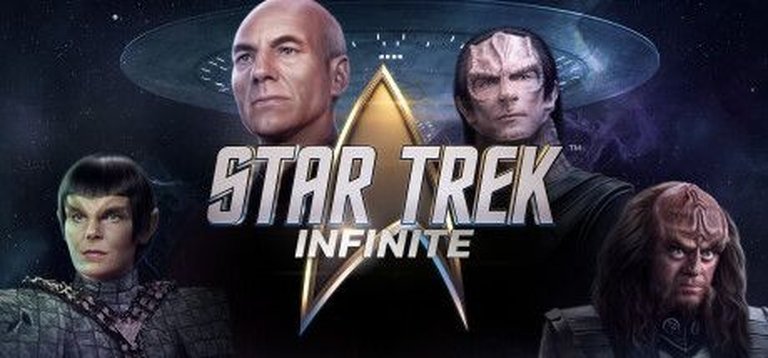
Star Trek: Infinite is a grand strategy game set in the iconic Star Trek universe, where players engage in real-time 4X gameplay by exploring, expanding, exploiting, and exterminating across a futuristic sci-fi setting. It features multiple factions, narrative-driven scenarios, and deep strategic management, offering high replayability for both veterans and newcomers to the genre.
Where to Buy Star Trek: Infinite
PC
Star Trek: Infinite Free Download
Star Trek: Infinite Patches & Updates
Star Trek: Infinite Mods
Star Trek: Infinite Guides & Walkthroughs
Star Trek: Infinite Reviews & Reception
metacritic.com (65/100): If Trekkies can stand that cognitive dissonance, they’ll find a home in Star Trek: Infinite, but experienced grand strategy gamers might find it too familiar for comfort.
ign.com : But while I really wanted to like Star Trek: Infinite, it didn’t seem to like me back.
pcgamer.com : Compelling, but not quite there yet. Needs two seasons to grow the beard.
opencritic.com (72/100): Compelling, but not quite there yet. Needs two seasons to grow the beard.
Star Trek: Infinite Cheats & Codes
PC
Press the tilde (~) key to open the console.
| Code | Effect |
|---|---|
| activate_all_traditions | Activates all Traditions |
| activate_ascension_perk [name] | Activates the specified Ascension Perk |
| activate_gateways | Activates all gateways in the galaxy |
| activate_relic [relic id] | Activates the triumph effect of specified relic |
| activate_tradition [tradition id] | Activates the specified Tradition |
| add_anomaly [anomaly id] | Adds an anomaly to the selected celestial body |
| add_intel [target] [amount] | Adds intel towards target, default 10 |
| add_loyalty [target] [amount] | Adds loyalty from target, default 10 |
| add_opinion [source] [target] [amount] | Increases source empire’s opinion of target empire by amount, default 40 |
| add_pops [species id] [amount] | Creates pops from species on selected celestial body |
| add_relic [relic id / all] | Grants specified relics or all relics |
| add_ship [design name] | Creates a ship of the designated design |
| add_spynetwork_value [target] [amount] | Adds infiltration progress on target |
| add_time [unit] [amount] | Adds time in units of days, months, or years |
| add_trait_leader [leader id] [trait id] | Adds trait to leader |
| add_trait_species [species id] [trait id] | Adds trait to species |
| advance_council_agenda [amount] | Adds progress to the council agenda |
| ai | Toggles the AI on or off |
| alloys [amount] | Adds Alloys, default 5000 |
| annex [target] | Takes control of all worlds and starbases of target |
| branchoffice | Take ownership of a planetary branch office |
| break_fleet_contract | Returns the selected leased fleet to its original owner |
| build_pops [amount] | Assembles pops to the selected celestial body |
| cash [amount] | Adds Energy Credits, default 5000 |
| colonize [colonizer pop id] | Starts the colonization process of the selected celestial body |
| communications | Establishes communications with all empires |
| contact | Starts first contact with all empires |
| create_megastructure [megastructure id] | Creates a Megastructure in the current system |
| create_navy [percent] | Creates a fleet using percentage of Naval Capacity |
| damage [amount] | All ships in the selected fleet take hull damage |
| debug_nomen | Toggles AI empires always refusing player proposals |
| debug_yesmen | Toggles AI empires always agreeing player proposals |
| debugtooltip | Shows target ID when hovering over it |
| destroy_colony | Removes colony |
| effect add_building = [building id] | Adds building to the selected celestial body |
| effect add_deposit = [deposit id] | Adds resource deposit or planetary feature |
| effect remove_deposit = [deposit id] | Removes resource deposit or planetary feature |
| effect add_district = [district id] | Adds district to the selected celestial body |
| effect add_planet_devastation = [amount] | Adds Devastation to the selected celestial body |
| effect country_add_ethic = [ethic id] | Adds ethic to the player empire |
| effect country_remove_ethic = [ethic id] | Removes ethic from the player empire |
| effect create_archaeological_site = [site id] | Adds archaeological site to the selected celestial body |
| effect force_add_civic = [civic id] | Adds civic to the player empire |
| effect force_remove_civic = [civic id] | Removes civic from the player empire |
| effect remove_modifier = [modifier id] | Removes modifier from the selected celestial body |
| effect set_origin = [origin id] | Changes player’s empire origin |
| effect shift_ethic = [ethic id] | Changes player’s empire ethics |
| end_senate_session | Ends vote |
| engineering [amount] | Get Engineering points |
| event [id] | Triggers a specified event |
| federation_add_cohesion [amount] | Adds cohesion to the Federation |
| federation_add_experience [amount] | Adds experience to the Federation |
| federation_add_cohesion_speed [amount] | Adds monthly cohesion to the Federation |
| federation_examine_leader | Causes a Federation succession |
| finish_research | Finishes all ongoing research |
| finish_special_projects | Finishes all special projects |
| finish_terraform | Finishes all ongoing terraforming |
| food [amount] | Adds Food |
| force_integrate [ID] | Forces an empire to integrate into your empire |
| free_government | Allows government change |
| free_policies | Allows policy change |
| grow_pops [amount] | Adds growing pops |
| help | Shows the list of all console commands |
| hire_all_leaders | Get all leaders |
| instant_build | Completes any ongoing buildings and upgrades |
| intel | Grants vision of the whole galaxy |
| influence [amount] | Adds Influence |
| invincible | God Mode, player ships take no damage |
| kill_pop [pop id] | Kills a specified pop |
| max_resources | Fills all resource storages to maximum capacity |
| minerals [amount] | Adds Minerals |
| observe | Switches to observer mode |
| own [planet id] | Take over selected planet |
| planet_ascension_tier [amount] | Set ascension tier |
| planet_class [id] | Change planet type |
| planet_happiness [amount] | Boost planet mood |
| planet_size [value] | Set planet size |
| physics [amount] | Get Physics points |
| random_ruler | Pick a new ruler |
| research_all_technologies 1 1 | Unlock all tech (incl. repeatables) |
| research_technology [id] | Unlock one tech |
| skills [amount] | Level up leaders |
| society [amount] | Get Society points |
| survey | Auto survey everything |
| techupdate | Refresh research options |
| unity [amount] | Add Unity |
| resource [amount] [type] | Add custom resource |
| skip_galactic_community_cooldowns | Skip GC cooldown |
| skip_federation_cooldowns | Remove fed cooldowns |
Star Trek: Infinite: A Franchise’s Ambitious Misstep in the Final Frontier of Grand Strategy
Introduction: The Dream and the Reality
For decades, the Star Trek franchise has been a fertile yet fraught ground for video game adaptations. Capturing its essence—a blend of exploration, diplomacy, moral quandaries, and iconic characters—within interactive media has proven uniquely challenging. The announcement of Star Trek: Infinite in 2023, a grand strategy 4X title from Paradox Interactive and Nimble Giant Entertainment, ignited a fire of anticipation among Trekkies and strategy enthusiasts alike. Here, it seemed, was a chance to finally command the Federation, Klingon Empire, Romulan Star Empire, or Cardassian Union with the depth and scale of a Stellaris-style sandbox. The thesis of this review, however, must confront a painful dichotomy: Star Trek: Infinite stands as a profoundly compelling and faithful thematic adaptation of its source material, yet it is simultaneously one of the most technically compromised and philosophically conflicted major releases in recent memory. Its brief, troubled lifecycle—ending development just five months after launch—cements it not as a classic, but as a cautionary tale of ambition colliding with execution, and a franchise license straining against the inherent logic of its chosen genre.
Development History & Context: From a Proven Engine to Uncharted Trouble
The Studio and the Vision: Nimble Giant Entertainment, an Argentine studio under the Embracer Group umbrella, was tasked with adapting Paradox’s acclaimed Clausewitz Engine (the backbone of Stellaris) to the Star Trek setting. The team, led by Game Director Ezequiel Maldonado and Technical Lead Andrés Ricardo Chamarra (as detailed in the “But Why Tho?” interview), was comprised of self-professed “Trekkies.” Their stated vision, as per the official Paradox description, was to create a game where players could “shape the story of your playthrough,” translating iconic narrative beats into a systemic, player-driven format. This meant focusing on the “Picard era” (The Next Generation/Deep Space Nine/Voyager period) and selecting four fleshed-out major powers from that timeframe as the sole playable factions.
The Technological and Design Context: Star Trek: Infinite is not a from-scratch engine but a heavily modified branch of Stellaris. This provided a robust, complex foundation for 4X gameplay—exploration, economy, research, diplomacy, and warfare—but also inherited its underlying assumptions. As the IGN review starkly notes, Stellaris’s core loop incentivizes “conquest and expansion,” a drive “totally out of step with the original show creator’s vision” for the post-scarcity, exploratory Federation. Nimble Giant’s task was to “streamline and simplify” these systems to better “resonate with the Star Trek franchise,” a fundamental design tension that would haunt the final product.
The Gaming Landscape and Release: Launched on October 12, 2023, for Windows and macOS, the game entered a crowded space. It directly competed with its own spiritual predecessor, the free, fan-made Stellaris mod “New Horizons,” which already offered a more complete and refined Star Trek grand strategy experience. Furthermore, 2023 saw the release of Star Trek: Resurgence, a narrative adventure game, creating a year of significant Trek gaming activity. The commercial landscape was also tricky; Paradox’s business model is synonymous with extensive DLC and post-launch support, but Infinite was marketed as a standalone $30 game, leading to immediate player suspicion that it was a repackaged subset of Stellaris with features removed to be sold back later—a charge levied in numerous user reviews on Metacritic and MobyGames.
Narrative & Thematic Deep Dive: The Strength in the Script
This is where Star Trek: Infinite unequivocally shines. The game’s narrative integration is its crowning achievement and the primary source of its fervent fan praise.
The Mission Tree System: Replacing Stellaris‘s generic tradition and aspiration trees, each faction possesses a unique, branching “Mission Tree.” This is not a linear checklist but a narrative pathway. For the Federation, completing objectives might reward you with the Enterprise-D and legendary officers like Data, Worf, or Troi, who provide unique bonuses. The tree forces moral and strategic choices: do you uphold the Prime Directive or intervene? Can you guide the Klingon Empire towards reform or descend into warmongering glory? The Romulan tree explores the schism with Vulcan and the looming supernova, while the Cardassian tree revolves around espionage and the brutal logic of the Union. As the “But Why Tho?” interview explains, the system is designed so that “the narrative events take measure of what is happening in the game. They don’t force things to happen most of the time.” This creates a brilliant synergy where canonical events (the Khitomer Massacre, the Romulan supernova, the Borg threat) act as both backdrop and active challenges, shaping strategy based on foreknowledge.
Canonical Fidelity and Alternative Histories: The game’s setting is meticulously crafted. It begins in 2346, pre-TNG, with the four major powers in a tense, balanced state. Scripted events accurately mirror major franchise beats. The PC Gamer review highlights a spectacular emergent moment: “the Enterprise was valiantly holding the line against an unstoppable Borg sphere, only to be rescued by Benjamin Sisko commanding a fleet of Voyagers.” This is the holy grail for Trek fans: the ability to remix the universe’s lore. The Mission Trees also include “non-canonical” paths, allowing the Federation to potentially conquer—a dark mirror exploration that, while mechanically viable, feels philosophically dissonant for many players. The inclusion of minor powers like the Betazoids, Bajorans, and Bolians adds color, though their role is largely as resources for the major powers to assimilate, trade with, or conquer, a point of frustration noted by several critics.
Thematic Dichotomy: The game’s greatest narrative strength is also a subtle weakness. The Federation’s mechanics are explicitly designed to be “vanilla,” as Tech Director Chamarra stated, with restrictions on offensive conquest wars. This authentically simulates the Federation’s ethos but can make its gameplay feel slower and more constrained compared to the militarily aggressive Klingons or the espionage-focused Cardassians. The game captures the * feeling* of Trek’s competing ideologies but, in doing so, creates an inherent imbalance in gameplay fun that mirrors the on-screen tension between exploration and conflict.
Gameplay Mechanics & Systems: A Flawed Foundation
Here, the cracks in the hull become gaping breaches. While ambitious, the implementation of core systems is inconsistent and, in many cases, broken.
Core Loop and Faction Asymmetry: The 4X loop—explore, expand, exploit, exterminate—is present and functional. Faction asymmetry is a clear success. The Klingons thrive on war and glory, suffering instability in peace. The Cardassians compensate for resource scarcity through aggressive conquest and a spy network. The Romulans employ puppet states and stealth. The Federation focuses on diplomacy and integration. This diversity is praised across reviews (IGN, PC Gamer, TheSixthAxis) as the primary hook for replayability.
The Underwhelming and Broken: However, almost every review cites significant, often game-breaking, flaws:
1. Combat: Universally panned as shallow. As Polygon and IGN note, it devolves to “build a larger force and throw it at them.” There is minimal tactical depth or specialization, a stark contrast to the nuanced ship-to-ship engagements fans might expect.
2. Integration/Espionage Mechanics: The IGN review is damning: “the process for integrating new cultures into my empire always ceases to function after a certain point.” This wasn’t an isolated bug but a persistent, progress-halting condition that rendered saves useless. Similar issues plagued spy missions and notifications (e.g., wrong voice lines playing for deaths).
3. UI and Tutorials: Described as “barebones” (IGN) and overly complicated (Nerd Stash). Newcomers to grand strategy are left to rely on YouTube tutorials. The interface often presents Stellaris legacy systems (like trading “energy credits” as the post-scarcity Federation) that break immersion.
4. The “DLC Feels” and Stripped Features: A major controversy, detailed in user reviews on Metacritic, accused Paradox of deliberately removing core Stellaris mechanics (like specific warp drive types, cloaking, wormhole generation) to create a “lesser” product that could then be sold in Infinite. This left a bitter taste, especially for existing Stellaris owners who felt they were paying for features they already owned, now locked behind a new license. The GameStar review succinctly calls it a “scaled-down Stellaris look-alike.”
World-Building, Art & Sound: Immersion Earned
Against the buggy mechanics, the game’s presentation is a consistent bright spot.
Visuals and Atmosphere: The art direction successfully captures the aesthetic of the TNG era. Ship designs are recognizable (Intrepid-, Galaxy-, Sovereign-, Defiant-, Galor-, D’deridex-, Negh’Var-class), and UI elements use a familiar LCARS-inspired palette. Space stations and planetary surfaces are adequately rendered, creating a believable, if not breathtaking, sci-fi setting.
Sound Design and Music: The use of licensed Star Trek music and sound effects is a major plus. The iconic themes and phaser sounds provide constant auditory reinforcement of the setting. Voice acting for leaders and events, while limited, is competent and adds to the immersion.
Contribution to Experience: These elements do the heavy lifting of making the player feel like they are in the Star Trek universe, even when the underlying systems are failing. As the Rock, Paper, Shotgun review notes, it’s an “undemanding but enjoyable large scale 4X, with an emphasis on exploration and remixing possibilities in a familiar but somewhat flexible setting.” The presentation sells the fantasy even when the gameplay mechanics fracture it.
Reception & Legacy: A Story of Potential Unfulfilled and a Community Betrayed
Critical Reception: Metacritic scores paint a clear picture: a Metascore of 65 (“Mixed or Average”) and a User Score of 4.6 (“Generally Unfavorable”). The critic spectrum was vast, from GameGrin’s perfect 10/10 (“a Trekkie’s dream”) to Eurogamer UK’s 40% and IGN’s 50%. The divide was roughly along the line of tolerance for technical issues versus passion for the license. Reviewers consistently praised the narrative integration and faction design but savaged the bugs, lack of innovation beyond skin-deep Stellaris changes, and shallow combat.
Commercial and Community Fallout: The most significant event in Infinite‘s history occurred on March 27, 2024, when Paradox and Nimble Giant announced on their official forums that development would cease immediately. No further patches or DLC would be made. This came mere months after release and following reports of layoffs at Nimble Giant (via Kotaku). The “Very Negative” recent Steam reviews crystallized the community’s feeling: the game was launched in an unfinished state and then abandoned. As Trek Central reported, user reviews accused Paradox of selling an “unfinished” product and abandoning it.
Influence and the New Horizons Question: Infinite‘s legacy is inextricably tied to the free Stellaris mod “ST: New Horizons.” Many critics and users alike argued that the mod, already mature and feature-rich, was a superior product. As COGconnected stated, the existence of the free mod made Infinite‘s DLC roadmaps and stripped features feel particularly egregious. Paradox’s attempt to monetize the Star Trek grand strategy fantasy arguably backfired, revitalizing interest in the community-driven mod and casting their commercial product as a failed, cheaper imitation. The game did not influence the industry; instead, it became a case study in how not to handle a licensed adaptation of a beloved modding community’s work.
Conclusion: The Final Verdict on a Failed Voyage
Star Trek: Infinite is a game of profound contradictions. It is a masterclass in thematic adaptation and a tragic example of technical incompetence. It offers a Mission Tree system that brilliantly translates Star Trek‘s serialized storytelling into a systemic format, yet it is built upon a core combat loop that is arguably less engaging than the show’s most derided space battles. It was developed by passionate fans who understood the soul of the franchise but was published by a studio whose business practices and technical QA fundamentally betrayed that passion.
Its place in video game history is not as a classic, but as a monument to missed opportunity and mismanaged expectations. It proves that a perfect theme and clever design ideas cannot compensate for a broken launch and a corporate strategy that alienates its own player base. The abrupt end of development confirms that Infinite was not the foundation for a living game, but a commercial product that failed to meet its own benchmarks or the hopes of its audience.
For the historian, Star Trek: Infinite serves as a critical data point: a warning that the complex, emergent narrative of grand strategy is a difficult vessel to pilot into the tightly plotted waters of an established franchise. It demonstrates the danger of stripping features from an existing, beloved product to create a new one, and the fatal consequences of launching a game in a state where core progression mechanics can simply cease to function. Its legacy will be twofold: as a tribute to the idea of a perfect Star Trek strategy game, and as a lament for the community that was left stranded when the ship’s developers beamed out for good. The final frontier, it seems, was just too vast and treacherous for this particular voyage.