
- Release Year: 2000
- Platforms: Windows
- Publisher: Activision Publishing, Inc.
- Genre: Special edition
- Gameplay: Physical extras
Description
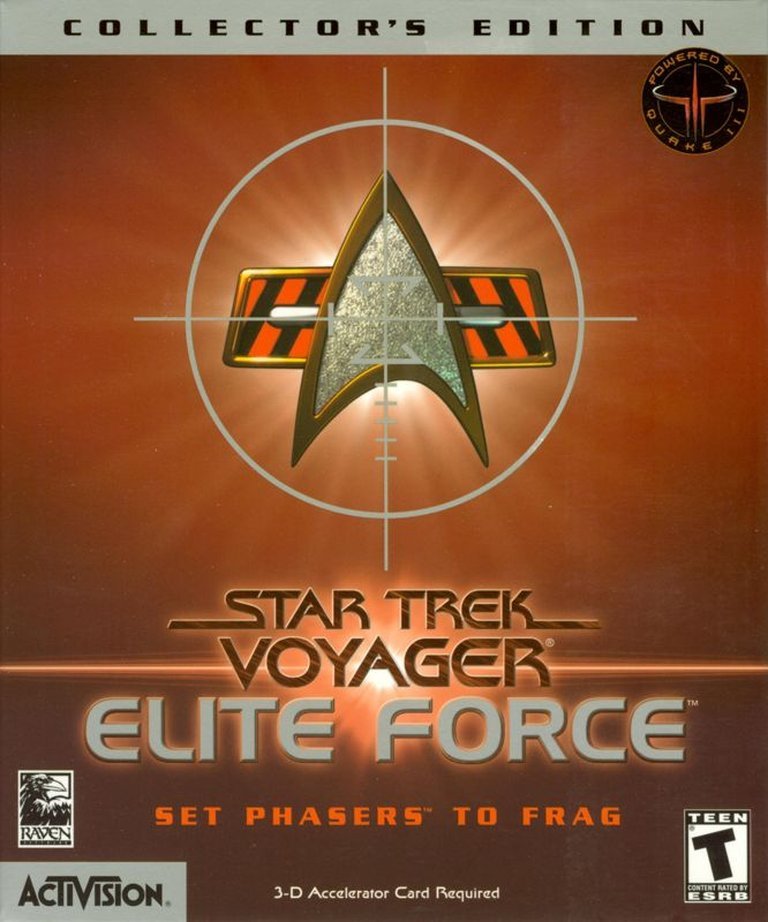
Star Trek: Voyager – Elite Force (Collector’s Edition) is a first-person shooter set in the Star Trek universe, specifically within the events of Star Trek: Voyager. Players take on the role of Ensign Alex Munro, a member of the Hazard Team, an elite security unit tasked with protecting the USS Voyager while it is trapped in a starship graveyard and under attack from various hostile factions. The Collector’s Edition includes the base game along with additional content such as a graphic novel and a lapel pin.
Star Trek: Voyager – Elite Force (Collector’s Edition) Free Download
Star Trek: Voyager – Elite Force (Collector’s Edition) Cracks & Fixes
Star Trek: Voyager – Elite Force (Collector’s Edition) Mods
Star Trek: Voyager – Elite Force (Collector’s Edition) Guides & Walkthroughs
Star Trek: Voyager – Elite Force (Collector’s Edition) Reviews & Reception
myabandonware.com : Elite Force is easily the best single-player FPS I’ve played since Half-life.
Star Trek: Voyager – Elite Force (Collector’s Edition) Cheats & Codes
PC
Press ~ to bring up the console, then enter sv_cheats 1 to enable cheat mode.
| Code | Effect |
|---|---|
| god | Toggle God mode |
| undying | 999 health and armor |
| noclip | No clipping |
| notarget | Invisibility |
| give [item name] | Get indicated item |
| give weapons | All weapons |
| give all | All weapons, weapon power, health |
| cg_thirdperson 1 | Third person view enabled |
| cg_thirdperson 0 | Third person view disabled |
| cg_thirdpersonrange [1-100] | Set third person view range |
| map [level name] | Level select |
| map _brig | Hidden intermission sequence |
| devmap [level name] | Enable cheats for level (on server) |
| +button3 | Enable constant multi-player taunts |
| -button3 | Disable constant multi-player taunts |
| ^[color number] | Set name color |
| cg_fov [number] | Set field of view; default is 80 |
| name [value] | Change name |
| model [model name] | Change character model |
| npc spawn [character name] | Spawn indicated character |
| npc kill [character name] | Kill indicated character |
| npc kill all | Kill all NPCs in current level |
| viewpos | Show current position in x y z |
| g_gravity | Show current gravity setting |
| g_gravity [number] | Set gravity; default is 800 |
| ui_closingcredits | Views ending credits |
| dir video | List FMV sequences |
| cinematic [filename] | Plays indicated FMV sequence |
| bind [key command] | Bind keys; for example: bind F12 map |
| give health [number] | Set health |
| give armor [number] | Set armor |
| give weaponnum [number] | Get weapon |
| kill | Suicide |
| vid_restart | Restart video engine |
| r_gamma [x.x] | Set brightness; 1.0 is default |
| sv_cheats 0 | Deactivate cheat mode |
PlayStation 2
Pause the game and enter the code to activate code effect.
| Code | Effect |
|---|---|
| Hold L1 L2 then press Select | Auto Lock |
| Hold L1 R1 then press Select | FULL Armor |
| Hold L1, L2, R1, R2, and R3, then press select | GOD MODE |
| Hold L1,L2,R1,R2,L3 and the press Select | All Weapons |
| Hold R1 R2 L1 L2 then press Select | FULL Health |
| Hold R1 R2 then press Select | FULLAmmo |
Star Trek: Voyager – Elite Force (Collector’s Edition): A Definitive Review
Introduction
In the often-tumultuous constellation of Star Trek video games, Star Trek: Voyager – Elite Force (Collector’s Edition) shines as a supernova. Released in 2000 by Raven Software and Activision, this first-person shooter not only broke the curse of mediocre Trek adaptations but redefined expectations for licensed games. Blending the narrative depth of Voyager’s Delta Quadrant odyssey with the visceral thrills of id Tech 3-powered combat, Elite Force became a watershed moment for both the franchise and the genre. This review excavates its legacy, celebrating how it bridged the gap between die-hard Trekkies and FPS enthusiasts while boldly innovating within technological constraints.
Development History & Context
Studio Vision & Technological Ambitions
Raven Software, fresh from successes like Heretic and Soldier of Fortune, faced a unique challenge: adapting Voyager’s episodic storytelling into a coherent FPS. Licensed from Viacom by Activision in 1998, the project coincided with a resurgence in narrative-driven shooters like Half-Life (1998). Raven leveraged id Software’s id Tech 3 engine (debuted in Quake III Arena) to render Voyager’s labyrinthine corridors and alien vessels with unprecedented fidelity. Blueprints and set photos ensured the USS Voyager’s on-screen authenticity—down to the carpet textures.
Constraints & Innovations
The late-’90s hardware limitations necessitated creative solutions. While id Tech 3 excelled at closed environments, Raven prioritized scripted sequences and Icarus AI to simulate crew interactions, inspired by Half-Life’s pacing. However, unlike Valve’s opus, Elite Force introduced branching outcomes—such as saving squadmates from Borg assimilation—that added replayability. The Collector’s Edition (featuring a 96-page graphic novel, lapel pin, and Borg cube-shaped packaging) underscored Activision’s confidence, though the base game’s development cycle was a brisk 18 months.
Narrative & Thematic Deep Dive
Plot & Characters: A Voyager Episode Incarnate
Set during Season 6’s latter half (stardate 53854.7), the game follows Ensign Alex Munro (gender-selectable), a Hazard Team recruit tasked with protecting the stranded Voyager in a derelict starship graveyard. The Hazard Team—a tactical unit spearheaded by Tuvok—serves as a narrative linchpin, blending original characters like demolitions expert Austin Chang with series staples (Chell, Juliet Jurot).
Themes & Execution
The story channels Voyager’s core themes: isolation, resilience, and diplomacy under fire. Trapped by the extragalactic Forge—a station harvesting DNA to build an army—the crew’s survival hinges on tense alliances (e.g., bargaining with Borg against Species 8472). Munro’s arc, from reckless ensign to promoted lieutenant, mirrors the show’s focus on growth under duress. Notably, the script avoided killing major TV characters (a Paramount mandate), instead fleshing out the Hazard Team’s dynamics, including a subtle romantic subplot with sharpshooter Telsia Murphy.
Gameplay Mechanics & Systems
Core Loop: Phasers and Tactics
Elite Force masterfully integrates Star Trek’s tech into its FPS framework. The Infinity Modulator (I-MOD), a prototype anti-Borg weapon, embodies the game’s inventive arsenal, while staples like the photon burst launcher satisfy power fantasies. Combat balances squad tactics (AI teammates suppress enemies) with lone-wolf desperation, particularly in Borg levels where adaptive shields demand strategic weapon cycling.
Mission Design & Progression
The 30-level campaign oscillates between set-piece shootouts (e.g., scavenger base raids) and quieter character moments aboard Voyager. Holodeck training missions and zero-G sequences diversify pacing, though the campaign’s brevity (~8 hours) drew criticism. The Collector’s Edition’s expansions added “Virtual Voyager” explorable decks and holodeck minigames, enriching replayability.
Multiplayer: Holomatch Legacy
Dubbed “Holomatch,” multiplayer modes—from Borg assimilation matches to class-based “Specialties”—leveraged mod-friendly Quake III infrastructure. Though overshadowed by Quake’s pedigree, its themed maps (e.g., Voyager’s mess hall) and 32-player support cultivated a niche community.
World-Building, Art & Sound
Visual Fidelity:
Raven’s commitment to authenticity transformed id Tech 3’s angular tendencies into Voyager’s swooping nacelles and bio-mechanical Borg cubes. Lighting effects—phaser glows, warp core breaches—remain striking, though PS2 port downgrades marred its console debut.
Sound Design & Voice Acting
Original cast recordings (minus Jeri Ryan’s initial absence) and a cinematic score by Kevin Schilder amplified immersion. The hum of Voyager’s engines and the Borg’s mechanical drone grounded players in Trek’s auditory lexicon.
Reception & Legacy
Critical & Commercial Response
Lauded as “the first great Star Trek game” (IGN, 8.6/10), Elite Force scored 86% on Metacritic, earning accolades for storytelling and production values. However, sales faltered (64,725 PC copies in 2000) against Activision’s 700k expectations. The PS2 port’s clunky controls (52% Metacritic) further dented momentum.
Enduring Influence
Despite commercial underperformance, Elite Force’s DNA persists in narrative-driven shooters. Its 2020 freeware multiplayer release and sequels (Elite Force II) cemented its cult status, while retrospectives rank it among Trek’s top interactive experiences.
Conclusion
Final Verdict
Star Trek: Voyager – Elite Force (Collector’s Edition) is a triumph of licensed game design—a seamless fusion of Trek’s aspirational ethos and FPS adrenaline. Its technical ingenuity, narrative ambition, and attention to franchise lore set a benchmark few have matched. While its short campaign and dated AI show their age, its legacy as a trailblazer for Trek and story-driven shooters remains undeniable. For collectors and gamers alike, this Borg cube-shaped gem belongs in any Starship’s archive. Engage!
Rating: 4.5/5 ★★★★½
Key Takeaways:
– Landmark Star Trek adaptation with genre-defining FPS mechanics.
– Collector’s Edition extras enrich the lore and fan appeal.
– A testament to Raven Software’s creative engineering under constraints.