
- Release Year: 1998
- Platforms: Windows
- Publisher: LucasArts Entertainment Company LLC
- Genre: Compilation
- Game Mode: Single-player
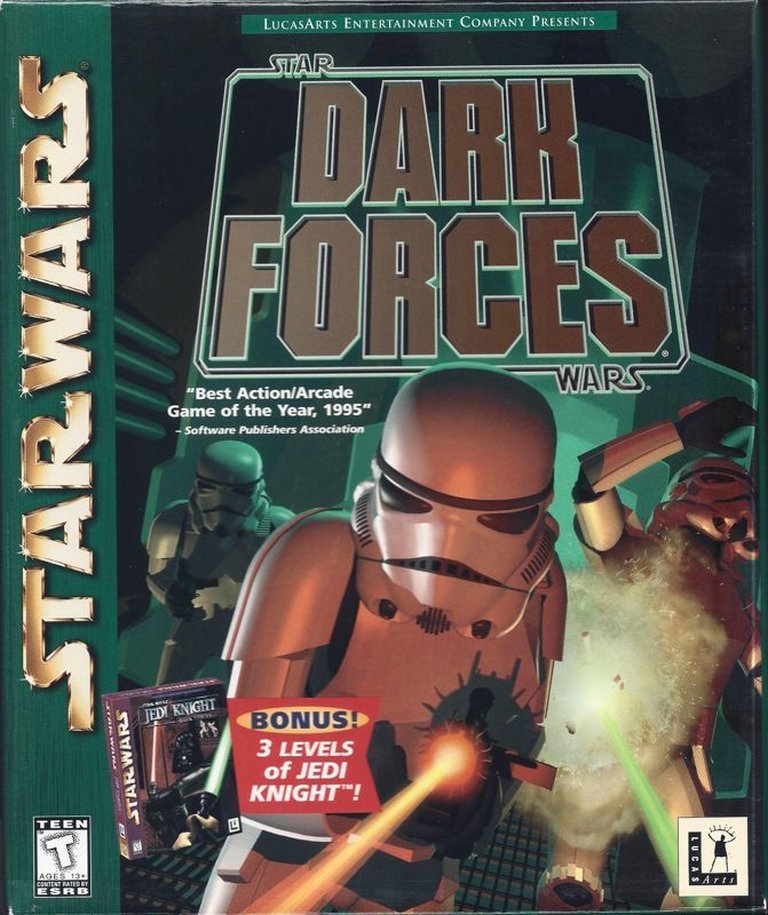
Description
Star Wars: Dark Forces + 3 Levels of Jedi Knight is a 1998 PC compilation that bundles two iconic entries in the Star Wars action series. It includes the full first-person shooter Star Wars: Dark Forces (1995), where players assume the role of mercenary Kyle Katarn on missions against the Galactic Empire, alongside three playable levels from its sequel, Star Wars: Jedi Knight – Dark Forces II (1997), which expands the gameplay with lightsaber combat and Force abilities as Katarn explores his Jedi heritage. Set during the Rebellion era, the games blend intense FPS action with Star Wars lore and cinematic storytelling.
Star Wars: Dark Forces + 3 Levels of Jedi Knight Reviews & Reception
reddit.com : The level designs, mechanics, graphics and storytelling were all massively improved.
Star Wars: Dark Forces + 3 Levels of Jedi Knight Cheats & Codes
PC (Original)
Press ‘t’ while playing, then type the code and press Enter. Some codes require ‘on’, ‘off’, or a numeric parameter.
| Code | Effect |
|---|---|
| jediwannabe on | Enable God mode |
| jediwannabe off | Disable God mode |
| red5 | All weapons |
| wamprat | All items |
| eriamjh | Flight mode |
| bactame | Full health |
| yodajammies | Full mana |
| sithlord | Dark Jedi Master |
| imayoda | Light Jedi Master |
| raccoonking | All Force powers |
| 5858lvr | Reveal full map |
| deeznuts | Level skip / Increase Force level |
| pinotnoir |
Warp to specified level (1-21) |
| slowmo on | Enable slow motion |
| slowmo off | Disable slow motion |
| thereisnotry | End current level (skip to next) |
| whiteflag 1 | Disable AI |
| whiteflag 0 | Enable AI |
| iamthebestjedi | Upside‑down mode |
| warp x,y,z | Warp to specific coordinates (not publicly available) |
| pinotnoir 1 | Restart level with current weapons |
| pinotnoir 0 | Disable level restart |
Star Wars: Dark Forces + 3 Levels of Jedi Knight: Review
Introduction
For a generation of gamers, Star Wars: Dark Forces + 3 Levels of Jedi Knight (1998) was a gateway drug to the galaxy far, far away—a compilation that bridged the tactile grit of 1995’s revolutionary first-person shooter Dark Forces with the embryonic Jedi power fantasy of its 1997 sequel. More than a mere repackaging, this anthology crystallized LucasArts’ bold evolution from corridor shooter innovator to pioneer of narrative-driven action, introducing players to Kyle Katarn, a rogue-turned-Jedi whose arc reshaped Star Wars gaming forever. This review excavates the compilation’s legacy through a historian’s lens, arguing that its fusion of industrial espionage thrills and Force-sensitive emergence marks a watershed in both the franchise and the FPS genre.
Development History & Context
Studio Vision & Technological Constraints
Developed by LucasArts, Dark Forces (1995) emerged during a post-Doom gold rush for first-person shooters. However, as Justin Chin (project lead) noted in interviews, the studio aimed to transcend genre conventions by introducing platforming mechanics (jumping, crouching) and multi-layered level design via the proprietary Jedi Engine—a “2.5D” hybrid that aped 3D spaces through sector-based rendering. This was no small feat in an era when DOS and early Windows systems strained under polygonal loads.
In contrast, Jedi Knight: Dark Forces II (1997) pioneered the Sith Engine, one of the first commercial adopters of Direct3D hardware acceleration. This allowed true 3D environments, dynamic lighting, and FMV cutscenes featuring live actors—a $1.5 million investment (PC Gamer, 1997) that gambled on cinematic storytelling in an age of sprite-based abstraction.
The Gaming Landscape
Released amidst Quake’s dominance and Final Fantasy VII’s reinvention of RPG scope, Dark Forces carved a niche with its puzzle-infused shooter design, while Jedi Knight leveraged nascent 3D accelerators like the Voodoo card to deliver blistering lightsaber duels. The 1998 compilation arrived as LucasArts pivoted toward multiplayer experimentation (Mysteries of the Sith’s co-op) and narrative depth—a stark contrast to the arcade immediacy of Shadows of the Empire (1996).
Narrative & Thematic Deep Dive
A Hero’s Reluctant Ascent
Dark Forces casts Kyle Katarn as a morally ambiguous mercenary—a deliberate subversion of Star Wars’ archetypal heroism. His theft of the Death Star plans (later retconned by Rogue One) and sabotage of the Dark Trooper Project frames the Rebellion as a dirty, infrastructure-war conflict. Industrial espionage, not destiny, drives him—a tone evoking Blade Runner’s cynicism.
Jedi Knight’s three-level preview, however, seeds Katarn’s transformation. Haunted by his father’s murder by the Dark Jedi Jerec, these missions (Barons Hed, Palace Escape, Fuel Station Launch) introduce Force powers and lightsaber combat as psychological conduits. Katarn’s struggle mirrors The Empire Strikes Back’s tension between pragmatism and mysticism, with the Dark/Light morality system presaging Knights of the Old Republic’s alignment scale.
Themes of Inheritance & Corruption
The compilation juxtaposes two narratives: Dark Forces’ techno-thriller (AI super-soldiers, corporate sabotage) with Jedi Knight’s mythic revenge tale. Katarn’s shift from blaster-for-hire to Jedi aspirant interrogates cyclical violence—a theme crystallized when sparing or slaying foes like Yun alters his path. The trilogy of novellas (Soldier for the Empire, Rebel Agent, Jedi Knight) further embeds this duality, painting Katarn as a Star Wars analog to Deus Ex’s JC Denton.
Gameplay Mechanics & Systems
From Gritty Shooter to Jedi Simulator
Dark Forces innovated with:
– Verticality: Ladder climbs, platforming in Anoat City Sewers.
– Environmental Puzzles: Reactor-core sabotage in The Arc Hammer.
– Weapon Depth: Secondary fire modes (e.g., concussion rifle’s remote detonation).
Jedi Knight’s sampled levels, however, showcase a paradigm shift:
– Lightsaber Dynamics: Manual deflection of blaster bolts, three combat stances.
– Force Powers: RPG-like progression trees (e.g., Speed vs. Grip).
– Branching Morality: Executing civilians or Imperial officers nudges Katarn toward the Dark Side.
UI & Progression
While Dark Forces employs a minimalist HUD (ammo/health counters), Jedi Knight overlays a Force Meter and power-select wheel—early attempts at diegetic immersion. The compilation’s lack of Jedi Knight’s full skill tree, however, risks alienating players mid-transformation.
World-Building, Art & Sound
Atmosphere as Character
Dark Forces’ diesel-punk aesthetic—Imperial detention centers’ rusted grates, Nar Shaddaa’s rain-slicked alleys—echoes Alien’s tactile horror. The Jedi Engine’s faux-3D convincingly evoked claustrophobia, with Dave Levison’s iMUSE system dynamically adapting John Williams’ motifs to gameplay tension.
Jedi Knight’s FMV sequences (featuring Jason Court’s Katarn) juxtapose pre-rendered backdrops with campy noir-esque dialogue. Yet its Dromund Kaas swamp level—sampled here—hints at the series’ Gothic future, with fog-shrouded ruins and Sith chanting foreshadowing KOTOR’s Korriban.
Sound Design’s Legacy
Dark Forces’ punchy blaster reports and droid whirrs set a benchmark, but Jedi Knight’s lightsaber hum and Force push audiovisuals became franchise DNA—later imitated by Jedi: Fallen Order.
Reception & Legacy
Critical & Commercial Impact
Dark Forces sold 300,000 copies at launch (LucasArts, 1995), while Jedi Knight scored 91/100 on Metacritic, praised for its “dizzying sense of scale” (IGN). The compilation itself was a budget-friendly curation, earning cult status for preserving both eras.
Industry Influence
– Lightsaber Gameplay: Blueprint for Jedi Outcast’s motion-captined duels.
– Morality Systems: Prefigured Fable and Mass Effect.
– Modding Community: Jedi Knight’s SDK birthed Movie Battles mods still active today.
Modern Reappraisal
2024’s Dark Forces Remaster underscores the compilation’s historical value. As Reddit users note, its DNA lives in Star Wars’ “gritty reboot” era (Andor, Rogue One), while Katarn’s absence from Disney canon magnifies his cult appeal.
Conclusion
Star Wars: Dark Forces + 3 Levels of Jedi Knight is less a relic than a Rosetta Stone—one that decodes LucasArts’ shift from pixel-perfect nostalgia to bold genre alchemy. Its value lies not in technical polish (though the Sith Engine dazzled), but in capturing gaming’s transition from arcade abstraction to cinematic immersion. Katarn’s journey—from stealing Death Star plans to grappling with Force demons—mirrors the medium’s own adolescent angst, wrestling with newfound power and consequence. For historians, this compilation is indispensable; for players, it remains a masterclass in how to evolve a franchise without severing its roots. 9/10—A New Hope for narrative FPS design.