
- Release Year: 2006
- Platforms: Windows
- Publisher: LucasArts
- Genre: Compilation
- Game Mode: LAN, Online PVP
- Setting: Star Wars
- Average Score: 85/100
Description
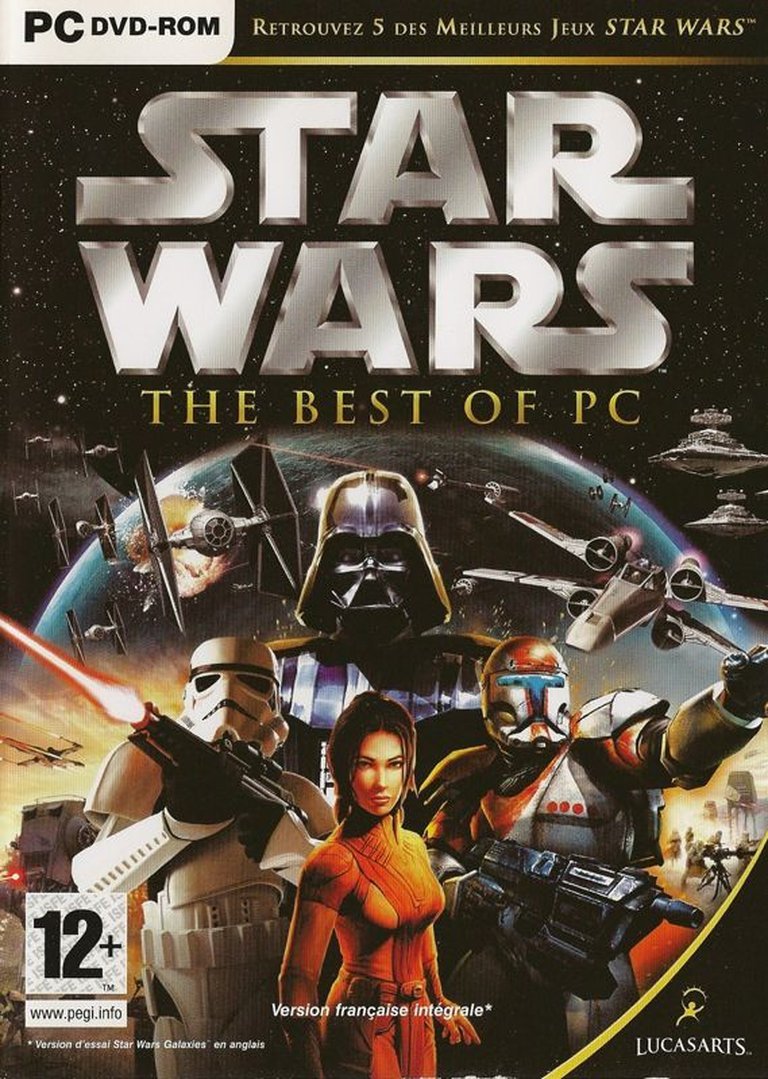
Star Wars: The Best of PC is a 2006 compilation anthology released by LucasArts, bundling six iconic Star Wars PC games spanning multiple genres. The collection includes tactical shooters like Republic Commando, strategy games such as Empire at War, action-adventures like Knights of the Old Republic, and Jedi-focused titles such as Jedi Knight II – Jedi Outcast, alongside a 14-day trial of Star Wars Galaxies: An Empire Divided. This curated package offered players a comprehensive Star Wars gaming experience across different eras and gameplay styles.
Star Wars: The Best of PC Free Download
Star Wars: The Best of PC Reviews & Reception
gamespot.com (85/100): 100% Worth the Money even if your not a Star Wars Fan!
Star Wars: The Best of PC Cheats & Codes
PC
Enter codes at the options menu.
| Code | Effect |
|---|---|
| overseer | All cheat options unlocked |
| james | James’ day of work |
| heroes | Spaceship and cast pictures |
| planets | Pre-production art |
| ships | Enemy ship gallery |
| woz | Christmas FMV sequence |
| lateam | View programming team |
| slteam | View programming team |
| simon | Pictures of Simon |
| credits | View credits |
| bluensf | Secret spaceship for bonus missions |
| jarjar | Jarjar mode; reversed controls |
| minime | Invincibility |
| director | Director’s cut mode |
| nohud | Bonus features unlocked |
| ltdjgd | Programmer message |
| bigone | Queen Amidala’s starship |
PC
Press ~ to open the console then enter helpusobi 1 to enable cheat mode. Then enter the following codes:
| Code | Effect |
|---|---|
| levelshot | Screenshot w/o console window |
| spawn [item name] | Spawns given item |
| give weaponnum [weapon #] | Spawns given weapon |
| kill | Suicide |
| force_heal | Uses Force Heal ability |
| G_knockback X | X is a number. The higher the number, the further people are knocked back. |
| give weapons | All weapons |
| name [enter name here] | Changes your name. |
| use atst_death | Destroy all AT-STs |
| cg_drawgun 1 | Disable weapon models. Enter again with a 0 at the end to turn the models back on. |
| cg_drawtimer 1 | Enables the Timer. Enter again, but with a 0 at the end to turn off. |
| give batteries | Full battery bar |
| give inventory | Full inventory |
| setforceall 3 | Gives you all the force powers on a level 3. |
| give all | Gives you max weapons, health and shields. |
| god | God mode. |
| npc kill all | Kill all NPCs |
| control [NPC name] | Lets you control any ally following you |
| noclip | No clipping mode, which allows you to float in the air. |
| setviewpos [x] [y] [z] [yaw] | Places camera at indicated position |
| quit | Quit the game without going through the menus. |
| cg_drawcrosshair 1 | Remove crosshair. (0 to replace) |
| where [classname] | Reveals where indicated entity is located |
| screenshot | Screenshot w/ console window |
| r_showtris ! | Wireframe mode |
PC
To enable cheats you must first edit a game file called ‘swkotor2.ini.’ Look for [Game Options] and add ‘EnableCheats=1’ below it and save. To use the cheats press the [~] key then type the code you want and press the [Enter] key.
| Code | Effect |
|---|---|
| revealmap | Reveals the map |
| invulnerability | God mode |
| infiniteuses | Infinite use of items |
| heal | Restores health and force points |
| dance_dance_ravan | Ravan turns into a dancing twi’lak |
| bright | Brightens dark areas |
| restartminigame | Restart mini game if you lose |
| turbo | Characters move faster |
| givesitharmour | Get 100 Armor |
| giverepair | Get 100 Advance Repair Kits |
| whereami | Shows you where you are on map |
| givecredits [number] | Gives credits |
| givecomspikes [number] | Gives 99 computer spikes |
| addexp [number] | Gives experience points |
| giveitem [number] | Get item of your choice |
| givemed | Get 100 med kits |
| addlevel [number] | Lets you level up |
| settreatinjury [number] | Raises treat injury skills |
| setcomputeruse [number] | Raises computer skills |
| setdemolitions [number] | Raises demolitions skills |
| setpersuade [number] | Raises persuade skills |
| setrepair [number] | Raises repair skills |
| setstealth [number] | Raises stealth skills |
| setawareness [number] | Raises awareness skills |
| addlightside [number] | Gives lightside points |
| adddarkside [number] | Gives darkside points |
| setwisdom [number] | Raises wisdom points |
| setcharisma [number] | Raises charismal points |
| setintelligence [number] | Raises intelligence points |
| setconstitution [number] | Raises constitution points |
| setdexterity [number] | Raises dexterity points |
| setstrength [number] | Raises strength points |
Star Wars: The Best of PC: Review
1. Introduction
In the pantheon of gaming compilations, Star Wars: The Best of PC (2006) stands as a definitive time capsule, a meticulously curated anthology that captures the zenith of Star Wars video game excellence on the PC platform. Released by LucasArts on DVD-ROM in November 2006, this collection assembled six titles—Star Wars: Battlefront, Star Wars: Empire at War, Star Wars Galaxies: An Empire Divided (14-day trial), Star Wars Jedi Knight II: Jedi Outcast, Star Wars: Knights of the Old Republic, and Star Wars: Republic Commando—spanning genres from RPG to real-time strategy. Together, these games represented the creative and commercial pinnacle of Star Wars gaming before Disney’s acquisition reshaped the franchise. This review posits that The Best of PC is not merely a nostalgic bundle but a masterclass in curation, showcasing unparalleled diversity, depth, and lasting impact on both the Star Wars universe and the broader gaming landscape.
2. Development History & Context
The compilation emerged from LucasArts’ strategic rebranding efforts in the mid-2000s, aiming to consolidate the franchise’s most successful PC titles into a single, accessible package. While the compilation itself was assembled by LucasArts, its constituent titles were developed by industry titans: BioWare (KOTOR), Pandemic Studios (Battlefront), Free Radical Design (Republic Commando), and Petroglyph Games (Empire at War). Each game was created during a golden era for Star Wars gaming (2002–2006), fueled by the cultural momentum of the prequel trilogy and the rising dominance of PC gaming.
Technologically, the titles pushed hardware boundaries. Empire at War leveraged 3D real-time strategy engines for both ground and space combat, while Republic Commando utilized the Unreal Engine to deliver squad-based tactical action. The gaming landscape of 2006 was defined by the rise of online multiplayer (reflected in Battlefront’s 32-player LAN support) and the maturation of RPG mechanics, with KOTOR’s D&D-inspired systems setting new standards for narrative choice. LucasArts’ decision to bundle these games—a mix of critical darlings (KOTOR earned 40+ Game of the Year awards) and bestsellers (Battlefront sold millions)—under a $39.99 price point was a masterstroke, capitalizing on the franchise’s enduring appeal while introducing classics to new audiences.
3. Narrative & Thematic Deep Dive
Each game in the compilation offers a unique lens into Star Wars lore, collectively spanning millennia of galactic history:
- Knights of the Old Republic (2003): BioWare’s magnum opus transports players 4,000 years before the films, framing a story of redemption and moral ambiguity. The protagonist’s journey—from amnesiac soldier to Jedi/Sith Lord—explores the cyclical nature of the Force. Themes like the corruption of power (via Darth Malak’s fleet) and the fragility of Jedi ideals resonate deeply, culminating in a twist that recontextualizes the saga’s core duality.
- Jedi Knight II: Jedi Outcast (2002): Set between Return of the Jedi and The Force Awakens, Kyle Katarn’s return to his Jedi roots explores the weight of legacy. The narrative grapples with trauma (Katarn’s abandonment of the Force) and the seductive darkness of power, epitomized by Desann’s cult. Its themes of isolation and responsibility are underscored by gothic environments like the Jedi Academy on Yavin 4.
- Republic Commando (2005): Focusing on Delta Squad, this title humanizes the Clone Wars through the lens of military brotherhood. Its narrative—centered on Order 66 and the fall of the Jedi—prioritizes grit over grandeur, emphasizing the ethics of loyalty and the dehumanization of war. The game’s “Sev” subplot remains a haunting commentary on wartime sacrifice.
- Battlefront (2004): While light on story, its “Galactic Conquest” mode implicitly frames the conflict as a war of attrition, with players embodying both Rebellion and Empire. Its thematic strength lies in its immersive reenactments of iconic battles (Hoth, Endor), reducing players to cogs in a larger ideological machine.
- Empire at War (2006): The game’s strategic layer treats the Galactic Civil War as a geopolitical chess match, with moral grayness in campaigns like “Forces of Corruption” (tyranny vs. pragmatism). Its narrative subtly critiques authoritarianism while celebrating Rebel resilience.
Across these titles, recurring motifs emerge: the duality of the Force, the cost of war, and the tension between individual choice and systemic oppression. The compilation’s diversity ensures that no single perspective dominates, instead offering a tapestry of Star Wars’ narrative potential.
4. Gameplay Mechanics & Systems
The Best of PC showcases remarkable genre innovation, with each title pioneering distinct mechanics:
- Knights of the Old Republic: BioWare’s D&D 3E adaptation introduced deep character customization. Class systems (Soldier, Scoundrel, Jedi) and skill trees enabled diverse playstyles, while dialogue choices dynamically shaped alliances and Force alignment. Its “persuade/deceive/intimidate” skill system remains a benchmark for RPG agency.
- Jedi Knight II: Jedi Outcast: The game revolutionized lightsaber combat with a physics-based “stance system” (fast, medium, strong). Force powers (Push, Pull, Lightning) integrated seamlessly with gunplay, and multiplayer modes like “Siege” added objective-driven teamwork. Its lightsaber dueling remains unmatched for visceral satisfaction.
- Republic Commando: As a squad-based tactical shooter, it emphasized command over direct action. Delta Squad’s AI companions (Fixer, Sev, Scorch) had distinct roles, and “order commands” (breach, frag, regroup) enabled tactical depth. Its cover system and weapon mods set precedents for modern tactical shooters.
- Battlefront: The “Conquest” mode blended objective-based gameplay with large-scale battles. Class asymmetry (snipers vs. rocket troopers) and vehicle integration (AT-STs, X-wings) created chaotic, memorable skirmishes. Its “Instant Action” mode became a template for multiplayer arena design.
- Empire at War: A hybrid of real-time strategy (RTS) and 4X mechanics, it featured a strategic “galactic map” where players moved fleets between planets. Ground battles transitioned into RTS skirmishes, while space combat emphasized capital ship tactics.
The compilation’s UI design reflected each game’s ethos: KOTOR’s clean, menu-driven interfaces contrasted with Republic Commando’s tactical HUD. Despite technical disparities (e.g., Galaxies’ dated MMO mechanics), the collection’s gameplay cohesion stemmed from a shared Star Wars identity—precision in movement, weight in combat, and immersion in its universe.
5. World-Building, Art & Sound
The compilation’s visual and auditory diversity is staggering, each game carving its niche in Star Wars lore:
- World-Building: From KOTOR’s ancient Sith tombs on Korriban to Republic Commando’s claustrophobic Separatist bunkers, the games expanded the galaxy’s geography. Battlefront’s maps (Tatooine’s Mos Eisley, Kashyyyk’s Wookiee villages) were lovingly detailed, while Empire at War introduced canonical planets like Felucia.
- Art Direction: Jedi Knight II adopted a gritty, photorealistic style, contrasting with KOTOR’s painterly, isometric vistas. Republic Commando used neon-lit industrial palettes, while Battlefront’s environments mirrored filmic grandeur. Even Galaxies’ voxel-based landscapes evoked a lived-in galaxy.
- Sound Design: John Williams’ score permeates each game, recontextualized for gameplay: Battlefront’s “Binary Sunset” during hero moments; KOTOR’s leitmotifs for Jedi/Sith duality. Sound effects—lightsaber hums, TIE fighter screeches—are universally iconic, but Republic Commando’s comms chatter added military realism.
Together, these elements forge an unparalleled sensory immersion. The compilation’s art and sound aren’t just window dressing; they are narrative tools, deepening the Star Wars mythos with every blaster shot and Force push.
6. Reception & Legacy
At launch, The Best of PC was lauded for its value proposition. Gameplay (Benelux) awarded it 88%, noting its appeal to both newcomers and veterans. Commercially, it capitalized on the franchise’s enduring popularity, bundling titles that had collectively sold over 10 million copies. Critics praised the curation, with KOTOR and Battlefront frequently highlighted as system-sellers.
Its legacy is twofold:
– Industry Influence: KOTOR’s narrative choices and Battlefront’s multiplayer blueprints inspired countless titles, from Mass Effect to Destiny. Republic Commando’s squad mechanics prefigured games like Gears of War.
– Cultural Preservation: The compilation became a time capsule for Star Wars gaming, preserving pre-Disney era design philosophies. Modern remasters (e.g., KOTOR on Switch) owe their existence to its success.
Over time, its reputation has only grown. While Galaxies was shuttered in 2011, the other titles remain revered, with KOTOR and Jedi Knight II sustaining modding communities. The compilation stands as a testament to an era when Star Wars games prioritized ambition over commercial homogeneity.
7. Conclusion
Star Wars: The Best of PC is more than a compilation; it is a meticulously crafted artifact, a digital museum showcasing the creative zenith of a franchise at its most innovative. Its diversity—from KOTOR’s philosophical depth to Battlefront’s chaotic multiplayer—ensures enduring replayability, while its technical achievements (real-time strategy, squad-based AI) set standards for generations. Though marred by the dated mechanics of Galaxies, the package’s value proposition remains unassailable.
In the annals of gaming history, this compilation occupies a unique space: a love letter to Star Wars’ PC golden age and a benchmark for anthology releases. It is not merely “the best of PC”—it is a definitive statement on how licensed games can transcend their source material to become timeless classics. For any fan of Star Wars or strategy/RPG hybrids, The Best of PC remains an essential, enduring masterpiece.