
- Release Year: 1996
- Platforms: Macintosh, Windows 16-bit, Windows
- Publisher: Sierra On-Line, Inc.
- Developer: Funnybone Interactive
- Genre: Adventure
- Perspective: 1st-person
- Game Mode: Single-player
- Gameplay: Graphic adventure, Interactive objects, Mini-games, Point and click
- Setting: North America
- Average Score: 76/100
Description
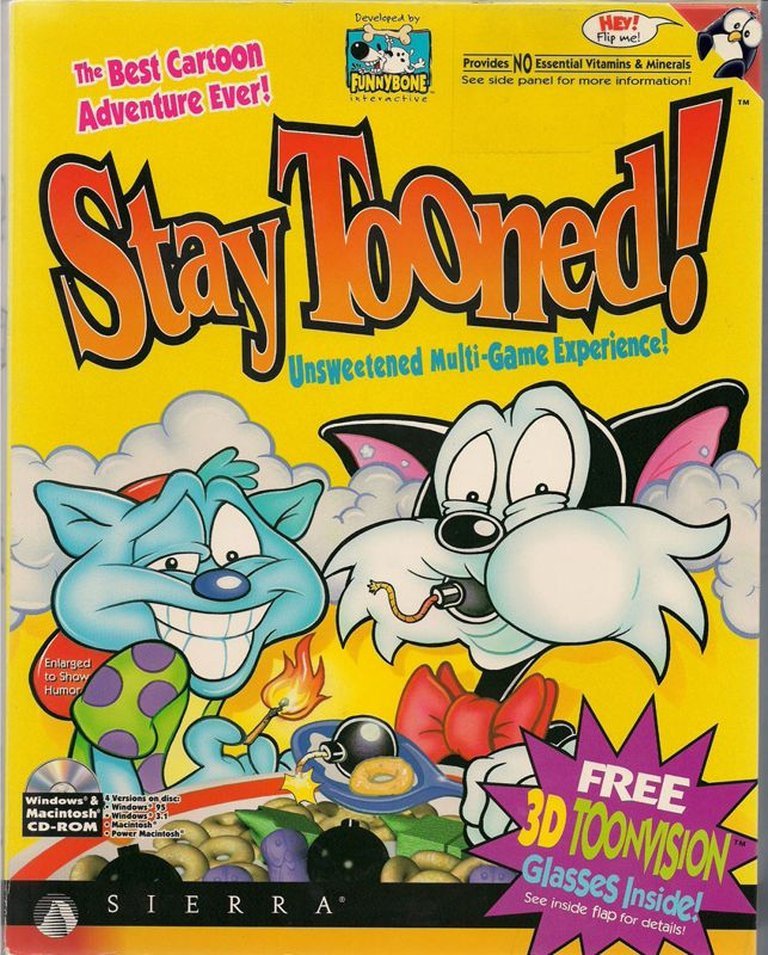
Stay Tooned! is a comedic adventure game set in a cartoon-infested apartment building, where players must find their lost TV remote to reign in escaped cartoon characters wreaking havoc. Blending traditional point-and-click adventure elements with mini-games, QuickTime video clips, and Saturday morning cartoon humor, the game features hand-painted backgrounds, interactive animations, and parodies of classic media, all rendered in Macromedia Director for a playful, chaotic experience.
Gameplay Videos
Stay Tooned! Free Download
PC
Stay Tooned! Guides & Walkthroughs
Stay Tooned! Reviews & Reception
mobygames.com (76/100): This interactive Saturday morning cartoon show will tickle your funny bone.
mobygames.com (76/100): This interactive Saturday morning cartoon show will tickle your funny bone.
Stay Tooned!: Review
In the sprawling, chaotic landscape of 1990s PC gaming, the mid-90s represented a golden age of multimedia experimentation. It was an era where the CD-ROM format allowed developers to stuff their discs full of grainy video clips, high-fidelity audio, and hand-drawn animation. Amidst the Myst clones and the Doom shooters, Sierra On-Line—a titan of the graphic adventure genre—published a title that defied easy categorization. Developed by Funnybone Interactive, Stay Tooned! (1996) is a manic, fourth-wall-breaking descent into cartoon anarchy. It serves as a fascinating time capsule of the era’s “edutainment” evolution into full-fledged entertainment, blending the mechanics of a point-and-click adventure with the pacing of a Saturday morning cartoon marathon.
Development History & Context
To understand Stay Tooned!, one must look at the trajectory of its developer, Funnybone Interactive. Originally known as “The Cute Company,” the studio cut its teeth on educational software and children’s titles, notably the Fisher-Price Read & Play series and Schoolhouse Rock! games. By 1996, the studio rebranded to Funnybone Interactive, signaling a shift toward broader humor and gameplay that wasn’t strictly educational.
The game was a joint effort between this burgeoning studio and the publishing giant Sierra On-Line. While Sierra was renowned for serious, text-heavy epics like King’s Quest or Gabriel Knight, Stay Tooned! represented a divergence into slapstick comedy and casual gameplay.
Technically, the game was built using Macromedia Director, a popular multimedia authoring tool of the era often used for animations and interactive CD-ROMs. This choice defined the game’s aesthetic, allowing for fluid, hand-drawn 2D animation that mimicked the quality of television cartoons. The development was spearheaded by designers Susan Swanson-Decker, Ben Howard, Kevin O’Neill, and Christopher Lewis. Their background in children’s software is evident in the game’s accessibility, yet they clearly leveraged the new “Funnybone” moniker to push the boundaries of absurdity. The game shipped with a pair of 3D glasses, a nod to the multimedia gimmickry of the time, designed to enhance specific mini-games included on the disc.
Narrative & Thematic Deep Dive
The Premise
The game opens with a meta-textual hook: the player is an ordinary resident in an unnamed city apartment building. The initial gameplay loop is deceptively mundane—channel surfing on your television. The channels parody mid-90s pop culture, featuring Whinefeld (a spoof of Seinfeld), Schleopardy (a parody of Jeopardy!), and even a pay-per-view channel titled The XXX Files. Interspersed with these clips are the game’s main antagonists—a group of cartoon characters who urge the player to press the “Red Button” on their remote.
When the player inevitably presses the button, the fourth wall shatters. The toons physically break out of the television, steal the remote, and “Toonify” the entire apartment complex. The building transforms from a realistic setting into a chaotic, animated landscape. The player’s goal becomes a quest for order: retrieve the remote and zap the rogue toons back into “TV Land.”
The Cast: A Cast of Archetypes
The game features a colorful cast of anthropomorphic animals and humans, each fulfilling a specific cartoon trope:
* Pixel and Chisel: The twin cats and primary antagonists. Pixel is the “Miss Perfect” perfectionist leader, while Chisel, wearing his signature red cap, is the destructive agent of chaos.
* Fiddle: A cowardly, black-and-white cat who serves as the Token Good Teammate. He is the only toon who actively helps the player, largely because he wants to go home.
* Schmooze: A short, orange bulldog with a black bowler hat, embodying the “Casanova Wannabe” trope. He is infatuated with Pixel, a love unrequited, and constantly seeks wealth and status.
* Scoops: A hyperactive dog with an obsession for gravy and a surprisingly impressive singing voice.
* Supporting Cast: The roster is filled out by Frank (a tough human toon), Dr. Pickles (a mad scientist), Mrs. Findley (the grouchy landlord), and the hapless pizza delivery guy.
Thematic Analysis
The underlying theme of Stay Tooned! is the clash between the mundane reality of the player and the anarchic logic of the cartoon world. The toons operate on “Toon Physics”— anvils drop, explosions blacken faces, and logic is non-existent. The narrative is surprisingly dark for a family title; the ending is a Gainax Ending (a surreal, often confusing conclusion). After the player successfully zaps the toons back into the TV, Chisel and Pixel enact a revenge plot, grabbing the player and dragging them into TV Land. In a final twist, the player realizes they have been transformed into a toon themselves, trapped forever in a world of eternal slapstick.
Gameplay Mechanics & Systems
Stay Tooned! is a hybrid beast—part graphic adventure, part mini-game compilation.
Exploration and Interface
The game utilizes a first-person, point-and-click interface. The cursor changes contextually (an eye for viewing, a hand for interacting, a fallout symbol for games). The primary loop involves navigating the five floors of the apartment complex, searching for gold keys to unlock new apartments.
The developers implemented a “randomization” system that was innovative for its time. While the map remains constant, the locations of keys, puzzles, and even the obstacles blocking the player’s path change with every playthrough. For example, accessing the fifth floor might require fixing a cable box in one run, but finding a missing elevator button in another.
The Mini-Game Core
Critics often compared the gameplay to Monty Python’s Complete Waste of Time. The “adventure” elements are often secondary to the sheer volume of interactive distractions. There are nearly 30 mini-games scattered throughout the apartments. Highlights include:
* Toon Boy: A handheld console game found in the player’s apartment.
* Kartoon Kombat: A direct parody of Mortal Kombat, featuring the toons fighting with exaggerated moves.
* Schleopardy: A trivia game hosted by the Alex Trebek parody.
* 3D Table Tennis: Utilizes the included 3D glasses for depth effects.
Chaos Mechanics
The game actively fights against the player’s sense of control. The “toons” frequently break the UI. Pixel might steal the mouse cursor and toss it to Scoops, forcing the player to physically shake the dog to get it back. The game utilizes “Interface Screws,” such as fake error messages or pies splattering the screen, blurring the line between the software and the cartoon world.
World-Building, Art & Sound
Visual Direction
The art style is the game’s strongest asset. Leveraging Macromedia Director, Funnybone Interactive achieved a quality of animation comparable to 90s television cartoons like Animaniacs or Tiny Toon Adventures. The transition from the “real” (pre-rendered 3D city) to the “toon” (hand-painted 2D backgrounds) is a striking visual hook. The game is packed with visual gags—background details, sight gags, and slapstick violence—that reward thorough exploration.
Sound Design
The audio is a masterclass in cartoon Foley work. The sound effects are classic “Boing,” “Crash,” and “Whistle” sounds that perfectly match the visual style. The soundtrack is notable for its character-specific musical numbers. Scoops performs Sinatra-esque crooners about food, while Fiddle has a rap-style track (“Where ya at, Mr. Fiddle”). These musical interludes add significant personality to the cast, elevating them from simple obstacles to memorable characters.
Reception & Legacy
Critical Reception
Upon release in October 1996, Stay Tooned! received generally positive reviews, averaging around 80% from critics.
* Electric Playground (7.5/10): Praised the game’s ability to capture the “sugar cereal” vibe of Saturday mornings, noting that if you enjoyed cartoons, you would enjoy the game.
* Gamezilla (83%): Called it a “fun twist on the adventure format,” though noted that the adventure elements sometimes got lost in the mini-games.
* HonestGamers (4/5): Defended the game against accusations of being mere “edutainment,” arguing it was a genuinely fun experience.
However, some critics felt the puzzles were too simple for hardcore adventure fans, positioning the game more as a casual or family title than a successor to Space Quest.
Commercial and Historical Legacy
While not a blockbuster hit, Stay Tooned! has gained a cult following. It is remembered for its high production values and its unique, slightly subversive humor. It stands as a testament to the creativity of the CD-ROM era before 3D acceleration became the industry standard.
Technically, the game has faced preservation issues. As a 16-bit application reliant on older QuickTime video codecs, running Stay Tooned! on modern systems (Windows 10/11 or macOS) is notoriously difficult without virtualization or emulation, leading to its presence on abandonware sites and browser-based emulators.
Conclusion
Stay Tooned! is a chaotic, charming, and occasionally frustrating relic of 1990s multimedia ambition. It successfully captures the manic energy of the cartoons it parodies, breaking down the walls between the player and the screen with a gleeful disregard for conventional game design. While its reliance on randomization and mini-games may frustrate purists looking for a traditional Sierra adventure, its strength lies in its world-building and character work.
For the historian, it represents a unique intersection where educational software developers attempted to crossover into mainstream entertainment, backed by the publishing might of Sierra. For the player, it offers a genuinely funny, albeit bizarre, trip into a world where the remote is the ultimate weapon, and the punishment for winning is becoming a cartoon yourself. It is a definitive “unsweetened” gem of the Windows 3.x era.
Verdict: A chaotic, cult-classic adventure that perfectly encapsulates the 90s multimedia boom. 4/5.