
- Release Year: 2003
- Platforms: Windows
- Publisher: Buka Entertainment, Microforum Italia S.p.A.
- Developer: Buka Entertainment, Gromada Inc.
- Genre: Strategy, Tactics
- Perspective: Diagonal-down
- Game Mode: Single-player
- Average Score: 82/100
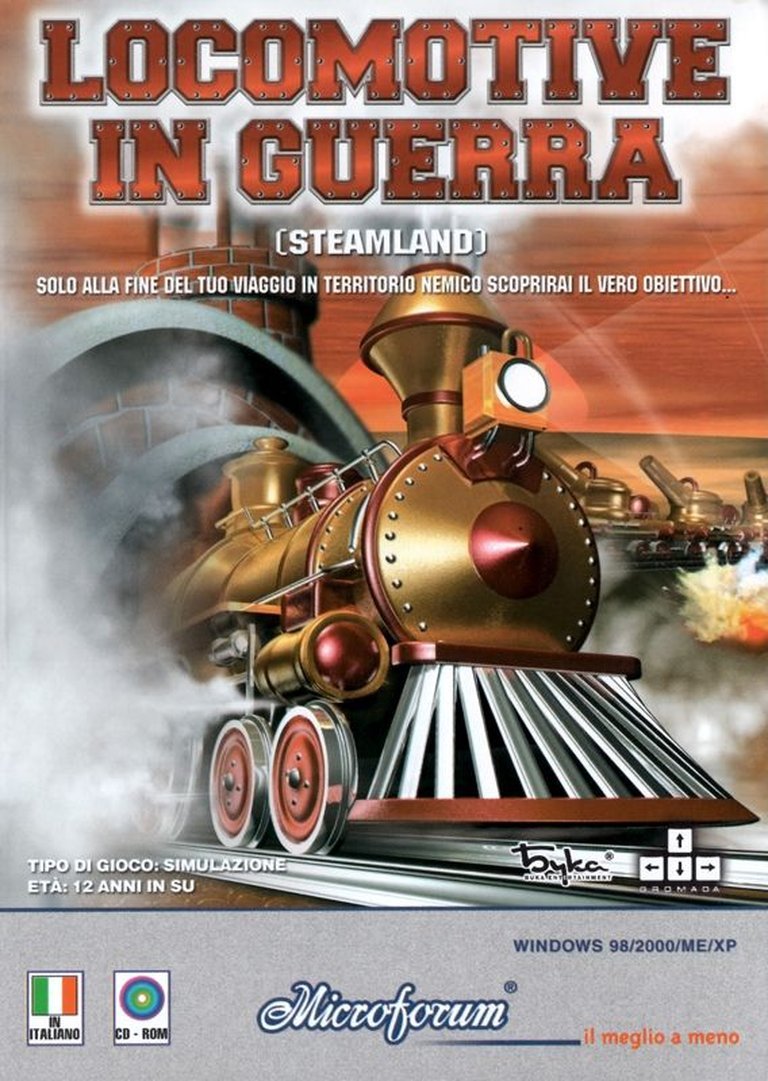
Description
Steamland is a real-time strategy game set in a vibrant, fantastical world featuring bizarre landscapes and a civilization of steam-powered robots engaged in perpetual conflict. Players take command of robotic trains equipped with missile weaponry, navigating through dynamic environments like volcanic eruptions and meteor showers to wage tactical warfare against rival factions.
Steamland Reviews & Reception
kritikanstvo.ru (80/100): Единственная в своем роде игра, которая не боится экспериментировать, и в этом ее главное достоинство.
Steamland Cheats & Codes
PC
Download and unpack the cheat enabler. During gameplay, use the following case-sensitive keys.
| Code | Effect |
|---|---|
| W | Win mission |
| # | Get a large train |
| x | Explosion under cursor |
| K | Kill Enemies on screen |
| B | Build mode (?) |
| A | Change army (?) |
| D | Show aidebug (?) |
| M | Set money (?) |
| h | Repair (?) |
Steamland: Review
Introduction
In the crowded pantheon of real-time strategy (RTS) games, where titans like StarCraft and Warcraft reigned supreme, a peculiar and audacious contender emerged from the Russian studio Gromada in 2003. Steamland—also known as Locoland in Europe and Locomotive in guerra in Italy—was a game that dared to reinvent the wheel, or rather, the railroad track. Its premise was deceptively simple yet wildly imaginative: command a civilization of sentient steam-robots locked in a war for resources, where armored trains replace infantry and rails dictate the battlefield. Yet for all its eccentric charm, Steamland remains a cult curiosity, a game that divided critics and players alike while birthing a passionate niche following. This review dissects Steamland not merely as a relic of its era, but as a flawed yet visionary artifact—a testament to the boundless creativity of mid-2000s Eastern European game development and a poignant reminder of how ambition can transcend technical limitations.
Development History & Context
Steamland was crafted by Gromada Inc., a Russian developer whose portfolio included the niche cult hit Gromada Revenge (2000), a vehicular combat game. For Steamland, the studio expanded its scope into full-scale RTS territory, but with an unorthodox twist. Led by Game Designer Eugene Pastukhov and Producer Ruslan Shelekhov, the team of 49 developers (including programmers Vitaly Maltsev and Boris Koudryashov, and artists Alexander Shushkov and Vladimir Paromov) aimed to create a “unique in its kind RTS” that blended strategic depth with accessible, toy-like mechanics. Their vision was explicitly shaped by the limitations of the era: DirectX 8.1-era hardware meant 3D graphics were rudimentary, and AI systems were rudimentary. The game required a Pentium III 500MHz CPU, 128MB RAM, and a 32MB graphics card—specifications that rendered it technically modest even at launch.
Released in December 2003 by Buka Entertainment and Microforum Italia S.p.A., Steamland arrived during a transitional period for RTS games. The genre was dominated by Blizzard’s Warcraft III and Ensemble Studios’ Age of Empires II, both celebrated for their polished mechanics and storytelling. In contrast, Steamland entered the market as an indie outsider, buoyed by the rising wave of Eastern European game development. Studios like CD Projekt and GSC Game World were gaining traction, but Steamland faced steep competition and was largely overlooked in Western markets. Its niche appeal was compounded by its unconventional subject matter: while steampunk was gaining traction in literature and film, it was rarely explored in RTS games. Gromada’s gamble was to marry this emerging aesthetic with a core gameplay loop centered on trains—a bold move that, in hindsight, prefigured the rise of “vehicle-centric” RTS hybrids.
Narrative & Thematic Deep Dive
The narrative of Steamland is sparse yet evocative, intentionally eschewing complex lore in favor of atmospheric storytelling. Set on a “colorful crazy world” of a fantastic planet, the game introduces a civilization of steam-powered robots locked in perpetual conflict. Bizarre flora, surreal landscapes, and sentient machinery populate this world, which lacks traditional nations or factions, instead framing the conflict as a struggle for raw resources between two robotic coalitions. The plot unfolds across 20 missions, each tasked with objectives like repelling “hostile creatures and elemental forces” or securing territory. The narrative’s true intrigue lies in its ambiguity: the game’s tagline, “After your long and difficult journey you’ll get to … what? This will be clear at the end of your mission,” hints at a philosophical twist about purpose and futility, though the payoff is deliberately enigmatic.
Characters are almost entirely absent; the focus is on the machines themselves. The trains serve as both protagonists and antagonists, their anthropomorphism implied through combat behaviors and customization. Dialogue is minimal, replaced by environmental storytelling—volcanic eruptions and meteor showers underscoreing the planet’s chaos. Thematically, Steamland explores industrialization as a double-edged sword: the robots’ reliance on steam and rails mirrors 19th-century colonialism, framing war as an inevitable byproduct of progress. The game’s steampunk aesthetic isn’t merely aesthetic; it’s a critique of unchecked technology, where sentient machines wage war over finite resources in a world hostile to their existence. This blend of whimsy and melancholy gives Steamland a unique tone, akin to a lost Soviet-era fairy tale reimagined through a cyberpunk lens.
Gameplay Mechanics & Systems
Steamland’s gameplay is its most radical departure from traditional RTS conventions, built around a single, brilliant constraint: units are trains, and movement is restricted to railroads. This transforms strategy from a free-form battle into a puzzle of track-laying, resource allocation, and tactical positioning. Players begin with a central depot, where factories are built to produce modular train coaches—each housing weapons (cannons, missile launchers), armor, or utility functions (mines, repair units). The core loop involves expanding the rail network, harvesting resources (coal, metal), and assembling trains to combat enemies or defend against environmental threats.
Combat is a mix of ranged and melee tactics. Trains can attack with weapons or ram enemies (triggered by holding Shift during an attack order), but their vulnerability lies in their linear movement. Combining trains for firepower or detaching damaged coaches adds layers of risk-reward. The depot interface—navigated via hotkeys (F1-F12, [, ] for construction)—is admirably intuitive, though the lack of a “pause” button (beyond time acceleration) can make micromanagement frantic. The control scheme relies heavily on the right mouse button for movement and attacks, with Shift for targeting and Ctrl for patrol modes. While hotkeys (e.g., Ctrl+1-9 to assign trains) streamline management, the AI is sluggish, with trains often ignoring commands or pathfinding poorly.
The game’s systems shine in their asymmetry. Environmental events—rain, snow, volcanic eruptions—disrupt visibility and movement, forcing adaptive tactics. Hostile creatures like giant insects or rock formations add unpredictability, turning resource gathering into a survival challenge. However, Steamland falters in balance and depth. Unit variety (20+ coaches) feels repetitive, and missions often devolve into “tank rush” strategies. The 20 missions are uneven, with early tutorials clashing with later trial-and-error puzzles. Yet despite these flaws, the train-centric mechanics remain a masterstroke, transforming a familiar genre into something refreshingly novel.
World-Building, Art & Sound
Steamland’s world is a triumph of constrained creativity. Built on a “3D landscape” engine with DirectX 8.1, the game renders a vibrant, alien planet rendered in bold, saturated colors. Bizarre biomes feature giant, crystalline plants, floating islands, and rivers of lava—all animated with simple yet effective particle effects. The weather system (rain, snow, meteor showers) and day/night cycles are visually striking, casting dynamic shadows that enhance the tactile sense of a living world. Trains themselves are charmingly detailed: clunky, piston-driven behemoths adorned with rivets and smokestacks, each customization option visible in the depot’s wireframe models.
Sound design complements the visuals without sophistication. Aleksey Doubovtsev’s soundtrack is a repetitive loop of accordion-heavy melodies that evoke Eastern European folk music, underscored by the chuffing of steam engines and clangs of metal. Environmental audio—crackling volcanoes, howling winds—adds immersion, but combat sounds are muffled and indistinct. The result is an atmosphere that feels both childlike and ominous, like a diorama come to life. This duality is Steamland’s greatest strength: it’s a world that invites play while hinting at decay, a steampunk dreamscape where whimsy masks underlying brutality.
Reception & Legacy
At launch, Steamland received a divided critical reception, reflecting its niche appeal. The Russian site Absolute Games (AG.ru) awarded it 80%, praising its “unique in its kind RTS” design and comparing it favorably to “toys from the GDR,” noting its self-aiming rockets as a standout feature. In contrast, the Czech outlet Doupe.cz scored it just 35%, lamenting that a game “five years out of date” offered “neither depth nor polish.” Commercial performance remains undocumented, but its legacy is evident in its enduring cult following. On Steam, it holds an 8.5/10 user rating from 182 reviews, with players fondly recalling its “puzzle meets strategy” blend.
Steamland’s true influence lies in its inspiration to future developers. The Reddit thread r/disenchantment features users nostalgic for its “ruined renaissance vibe,” while an itch.io forum from 2024 reveals a community-driven remake project, highlighting how the game’s concept remains viable despite its technical age. Its train-based mechanics prefigured titles like Railway Empire and Factorio, though none replicated its environmental chaos. Gromada’s subsequent work, including Battle Mages, failed to capture Steamland’s singular vision, cementing it as a one-of-a-kind experiment. As Eastern European gaming gained prominence post-2010, Steamland stands as a blueprint for how niche ideas can transcend their limitations—flawed, yes, but unforgettably inventive.
Conclusion
Steamland is a flawed masterpiece, a game that succeeds not in spite of its limitations, but because of them. Its train-based RTS mechanics, steampunk aesthetic, and chaotic environmental design coalesce into an experience that is as endearing as it is frustrating. Gromada’s creation may suffer from AI quirks, repetitive missions, and outdated visuals, but its core concept—a world where rails are the veins of war—remains unparalleled. In an industry often dominated by iterative sequels and AAA polish, Steamland is a poignant reminder of the magic that emerges when ambition collides with constraint. It may not be a classic in the traditional sense, but as a historical artifact, it is indispensable: a testament to the audacity of mid-2000s Russian game development and a beloved curiosity for those who cherish the weird and wonderful. For players seeking a strategy game with soul, Steamland isn’t just a relic—it’s a destination worth the journey.