
- Release Year: 1996
- Platforms: Macintosh, Windows 16-bit, Windows
- Publisher: DreamWorks Interactive L.L.C., JustSystems Corporation, Random House, Inc.
- Developer: Knowledge Adventure, Inc.
- Genre: art, Educational, Full Motion Video (FMV)
- Perspective: Interactive movie
- Game Mode: Single-player
- Gameplay: Interactive tutorial, Movie-making
- Setting: Cinema, Hollywood
- Average Score: 85/100
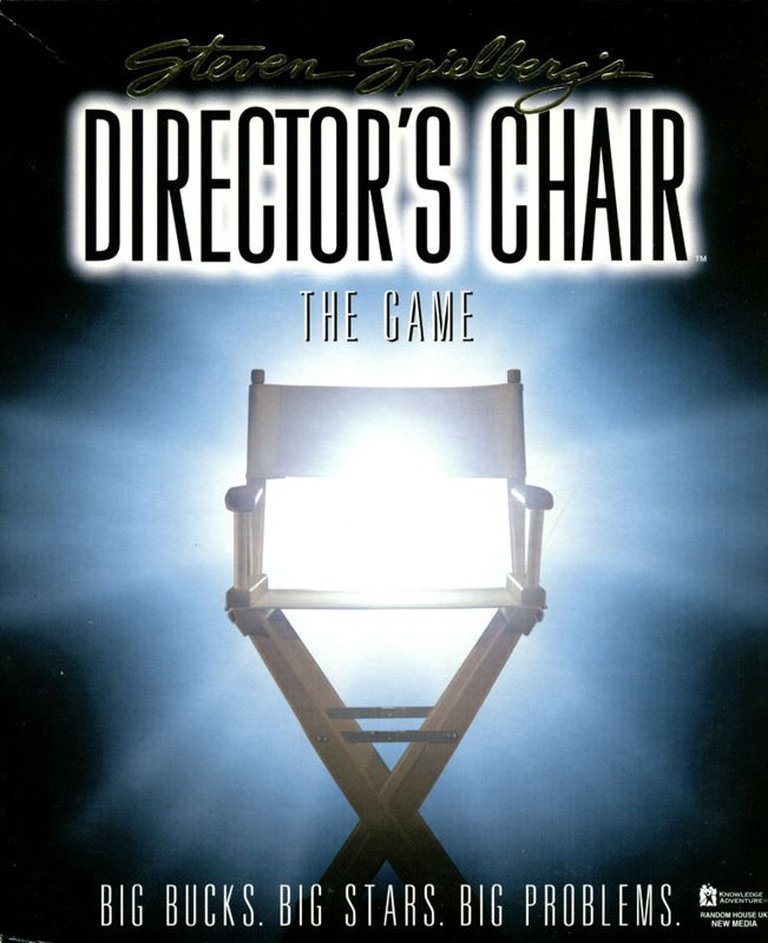
Description
Steven Spielberg’s Director’s Chair is an interactive movie-making educational game that places players in the director’s chair, guided by Spielberg himself and other cinema industry professionals. The premise allows players to make creative choices for their own film, starring Jennifer Aniston and Quentin Tarantino. The game utilizes full motion video to create an immersive experience, though it is largely based on clicking through options to see pre-determined outcomes rather than offering deep gameplay mechanics.
Gameplay Videos
Where to Buy Steven Spielberg’s Director’s Chair
PC
Steven Spielberg’s Director’s Chair Free Download
Steven Spielberg’s Director’s Chair Guides & Walkthroughs
Steven Spielberg’s Director’s Chair Reviews & Reception
imdb.com (85/100): A superb look at all aspect of movie making. Way ahead of its time.
denofgeek.com : The idea behind Steven Spielberg’s Director’s Chair was innovative and, on some level, commendable, but the reality didn’t quite deliver on the promise.
Steven Spielberg’s Director’s Chair: A Pioneering Yet Flawed Experiment in Interactive Filmmaking
Introduction
In the mid-1990s, the intersection of cinema and video games was a burgeoning frontier, and few titles embodied this fusion as ambitiously as Steven Spielberg’s Director’s Chair. Released in 1996, this simulation game promised players the chance to step into the shoes of a Hollywood director, guided by the legendary Steven Spielberg himself. With a cast featuring Jennifer Aniston, Quentin Tarantino, and Penn & Teller, the game was a bold experiment in interactive storytelling and filmmaking education. However, despite its innovative premise, the game’s execution was marred by technological limitations and a lack of genuine creative freedom. This review will delve into the game’s development history, narrative and thematic elements, gameplay mechanics, world-building, reception, and legacy, ultimately assessing its place in video game history.
Development History & Context
The Studio and Creators’ Vision
Steven Spielberg’s Director’s Chair was developed by Knowledge Adventure, an educational software company, in collaboration with DreamWorks Interactive, Spielberg’s production company. The game was produced by Roger Holzberg, who also served as a designer, and featured contributions from Hollywood professionals such as editor Michael Kahn, special effects supervisor Michael Lantieri, and cinematographer Dean Cundey. Spielberg himself served as the live-action director and executive producer, appearing in the game to guide players through the filmmaking process.
The game’s vision was to provide an immersive, educational experience that would demystify the filmmaking process for aspiring directors. It aimed to leverage the emerging CD-ROM technology to deliver high-quality full-motion video (FMV) content, a novel feature at the time. The game was marketed as a tool for budding filmmakers to understand the complexities of Hollywood production, from scriptwriting to post-production.
Technological Constraints and the Gaming Landscape
The mid-1990s were a transitional period for the gaming industry, marked by the shift from floppy disks to CD-ROMs, which allowed for higher-quality graphics, sound, and video. Director’s Chair was one of the first games to fully exploit this technology, featuring extensive FMV sequences. However, the limitations of the era meant that the game’s interactive elements were often constrained by the need to pre-render and compress video content, resulting in a linear and somewhat clunky experience.
The gaming landscape at the time was dominated by genres like first-person shooters, role-playing games, and strategy titles. FMV games, which relied heavily on video content, were a niche but growing category. Titles like Phantasmagoria and Night Trap had already explored the potential of FMV, but Director’s Chair distinguished itself by focusing on the creative process rather than narrative-driven gameplay.
Narrative & Thematic Deep Dive
Plot and Characters
The game’s narrative revolves around a player-directed short film featuring Quentin Tarantino as a prisoner on death row, falsely accused of murdering an elderly woman (played by Katherine Helmond). Jennifer Aniston portrays his girlfriend, who sets out to clear his name by investigating a pair of sinister magicians (Penn & Teller). The plot is straightforward and serves as a vehicle for the game’s educational objectives rather than a compelling story in its own right.
The characters are largely one-dimensional, reflecting their roles as educational tools rather than fully realized personalities. Tarantino’s performance is notably over-the-top, which some critics found humorous but others found grating. Aniston’s character is more subdued, serving as the narrative’s emotional anchor. The magicians, played by Penn & Teller, add a touch of whimsy to the otherwise serious plot.
Dialogue and Themes
The dialogue in Director’s Chair is serviceable but rarely memorable. The game’s primary focus is on the technical aspects of filmmaking, so the script is often secondary to the educational content. Themes of justice, redemption, and the power of cinema are touched upon, but they are not explored in depth. The game’s true thematic focus is on the challenges and rewards of the filmmaking process, highlighting the collaboration, creativity, and problem-solving required to bring a project to life.
Gameplay Mechanics & Systems
Core Gameplay Loops
Director’s Chair is structured around a series of linear, point-and-click tasks that guide the player through the filmmaking process. The game is divided into four levels of play: Novice, Intermediate, Advanced, and “A-List.” Each level offers increasing levels of creative control and budget, but the core gameplay remains largely the same.
The player begins by working with scriptwriters Ted Elliott and Terry Rossio to structure the film’s narrative. This involves selecting and arranging pre-written scenes, a process that feels more like a tutorial than genuine creative input. The player then moves on to the production phase, where they choose camera angles and direct the actors. This segment is similarly constrained, offering only a few predefined options for each scene.
Combat, Progression, and UI
There is no traditional combat in Director’s Chair, as the game is not action-oriented. Instead, the player’s “battles” are against time and budget constraints. The game’s progression is linear, with each level unlocking new options and resources. The user interface is functional but dated, reflecting the technological limitations of the era. The game’s reliance on FMV means that much of the interaction is limited to clicking on pre-recorded video segments.
Innovative and Flawed Systems
One of the game’s most innovative features is its editing suite, which allows players to cut and arrange footage, add sound effects, and create a soundtrack. This aspect of the game is surprisingly robust and offers a genuine sense of creative control. However, the game’s reliance on pre-recorded content limits the player’s ability to truly shape the final product.
The game’s attempt to simulate the realities of filmmaking, such as budget management and scheduling, is commendable but often feels pedantic. The constant interruptions from studio staff, while intended to add realism, can become frustrating and detract from the gameplay experience.
World-Building, Art & Sound
Setting and Atmosphere
The game’s setting is a Hollywood studio lot, complete with soundstages, editing suites, and offices. The art direction is functional but unremarkable, with the FMV content serving as the primary visual element. The game’s atmosphere is a mix of excitement and stress, reflecting the high-pressure environment of film production.
Visual Direction
The visuals in Director’s Chair are a product of their time, with the FMV content showing the limitations of mid-1990s technology. The footage is often grainy and compressed, and the transitions between scenes can be jarring. However, the game’s use of real actors and sets lends it a sense of authenticity that many other FMV games lacked.
Sound Design
The sound design is similarly constrained by the era’s technology, with audio quality that can be tinny and repetitive. The soundtrack is a mix of original music and stock sound effects, which the player can customize during the editing process. The voice acting is serviceable, with Spielberg’s guidance providing a sense of authority and expertise.
Reception & Legacy
Critical and Commercial Reception
Director’s Chair received mixed reviews upon its release. Critics praised the game’s ambitious concept and educational value but criticized its lack of creative freedom and repetitive gameplay. The game’s reliance on FMV, while innovative at the time, was seen as a limitation rather than a strength. The game’s commercial performance was modest, and it failed to achieve the cultural impact that its creators had hoped for.
Influence on Subsequent Games and the Industry
Despite its flaws, Director’s Chair had a lasting influence on the gaming industry. Its attempt to simulate the filmmaking process inspired later titles like The Movies (2005), which expanded on the concept with greater creative freedom and more sophisticated gameplay mechanics. The game’s use of FMV also paved the way for future experiments in interactive storytelling, such as Black Mirror: Bandersnatch (2018).
In 2020, the short film within Director’s Chair was reimagined as a free browser-based interactive movie by Molleindustria, presented in a choose-your-own-adventure style similar to Bandersnatch. This reimagining highlighted the enduring appeal of the game’s concept and its potential for modern adaptations.
Conclusion
Steven Spielberg’s Director’s Chair was a pioneering but flawed experiment in interactive filmmaking. Its ambitious vision to demystify the filmmaking process was hampered by the technological limitations of the era and a lack of genuine creative freedom. While the game’s educational value and innovative use of FMV are commendable, its repetitive gameplay and linear structure ultimately limited its appeal.
Despite its shortcomings, Director’s Chair holds a unique place in video game history as one of the first attempts to blend cinema and interactive media. Its influence can be seen in later titles that sought to offer players a taste of the creative process, and its legacy endures as a testament to the bold experiments of the mid-1990s gaming landscape. While it may not be remembered as a classic, Director’s Chair remains a fascinating artifact of a time when the boundaries between film and video games were being explored and redefined.