
- Release Year: 2024
- Platforms: Windows, Macintosh, PlayStation 4, Nintendo Switch
- Publisher: Purple Brick Games
- Developer: Purple Brick Games
- Genre: Adventure, Visual novel
- Perspective: Third-person
- Gameplay: Interactive Visual Novel, Quick Time Events, Point-and-Click
- Setting: Contemporary
- Average Score: 66/100
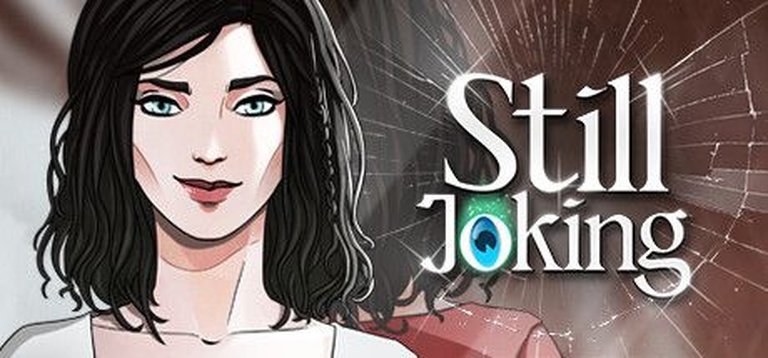
Description
Still Joking is a contemporary adventure visual novel that casts players as Iris, a bewildered and fiery female ghost protagonist. Set in a mysterious mirrorverse that reflects her own world, Iris embarks on a branching, choose-your-own-adventure journey to uncover the truth behind her real-world counterpart’s fate and overcome personal trauma. The game features an intriguing mix of narrative depth, point-and-click mechanics, and Quick Time Events, offering over 1,000 unique choices that shape its twisty mystery tale and lead to multiple endings, all while exploring themes of identity and reflection.
Gameplay Videos
Where to Get Still Joking
Guides & Walkthroughs
Reviews & Reception
metacritic.com (66/100): Still Joking has quite a few positives but I would say it also has equally as many negatives.
churapereviews.com : Still Joking was hard to get into, and even harder to recommend.
opencritic.com : Still Joking had a lot of potential in its plot, but the 400,000 words did little to introduce us to it and bring it to life, settling instead for short, inorganic quips, rushed ideas, and clichés.
gamerescape.com : This game, developed and published by Purple Brick Games, brilliantly mixes the elements of visual novels, interactive fiction, and adventure to facilitate exploration into an intriguing what-if.
gamegrin.com : Most unfortunately, however, that is about the last time I genuinely enjoyed and connected to the game, as right off the bat, the dialogue fell flat.
Still Joking: A Mirror’s Edge, Shrouded in Silence and Spelling Errors
In the ever-expanding universe of interactive fiction and visual novels, few concepts are as immediately captivating as the one at the core of Purple Brick Games’ debut title, Still Joking. Launched initially on Windows in May 2024, with Macintosh, PlayStation 4, and Nintendo Switch versions following in 2025, this game dares to ask: what if our mirror reflections live lives independent of our own, and what happens when their “prototypes” disappear? It’s a premise that promises a journey of existential dread, mystery, and self-discovery. However, while Still Joking delivers an ambitious narrative tapestry brimming with choices, its execution often falters under the weight of uneven writing, technical shortcomings, and a jarring lack of polish, ultimately presenting a compelling but deeply flawed experience that leaves both critics and players with mixed feelings. This review will delve into the multifaceted layers of Still Joking, exploring its ambitious vision, narrative intricacies, gameplay mechanics, and its place within the contemporary gaming landscape.
Development History & Context
Still Joking emerges from Purple Brick Games, a self-described “small international team” with an extraordinarily diverse background, including professionals ranging from lawyers and teachers to economists and, indeed, a game designer. This eclectic mix of talent, as highlighted on their Kickstarter page, speaks to a passion project born from a collective desire to craft a unique interactive experience. As a debut title, Still Joking represents their first foray into game development, a brave undertaking given the competitive and often unforgiving nature of the industry.
The game’s initial release in mid-2024 places it firmly within an era where the visual novel genre has seen a resurgence in popularity, propelled by titles like The House in Fata Morgana, Doki Doki Literature Club!, and Neo Cab. These predecessors set a high bar for narrative depth, tight writing, and innovative stylistic choices. Purple Brick Games’ vision for Still Joking aimed to push the boundaries of the genre by incorporating a vast, branching narrative boasting “more than 1,000 unique choices” and over “400,000 words,” coupled with interactive elements such as Quick Time Events (QTEs) and investigation mechanics, all wrapped around a “multiverse (mirrorverse?) bend.”
Technologically, as a contemporary release, Still Joking isn’t constrained by archaic hardware. Its availability across PC, Mac, and soon consoles (PS4, Switch) speaks to its accessibility. However, it’s clear the development was focused more on narrative scale than cutting-edge presentation. Some reviewers noted visuals “straight out of that cash-grab android game, ‘Episode’” and the use of a “default text box,” hinting at a budget-conscious development cycle common among indie studios. This context is crucial, as the game’s eventual reception would largely hinge on whether its ambitious narrative could overcome these perceived production limitations. The current gaming landscape, as one critic observed, is seeing a “death of the ‘middle class'” of games, leaving a dichotomy between massive AAA titles and smaller, often innovation-driven indies. Still Joking firmly positions itself in the latter, showcasing the creative drive that still flourishes in independent development, even if the resources for extensive polish are not always available.
Narrative & Thematic Deep Dive
At its core, Still Joking is an adventure-mystery visual novel built upon a truly imaginative premise. Players step into the shoes of Iris, a reflection of Serena, a famous actress who is brutally murdered in front of a mirror. This chilling opening thrusts Iris into an unfamiliar existence; freed from her role as a mere mirror image, she is now a sentient being in the “mirror world,” tasked with navigating her newfound independence while simultaneously unraveling the “why” behind her prototype’s murder. It’s a compelling twist on the classic detective story, where the “who” is known, but the motives remain shrouded in mystery.
Plot & World-Building
The narrative quickly introduces Iris to “The Community,” a governing body in the mirror world dedicated to helping reflections of deceased prototypes transition to their new lives. This administrative structure provides Iris with a Curator, Dora, and options for her future: becoming a “practitioner” (a doer), a “scientist” (a thinker), or choosing no path at all. Her journey involves exploring a mysterious “void” and encountering “mysterious cracks” that hint at deeper cosmic machinations within this reflection-laden reality. The game’s branching narrative ensures that Iris’s choices—whether to solve problems or create them, to accept a “cheese roll from the Chosen One” or to delve into the nature of cracks—have significant, lasting ramifications, leading to multiple endings for main storylines and individual characters.
However, the ambitious scope of the plot is not without its detractors. Some critics found the narrative to “drag on at times,” particularly during lengthy “info dumps” and “technical conversations” that felt tedious to read. The sheer number of sub-plots and unanswered questions left some feeling overwhelmed and disengaged, questioning the consistency of the mirror world’s rules and the rushed introduction of complex concepts without adequate explanation. The sensation of being “thrown into the next thing and the next thing and the next thing” without proper pacing or clarity detracted from the immersion for many.
Characters & Dialogue
Iris, as the protagonist, is designed to be the game’s central selling point. She is described as “witty, sharp, and determined,” engaging in internal monologues with her subconsciousness, “Iris 2,” which offers a deeper glimpse into her character. While many reviewers found Iris charismatic and genuinely funny, often saying things “I don’t usually see from main characters,” this wit became a double-edged sword. Her incessant joking, even in “serious situations,” sometimes pushed her into “childish territory” and made it difficult for players to feel her purported grief for Serena. Critics noted that the game constantly told them Iris was grieving, but her dialogue rarely showed it convincingly, with her sarcasm often feeling “emotionally stunted” rather than nuanced.
The supporting cast includes a vibrant array of archetypes: Johnny, the “cutie” and “fuckboy” leader of the practitioners with witty, “horny” banter; Dora, the “mom-like” Curator whose exasperated call-outs are heartwarming; Tony, “the Chosen One” with innate abilities; Third, a man who loves tea; and Maximillian, who prefers not to be called Max. While these characters offer a “great range of emotional displays,” some reviewers felt they were “either a stereotype, a cliché, or fits into a neat box,” making them predictable. Dialogue interactions, particularly the recurring “Iris!” or “still joking” responses to Iris’s quips, became repetitive and further highlighted the perceived lack of character depth. A particularly jarring note was the inclusion of a “random racial slur” mid-game, which one critic deemed unnecessary and ironic given the mirror-world setting.
Thematic Resonance
Despite these narrative inconsistencies, Still Joking grapples with profound themes. The “multiverse (mirrorverse?)” concept powerfully explores the nature of identity and reflection, forcing players to consider what makes a person unique versus a copy. Iris’s struggle to move past the trauma of her prototype’s death and forge her own path is a clear journey of self-discovery. The choices presented throughout the game — building a future, solving a murder, dealing with factions, or even creating problems — underscore the themes of agency and consequence, positing that even in a world of reflections, individual decisions profoundly shape one’s existence. The game attempts to blur the lines between fun and serious gameplay, challenging players to navigate ethical dilemmas and personal growth within its unique setting.
Gameplay Mechanics & Systems
Still Joking is primarily an interactive novel, characterized by reading through text and making consequential decisions. Its core gameplay loop revolves around player choice, with the promise of “more than 1,000 unique choices” steering the narrative in various directions and leading to “multiple endings.”
Core Gameplay & Interface
The interface is largely “point and select,” typical for visual novels, allowing players to click through dialogue and select options. While some found the basic text box design to be “low effort,” others appreciated subtle touches like the mirrored text, which reinforces the game’s central theme. The game operates with a “fixed / flip-screen” visual style, presenting static or minimally animated scenes.
Interactive Elements
Beyond dialogue choices, Still Joking integrates several interactive elements to break up the reading experience. These include:
* Dialogue Approach Options: Instead of simple A/B choices, players can sometimes select an “approach” for how Iris speaks or asks questions. This system aims to encourage more thoughtful engagement, as performing well in conversations supposedly yields more information, crucial for solving the central murder mystery.
* Quick Time Events (QTEs): These appear intermittently, but critical reception was lukewarm, with one reviewer calling them “empty gameplay mechanics” and admitting to automatically ignoring them. Another noted them as “token puzzles.”
* Puzzles/Minigames: These “mostly pointing and clicking” activities are found primarily in interactions with the scientist/practitioner factions. Success in these tasks impacts Iris’s standing with her chosen group and contributes to her character development.
* Time Management: The game incorporates a time management mechanic, limiting Iris’s opportunities to perform “everything she wants to.” This forces players to make strategic choices about how Iris spends her time, prioritizing tasks and relationships to maximize effectiveness.
* Iris’s Journal: A standard visual novel feature, Iris’s journal tracks relationships, achievements, and documents her journey, providing players with a convenient overview of their progress and narrative threads.
Innovation & Flaws
While Still Joking is lauded for its expansive choice-based system, which genuinely enhances replayability and ensures “no two exchanges have to be the same,” it “does not innovate much” within the broader visual novel genre. The interactivity, for some, felt like “busy work” that “doesn’t add to the story” and often felt like “a distraction from the main story.” The fundamental “gameplay is as limited” as expected from an interactive novel, appealing primarily to genre enthusiasts. A significant flaw, mentioned by multiple players in community discussions and one review, was the presence of an “Under Construction” pop-up at the end of a playthrough route, indicating unfinished content upon release. This glaring issue suggests a rushed development cycle and severely undermines the player experience.
World-Building, Art & Sound
The world of Still Joking is its most compelling conceptual asset, inviting players into a “world of reflections where everything is like on our side of the mirror but a little different.” This “mirrorverse” setting, complete with its own societal structures like “The Community” and mysterious phenomena such as “the void” and “cracks,” provides a rich backdrop for its narrative.
Setting & Atmosphere
The premise itself fosters an intriguing, often unsettling atmosphere. The initial shock of witnessing Serena’s murder, combined with Iris’s sudden, disorienting freedom, creates a sense of existential fragility. The exploration of the “deadly void” further contributes to a mysterious and atmospheric tone. However, this atmosphere is frequently undercut by the game’s technical and narrative shortcomings, particularly the lack of consistent mood-setting audio.
Visual Direction
Visually, Still Joking presents a mixed bag. The art style itself is often praised as “colorful” and the character designs “beautiful,” with many finding the overall aesthetic “stunning” and “cool.” High-quality cutscenes and character sprites contribute to moments of visual appeal. Yet, this praise is tempered by observations of “choppy cutscenes/character sprites” and “visual hiccups,” suggesting an uneven level of polish throughout the game’s artistic presentation. While the team was capable of excellent visual work, inconsistencies were noticeable and detracted from the experience for some. The thoughtful detail of reflected text, as noted by one reviewer, is a clever thematic touch that demonstrates creative consideration.
Sound Design
The sound design is arguably Still Joking‘s most pronounced weakness. Critics across the board highlighted the “non-existent” or “limited sound design,” with descriptions ranging from “lacked a lot of actual audio” to “a staggering amount of silence.” The game “has no voice acting,” which is common for visual novels but compounds the issue when ambient soundscapes and musical scores are also largely absent. Full music scores were “very few and far between,” primarily appearing during “very intense moments” or “dramatic scenes and some of Iris’ flashbacks.” Even then, music occasionally started “randomly… expecting something to happen but nothing actually did,” further breaking immersion. While recorded sound effects like “doors opening or closing, objects shattering, etc were pretty smooth,” the overall “audio situation was all over the place and it lost me along the way.” This auditory vacuum significantly impacts the game’s ability to immerse players and effectively convey emotional or atmospheric shifts.
Reception & Legacy
Upon its release in May 2024, Still Joking garnered a mixed critical reception. MobyGames registered a Moby Score of 7.1 out of 26.9K games, with an average critic score of 72% based on 7 ratings. On Metacritic, it received a “Mixed or Average” Metascore of 66 based on 4 critic reviews. This split reflects the dichotomy between its ambitious premise and its flawed execution.
Critical and Commercial Reception at Launch
Positive Reviews (80-85%): Critics such as The Gaming Outsider, Movies Games and Tech, Gameluster, and Softpedia praised Still Joking for its “intriguing mix of narrative depth,” “multiverse (mirrorverse?) bend,” and the sheer volume of player choices that promise divergent narrative paths. Iris was often singled out as a “great protagonist” and “witty MC,” making the game a “must-play” for fans of visual novels who appreciate complex stories and character-driven experiences. Softpedia noted that while the game “does not innovate much,” it “executes on its premise well and takes players through some wild narrative moments.”
Mixed Reviews (70-76%): Gamer Escape and Nindie Spotlight offered more balanced assessments. They lauded the “unique, rich, and quite enticing” story, “fun, loveable characters,” and the compelling world-building. The gameplay was described as “uncomplicated and straightforward” but effective in forcing players to think. However, these reviews also highlighted significant drawbacks, including “choppy visuals,” “audio non-existent,” and a game “riddled with spelling errors.” Conversations were noted as occasionally “too long” or “tedious,” impacting immersion. Nindie Spotlight also pointed out that player agency, while present, was “inherently constrained by the choices you’ve made.”
Negative Reviews (35-50%): GameGrin and StorymodeInfo provided the harshest criticisms. StorymodeInfo unequivocally described the writing as “extremely poor,” “derivative, repetitive and droning,” with “unfunny wisecracks” that felt forced. The reviewer stopped playing after four and a half hours, citing the “clunky and unwieldy nature of the writing.” GameGrin echoed these sentiments, stating the game “spread itself thin,” had “too many questions, too many sub-plots,” and “empty gameplay mechanics.” The protagonist’s sarcasm was seen as undermining emotional depth, and characters were criticized as “stereotypes” or “clichés.” Both reviews heavily criticized the “staggering amount of silence” in the sound design and the pervasive “lack of polishing,” culminating in the discovery of an “under construction” pop-up that suggested a rushed, unfinished release.
Commercially, the game was priced at $14.99 on most platforms, with GOG.com offering Windows and Macintosh versions at a lower $4.49-$5.99 price point. The reported “Collected By 3 players” on MobyGames, while an early metric, suggests a limited initial commercial footprint, likely impacted by the mixed reviews and indie nature.
Legacy and Influence
Given its recent release, Still Joking‘s long-term legacy is yet to be written. However, its immediate impact highlights the challenges and opportunities within the indie visual novel space. It stands as an example of a game with an incredibly strong, unique core concept—one that many critics found genuinely intriguing—struggling to fully realize its potential due to issues in writing consistency, technical polish, and sound design. While it “does not innovate much” in gameplay, its ambitious approach to player choice and branching narratives is commendable for a debut title.
Its influence might be more anecdotal, serving as a cautionary tale for aspiring visual novel developers about the paramount importance of editing, sound design, and narrative pacing, even when working with a compelling premise. In a market saturated with high-quality visual novels, Still Joking demonstrates that a great “hook” needs robust execution to truly shine and leave a lasting mark.
Conclusion
Still Joking is a fascinating, if frustrating, experience. Purple Brick Games dared to explore a captivating “what if” scenario, crafting a world where reflections gain sentience and grapple with murder, identity, and existential freedom. The game’s strength lies in its genuinely unique premise, the sheer breadth of its branching narrative, and the admirable ambition to offer over a thousand choices that shape Iris’s journey of self-discovery. When its witty banter lands, and its compelling murder mystery unfolds, it offers glimpses of the brilliant visual novel it aspires to be.
However, these moments of brilliance are too often overshadowed by significant shortcomings. The writing, while sometimes praised, frequently falls flat, becoming repetitive, overwritten, or plagued by grammatical and spelling errors that actively hinder immersion. Iris’s persistent sarcastic tone, intended as a strength, can grate in serious contexts, undermining the emotional weight of her journey. The lack of voice acting, combined with a “non-existent” sound design, creates an auditory void that is genuinely detrimental to the experience, failing to set mood or enhance dramatic moments. Visual inconsistencies and, most notably, the discovery of unfinished content in the form of an “under construction” pop-up paint a picture of a game released before it was truly ready.
Ultimately, Still Joking occupies a curious place in the contemporary gaming landscape. It is a testament to the boundless creativity of independent developers, a game with a big heart and even bigger ideas. Yet, it also serves as a stark reminder that even the most innovative concepts require meticulous execution and polish to truly resonate. For dedicated fans of visual novels who prioritize narrative ambition and player agency above all else, and who are willing to overlook significant technical and literary rough edges, Still Joking offers a unique journey worth undertaking, perhaps ideally on sale. For others, its flaws may prove too prominent to ignore. Purple Brick Games has shown a knack for intriguing concepts; with more refinement and focus on polish in future projects, their sophomore effort could truly shine. For now, Still Joking is a reflection that, while intriguing, remains somewhat blurry around the edges.