
- Release Year: 2001
- Platforms: Windows
- Publisher: Bongfish GmbH
- Developer: Bongfish GmbH
- Genre: Sports
- Perspective: Behind view
- Game Mode: Single-player
- Gameplay: Skiing, Snowboarding
- Setting: Snowy landscape
- Average Score: 60/100
Description
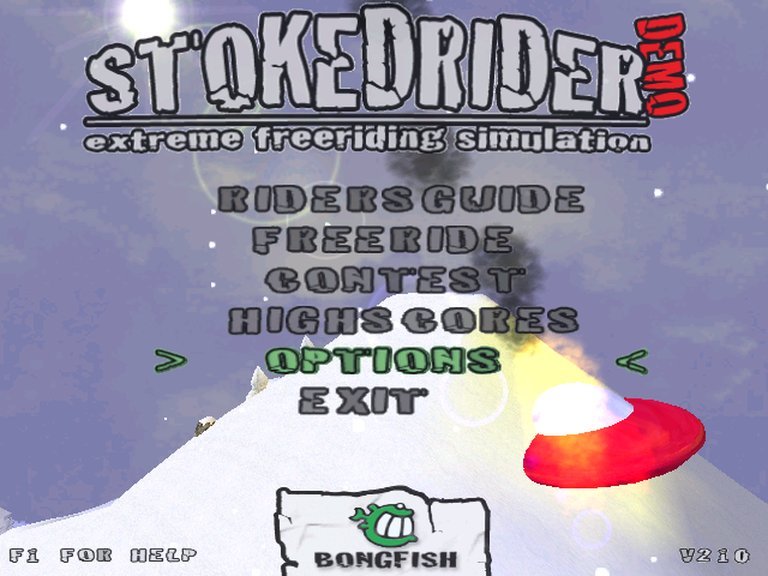
STOKEDRIDER is a freeware snowboarding game featuring a green-skinned alien as the protagonist, set in vast, procedurally generated snowy mountain landscapes. Players can freely explore in Freeride mode by collecting pickups to unlock new zones while performing jumps and tricks, or compete in Contest mode to achieve the highest score and complete goals within a 60-second time limit.
StokedRider Reviews & Reception
metacritic.com (68/100): Stoked is probably one of the most competent snowboarding games available.
en.wikipedia.org (68/100): it’s a blast, and … easy choice for boarders looking for a virtual outlet for their shredding fantasies.
StokedRider: Review
Introduction
Imagine hurtling down an endless, procedurally generated snowy expanse on a snowboard, not as some branded pro athlete, but as a cheeky green-skinned alien pulling off gravity-defying tricks amid towering peaks and hidden zones—welcome to StokedRider, the unassuming 2001 freeware gem that kicked off a cult-favorite series. Born from a humble advertising stunt and exploding into a passion project thanks to over 100,000 downloads of its predecessor, this Windows-exclusive snowboarding odyssey from Austrian indie studio Bongfish GmbH captured the raw thrill of freeride snowboarding in an era dominated by arcade flash like SSX. As a game historian, I argue that StokedRider is a foundational artifact of indie sports gaming: a technically ambitious proof-of-concept that prioritized boundless exploration and trick mastery over polished narratives, foreshadowing the open-mountain sims of today while embodying the scrappy DIY spirit of early 2000s freeware.
Development History & Context
Bongfish GmbH, a small Austrian outfit founded by visionaries like Klaus Hufnagl and Michael Putz, birthed StokedRider in May 2001 as a direct evolution of FLOW.game—a 1999 Flash animation and CD-ROM promo tied to FLOW snowboard gear. What started as a simple alien-snowboarder cartoon for catalogs ballooned into a full prototype after massive grassroots hype; positive feedback from over 100,000 downloads compelled Bongfish to pour their all into this “work-in-progress” freeware title, self-published and downloadable for zilch.
The core team was lean and multi-hat-wearing: Hufnagl and Putz handled game design, graphics, sound, and programming, showcasing the era’s indie hustle where two polymaths could helm a 3D project. Raimund Leitner crafted the terrain engine (earning “C++ guru” cred), Edmund Hupf managed server-side code for potential online features, and Philipp Stecher chipped in 3D modeling. A laundry list of “thanks” nods to collaborators like FLOW, ATI Technologies, and a special salute to Alain Villaume, the spark who ignited this alien adventure. Technologically, it grappled with early-2000s Windows constraints—DirectX-era 3D rendering on modest hardware, procedural generation for “endless” landscapes to sidestep storage limits, and behind-the-view camera for fluid control.
The gaming landscape circa 2001 was ripe for disruption: Console giants like SSX (2000) and Tony Hawk’s Pro Skater 2 ruled arcade sports with linear tracks and combo frenzy, while PC freeware languished in 2D obscurity. StokedRider bucked trends by embracing big-mountain freeride simulation—procedural terrains mimicking real backcountry runs—pioneering what would become the Stoked series’ hallmark. As freeware/public domain, it democratized high-skill snowboarding amid dial-up downloads, predating Steam’s indie boom and influencing open-world extremes in games like Steep (2016).
Narrative & Thematic Deep Dive
StokedRider eschews conventional storytelling for a plotless, vibe-driven experience centered on its enigmatic green-skinned alien protagonist—a holdover from FLOW.game‘s ad roots. No cutscenes, voiceovers, or dialogue exist; instead, the “narrative” unfolds through emergent play: you drop onto infinite snowy slopes, chaining tricks to collect pickups and unlock mountain zones, embodying pure, unadulterated freedom. This alien rider, with its cartoonish flair (echoing cell-shading hints in later sequels), serves as a thematic Trojan horse—subverting snowboarding’s macho pro culture by injecting extraterrestrial whimsy, grouping it with rarities like alien-led sports titles.
Thematically, it’s a love letter to freeride ethos: rebellion against groomed parks and timed races, favoring endless exploration over competition. “Freeride” mode symbolizes liberation, where pickup hoards gatekeep diverse landscapes (steep cliffs, powder bowls), mirroring real big-mountain progression from novice drops to heli-accessed chutes. “Contest” injects tension with 60-second scoring sprints and goals, but even here, themes prioritize style over spam—power-ups like “molotov” boosts reward trick combos, critiquing “hucker” (reckless) riding that later sequels formalized.
Underlying motifs draw from Austrian backcountry culture (nodding Tommy Brunner’s future involvement) and indie ethos: the alien as outsider thriving in hostile whitespaces evokes immigrant grit, while procedural infinity critiques finite game worlds. No deep lore, but credits’ shoutouts (e.g., “CIRQUE DE DELAY,” “REDLIGHTSFLASH”) hint at underground snow/surf scenes, weaving a subtle tapestry of subcultural homage. In an era of narrative-heavy adventures, StokedRider‘s silence amplifies immersion—your runs are the story.
Gameplay Mechanics & Systems
At its core, StokedRider loops around intuitive direct-control snowboarding: analog stick/keyboard for carving, jumps, spins, and grabs, with a behind-view camera enabling 360-degree trick chaining. Freeride mode offers timeless sandbox joy—generate endless terrain, hunt pickups to portal into variant zones (e.g., denser forests, sheerer drops), practicing maneuvers like butters, 180s, and aerial combos. Controls feel responsive for 2001 freeware, praised in retrospectives as “intuitive,” though era hardware might stutter on complex tricks.
Contest mode ramps stakes: 60 seconds to max score via tricks, sequences, and goals (e.g., “clear X cliff”), unlocking bonuses like time extensions or speed bursts. Innovative systems shine: procedural generation ensures replayability (no two runs identical), pickup economy gates progression organically, and power-ups (molotov for nitro boosts) incentivize stylish combos over button-mashing. Character progression is light—skill accrues implicitly via mastery, with no RPG trees, keeping focus on pure riding.
UI is minimalist: speed/height meters, score ticker, pickup counter—clean but basic, sans tutorials (learn by wipeouts). Flaws? Occasional physics jank (unpredictable landings, per series DNA) and no multiplayer limit longevity, but as “coffee break” freeware, it’s flawlessly looped. Compared to Amped (2001), it innovates with true openness, flaws notwithstanding.
| Mechanic | Strengths | Weaknesses |
|---|---|---|
| Controls | Fluid carving, trick variety | Keyboard finickiness on modern setups |
| Modes | Freeride infinity, Contest goals | Short timers limit depth |
| Progression | Pickup-unlocked zones | No customization/gear |
| Physics | Trick responsiveness | Era-typical glitches |
World-Building, Art & Sound
The game’s world is a procedural masterpiece: vast, seamless snowy mountains with zoned variety—powder fields, cliff bands, forested ridges—unlocked via pickups, evoking infinite Alaska backcountry (foreshadowing sequels). Atmosphere nails freeride solitude: howling winds, crunching snow, dynamic day/night? (implied via endless gen), fostering meditative flow states amid adrenaline spikes.
Art direction punches above freeware weight: solid 3D models (alien’s goofy animations pop), detailed terrains via Leitner’s engine, and snowy vistas lauded as “excellent” for 2001—think low-poly charm with atmospheric fog, particle powder. No cel-shading yet (saved for Brunner edition), but vibrant whites/blues immerse.
Sound design, helmed by Hufnagl/Putz, leans ambient: whooshing boards, thumping landings, trick chimes—serviceable but sparse, no soundtrack named (perhaps procedural loops). It amplifies isolation, letting board-snow symphony dominate; power-up jingles add juice. Collectively, these forge a hypnotic, alien-vs-mountain vibe—raw, unpretentious, elevating simple sports to exploratory art.
Reception & Legacy
Launch reception was niche: MobyGames logs a lone 2.0/5 player rating (no reviews), but Home of the Underdogs bucks at 8.28/10 from 21 votes, hailing it a “packed” underdog with “excellent 3D” and addictive loops. Freeware status muted mainstream noise amid SSX Tricky hype, yet 100k+ precursor downloads fueled word-of-mouth.
Legacy endures as Stoked series progenitor: spawned Stoked Rider ft. Tommy Brunner (2005, Brunner died post-release), Alaska Alien (2006), Drop Point: Alaska (2007 Mac spin-off), culminating in Stoked (2009 Xbox 360, Metacritic 68/100) and Big Air Edition (72/100)—praised for open mountains, weather, but dinged for physics/bugs. Influenced genre shift to sim-rides (Steep, Lonely Mountains), pioneering procedural freeride and alien protagonists. Cult status on abandonware sites cements it as indie pioneer, preserved via MobyGames (added 2019) and fan archives.
Conclusion
StokedRider transcends its freeware roots—a scrappy alien joyride that nailed freeride’s soul through procedural infinity, trick mastery, and unfiltered exploration, despite UI sparsity and tech quirks. In video game history, it occupies a vital niche: the spark for Bongfish’s ascent, bridging ad-novelty to commercial sims, and proving indies could shred with giants. Definitive verdict: Essential for snowboarding historians and retro fans—download it today (5MB abandonware bliss) and carve eternity. 9/10—a stoked legend.