
- Release Year: 2010
- Platforms: Windows
- Publisher: Just A Game GmbH, Matrix Games, Ltd., Wastelands Interactive
- Developer: Wastelands Interactive
- Genre: Strategy, Tactics
- Perspective: Top-down
- Game Mode: Single-player
- Gameplay: Diplomacy, Resource Management, Technology research, Turn-based
- Setting: Historical events, World War II
- Average Score: 61/100
Description
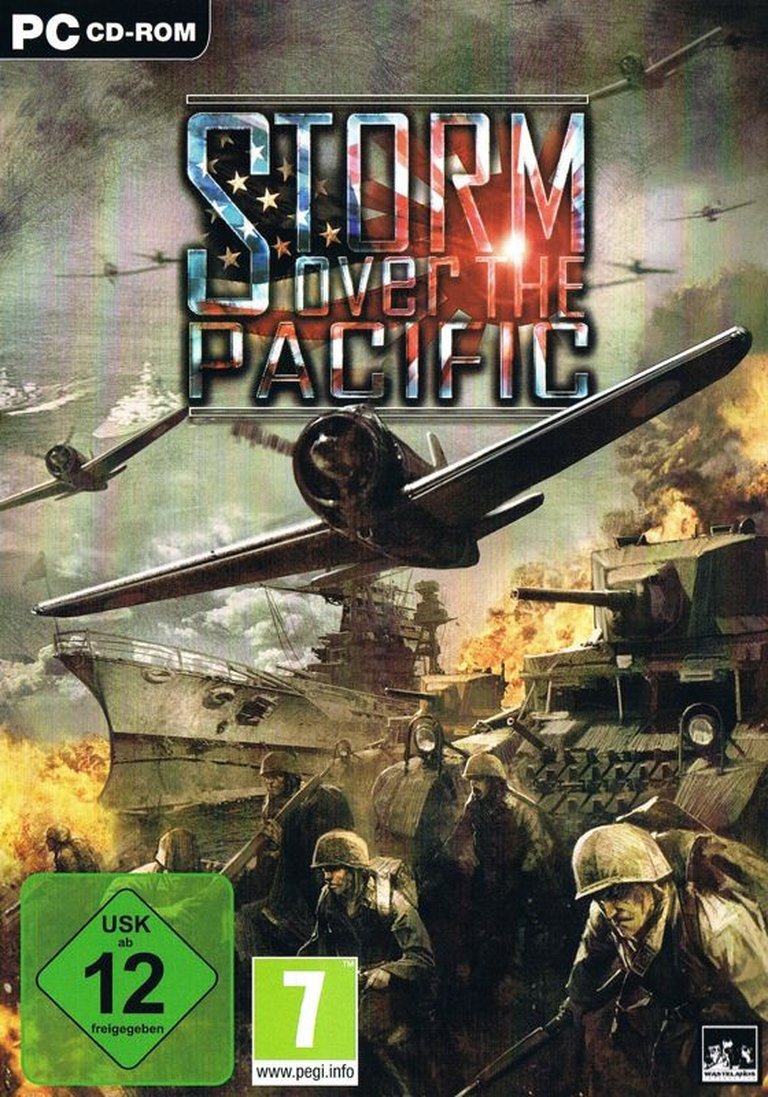
Storm over the Pacific is a turn-based strategic game set during the Pacific Theater of World War II from 1937 to 1945. Players choose from 26 historically accurate countries, each with precise military structures, and must navigate complex economic systems, maintain alliances, and engage in a race to develop the atomic bomb to end the war. The game offers four major campaigns and various smaller scenarios, all featuring detailed historical orders of battle with real unit names and commanders.
Gameplay Videos
Where to Buy Storm over the Pacific
PC
Storm over the Pacific Cracks & Fixes
Storm over the Pacific Patches & Updates
Storm over the Pacific Guides & Walkthroughs
Storm over the Pacific Reviews & Reception
metacritic.com (63/100): A comprehensive game for armchair generals and hobby tacticians – but too dry and complex for beginners.
elder-geek.com : Despite all its lacking’s it has a way of drawing you in.
forums.matrixgames.com (72/100): Comprehensive scenarios, easy to pick up and play yet sufficiently complex.
Storm over the Pacific Cheats & Codes
PC
Hold Shift + C to open console, then enter the following codes:
| Code | Effect |
|---|---|
| #johnconnor | disable AI |
| #iamback | enable AI |
| #igotnukes | instant victory |
| #whiteflag | instant defeat |
| #warbonds | +500 resources |
| #orbitalcommand | disable fog of war |
| #warbonds |
Given you |
| #income |
Given you |
| #overtime |
Given you |
| #landcp |
Given you |
| #navalcp |
Given you |
| #aircp |
Given you |
Storm over the Pacific: Review
Introduction
In the vast ocean of World War II strategy games, Storm over the Pacific emerges as a niche yet ambitious vessel, charting a course through the tumultuous waters of the Pacific Theater from 1937 to 1945. Developed by the Polish studio Wastelands Interactive and published by Matrix Games, this 2010 release positions itself as a detailed, historically grounded alternative to titans like Hearts of Iron. With 26 playable nations, granular order of battle (OOB) data, and a focus on logistical warfare, the game promises a grand-strategy experience. Yet, as we shall delve into its depths, Storm over the Pacific embodies both the strengths and limitations of its era—a game revered by hardcore wargamers for its authenticity yet criticized for its archaic presentation and daunting complexity. This review dissects its legacy, gameplay, and cultural footprint, arguing that while it fails to achieve mainstream appeal, it remains a testament to the enduring appeal of meticulous historical simulation.
Development History & Context
Wastelands Interactive, a Polish development house founded in the mid-2000s, cut its teeth on WWII grand strategy with titles like WW2: Time of Wrath (2008) and Time of Fury (2010). Storm over the Pacific represented their first major pivot to a specific theater, leveraging their existing engine to simulate the sprawling Pacific conflict. Led by Artur Gołębiewski (CEO, game design) and Leszek Lisowski (CFO, production), the team of 61 contributors prioritized historical fidelity over flash, embedding painstakingly researched OOBs—complete with real unit names, commanders, and specifications—into the game’s DNA.
Technically, the game operated within the constraints of 2010: DirectX 9.0c, minimal hardware requirements (Pentium III 1.2 GHz, 1GB RAM), and a reliance on 2D sprites and hex grids. The Pacific’s vastness—spanning China, Australia, Siberia, and thousands of oceanic hexes—demanded efficient coding, resulting in a top-down map that prioritized function over aesthetics. This era saw a resurgence of hardcore wargames (Gary Grigsby’s War in the Pacific, Uncommon Valor), but Storm over the Pacific stood apart by offering accessibility through modularity: players could control single nations or coalitions, tailoring complexity to their appetite. The vision, as echoed in developer forums, was to create a “sandbox for armchair admirals,” where history served as a canvas, not a script.
Narrative & Thematic Deep Dive
While lacking a traditional narrative, Storm over the Pacific weaves a rich tapestry of historical events and emergent storytelling. The game’s “narrative” is driven by player decisions interacting with scripted historical triggers—Pearl Harbor, the Doolittle Raid, atomic bomb development—each dynamically altering the war’s trajectory. For instance, choosing to fortify Midway or divert resources from China can radically shift Japan’s fate.
Thematically, the game explores the brutal calculus of total war. Resource scarcity (Production Points for industry, Diplomacy Points for alliances) forces players into agonizing trade-offs: prioritize naval carriers to contest the Pacific, or invest in infantry to quell Chinese uprisings? The atomic bomb race adds existential tension, with the US and Japan racing to harness nuclear power, a mechanic that underscores the war’s apocalyptic potential. Characters are historical figures—Yamamoto, MacArthur—who serve as avatars rather than fully realized personalities, their impact felt through gameplay modifiers like morale or command efficiency. Dialogue is minimal, confined to event pop-ups that deliver dry historical flavor (“Japanese forces land at Malaya”). The overarching theme is one of consequence: every decision reverberates across the Pacific, from supply lines to civilian populations, creating a deeply personal, if impersonal, narrative of grand strategy.
Gameplay Mechanics & Systems
Storm over the Pacific‘s core loop revolves around hex-based movement, resource allocation, and tactical combat. Players manage land, sea, and air units across a grid-heavy map, each hex representing a strategic chokepoint or resource node. Movement is governed by unit type (e.g., battleships move slower than destroyers), while combat resolves through abstract calculations—no animations, just text reports of damage and losses. This austerity, while authentic to wargaming traditions, often feels sterile.
Innovations and Flaws
The supply system stands as a highlight: units without supply lines suffer attrition, forcing players to balance aggression with logistics—a historically accurate yet punishing mechanic. Economic management, though simplified, adds depth: players convert resources into factories or research, with long-term investments (e.g., radar technology) crucial for naval dominance. The game’s flexibility is its greatest strength: controlling Australia while also managing Thailand as a minor ally, for example, creates layered strategic challenges.
Yet, systems are undermined by execution. The UI, while customizable, is cluttered and unintuitive, with poorly labeled buttons and a tutorial that vanishes mid-lesson, leaving players to memorize complex controls. Naval combat, in particular, draws criticism: reports describe fleets “shooting at each other” with minimal visual feedback, transports sailing unescorted, and carrier duels feeling arbitrary. Land combat fares better, with 16 unit types (infantry, tanks, artillery) offering tactical variety, but the lack of terrain modifiers (beyond basic defense values) robs battles of nuance. AI, too, is inconsistent—aggressive on economic fronts but prone to illogical naval maneuvers. Ultimately, the game demands patience, rewarding meticulous planning with stunning historical authenticity at the cost of accessibility.
World-Building, Art & Sound
The Pacific Theater is rendered with impressive geographical scope, stretching from the US West Coast to India, with hexes representing islands, atolls, and coastal cities. Landscapes are depicted via static, low-resolution textures—jungles, deserts, and urban centers—while units are functional sprites lacking animation. When a unit moves, it simply “teleports” to the next hex, a stark visual reminder of the game’s budgetary constraints. Custom graphics for major powers (e.g., US Marines in green, Japanese soldiers in khaki) add minimal flavor, but the aesthetic remains utilitarian, prioritizing clarity over immersion.
Sound design is equally spare. A single, looping orchestral track (reputedly an hour long) drones persistently, growing tedious quickly. No sound effects accompany combat or movement, leaving a void that the game’s historical events—read aloud in text—cannot fill. This austerity serves the simulationist ethos but fails to evoke the atmosphere of war. Fog of war options (customizable for visibility) and weather systems (rain, snow) add strategic depth, yet they cannot compensate for the overall lack of sensory engagement. The world feels less a living theater and more a chessboard, where history is the only actor.
Reception & Legacy
Upon release in June 2010, Storm over the Pacific garnered mixed reviews. Critics praised its depth and historical accuracy; GamingXP lauded it as “comprehensive for armchair generals,” while Elder-Geek noted its appeal to “a very small niche.” However, mainstream outlets derided its dated graphics and impenetrable UI. User reviews on Steam (47% positive) echoed this divide: enthusiasts celebrated its “hundreds of hours of gameplay” and modding potential, while newcomers lamented bugs, crashes (especially on Windows 7), and a “horrible” interface.
Commercially, the game achieved modest success, later re-released on Steam in 2014 for $0.49—a price point reflecting its cult status. Its legacy lies in its influence on indie wargaming: Wastelands’ subsequent titles (Strategic War in Europe, Time of Fury) refined its engine, and the game’s active modding community (on platforms like Matrix Games forums) continued to add scenarios and fixes, preserving its relevance. Historically, it stands as a bridge between older hex-based wargames and modern systems, demonstrating that demand for hardcore WWII simulation persists even amid AAA saturation. Yet, it never reached the heights of contemporaries like Gary Grigsby’s War in the Pacific, remembered more for its ambition than its accessibility.
Conclusion
Storm over the Pacific is a relic of a bygone era—an uncompromising grand-strategy simulation that rewards dedication with unparalleled historical depth. Its strengths—a meticulously researched Pacific Theater, flexible nation management, and emergent storytelling—make it a jewel for hardcore wargamers. Yet, its archaic presentation, punishing learning curve, and systemic flaws (notably naval combat) render it impenetrable to casual players. In the pantheon of WWII games, it occupies a unique niche: not a masterpiece, but a testament to the enduring appeal of “what if” history. For the patient strategist willing to overlook its aesthetic shortcomings, Storm over the Pacific offers a profound, if flawed, journey through one of history’s greatest conflicts. For everyone else, it remains a storm best observed from the shore.
Verdict: A historically rich but mechanically dated wargame, best suited for patient purists of the genre.