
- Release Year: 2009
- Platforms: PlayStation 3, Windows, Xbox 360
- Publisher: SEGA Europe Ltd., SEGA of America, Inc.
- Developer: The Creative Assembly International Limited
- Genre: Strategy, Tactics
- Perspective: Diagonal-down
- Game Mode: Online PVP, Single-player
- Gameplay: Capture points, No base building, Real-time strategy (RTS), Reinforcements, Upgrades, Whip Select
- Setting: Futuristic, Sci-fi
- Average Score: 44/100
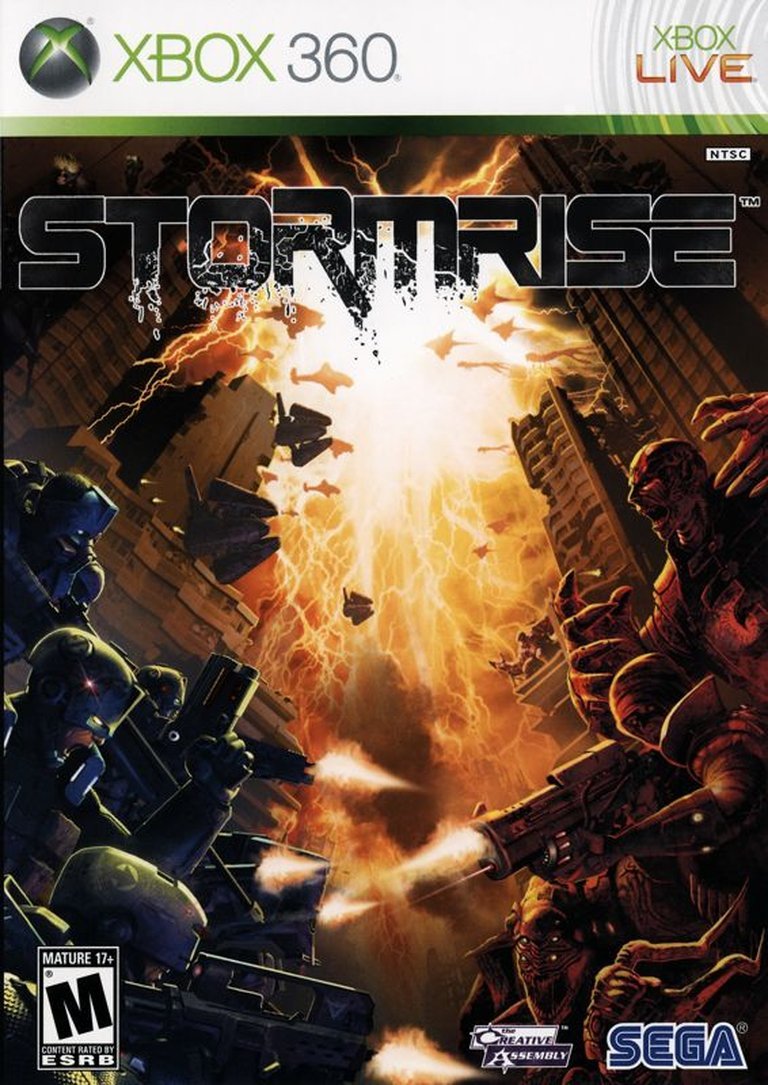
Description
In a dystopian future ravaged by catastrophic storms triggered by a flawed artificial force field meant to combat Global Warming, known as the Happening, humanity splits into two factions: the Echelon, privileged survivors awakening from cryogenic sleep in underground caverns to reclaim the surface, and the Sai, mutated humans who adapted to the harsh, storm-torn world by merging with nature. Stormrise is a real-time strategy game set in this sci-fi wasteland, where players command squads of units in intense battles without traditional base building, using innovative controls like Whip Select to switch perspectives and a 3D cursor for tactical commands, capturing control points to summon reinforcements and upgrades.
Gameplay Videos
Where to Get Stormrise
Patches & Mods
Guides & Walkthroughs
Reviews & Reception
metacritic.com (48/100): Generally Unfavorable Based on 36 Critic Reviews
ign.com : the game’s technical problems, coupled with some truly frustrating control limitations, ultimately makes Stormrise a disappointing entry in the genre at best.
bullz-eye.com (40/100): As far as RTS games go, this one’s about as ho-hum as it can get.
Stormrise: Review
Introduction
In the scorched remnants of a world ravaged by humanity’s hubris, two factions claw their way toward dominance: the technologically resurgent Echelon, awakening from cryogenic slumber to reclaim their birthright, and the feral Sai, evolution’s grim survivors bonded to a hostile nature. This is the cataclysmic backdrop of Stormrise, a 2009 real-time tactics game from Creative Assembly’s Australian studio that dared to reimagine the RTS genre for consoles. As a beacon of ambition in an era when strategy games were still clawing for relevance on living-room hardware, Stormrise promised verticality, immersive front-line command, and a narrative of post-apocalyptic redemption. Yet, its legacy is one of unfulfilled potential—a bold experiment that crumbled under technical woes and design missteps. My thesis: While Stormrise innovates with its squad-based perspective and multi-layered battlefields, its execution falters so profoundly in controls, AI, and polish that it stands as a cautionary tale for genre pioneers, more memorable for its flaws than its fleeting highs.
Development History & Context
Stormrise emerged from the ambitious but under-resourced Creative Assembly Australia, a satellite studio of the renowned UK-based developer behind the Total War series. Founded in the mid-2000s, the Australian team sought to leverage their parent’s expertise in epic-scale strategy while adapting it for the nascent console RTS market. Creative Director Ken Turner envisioned a game that broke from traditional top-down RTS views, inspired by the challenges of translating mouse-and-keyboard precision to analog sticks. The core innovation—the “Whip Select” system—was born from this: a gesture-based mechanic for switching between squads, akin to a digital lasso, designed to immerse players in the chaos of battle rather than overseeing it from afar.
Development began around 2007, with Sega as publisher, aiming for a simultaneous launch on PlayStation 3, Xbox 360, and PC in March 2009. Technological constraints defined the project; the PS3 and Xbox 360’s hardware struggled with the game’s fully 3D environments and vertical combat layers (air, surface, underground), leading to compromises in AI pathfinding and framerate stability. The PC version, curiously ported despite console-first design, required Windows Vista and DirectX 10.1, limiting accessibility and exacerbating input mismatches—Whip Select felt alien with a mouse.
The gaming landscape of 2009 was RTS-hostile on consoles. PC dominated with stalwarts like Command & Conquer and StarCraft II (then in beta), while console attempts like Ubisoft’s Tom Clancy’s EndWar (2008) experimented with voice controls but met mixed success. Ensemble Studios’ Halo Wars launched just weeks after Stormrise, overshadowing it with polished, accessible gameplay. Creative Assembly Australia operated on a tighter budget than their UK counterparts, contributing to rushed polish; bugs plagued demos, and post-launch support evaporated after a single patch. This context underscores Stormrise‘s noble but ill-fated bid: a studio pushing boundaries amid hardware limitations and fierce competition, only to deliver a product that felt unfinished.
Key Development Milestones
- Pre-Production (2007): Focus on verticality and no-base-building to suit console controls; early prototypes emphasized squad immersion.
- Alpha/Beta (2008): Whip Select refined for analog sticks; storyboarding integrated post-apocalyptic themes from environmental sci-fi like Dune.
- Launch (March 2009): Cross-platform release; PC version criticized for ignoring controller support.
- Post-Launch Fallout: Patch 2 canceled in April 2009 due to costs; Turner departed amid low sales.
Narrative & Thematic Deep Dive
Stormrise‘s story unfolds in a near-future Earth scarred by “The Happening”—a global warming countermeasure gone catastrophically wrong. Orbital satellites meant to shield the planet instead unleashed firestorms that scorched the surface, forcing elite survivors into cryogenic caverns. Centuries later, the Echelon emerge: cybernetically enhanced humans wielding mechs and drones, driven by a manifesto of reclamation. Opposing them are the Sai, surface-dwellers who mutated into symbiotic guardians of nature, their psychic “Sai energy” manifesting as tentacles, teleports, and acid barrages. Protagonist Commander Aiden Geary, an Echelon leader voiced by Robin Atkin Downes, navigates this divide, his arc hinting at hybrid heritage that blurs faction lines.
The plot spans 15 single-player missions, alternating Echelon and Sai campaigns, chronicling escalating tensions from uneasy truce to all-out war. Key beats include Geary’s awakening aboard the Eclipse (a massive orbital vessel), Sai shaman Geist’s visions of ecological revenge, and betrayals like the rogue Echelon commander Avalon. Dialogue, delivered via Nolan North’s gravelly narration and a cast including Courtenay Taylor as the ethereal Sable, aims for gritty profundity but often lands in cliché. Lines like “Only one shall rise” underscore the tagline, while Geary’s internal monologues probe themes of adaptation versus domination: “We built walls against the storm; they became the storm.”
Thematically, Stormrise grapples with environmental hubris and evolution’s cost, echoing Dune‘s ecological allegory and Warhammer 40k‘s factional zealotry. The Echelon represent technocratic arrogance—cold, hierarchical, with upgrades symbolizing dehumanization—while the Sai embody primal resilience, their organic units (like the Matriarch crab-spawning beast) evoking nature’s wrath. Grey-and-grey morality shines through: Echelon seek restoration but at Sai expense; Sai defend their world but resist progress. Yet, the narrative falters in delivery—cutscenes are sparse and glitchy, characters underdeveloped (Geary’s hybrid twist feels tacked-on), and dialogue wooden, prioritizing exposition over emotion. Themes of unity amid apocalypse intrigue but drown in pacing issues, scripted events, and a multiplayer mode that abandons story entirely.
Character Analysis
- Aiden Geary (Echelon): Stoic commander; his arc from loyalist to questioner highlights identity crisis.
- Geist (Sai): Psychic elder; embodies tribal wisdom, with drones symbolizing communal bonds.
- Supporting Cast: Figures like the sniper-piloting Stalker or flame-throwing Enforcers add flavor but lack depth, serving as plot devices.
Gameplay Mechanics & Systems
At its core, Stormrise discards traditional RTS base-building for node-capture skirmishes, emphasizing tactical squad management in real-time. Players start with predefined units (nine per faction) and a warp gate for reinforcements, capturing energy-generating control points to fund upgrades, turrets, and spawns. The loop: Scout vertically layered maps (rooftops, tunnels, skies), whip between squads to micro-manage fights, and escalate via loadout swaps—Echelon’s Scorpions toggle missiles to flamers; Sai’s Spectres cloak or mind-control foes.
Combat thrives on verticality: Echelon air units like Seekers strafe from above, Sai burrow underground for ambushes. Progression ties to energy: Capture nodes in three tiers (basic collection, shielded defense, warp gate expansion), unlocking alternate weapons and tactics via radial menus. UI innovates with a 3D cursor for precise orders and indirect commands (drag arrows for pathing), but Whip Select—the star mechanic—flaws the system. Holding a button summons a “whip” beam to lasso squad icons; on consoles, it’s fluid for small-scale battles, but PC mouse adaptation is clunky, icons cluttering amid chaos.
Flaws abound: AI is abysmal—units pathfind poorly, ignoring cover or charging suicidally (e.g., snipers rushing turrets). Grouping (up to three squads) helps, but large armies overwhelm the camera, which locks to selected units, obscuring overviews. Bugs compound frustration: Frozen animations, invisible deaths, checkpoint failures force mission restarts. Multiplayer (2-8 players) mirrors single-player but adds asymmetry—Echelon’s tech edges early, Sai’s psychics late-game—yet lacks depth, with unbalanced maps and ghost-town lobbies post-launch.
Innovations like vertical scouting (e.g., rooftop flanks) and no-mic voice commands (unlike EndWar) shine in isolation, but core loops devolve into attrition wars. Character progression via upgrades feels rewarding initially, but repetitive missions erode engagement.
Core Strengths and Weaknesses
- Strengths: Immersive squad perspective; vertical tactics add depth (e.g., underground Sai vs. Echelon drones).
- Weaknesses: Whip Select fails in frenzy; AI/pathfinding bugs; single-save system punishes experimentation.
- UI/Controls Breakdown: Radial menus intuitive; camera “ornery” per reviews, demanding constant whips that fatigue players.
World-Building, Art & Sound
Stormrise‘s post-apocalyptic Earth is a desolate masterpiece on paper: Storm-lashed ruins, cryogenic caverns, and overgrown wastelands evoke a Mad Max-meets-Horizon Zero Dawn vibe. Verticality enhances immersion—battles span shattered skyscrapers (Echelon strongholds) and fungal tunnels (Sai domains)—fostering atmosphere through dynamic weather: Acid rains hinder visibility, gales scatter units. Multiplayer maps like urban hives amplify this, with nodes perched on precarious ledges.
Visually, art direction by Jason Dalton impresses with detailed models—the hulking Echelon Eclipse orbits menacingly, Sai Matriarchs scuttle with grotesque fluidity—but execution stumbles. Muddy textures, pop-in, and subpar lighting (especially PC) undermine the sci-fi grit; cutscenes lag behind in-game fidelity. Framerate dips during clashes (30-40 FPS on consoles, worse on PC) shatter immersion, with aliasing and glitches (e.g., clipping units) evoking an unpolished beta.
Sound design, scored by Jeff van Dyck, pulses with thematic weight: Ominous synths underscore Echelon tech, tribal chants Sai rituals, building tension in storms’ howls. Voice acting shines—Downes’ Geary broods effectively, North’s narration grounds lore—but muffled effects (e.g., vanishing gunfire) and repetitive alerts grate. Ambient ruins creak convincingly, yet bugs mute impacts, diluting the visceral punch. Overall, these elements craft a haunting world that contributes to fleeting awe, but technical hurdles prevent full atmospheric payoff.
Sensory Highlights
- Visuals: Vertical layers create tactical poetry; stormy vistas evocative.
- Audio: Van Dyck’s score elevates themes; unit barks add personality (e.g., Sai’s feral snarls).
- Atmosphere Contribution: Reinforces eco-horror, but glitches pull players out.
Reception & Legacy
Upon 2009 release, Stormrise bombed critically and commercially. Metacritic aggregates scored PC at 42/100 (“generally unfavorable”), PS3 at 51/100 (“mixed”), and Xbox 360 at 48/100—trailing Halo Wars (82/100). Of 43 MobyGames reviews, averages hover at 46%, with IGN’s 2.1/10 PC verdict decrying it as “avoid at all costs” for buggy controls and AI. GameSpot’s 2.5/10 called it a “broken debacle,” praising ideas like Whip Select but lambasting execution: “What were they thinking?” Positive outliers (e.g., GameZone’s 7.9/10) lauded innovation, but consensus fixated on frustrations—cumbersome camera, unplayable glitches, and a campaign that “tedious[ly]” drags.
Commercially, low sales (under 100,000 units estimated) doomed support; Patch 2’s cancellation in April 2009 cited “costs and risks,” with Ken Turner exiting. Player scores average 3.1/5 on MobyGames (12 ratings), praising multiplayer balance but decrying single-player grind. Reputation evolved from “flawed gem” to “forgotten flop”—forums like Reddit recall it as a “what if” for console RTS, influencing none directly but warning against rushed ports (e.g., PC’s absent controller support).
Industry influence is negligible; Total War thrived, but Stormrise deterred Sega from similar risks, paving for safer bets like Alien: Isolation. In history, it’s a footnote: Ambitious verticality inspired later titles (Relic’s multi-level designs), but as a whole, it exemplifies 7th-gen pitfalls—overambition without polish—cementing Creative Assembly Australia’s pivot away from originals.
Reception Metrics
- Critic Consensus: 46% average; “Innovative but broken” (e.g., Eurogamer: 3/10, “stymied by execution”).
- Player Feedback: Mixed; multiplayer viable short-term, campaign “frustrating.”
- Evolution: From launch hype to cult curiosity; no remaster, servers offline by 2012.
Conclusion
Stormrise weaves a tapestry of post-apocalyptic intrigue, vertical tactical depth, and eco-thematic resonance, elevated by strong world-building and audio flair. Yet, its ambitions are torpedoed by atrocious controls, buggy AI, and unrefined systems that render battles chaotic rather than strategic. As a console RTS pioneer, it captures the genre’s front-line thrill but fails to deliver cohesion, leaving players exasperated amid its stormy ruins. In video game history, Stormrise occupies a tragic niche: A flawed artifact of 2009’s console wars, warranting study for devs but evasion for players. Verdict: 4/10—ambitious misfire, best as a lesson in what not to do. If you’re a genre historian, boot it up; otherwise, seek Halo Wars for RTS solace.