
- Release Year: 2007
- Platforms: Windows
- Publisher: Kalypso Media GmbH
- Genre: Compilation
- Perspective: Top-down
- Game Mode: Hotseat, Single-player
- Gameplay: Turn-based strategy, Wargame
- Setting: World War II
- Average Score: 62/100
Description
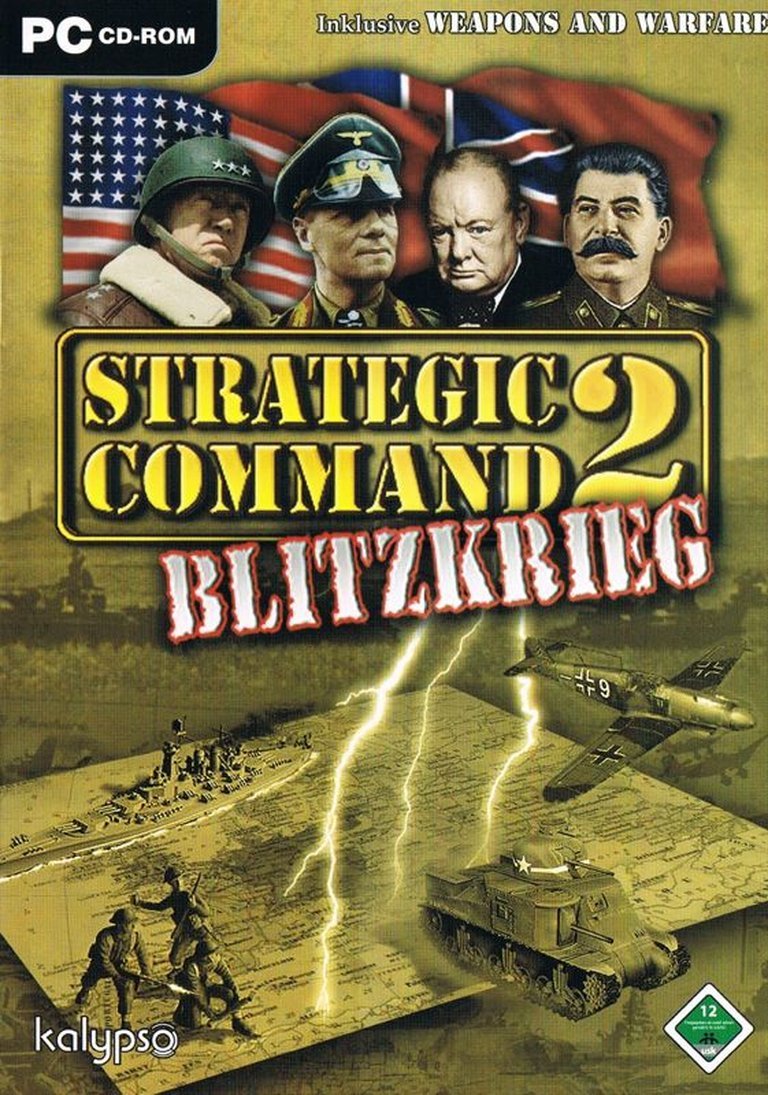
Strategic Command 2: Blitzkrieg is a turn-based grand strategy game set during World War II’s European Theater, where players command either Axis or Allied forces, managing military units, technological research, and diplomatic pressure across detailed maps covering Europe, North Africa, and beyond. Developed by Fury Software and published in 2006, it introduced innovations like weather effects, specialized units (paratroops, engineers), and a diplomatic system, alongside campaigns and scenarios including North Africa, D-Day, and the Battle of the Bulge, later expanded with ‘Weapons and Warfare’ (enhancing naval/terrain mechanics) and ‘Patton Drives East’ (adding post-war hypothetical conflicts).
Gameplay Videos
Strategic Command 2: Blitzkrieg Patches & Updates
Strategic Command 2: Blitzkrieg Guides & Walkthroughs
Strategic Command 2: Blitzkrieg Reviews & Reception
metacritic.com (64/100): An excellent war game. Blitzkrieg fixes almost all of the problems the first game had (a small Africa etc). The AI could still be better, though.
ign.com (59/100): Loads of substance but not much style.
gamewatcher.com : Overall this game really is for the hardcore of turn-based strategists as otherwise you could soon be finding yourself turned away by the lack of visual and audio passion in Strategic Command 2.
Strategic Command 2: Blitzkrieg Cheats & Codes
PC
Shift + C to open console
| Code | Effect |
|---|---|
| #johnconnor | disable AI |
| #iamback | enable AI |
| #igotnukes | instant victory |
| #whiteflag | instant defeat |
| #warbonds | +500 resources |
| #orbitalcommand | disable fog of war |
| #warbonds |
Given you |
| #income |
Given you |
| #overtime |
Given you |
| #landcp |
Given you |
| #navalcp |
Given you |
| #aircp |
Given you |
Strategic Command 2: Blitzkrieg: Review
Introduction
In the pantheon of World War II grand strategy games, Strategic Command 2: Blitzkrieg occupies a unique niche—a meticulous, numbers-driven wargame that prioritizes depth over dazzle. Released in 2006 as the sequel to Strategic Command: European Theater, it represents an evolutionary leap in the series, introducing weather, diplomacy, and expanded unit types while retaining the series’ signature hex-free tile-based mechanics. Yet, despite its ambitious scope and strategic richness, the game remains a polarizing entry, celebrated by hardcore wargamers for its simulationist rigor but criticized by mainstream reviewers for its austere presentation and opaque systems. This review argues that Blitzkrieg is a quintessential “grognard’s game”—a masterpiece of accessible complexity that sacrifices stylistic flair for unparalleled replayability and historical granularity, cementing its legacy as a cornerstone of turn-based WWII strategy.
Development History & Context
Developed by Canadian studio Fury Software under the direction of founder Hubert Cater and published by Battlefront.com in 2006, Blitzkrieg was born from a desire to refine the foundation laid by its 2002 predecessor. Cater, a veteran of board wargaming, envisioned a game that retained the accessibility of traditional hex-and-counter simulations while integrating modern features like dynamic weather and diplomacy. The team, comprising roughly 18 members across programming, art, and design, faced the technological constraints of mid-2000s PC gaming, targeting systems as modest as a Pentium III 1 GHz with 256 MB RAM. This approach ensured broad compatibility but limited graphical ambitions.
The 2006 gaming landscape was dominated by real-time strategy (RTS) titans like Age of Empires III and Company of Heroes, but turn-based grand strategy was also burgeoning, with Hearts of Iron II (2005) setting the bar for complexity. Battlefront.com, a niche publisher specializing in military simulations, marketed Blitzkrieg as a middle ground—less intimidating than hardcore wargames like Third Reich but more detailed than board-game adaptations. This positioning aimed to attract both hardened grognards and newcomers seeking a WWII sandbox, with expansions like Weapons and Warfare (2007) and Patton Drives East (2008) extending its lifespan and scope post-release.
Narrative & Thematic Deep Dive
Blitzkrieg eschews a linear narrative in favor of emergent storytelling, with history rewritten through player decisions. Its campaigns—beginning in 1939 (Poland), 1940 (Scandinavia/France), 1941 (Barbarossa), 1942 (Stalingrad), 1943 (Sicily), and 1944 (D-Day)—serve as canvases for alternative outcomes. The absence of scripted narratives is deliberate, emphasizing player agency: capturing Leningrad in 1941 or halting the Allied advance at Normandy in 1944 alters the war’s entire trajectory.
Thematic depth lies in its simulation of systemic pressures: production bottlenecks (via Military Production Points, or MPPs), weather’s impact on logistics, and diplomatic friction. Neutral nations like Spain or Turkey can be swayed to join the war or remain isolationist, adding geopolitical tension. The Patton Drives East expansion further explores alternate history, introducing Cold War-era conflicts (e.g., a 1948 U.S.-USSR war) that probe themes of ideological rivalry and post-war instability. While devoid of character-driven drama, the game’s narrative is one of cold, calculated risk—a chess match with the ghost of Hitler.
Gameplay Mechanics & Systems
Blitzkrieg‘s core loop revolves around turn-based operational command on a tile-based map spanning Europe, North Africa, and the Atlantic. Players manage 16 unit types (infantry, tanks, bombers, paratroopers) across 30 nations, balancing movement, combat, production, and research.
- Combat: Abstract yet nuanced, resolving battles via hidden variables (morale, entrenchment, terrain modifiers). Critics like IGN lamented its opacity, while fans praised its realism—e.g., paratroopers enabling airborne assaults or engineers constructing bridges.
- Production & Research: MPPs, generated by captured cities and ports, fund unit purchases and technology upgrades (e.g., advancing armor or aviation). Research is broad (e.g., “infantry” rather than specific models), favoring accessibility over granularity.
- Diplomacy: A cornerstone innovation, allowing players to pressure neutrals (e.g., funding coups in Vichy France) or counter-diplomacy (e.g., Axis deterring Turkey from joining Allies).
- Scenarios: Six open-ended campaigns and five focused mini-campaigns (Kursk, Market Garden, Bulge) offer varied scales. The v1.08 patch added a “Global Campaign,” expanding the map to include Asia-Pacific and the Americas.
- AI: Layered and adaptive, with three-tiered decision-making (force analysis, regional posture, campaign scripts). Praised by Armchair General for its challenge, it occasionally overextends or neglects defenses.
- Editor: A robust suite enabling custom maps, units, events (e.g., “Siberian troops arriving at Stalingrad”), and scripting, fostering a vibrant modding community.
World-Building, Art & Sound
Blitzkrieg builds its world through meticulous historical reconstruction, not visual flair. The 120×38 tile map (expandable to 256×256) renders Europe’s topography with rivers, forests, and urban centers, each affecting movement and combat. North Africa’s deserts and the Atlantic’s convoy routes emphasize logistical challenges, while terrain like bocage hedges or frozen rivers adds tactical depth.
Artistically, the game is a relic of 2006’s austere wargaming aesthetics. Unit sprites are static, top-down icons—tanks resemble cardboard cutouts, and cities are featureless blobs. Weather effects (snow, mud) are visualized as simple color shifts, lacking dynamism. Sound design is equally minimal: generic explosions, tank rumbles, and silence outside menu music. This intentional sparsity underscores the game’s focus on mechanics over immersion, but as IGN noted, it results in “loads of substance, but not much style.”
Reception & Legacy
Upon release, Blitzkrieg received mixed reviews (Metacritic: 64/100). Critics lauded its depth and replayability but criticized its presentation:
– IGN (5.9/10) called it “dry” and “unexciting,” praising scenarios but lambasting opaque combat.
– Armchair General (81/100) countered, applauding “clear unit details” and accessibility for newcomers.
– Strategy Informer deemed it “for hardcore strategists” only.
Commercially, it found a niche in wargaming circles, bolstered by Battlefront.com’s dedicated fanbase and expansions that addressed early criticisms (e.g., Weapons and Warfare’s improved AI). Its legacy endures in three ways:
1. Series Evolution: The second engine (tile-based) became the foundation for Pacific Theater (2008) and Global Conflict (2010), expanding the series’ scope beyond Europe.
2. Modding Community: The editor enabled thousands of user-made scenarios, from alternate WWII histories to Cold War conflicts, preserving its longevity.
3. Genre Influence: It bridged gap between hardcore wargames and accessible strategy, inspiring titles like Strategic Mind: Blitzkrieg (2020). Modern re-releases (e.g., Strategic Command Classic: WWII in 2018) attests to its enduring appeal.
Conclusion
Strategic Command 2: Blitzkrieg is a paradox—a game that feels both dated and timeless. Its austere presentation and abstract combat may alienate those seeking cinematic thrills, but for turn-based strategists, it remains a masterpiece of systemic depth and historical flexibility. The introduction of weather, diplomacy, and unit variety revolutionized the series, while its editor and campaigns fostered unprecedented replayability. Though overshadowed by visually stunning contemporaries, Blitzkrieg’s legacy lies in its unwavering commitment to the grognard’s creed: that the most compelling war stories are told not through cutscenes, but through the weight of a single decision on a hexless tile. In the annals of WWII gaming, it is less a classic and more a vital reference—a blueprint for how depth and accessibility can coexist, even at the cost of style.