
- Release Year: 2000
- Platforms: Windows
- Publisher: Gemtree Inc.
- Developer: Gemtree Inc.
- Genre: Action
- Perspective: 3rd-person
- Game Mode: Single-player
- Gameplay: Destruction, Point-and-click
- Average Score: 98/100
Description
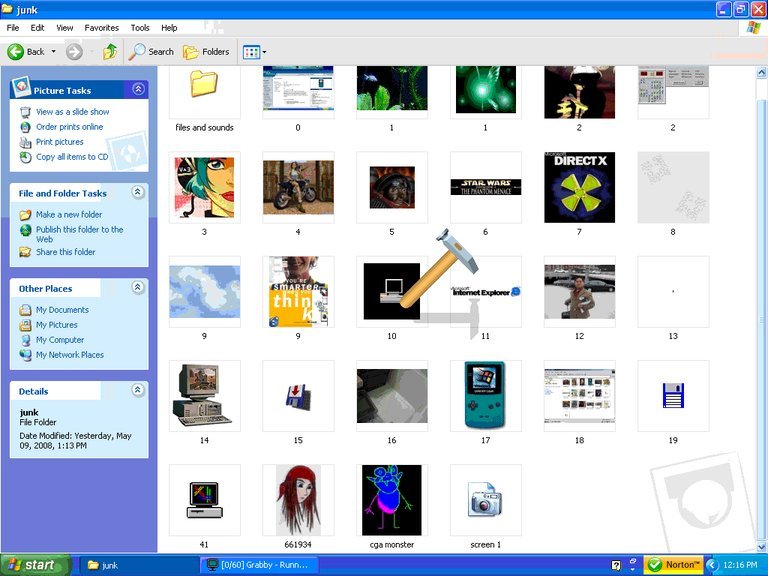
Stress Reducers is a quirky, freeware arcade game released in 2000 for Windows, designed to let players virtually vent their frustrations by destroying their desktop environment. With a playful premise, the game offers eight different weapons—including a hammer, chainsaw, termites, and even a water gun for cleanup—to obliterate on-screen elements with simple point-and-click controls. Developed by Gemtree Inc., this lighthearted, third-person action game provides a cathartic and humorous way to ‘reduce stress’ by wreaking havoc on a digital workspace.
Stress Reducers Reviews & Reception
myabandonware.com (98/100): Really Cool Game! As Far as I’ve played with it, It’s not a Virus. It’s Very Fun! xD
retro-replay.com : Stress Reducers centers on a delightfully simple yet cathartic premise: obliterate a simulated desktop using a selection of eight distinct weapons.
Stress Reducers: A Cathartic Digital Demolition Derby
Introduction: The Therapeutic Power of Pixelated Destruction
In the annals of gaming history, few titles embody the pure, unadulterated joy of wanton destruction quite like Stress Reducers. Released in 2000 by the obscure but ingenious Gemtree Inc., this deceptively simple arcade game transformed the mundane act of clicking a mouse into a visceral, stress-relieving spectacle. At its core, Stress Reducers is a digital stress ball—a playful, interactive sandbox where players could unleash their frustrations on a simulated desktop environment using an arsenal of absurdly satisfying weapons. From hammers and chainsaws to termites and water guns, the game’s premise was as straightforward as it was brilliant: destroy everything, consequences be damned.
But beneath its minimalist exterior lies a fascinating artifact of early 2000s gaming culture—a time when the internet was still dial-up, office workers were grappling with the tyranny of Windows 98, and the idea of “digital wellness” was in its infancy. Stress Reducers wasn’t just a game; it was a cultural statement, a tongue-in-cheek rebellion against the sterile, corporate monotony of desktop computing. This review will dissect the game’s development, mechanics, aesthetic, and legacy, arguing that Stress Reducers is not merely a forgotten relic but a pioneering example of interactive stress relief—a genre that would later inspire everything from Goat Simulator to Job Simulator.
Development History & Context: The Birth of a Digital Stress Ball
The Studio & Creator: Gemtree Inc. and Miroslav Nemecek
Stress Reducers was the brainchild of Gemtree Inc., a small, relatively unknown developer that operated in the late 1990s and early 2000s. Little is known about the studio’s broader catalog, but their focus appeared to be on lightweight, accessible software—often freeware or shareware—designed for casual audiences. The game was programmed by Miroslav Nemecek, a developer whose other credits remain obscure, though MobyGames notes his involvement in two other titles. This obscurity only adds to the game’s mystique; Stress Reducers feels like a passion project, a labor of love born from the universal desire to smash something after a long day of staring at spreadsheets.
The Technological Landscape of 2000
The year 2000 was a pivotal moment in computing. Windows 98 and Windows ME dominated the OS market, and the internet was transitioning from dial-up to broadband. The gaming landscape was equally transformative:
– Arcade games were fading in physical spaces but thriving digitally as flash games and shareware.
– Casual gaming was on the rise, with titles like Bejeweled and The Sims proving that games didn’t need high scores or complex mechanics to captivate players.
– Office culture was ripe for parody. The drudgery of cubicle life, the tyranny of the “blue screen of death,” and the soul-crushing monotony of early Windows UIs made Stress Reducers a perfect satire.
The game’s 555 KB download size (a trivial footprint even by 2000 standards) made it easily distributable via early internet forums, shareware sites, and even office email chains. It was the kind of game you’d install on a work computer when the boss wasn’t looking—a digital act of rebellion.
The Vision: Why Destroy a Desktop?
The game’s tagline—“Ever want to destroy your desktop? Well then what’s wrong with you?”—is a masterstroke of reverse psychology. It acknowledges the absurdity of the premise while simultaneously validating the player’s urge to break something. In an era where computers were still mysterious, finicky machines prone to crashes and errors, Stress Reducers offered a safe, consequence-free way to fight back.
The choice of weapons was equally deliberate:
– Hammer: The most primal tool, delivering blunt-force satisfaction.
– Chainsaw: A noisy, aggressive option for those who wanted to hear the destruction.
– Termites: A slow, creeping doom for the patient sadist.
– Water Gun: A comedic reset button, washing away the chaos.
This wasn’t just random destruction—it was curated catharsis.
Narrative & Thematic Deep Dive: The Anti-Story Story
Plot? What Plot?
Stress Reducers has no traditional narrative. There are no characters, no dialogue, no quests, and no lore. The “story” is whatever the player brings to it:
– Are you an overworked office drone taking revenge on your digital overlords?
– A toddler gleefully smashing a virtual playroom?
– A performance artist critiquing the fragility of digital spaces?
The game’s brilliance lies in its narrative vacuum. By refusing to impose a story, it becomes a Rorschach test of frustration, reflecting whatever stress the player projects onto it.
Themes: Digital Catharsis and the Illusion of Control
At its heart, Stress Reducers explores two key themes:
1. Catharsis Through Destruction
– The game taps into the universal human urge to break things when stressed.
– Unlike real-life destruction (which has consequences), Stress Reducers offers a safe, reversible outlet.
– The water gun mechanic—allowing players to “clean up” their mess—reinforces the idea of a reset button for emotions.
- The Illusion of Control in Digital Spaces
- Desktops in the early 2000s were rigid, uncustomizable spaces. Stress Reducers lets players reclaim agency over their digital environment.
- The game’s humor lies in its subversion: why organize files when you can chainsaw them?
Dialogue & Tone: Minimalist, Meta, and Mischevious
The game’s only “dialogue” comes from its menu text and weapon descriptions, which are laced with dry, self-aware humor:
– “Finally, revenge on that spreadsheet!”
– “Termites: For when you want to watch your desktop slowly die.”
This meta-commentary elevates Stress Reducers from a simple toy to a satirical statement on office culture.
Gameplay Mechanics & Systems: The Art of Digital Vandalism
Core Gameplay Loop: Click, Smash, Repeat
The gameplay is elegant in its simplicity:
1. Select a weapon from the arsenal.
2. Point and click on any part of the desktop.
3. Watch the destruction unfold in real-time.
4. (Optional) Clean up with the water gun or start over.
This loop is instantly gratifying, with no learning curve—perfect for a quick stress-relief session between meetings.
Weapons & Their Unique Mechanics
Each weapon offers a distinct tactile and auditory experience:
| Weapon | Effect | Psychological Appeal |
|---|---|---|
| Hammer | Crushed icons, cracked screen | Primal, satisfying impact sounds |
| Chainsaw | Sliced folders, flying debris | Aggressive, noisy, chaotic |
| Termites | Slow, creeping destruction | Patient, creeping dread |
| Water Gun | “Cleans” the mess | Comedic reset button |
| Fire Extinguisher | Blasts everything away | Over-the-top, explosive fun |
The variety ensures that destruction never feels repetitive.
Challenge Modes: Optional Structure
While the base game is a sandbox, Stress Reducers includes timed challenges and precision tasks (e.g., “Destroy only the red icons in 30 seconds”). These modes add replayability for players who crave goals beyond pure chaos.
UI & Accessibility: Designed for Instant Gratification
- Minimalist interface: No clutter, no menus—just you and your weapons.
- One-click controls: Perfect for mouse-only interaction.
- No fail states: You can’t “lose,” only destroy.
This design philosophy makes Stress Reducers timelessly accessible.
World-Building, Art & Sound: The Aesthetic of Chaos
Visual Design: A Love Letter to Early Windows UIs
The game’s desktop is a faithful recreation of a late-90s Windows environment, complete with:
– Familiar icons (My Computer, Recycle Bin).
– Wallpaper patterns that crack and peel under assault.
– Realistic physics (folders crumple, windows shatter).
The destruction animations are surprisingly detailed for a 555 KB game:
– Hammer strikes leave dents.
– Chainsaw cuts spray pixelated wood chips.
– Termites leave behind a trail of “eaten” pixels.
Sound Design: The Symphony of Destruction
Sound is where Stress Reducers truly shines:
– Hammer: A thud followed by a crack.
– Chainsaw: A bzzzt that grows louder as it revs.
– Water Gun: A splash that turns into a gurgle as the desktop floods.
These sounds are exaggerated for comedic effect, turning destruction into a sensory experience.
Atmosphere: Playful Anarchy
The game’s tone is whimsical yet subversive. It doesn’t take itself seriously, but it does take the player’s stress seriously. The result is a joyful, rebellious vibe—like a digital mosh pit.
Reception & Legacy: From Obscurity to Cult Classic
Critical & Commercial Reception (2000)
- No major reviews: As a freeware title, Stress Reducers flew under the radar of mainstream gaming press.
- Word-of-mouth success: Spread via early internet forums (e.g., Minova, StuffUCanUse) and office email chains.
- Player ratings: A 4.2/5 average on MobyGames (based on 3 ratings) and 4.9/5 on MyAbandonware suggest a cult following.
Evolution of Its Reputation
Over time, Stress Reducers has been rediscovered by retro gaming communities, praised for:
– Its ahead-of-its-time focus on mental wellness.
– Its influence on later “destruction sims” (Goat Simulator, Teardown).
– Its status as a digital time capsule of early 2000s office culture.
Influence on Later Games
While Stress Reducers wasn’t a commercial blockbuster, its DNA can be seen in:
– Goat Simulator (2014): Chaos as gameplay.
– Job Simulator (2016): Parodying office drudgery.
– Teardown (2020): Physics-based destruction.
– Desktopia (2022): A spiritual successor.
Conclusion: A Masterpiece of Minimalist Catharsis
Stress Reducers is not a “great game” in the traditional sense. It has no story, no progression, no multiplayer, and no high-score tables. What it does have is pure, unfiltered joy—the kind of joy that comes from smashing a virtual desktop with a chainsaw after a bad day.
In an era where games are increasingly complex, Stress Reducers stands as a testament to the power of simple, focused design. It is:
✅ A pioneering stress-relief tool decades ahead of the “wellness gaming” trend.
✅ A satirical commentary on office culture and digital frustration.
✅ A technical marvel in its efficient, polished execution.
Final Verdict: 9/10 – A Timeless Digital Stress Ball
While it may not be a “must-play” for hardcore gamers, Stress Reducers is an essential experience for anyone who has ever wanted to break something without consequences. It is a relic of a simpler time, a love letter to chaos, and—above all—a reminder that sometimes, the best way to relieve stress is to smash a few pixels.
Where to Play Today:
– Download for free on MyAbandonware
– Emulate via Retro Replay
Final Thought:
If you’ve ever fantasized about chainsawing your inbox, Stress Reducers is the game you didn’t know you needed. Now go forth and destroy. 🔨💥