
- Release Year: 2008
- Platforms: Windows
- Publisher: Anuman Interactive SA
- Genre: Compilation
Description
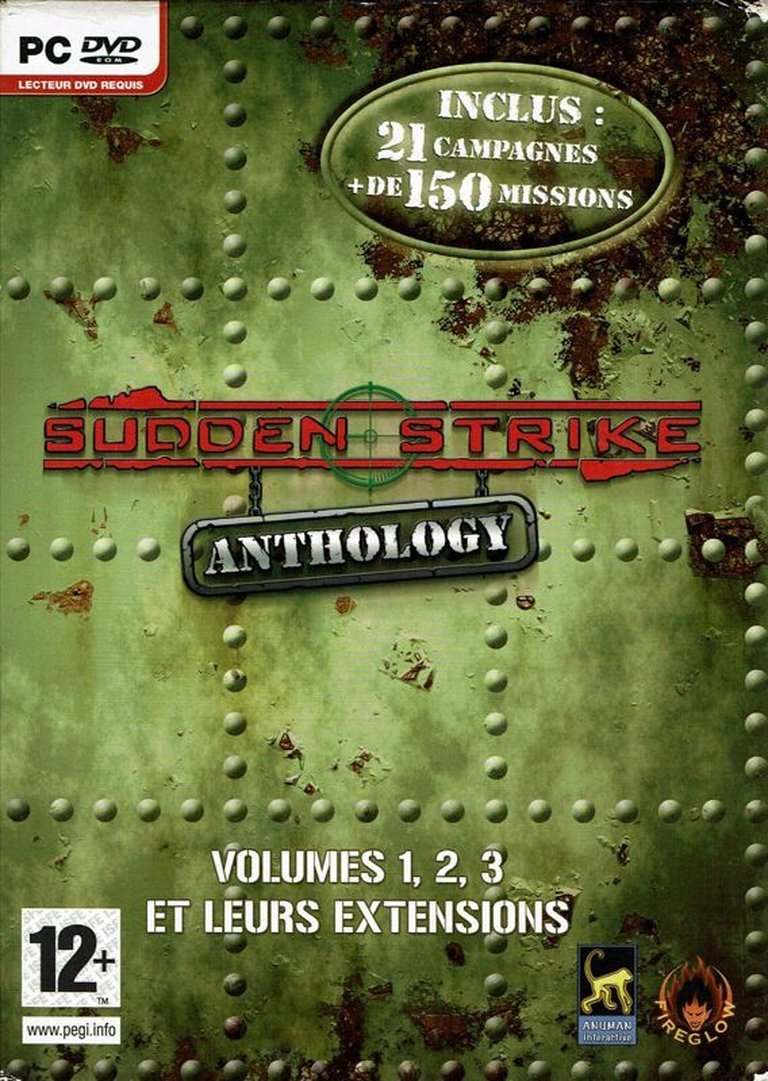
Sudden Strike: Anthology is a compilation of real-time tactics games set in World War II, where players command military units like infantry, tanks, and artillery in tactical battles that emphasize strategy and positioning over resource gathering or base building. This anthology includes Sudden Strike: Complete Edition, Sudden Strike II: Gold, and Sudden Strike 3: Arms for Victory, offering a comprehensive collection of WWII combat scenarios from the classic series.
Sudden Strike: Anthology Reviews & Reception
review-pc-game.blogspot.com : this was one of my favorite World War II games
retro-replay.com : offers unparalleled depth, challenge, and replay value
Sudden Strike: Anthology Cheats & Codes
Sudden Strike (PC)
Press [Enter] key in game, then enter one of the following cheats (the codes are case sensitive, don’t forget the **):
| Code | Effect |
|---|---|
| **superman | No Damage to Own Units |
| **starcraft | 100 bombers and 100 spyplanes |
| **nofog | View Full Map and All Units |
| **staticfog | Reset nofog Cheat |
| **audiemurphy | Reinforcements of 10 of the nation’s strongest tanks |
| **Iloveexplosions | 20 transport planes that have atom bombs |
| **movietime | All movies, they will be in the options screen |
Sudden Strike 2 (German Version) (PC)
Press [Enter] during gameplay, then enter one of the following codes to activate the corresponding cheat function.
| Code | Effect |
|---|---|
| **omniscience | Disable Fog of War |
| **blitzkrieg | Instant Victory |
| **koenigstiger | God Mode |
Sudden Strike 2 (English Version) (PC)
Press [Enter] during gameplay then enter one of the following codes to activate the corresponding cheat function then press [ENTER] again.
| Code | Effect |
|---|---|
| *omniscience* | Disable fog of war |
| *blitzkrieg* | Instant victory |
| *koenigstiger* | God mode |
Sudden Strike: Anthology: The Preservation of a Tactical Pioneer
In an industry often fixated on the new and the next, anthologies serve a crucial, if understated, purpose: they are digital museums, safeguarding titles that might otherwise fade into obsolescence. Sudden Strike: Anthology (2008) is precisely such a vessel, a carefully curated time capsule that captures the rise, refinement, and 3D transformation of one of real-time strategy’s most principled and influential dissenters. Far more than a simple repackaging, this compilation—gathering Sudden Strike: Complete Edition (2008), Sudden Strike II: Gold (2008), and Sudden Strike 3: Arms for Victory (2007)—is an essential document of a studio’s unwavering design philosophy and a genre’s formative years. It stands as a testament to the enduring appeal of pure, unadulterated tactical command, stripped of the economic micromanagement that would come to dominate the RTS landscape.
Development History & Context: The Russian-German Symbiosis
The story of Sudden Strike is inseparable from its creators, the Cypriot-based Fireglow Games, and its long-time German publisher, CDV Software Entertainment. Emerging from the Russian PC development scene of the late 1990s, Fireglow’s team, including key figures like director Victor Streltsov and programmer Victor Bargachev, had already explored tactical combat with Counter Action (1996). That game, known in Russia as Confrontation, served as the direct prototype and spiritual predecessor. When Sudden Strike launched in 2000 (marketed as Confrontation III in its native Russia), it wasn’t an invention ex nihilo but a crystallization and refinement of those earlier, less-polished concepts.
The technological context was pivotal. Operating on modest budgets and targeting the Windows 98/ME/2000/XP demographic, Fireglow eschewed the burgeoning 3D acceleration race of the era. Instead, they honed a proprietary 2D isometric engine that prioritized functionality over flash. This constraint became a virtue: the clean, readable sprites and environments ensured that tactical clarity—the king of the Sudden Strike design—was never compromised by graphical showmanship. The collaboration with CDV, a publisher with a keen eye for niche European strategy titles, provided the Western marketing and distribution muscle necessary to turn this Russian-developed game into a transcontinental commercial success.
The gaming landscape of 2000 was dominated by the juggernauts StarCraft and Age of Empires II. These titles defined the “real-time strategy” genre with their dual pillars of resource gathering/base building (econ) and large-scale army clashes (army). Sudden Strike audaciously declared that the army pillar alone was sufficient for a deeply compelling experience. This was the birth of the “real-time tactics” (RTT) sub-genre, a term that would come to define the series. The anthology, therefore, is not just a collection of games; it is a curated retrospective of this defined ideological split, showing how Fireglow refined and eventually evolved its own dogma.
Narrative & Thematic Deep Dive: The Silence of the Battlefield
To speak of a traditional “narrative” in Sudden Strike is to misunderstand its core purpose. There are no heroes, no character arcs, no cinematic cutscenes weaving a grand plot. The story is the battlefield itself, and the narrative is written in the movement of units and the fall of objectives. The “plot” is delivered through sparse, utilitarian mission briefings—text-only screens that state objectives (“Capture the airfield,” “Hold the port,” “Destroy the enemy armor column”) and occasionally hint at historical context.
The thematic heart of the anthology is historical authenticity as a gameplay mechanic. The playable factions—the Soviet Union, Nazi Germany, the United States/United Kingdom (Allies), and later Japan in SSII—are not balanced for fairness but for historical accuracy. The Soviet campaign often presents the player with overwhelming numerical challenges but less sophisticated equipment, mirroring the brutal, attritional nature of the Eastern Front. The German missions frequently task the player with holding against superior forces using superior tactics and technology, evoking the desperate, defensive struggles of 1943-45. The Allied campaign focuses on combined-arms operations and breakout tactics, as seen in the fictional-but-authentic Normandy scenarios.
Sudden Strike: Forever, included as part of the Complete Edition, adds nuance with its new scenarios. A British mission might task you with defending a desert port (evoking Tobruk), while a Soviet scenario could involve a winter counter-offensive. The briefings gain a slight layer of characterization, mentioning specific commanders or the morale of troops, but the focus remains resolutely on the tactical problem. The theme is not “war is hell” in a dramatic sense, but “war is a series of interconnected tactical puzzles.” The anthology collectively argues that the scale and diversity of World War II—from the frozen steppes to the Pacific jungles—is its own greatest narrative, and each mission is a vignette within that epic.
Gameplay Mechanics & Systems: The Calculus of Combat
This is where the Sudden Strike series, and by extension this anthology, stakes its claim to immortality. The foundational loop is brutally simple: you are given a fixed force of infantry, tanks, artillery, and sometimes aircraft. Your mission is to achieve a specific objective on a map littered with enemy forces, defensive positions, and terrain. There is no ore mining, no barracks queue, no tech tree to climb. Reinforcements are a precious, scripted reward for completing secondary objectives or after a set time, not an infinite stream.
This design choice forces a commander’s mindset:
1. Conservation of Force: Every tank lost is irreplaceable. A reckless charge is a path to failure. Infantry must be shielded, armor used judiciously.
2. Line of Sight (LoS) & Cover: The isometric, tile-based engine features rigorous LoS mechanics. Forests, buildings, and hills block vision and fire. Garrisoning infantry in buildings grants them a significant firing bonus and protection. This makes scouting with light units or aircraft critical. Ambushes from unseen directions are a constant threat.
3. Suppression & Morale: Units under fire can become suppressed, reducing their effectiveness. Breaking morale causes a unit to rout. Managing this requires rotating frontline units, utilizing support weapons (like machine guns) to pin enemies, and shielding flanks.
4. Supply & Logistics: Sudden Strike and its expansions introduce a nuanced supply system. Ammunition is finite; artillery and antitank guns require resupply trucks or nearby ammo dumps to sustain fire. Tanks need repair vehicles to recover from damage. This creates a secondary front—the supply line—that is as vital as the attack.
5. Unit Archetypes & Rock-Paper-Scissors: The system is a classic, deep RTT triangle. Infantry in buildings or forests can devastate tanks with antitank weapons (rock). Tanks can overrun exposed infantry with machine gun fire and tracks (paper). Tanks are helpless against hidden, dug-in antitank guns or assault guns (scissors). Aircraft provide reconnaissance and strike power but are vulnerable to flak.
6. The “Hold Fire” Command: A brilliant, simple innovation. You can order units to hold fire, making them invisible until they choose to engage. This is the primary tool for setting devastating ambushes.
Evolution Across the Anthology:
* Sudden Strike: Complete Edition represents the “pure” form. The controls are functional but sometimes clunky; the camera is fixed isometric. Its genius is in its brutal, unforgiving purity.
* Sudden Strike II: Gold refines the formula extensively. The interface is improved, resolutions are higher, and new units (like Japanese infantry with banzai charges, or British commandos) add factional flavor. The campaign structure is more varied, and the inclusion of a full map and scenario editor massively expanded the game’s lifespan through user-generated content.
* Sudden Strike 3: Arms for Victory marks the controversial leap to a fully 3D graphics engine. The core tactical DNA remains, but the perspective shifts to a true 3D camera that can be rotated and zoomed. This improved spatial awareness but sacrificed some of the crisp, readable 2D clarity. It introduced direct control of individual units (look-at, fire-at) and more dynamic unit animations. Some purists felt this 3D layer added unwanted complexity and visual clutter, but it undeniably modernized the presentation.
Flaws & Frictions: The series is famously difficult, with a steep learning curve. The AI, while capable of clever flanking maneuvers, can also be erratic. The user interface, even in SSII, feels dated and less responsive than contemporary titles like Company of Heroes. The lack of a robust, modern multiplayer matchmaking service (a relic of its pre-Steam era) is a significant barrier to the competitive community that once thrived around it.
World-Building, Art & Sound: Authenticity Through Abstraction
The Sudden Strike aesthetic is one of stylized realism. The 2D sprite work in the first two titles is exceptional for its time. Tank models (T-34s, Panzer IVs, Shermans) are distinct and recognizable. Infantry squads are animated collections of sprites. The environmental art—the European villages, the North African desert, the Pacific jungle clearings—is less about photographic fidelity and more about tactical readability. A cluster of green sprites is a forest; grey blocks are buildings; brown tiles are earth. This abstraction ensures that at a glance, you understand the lay of the land and the dangers it holds.
Sudden Strike 3‘s 3D models are blockier by modern standards, but they bring a new sense of scale and immersion. You can see the treads on a tank, the individual soldiers in a squad. The destructible environments, a hallmark of the series, are phenomenal. Buildings don’t just crumble with a health bar; they collapse section by section, with walls toppling and roofs caving in, dynamically altering the battlefield and LoS. This isn’t just visual spectacle; it’s a core tactical element. Bombing a bridge isn’t an objective checkbox; it physically severs an enemy’s advance.
The sound design is utilitarian and effective. The bass-thump of a tank gun, the rattling of machine guns, the whine of dive-bombers—all are clear, directional, and immediately informative. The soundtrack is sparse, often consisting of tense, atmospheric tracks that swell during major engagements, but the dominant audio is the symphony of warfare: explosions, orders shouted in German or Russian, the crunch of tracks on stone. This audio minimalism prevents sensory overload and keeps the player’s focus on the tactical soundscape.
Reception & Legacy: A Piloted Path
At Launch: The original Sudden Strike (2000) was a monumental commercial success, particularly in Germany and France. It debuted at #1 in Germany, earned a “Gold” award (100,000+ sales) from the VUD within a month, and was upgraded to “Platinum” (200,000+) by year’s end. Global sales reached approximately 800,000 units by 2002, a stellar figure for a niche PC RTT title. It was celebrated for its intense, realistic tactics and its refreshing departure from the Command & Conquer/StarCraft mold. Critically, it was “average” by Metacritic’s aggregation (69/100), with reviewers split between those who reviled its difficulty and lack of hand-holding (e.g., GameSpot‘s 5.6/10) and those who praised its pure tactical depth (IGN‘s 8.1/10, GameSpy‘s 88%).
Sudden Strike II (2002) maintained this core audience, improving the package but not radically reinventing it. Sudden Strike 3 (2007) received a cooler reception, as its shift to 3D was seen by many as diluting the crisp, decisive gameplay that defined the series.
As an Anthology (2008): Released by Anuman Interactive (who had acquired CDV’s assets), the anthology’s reception is nearly invisible in critical archives, as MobyGames confirms with a complete absence of critic reviews. This speaks to its nature as a deep-catalog product aimed at series loyalists and retro-strategy enthusiasts rather than the broader gaming press. Its value lies in preservation and convenience.
Legacy & Influence: The Sudden Strike series’ legacy is profound but specific:
1. Genre Definition: It codified the “Real-Time Tactics” genre, directly inspiring later titles like Blitzkrieg (from the same engine!), Codename: Panzers, and Men of War. The “no-base, focus on tactics” philosophy is now a well-established branch of strategy gaming.
2. Engine as a Platform: The Sudden Strike 2 engine was so robust and moddable that it was licensed and used for numerous other WW2 titles, most notably the Blitzkrieg series. Its map editor fostered a massive modding community.
3. A Design Touchstone: For players who found traditional RTS too frantic or economic, Sudden Strike offered a contemplative, chess-like alternative. It proved there was a significant market for tactical density over economic sprawl.
4. Historical Simulation Niche: Alongside tactical wargames like Close Combat and Combat Mission, it carved a space for WW2 simulation that prioritized unit authenticity, terrain, and logistics over arcade action.
The later Sudden Strike 4 (2017), developed by a Hungarian studio (Kite Games), attempted to revive the formula with modern graphics and new “commander skill tree” systems, but reviews indicated it struggled to fully capture the brutal, elegant simplicity of the original Fireglow titles.
Conclusion: An Indispensable Relic
Sudden Strike: Anthology is not a flawless collection, nor is it a visually stunning one by contemporary standards. Its interfaces are archaic, its AI sometimes obtuse, and its difficulty curve can feel punitive. Yet, to dismiss it on these grounds is to miss its monumental achievement. It presents the complete, unexpurgated evolution of a studio that refused to compromise on its central thesis: that the drama of World War II can be found not in building an empire, but in the gut-wrenching moment a Tiger tank ambushes a column of unsuspecting T-34s; not in harvesting resources, but in rationing the last of your anti-tank ammunition.
The anthology’s true value is historical. It allows a player to trace the lineage of a genre—from the stark, punishing purity of the 2000 original, through the refined, mod-friendly SSII, to the ambitious but divisive 3D transition of SS3. It is a masterclass in game design consistency, showing how core mechanics can be iterated upon (better UI, 3D camera, new units) while the fundamental experience remains intact. For the scholar of RTT design, the historian of PC gaming, or the enthusiast craving a deep, mentally demanding strategic challenge, Sudden Strike: Anthology is essential. It is a preserved specimen of a different kind of war game—one where brains always trump button-mashing, and where the weight of history is felt in every irreplaceable life on the battlefield. Its place in history is secured not by sales charts alone, but by the indelible blueprint it provided for a smarter, slower, and infinitely more consequential form of real-time combat.