
- Release Year: 2005
- Platforms: Windows
- Publisher: bhv Distribution GmbH
- Genre: Number puzzle – Sudoku, Puzzle, Word
- Perspective: Top-down
- Game Mode: Single-player
- Gameplay: Logic puzzles, Procedural generation, Sudoku
Description
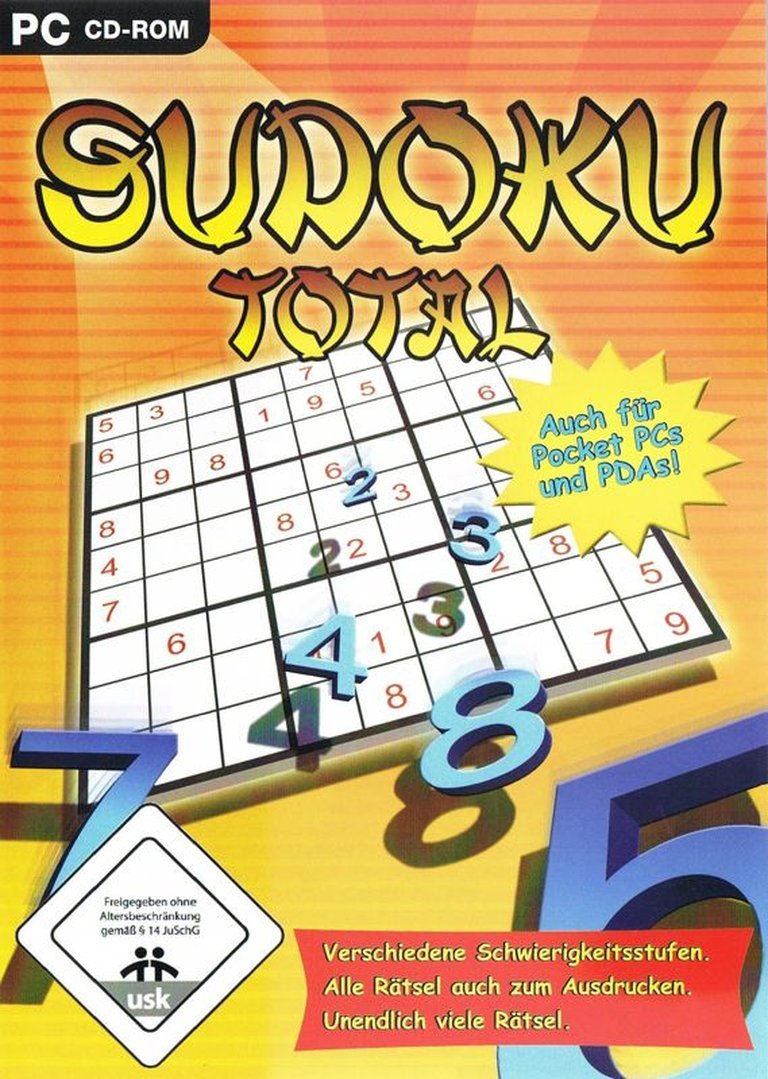
Sudoku Total is a Windows-based puzzle game that offers computer-generated Sudoku puzzles with three selectable difficulty levels. Players can enhance their skills using in-game features such as hints, complete solution displays, and time tracking, while also having the option to print puzzles for offline, paper-based solving.
Sudoku Total: Review
Introduction: The Logic of an Era
In the mid-2000s, a peculiar cultural phenomenon swept the globe: a humble pencil-and-paper logic puzzle, imported from Japan, conquered commuter trains, coffee tables, and newspaper stands with the force of a viral trend long before the term was common currency. Sudoku was everywhere. Against this backdrop of rampant, almost manic popularity, the software market responded with a deluge of digital adaptations, varying wildly in quality and ambition. Into this crowded field stepped Sudoku Total, a commercial Windows title released in December 2005 by the German publisher bhv Distribution GmbH. It arrived not as a pioneer or a innovator, but as a crystallized artifact of the exact moment its namesake puzzle became a ubiquitous global craze. This review posits that Sudoku Total is a fascinating case study in trend-chasing software: a technically competent, feature-stacked, yet profoundly auteur-less product that offers a perfect mirror of the 2005 Sudoku ecosystem, prioritizing utility and accessibility over artistic vision or gameplay innovation. It is not a game in the traditional sense of narrative or mechanical depth, but a digital tool—a polished, user-friendly interface for the consumption of generated logic puzzles—whose historical value lies precisely in its unassuming, derivative nature.
Development History & Context: Capturing the Crest of a Wave
To understand Sudoku Total, one must first understand the tidal wave it rode. The puzzle’s journey is a masterclass in cultural translation. From Leonhard Euler’s 18th-century Latin Squares, to Howard Garns’ 1979 American “Number Place,” to Nikoli’s 1984 Japanese renaming and refinement, Sudoku was a slow-burning success primarily confined to Japan for two decades. The catalyst for global explosion was Wayne Gould, a New Zealand judge who, inspired during a 1997 trip to Tokyo, spent years developing the Pappocom Sudoku generator. His pitch to The Times of London in November 2004 was the spark. By 2005, as detailed in multiple historical accounts, Sudoku was a full-blown mania: syndicated globally, the subject of TV shows, and credited with everything from improving mental acuity to delaying Alzheimer’s. The market was instantly saturated with books, handheld devices, and software.
It is into this gold rush that bhv Distribution GmbH, a German software house known for budget and compilation titles (often in the “entertainment” and “hobby” genres), released Sudoku Total. The development studio is not credited on the MobyGames entry, suggesting it was either an internal bhv project or a commissioned work from a small, uncredited team. The technological context is that of the mid-2000s Windows PC: CD-ROM distribution, 2D graphical interfaces, and a user base comfortable with mouse-driven point-and-click mechanics. The constraints were not technical horsepower but market saturation. The challenge for bhv was not how to implement Sudoku, but how to differentiate their version in a sea of near-identical competitors. Their solution, as the game’s description reveals, was to pack in every expected utility feature—multiple difficulties, timers, hints, full solutions, and printing—into a single, no-frills package. There was no visionary lead designer or proprietary algorithm touted; this was a product built from a checklist of desired features, aimed squarely at the casual puzzle enthusiast who had just discovered the joy of filling grids on their morning commute.
Narrative & Thematic Deep Dive: The Zen of the Empty Grid
Sudoku Total presents a profound and deliberate narrative void. It has no plot, no characters, no dialogue, and no setting in a conventional sense. Its “world” is the abstract, austere plane of the 9×9 grid. This is not a failure of design but its core philosophical and functional thesis. Whereas other puzzle games might dress their mechanics in thematic clothing—Minesweeper with its minefield, Dr. Mario with its viral invasion—Sudoku Total embraces the pure form. Its thematic essence is that of order from chaos, logic triumphing over ambiguity.
The “narrative” experienced by the player is a purely internal, mental journey. It begins with a state of disorder (a partially filled grid with missing numbers). Through a process of deduction, pattern recognition, and constraint satisfaction, the player imposes a singular, perfect order upon that chaos. The game’s minimal aesthetic—a top-down view of a clean grid—serves as a blank canvas for this cognitive drama. The only “story” is that of the player’s own problem-solving process. The included functions—hints and full solutions—introduce a meta-narrative about the relationship between challenge and assistance. Requesting a hint is a moment of branching narrative: the story continues, but with a significant plot point revealed. Requesting the full solution is akin to an ending, but one that renders the player’s agency moot. The theme, therefore, is not one of heroism or discovery, but of personal mastery and mental hygiene. It aligns with Sudoku’s broader cultural positioning as a brain-training exercise, a meditative practice for an overstimulated world. The game’s utter lack of extrinsic narrative forces the focus entirely inward, onto the intrinsic narrative of logical resolution.
Gameplay Mechanics & Systems: Functionalism in Practice
The mechanical heart of Sudoku Total is the classic Sudoku ruleset: fill a 9×9 grid so that each row, each column, and each of the nine 3×3 sub-grids (boxes) contains all digits from 1 to 9 exactly once. The game’s implementation is straightforward and functional.
Core Loops: The primary loop is a direct translation of paper-based solving: inspect the grid, apply logical rules (naked singles, hidden singles, etc.), place a number, repeat. The digital interface simply replaces the pencil with a mouse click. A secondary, complementary loop is the tracking of best times, which adds a performance layer, transforming the contemplative puzzle into a timed mental sport. This taps into the broader “brain game” craze of the era.
Progression & Difficulty: The game offers three selectable difficulty levels. This is a critical system, as the source material (historical articles) emphasizes that Nikoli’s innovation included establishing difficulty grading. Sudoku Total‘s implementation is likely based on the number and placement of givens (pre-filled numbers), though the specific algorithm is not documented. This creates a clear, if superficial, progression path for the player from “Easy” to “Hard.”
User Interface & Utility Features: This is where Sudoku Total stakes its claim. Its UI is a model of utilitarian clarity:
* Cell Selection & Number Entry: Click a cell, press a number key (1-9) or click an on-screen number pad.
* Note-Taking (Pencil Mode): While not explicitly detailed in the Moby description, such functionality was standard in even basic Sudoku software of the era. The ability to toggle a “pencil” mode for marking potential candidates is a near-essential utility feature that would be expected.
* Help System: This is the game’s flagship feature suite. It includes:
* Hints: A system that reveals a single logical cell. The sophistication varies—it might simply show the next solvable cell (a “naked single”) or attempt to identify a more complex pattern. This is a direct response to player frustration and a key accessibility tool.
* Complete Solution: Functions as an “auto-solve” or “give up” option, instantly filling the grid. This transforms the game from a challenge to a revelation tool.
* Print Function: This is a remarkable and defining feature. It explicitly acknowledges the analog/digital hybrid playstyle prevalent in 2005. A player could generate a puzzle on their PC, print it on paper, solve it during a train commute with a real pen, and later check their solution against the digital version. This bridged the gap between the new digital convenience and the tactile satisfaction of paper, a smart nod to Sudoku’s print-magazine origins.
Innovation vs. Flaws: There is no mechanical innovation here. The systems are entirely derivative of the established Sudoku software canon. Potential flaws are inherent to its minimalist philosophy: a lack of error checking (highlighting contradictory placements), candidate highlighters (filtering the grid to show all instances of a specific number), or a robust statistics tracker beyond best time. The absence of these features, common in later or more advanced programs, marks it as a product of its time—focused on the core act of generation and solving, not meta-game analysis.
World-Building, Art & Sound: The Aesthetic of the Void
Sudoku Total exists in a non-world. Its art and sound design are not attempts to build an atmosphere or setting but to create a neutral, distraction-free environment for pure cognition.
- Visual Direction: The perspective is, as noted, top-down. The graphical assets are almost certainly basic, raster-drawn numbers on a grid, perhaps with subtle color-coding for givens vs. player input. The color palette would be muted—likely beige, white, black, soft grays—prioritizing legibility over style. There is no animation when placing numbers; a click and a number appearing is the full feedback loop. The “world” is the grid itself, rendered with surgical precision to avoid any visual clutter that might break concentration. It is the digital equivalent of a pristine puzzle on a clean sheet of paper.
- Sound Design: Given the era and genre, sound is likely minimal or optional. At most, there would be simple, unobtrusive clicks or tones for selection and confirmation. Any background music would begeneric, ambient, and easily muted—a feature, not an experience. The soundscape is designed to be ignored, a stark contrast to the diegetic and non-diegetic audio of narrative-driven games. Silence is the intended auditory state.
- Contribution to Experience: This total aesthetic minimalism is the game’s greatest strength and most profound statement. It removes all barriers between the player’s mind and the logical structure of Sudoku. There is no story to interpret, no character to relate to, no environment to explore—only the puzzle. This aligns perfectly with the historical accounts of Sudoku’s appeal: its language-independent, culture-agnostic, purely logical nature. Sudoku Total builds a world that is, in essence, a thinking space. The experience is meditative, repetitive, and intensely focused. The “atmosphere” is one of quiet, solitary concentration.
Reception & Legacy: A Ghost in the Machine
Critically and commercially, Sudoku Total exists in a state of near-total archival silence. There are no critic reviews aggregated on its MobyGames page, and no user reviews at all. This is not an anomaly but the norm for countless budget-priced, niche-market puzzle titles from the mid-2000s. Its commercial success is impossible to quantify precisely, but as a commercial CD-ROM release by a known publisher during the 2005 peak, it undoubtedly found a market—likely in software bundles, discount bins, and alongside similar titles in retail stores. Its legacy, however, is almost entirely as a cultural artifact.
While massively influential games alter their genres, Sudoku Total represents the democratization and commoditization of a phenomenon. It is a direct descendant of the 2004-2005 newspaper boom and the early digital adaptations like Wayne Gould’s Pappocom Sudoku. Its legacy is twofold:
- As a Benchmark of Accessibility: By bundling printing, hints, solutions, and difficulty selection, it codified the “standard feature set” for casual Sudoku software for years. Later, more sophisticated applications would build upon this foundation.
- As a Historical Snapshot: It captures the moment when Sudoku transitioned from a newspaper craze to a permanent fixture in the digital casual games landscape. Its lack of online leaderboards (2005’s internet was not yet the always-connected cloud) and its inclusion of local printing highlight its pre-smartphone, desktop-PC-centric era. It is a game that assumes you will solve puzzles on this computer or on a piece of paper you tear from your printer, not on a phone while waiting in line.
Its influence on the industry is indirect. It is a data point in the vast, profitable world of “casual puzzle games,” a genre that would later be dominated by mobile giants like Sudoku.com. It proves that during the 2005 boom, there was enough demand to support dozens of such equivalent titles from publishers like bhv. It did not invent a mechanic or define a subgenre; it exemplified a market condition.
Conclusion: The Perfectly Average Puzzle
Sudoku Total is not a game one judges by traditional metrics of creativity, narrative, or mechanical innovation. To critique it for lacking a story or groundbreaking systems is to miss its point entirely. It is a perfectly average, perfectly competent, and perfectly time-bound piece of software.
Its definitive verdict in the annals of video game history is this: Sudoku Total is the canonical example of a trend-chasing utility game from the peak of the Sudoku bubble. It is a sober, unadorned, and effective conduit for one of humanity’s most perfect logic puzzles during the period of its maximum mainstream saturation. It adds nothing to Sudoku itself but provides—with reliable, no-nonsense efficiency—everything a player of the era could reasonably want from a digital version, acknowledging the dual desires for screen-based convenience and paper-based tangibility.
For the historian, it is invaluable as a period piece. For the player seeking a novel Sudoku experience, it is obsolete, superseded by free web and mobile apps with richer features and seamless integration. Its place is not on a “Greatest Games” list, but in a museum of 2000s Casual Gaming, a silent, grid-filled monument to the brief, glorious moment when the entire world seemed to be staring at a handful of numbers, searching for that single, logical path to completion. Its legacy is the legacy of Sudoku itself: simple, universal, and eternally satisfying in its pure form, regardless of the medium through which it is consumed.