
- Release Year: 1998
- Platforms: PlayStation 3, PlayStation, PS Vita, PSP, Windows
- Publisher: Konami Co., Ltd., Konami Digital Entertainment Co., Ltd., Sony Computer Entertainment America LLC
- Developer: Konami Computer Entertainment Tokyo Co., Ltd.
- Genre: Role-playing (RPG)
- Perspective: Top-down
- Game Mode: Single-player
- Gameplay: Base building, Magic, Mini-games, Recruitment, Turn-based combat
- Setting: Fantasy
- Average Score: 87/100
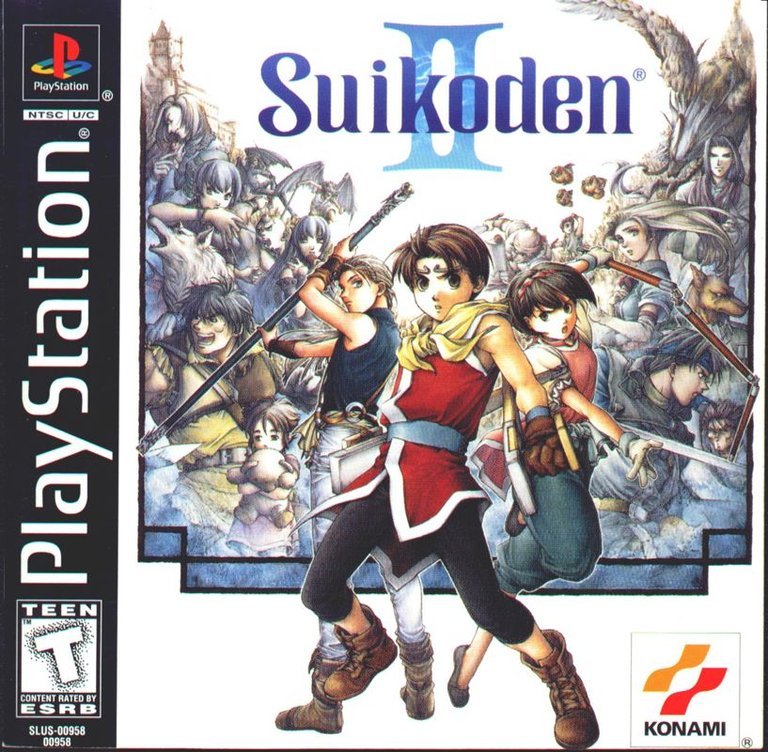
Description
Suikoden II is a Japanese-style role-playing game set in a fantasy world at war, where players follow a young soldier who escapes his country’s tyranny and becomes embroiled in a complex political struggle between nations. As part of the resistance, players build an army by recruiting 108 characters (Stars of Destiny), customize a castle headquarters, and engage in both traditional turn-based combat and strategic grid-based battles. The game explores themes of war, friendship, and betrayal, allowing players to equip characters with magical runes while experiencing a rich narrative with multiple endings.
Gameplay Videos
Where to Buy Suikoden II
Suikoden II Free Download
PC
PSP
PlayStation
PlayStation 3
Suikoden II Patches & Updates
Suikoden II Mods
Suikoden II Guides & Walkthroughs
Suikoden II Reviews & Reception
metacritic.com (82/100): I would place this one up there with “Xenogears” and “Grandia” as the three must buy RPGs for the system.
rpg-o-mania.com : The Suikoden series is THE MOST underrated series in history of role playing games. That said, Suikoden 2 is a step up in every way from it’s prequel. It may not be the flashiest, or prettiest rpg in history but it certainly has the most heart.
imdb.com (90/100): this game is just simply amazing,the music is unbelievable,the characters,script,places,pacing,control and everything is a perfect 100/100 the best game i have ever played
ign.com (90/100): An epic tale of friendship and treachery that can only be described as breathtaking, SUIKODEN 2 will leave you crying for a follow-up by the time you’re done with it.
Suikoden II Cheats & Codes
PlayStation
At the name entry screen, highlight ‘Determine’, then press L2 + R2.
| Code | Effect |
|---|---|
| L2 + R2 | Random name entry |
PlayStation
| Code | Effect |
|---|---|
| 8006A4F8 FFFF | Unlimited Money |
| 8006A4F8 423F 8006A4FA 000F |
Max Money |
| D0071660 14AF 80071662 2400 D0071728 0009 8007172A 1000 D00716B0 088A 800716B2 2400 |
Unlimited Items (All Slots) |
| 50005224 0000 80069894 03E7 |
Quick Level Gain (All Characters) |
| 80023F62 0006 | Always Roll 6 |
| 80023F62 000A | Always Score Triple In Dice Game |
| 80024AD8 0006 | Always Climb In Rope Game |
| 80023FF6 1964 80024242 19C8 |
Always Catch Fish |
| 800965E4 0000 800961F6 2400 80096206 2400 8009621A 2400 80096226 2400 |
Walk Through Walls |
| 8006AA52 0000 8006AA54 0000 8006AA56 0000 |
Game Time 00:00:00 |
| D002566C 0000 8002566E 0000 |
No Random Encounters |
| 3006AF6D 0023 | McDohl Plotline Unlocked |
| D006A486 801F 3006A46A 0052 |
Ghetto McDohl Unlock Code |
| 3006AEB9 00FF | [“Headquarters” Castle] |
| 3006AE41 0007 | [Abizboah] |
| 3006AE79 0007 | [Adlai] |
| 3006AE82 0007 | [Alberto] |
| 3006AE6F 0007 | [Alex] |
| 300747E0 0007 | [All Allies Are Long Range] |
| 80023FF6 1964 80024242 1970 |
[Always Catch Fish] |
| D0062124 0000 80024AD8 0006 |
[Always Climb In Rope Game] |
| D0062124 0000 80023F62 000A |
[Always Score a Triple in Chinchirorin] |
| 3006AE35 0007 | [Amada] |
| 3006AE37 0007 | [Anita] |
| 3006AE80 0007 | [Annallee] |
| 3006AE65 0007 | [Apple] |
| 30069EB7 0000 | [Armor Equipped Modifier] |
| 3006A1F3 0000 | [Armor Equipped Modifier] |
| 3006A0D3 0000 | [Armor Equipped Modifier] |
| 30069D4F 0000 | [Armor Equipped Modifier] |
| 3006A08B 0000 | [Armor Equipped Modifier] |
| 3006A25F 0000 | [Armor Equipped Modifier] |
| 30069E03 0000 | [Armor Equipped Modifier] |
| 3006A23B 0000 | [Armor Equipped Modifier] |
| 30069CBF 0000 | [Armor Equipped Modifier] |
| 3006A067 0000 | [Armor Equipped Modifier] |
| 30069C0B 0000 | [Armor Equipped Modifier] |
| 3006995F 0000 | [Armor Equipped Modifier] |
| 30069E27 0000 | [Armor Equipped Modifier] |
| 30069B0F 0000 | [Armor Equipped Modifier] |
| 30069DBB 0000 | [Armor Equipped Modifier] |
| 3006A40F 0000 | [Armor Equipped Modifier] |
| 300713D8 0000 | [ALL “Locked” Armor removable] |
| 3007136C 0000 | [ALL “Locked” Head Runes removable] |
| 300712AC 0000 | [ALL “Locked” Helmets removable] |
| 300713F8 0000 | [ALL “Locked” LH Runes removable] |
| 30071334 0000 | [ALL “Locked” Other(items) removable] |
| 30071398 0000 | [ALL “Locked” RH Runes removable] |
| 30071304 0000 | [ALL “Locked” Shield removable] |
| 3007141C 0000 | [ALL “Locked” Weapon Runes removable] |
| 3007483C 000F 30074840 0082 |
[Blacksmith One Sharpen Max WPN Level] |
| 80072E9A 1045 | [Buy/Sell Max Infinite Money] |
| 3006A8CD 00?? 3006A8CE 00?? 3006A8CF 00?? 3006A8D0 00?? 3006A8D1 00?? 3006A8D2 00?? 3006A8D3 00?? 3006A8D4 00?? |
[Castle Name Modifier] |
| 50005224 0000 8002AB1A ???? |
[Damage Modifier (all)] |
| D0062124 ???? 8002AB1A ???? |
[Damage Modifier (Hero)] |
| 80088984 ???? | [ATT Characters Modifier] |
| 80088AF4 ???? | [DEF Characters Modifier] |
| D0062124 ???? 80024AD8 0006 |
[Always Climb In Rope Game] |
| D0062124 ???? 80023F62 000A |
[Always Score a Triple in Chinchirorin] |
| Enable All Characters Reach to Level 100 | [Enable All Characters Reach to Level 100] |
Suikoden II: A Definitive Retrospective of Gaming’s Underrated Epic
Introduction
In the pantheon of role-playing games, certain titles transcend their medium to become cultural touchstones, yet remain frustratingly obscured by circumstance. Suikoden II, Konami’s 1998 PlayStation masterpiece, stands as the quintessential example of such a masterpiece. Initially overshadowed by the era’s 3D graphical revolution and suffering from a criminally limited print run, it has since ascended to legendary status as one of the greatest JRPGs ever conceived. Its enduring legacy lies not in technological spectacle, but in its unparalleled synthesis of narrative depth, emotional resonance, and mechanical ambition. This review will dissect Suikoden II through the lens of its development, narrative brilliance, innovative systems, artistic merit, and cultural impact, arguing that its status as a cult classic is not merely a testament to its quality, but to its unassailable position as a benchmark for storytelling and emotional weight in interactive entertainment.
Development History & Context
Suikoden II emerged from the fertile creative soil of Konami’s Computer Entertainment Tokyo, under the stewardship of director, writer, and producer Yoshitaka Murayama. Following the critical if not commercial success of the original Suikoden (1995), Murayama and his team embarked on an ambitious sequel with a clear mandate: to refine and expand upon the first game’s revolutionary concepts while crafting an even grander narrative. The team, including key figures like character designer Fumi Ishikawa and composer Miki Higashino, operated under significant technological constraints. Released in December 1998 in Japan and September 1999 in North America, the game arrived on the PlayStation during an era dominated by the photorealistic ambitions of titles like Final Fantasy VIII. This created a stark visual dichotomy; while contemporaries pushed polygons, Suikoden II embraced a meticulously crafted 2D sprite-based aesthetic, a deliberate choice that prioritized artistic cohesion and expressive character design over graphical fidelity.
Murayama’s vision was profoundly influenced by the classical Chinese novel Shui Hu Zhuan (Water Margin), which provided the foundational mythos of the “108 Stars of Destiny.” However, he transposed this framework into a richly original fantasy world, focusing on themes of war, political intrigue, moral ambiguity, and the cyclical nature of conflict. The game’s narrative, largely penned by Murayama himself, was conceived as a direct sequel set three years after the events of the first Suikoden, weaving in familiar characters while introducing a new generation of heroes. The development team’s commitment to this vision is evident in the game’s intricate political landscape and the sheer breadth of its cast. Remarkably, despite the pressures of the era, Suikoden II integrated features like a data transfer system from the first game—a novel concept at the time—allowing returning characters to carry over levels and equipment, enhancing continuity and rewarding dedicated players. This technical ingenuity, coupled with a focus on player-driven narrative through the recruitment of 108 characters, solidified Suikoden II not just as a sequel, but as a profound statement on interactive storytelling.
Narrative & Thematic Deep Dive
The narrative of Suikoden II is a masterclass in tragic grandeur, chronicling the brutal Dunan Unification War between the tyrannical Highland Kingdom and the fractured City-States of Jowston. Players assume the role of a silent protagonist, Riou, an orphan raised by the heroic swordsman Genkaku alongside his fiercely loyal sister, Nanami. The plot explodes into life with a devastating betrayal: Highland’s psychotic Prince Luca Blight orchestrates the massacre of his own youth brigade—including Riou and his best friend, Jowy Atreides—to fabricate a pretext for invading Jowston. This act of calculated savagery sets the stage for a complex tale of divided loyalties and inescapable destiny. After a desperate escape, Riou and Jowy each gain one half of the sentient “Rune of the Beginning,” a True Rune that binds them to a fated rivalry, forcing them down opposing paths despite their profound bond.
The narrative’s brilliance lies in its nuanced exploration of causality, moral compromise, and the human cost of war. Characters are rarely archetypal heroes or villains; they are products of their circumstances, driven by ideology, trauma, or survival. Luca Blight, for instance, is not merely a caricatured madman but a figure shaped by witnessing his mother’s rape by Jowston soldiers, his hatred a warped response to historical injustice. Jowy’s defection to Highland is not simple betrayal but a desperate, pragmatic attempt to mitigate the coming slaughter from within, his tragic arc underscored by his love for Riou and his desire to protect the innocent Pilika. The game excels in subverting expectations, culminating in sequences of staggering emotional impact—most notably Nanami’s self-sacrifice, which shatters the player’s emotional defenses and becomes a catalyst for Riou’s resolve.
Thematic depth permeates every layer. The “108 Stars of Destiny” concept is not a mere recruitment gimmick but a metaphor for collective agency versus individual fate. As Riou gathers this diverse assembly—mercenaries, mages, nobles, and commoners—he forges a new identity, transforming from a soldier into a reluctant leader. The narrative constantly questions the nature of power and responsibility, embodied by the Rune of Beginning’s curse and the Beast Rune’s destructive influence. The dialogue, particularly in character-defining moments, is sparse yet potent, conveying volumes through subtext. The game’s multiple endings, triggered by player choices like recruiting all Stars of Destiny or Nanami’s survival, reinforce its core themes of hope, reconciliation, and the possibility of breaking destructive cycles. In a genre often criticized for simplistic binaries, Suikoden II offers a tapestry of grey moralities, where victory demands sacrifice, and peace requires understanding one’s enemies.
Gameplay Mechanics & Systems
Suikoden II refines the original game’s framework into a remarkably cohesive and multifaceted experience, balancing traditional RPG exploration with strategic depth and character-driven progression. At its core lies the recruitment of the 108 Stars of Destiny, a process that drives both narrative and gameplay. Characters are not acquired simply by story progression; many require dedicated side quests, uncovering hidden locations, or solving personal dilemmas. This transforms the world into a living ecosystem where every NPC interaction feels purposeful, rewarding thorough exploration with rich character backstories and new party members.
The battle system is a tripartite affair, each with distinct mechanics:
1. Standard Turn-Based Combat: Featuring parties of up to six characters, it emphasizes strategic synergy through “Unite Attacks.” These devastating combination moves—triggered by specific character pairings—require familiarity with the roster, turning battles into dynamic showcases of character relationships. The rune system, allowing equipping of up to three runes per character (a significant upgrade from the first game), offers incredible tactical flexibility. Runes provide spells, stat boosts, or passive abilities, with limited uses per battle tier, encouraging resource management. Experience distribution, based on level differentials, streamlines party-building, allowing lower-level recruits to catch up quickly.
2. Duels: These one-on-one confrontations reduce combat to a tense “Rock, Paper, Scissors” mechanic, mirroring the dramatic tension of the moment. Players choose between Attack, Wild Attack, or Defend, with success hinging on correctly anticipating the opponent’s move based on contextual dialogue cues. While divisive for its reliance on luck, these moments punctuate key plot points with cinematic intensity.
3. Strategic War Battles: Representing the most significant evolution from the first game, these tactical grid-based conflicts involve maneuvering armies of units led by recruited characters. Units possess unique abilities (archery, healing, enhanced defense), and positioning is crucial for surrounding enemies. Movement is deliberately restricted (1-2 squares per turn), emphasizing careful planning. While criticized for occasional difficulty and less polished visuals compared to the main game, these battles scale the conflict to epic proportions, making the player feel like a true commander.
The castle base, a series staple, expands into a bustling hub where characters interact, items are crafted, and mini-games (like the surprisingly deep cooking contests, fishing, and dice games) offer respite and rewards. The party inventory system, shared among all six active members, eliminates tedious micromanagement. Critically, the ability to import save data from Suikoden I grants returning characters elevated stats, equipment, and unique recruitment scenes, a forward-thinking feature that rewarded long-term fans and enriched the series’ continuity. Despite minor quibbles—such as fixed grid-based town navigation and occasional UI clunkiness—the systems coalesce into an experience where every mechanic serves the overarching narrative and world-building.
World-Building, Art & Sound
The world of Suikoden II is a meticulously realized tapestry of distinct cultures, political factions, and ancient lore, primarily set in the Dunan region. The conflict between Highland’s monolithic, militaristic society and Jowston’s fractious, alliance-based city-states provides a rich backdrop for exploring themes of nationalism, autonomy, and the burdens of leadership. Locations are imbued with history: Muse, the glittering capital; Greenhill, the scholarly academy; Two River, the bustling trade hub; and the war-torn plains, each with unique architecture, economies, and social dynamics. This geographical and cultural diversity is deepened by references to the wider Suikoden universe, including the enigmatic Sindar ruins and the ever-present shadow of the sprawling Holy Kingdom of Harmonia.
Visually, Suikoden II is a triumph of artistic restraint and detail. While its 2D sprites and pre-rendered backgrounds were visually modest compared to the era’s 3D blockbusters, they possessed a timeless charm and expressive power. Character sprites are richly detailed with subtle animations, and environments utilize sophisticated color palettes, lighting, and parallax scrolling to create depth and atmosphere. Towns, while sometimes large, are distinct and navigable, avoiding the tile-based repetition of its predecessor. Battle sprites, despite occasional “big pixel” scaling issues during zooms, are animated with fluidity and personality. Character portraits, static though they may be, are rendered with exceptional care by Fumi Ishikawa, their designs instantly conveying personality and emotion—a stern general, a mischievous thief, a weary mage.
The game’s true sonic masterpiece lies in its soundtrack by Miki Higashino. Far exceeding the quality of the first game, the score is a breathtaking fusion of Celtic folk melodies, traditional Japanese motifs, sweeping orchestral passages (reportedly featuring the Philharmonic Orchestra of Warsaw), and haunting vocal themes. Tracks like “Reminiscence,” “Gentle Wind,” and the iconic “Riou’s Theme” are not merely background music but emotional anchors, amplifying the narrative’s pathos and grandeur. Sound design, while more functional, provides crisp feedback for actions and environmental cues, from the clink of armor to the rustle of leaves. The audiovisual synergy elevates key moments: the melancholy swell of music during Nanami’s funeral, the driving percussion of a war charge, the quiet intimacy of a character’s theme in a quiet inn. This cohesive artistic direction transforms the game’s world from a setting into a lived-in, breathing entity, where music and visuals conspire to deliver profound emotional resonance.
Reception & Legacy
Upon its release, Suikoden II suffered from a double blow: a limited print run in North America and a critical reception somewhat muted by the industry’s prevailing 3D fixation. While garnering positive reviews (averaging 81% on Metacritic), some critics dismissed its dated visuals, with publications like GameSpot (76%) noting it “brings nothing new to the genre.” Commercially, it was a niche success, quickly becoming scarce and fetching exorbitant prices on the secondary market, cementing its “holy grail” status among collectors. However, the narrative began to shift dramatically in the years following its release. As the limitations of the 3D era faded and appreciation for narrative depth grew, Suikoden II underwent critical re-evaluation. Retrospectives from publications like IGN (90%), GameCritics (90%), and Next Generation (80%) lauded its storytelling, characters, and ambition. Classic-games.net (90%) declared it “one of the greatest of all time,” a sentiment echoed by countless player testimonials and online communities.
Its legacy is now firmly established as a cult classic and a benchmark for the JRPG genre. It consistently ranks among the greatest PlayStation games ever made and frequently appears in “best of all time” lists alongside titans like Chrono Trigger and Final Fantasy VII. Its influence is evident in games that prioritize ensemble casts, political narratives, and emotional storytelling over graphical spectacle. The passionate fanbase, kept alive through decades of advocacy, culminated in the long-awaited 2025 HD remaster (Suikoden I & II HD Remaster: Gate Rune & Dunan Unification Wars), introducing the masterpiece to new generations. The announcement of an anime adaptation in 2026 further underscores its enduring cultural significance. Suikoden II stands as a testament to the power of artistic vision and narrative depth, proving that a game’s true legacy lies not in its graphical fidelity, but in the indelible mark it leaves on the hearts and minds of players.
Conclusion
Suikoden II transcends its initial obscurity to stand as one of the undisputed masterpieces of the role-playing genre. It is a game of profound emotional weight, where every narrative beat, character interaction, and strategic choice resonates with consequence. Murayama’s vision, unfettered by the era’s technological obsessions, created a world where war’s brutal realities and the fragility of human bonds are explored with unflinching honesty and remarkable depth. The gameplay, blending traditional JRPG combat with innovative strategic elements and the compelling recruitment mechanic, serves this narrative, creating an experience that is both intellectually engaging and viscerally affecting.
Its legacy is etched in stone: it redefined what a JRPG could be, proving that pixel art and orchestral music could convey more emotional power than polygons and FM ever could. It is a game that rewards patience, celebrates diversity through its 108 Stars of Destiny, and delivers one of the most cathartic and bittersweet conclusions in gaming history. While its initial release was a victim of circumstance and timing, its rediscovery by successive generations of players has cemented its status as a timeless classic. Suikoden II is not merely a game; it is a sprawling, emotional epic that reminds us why we play—to live, to lose, to fight, and ultimately, to find meaning in the struggle. Its place in video game history is not just secure—it is monumental.