
- Release Year: 2001
- Platforms: Windows
- Publisher: Memir Software Ltd., Musicbank Ltd.
- Genre: Compilation
Description
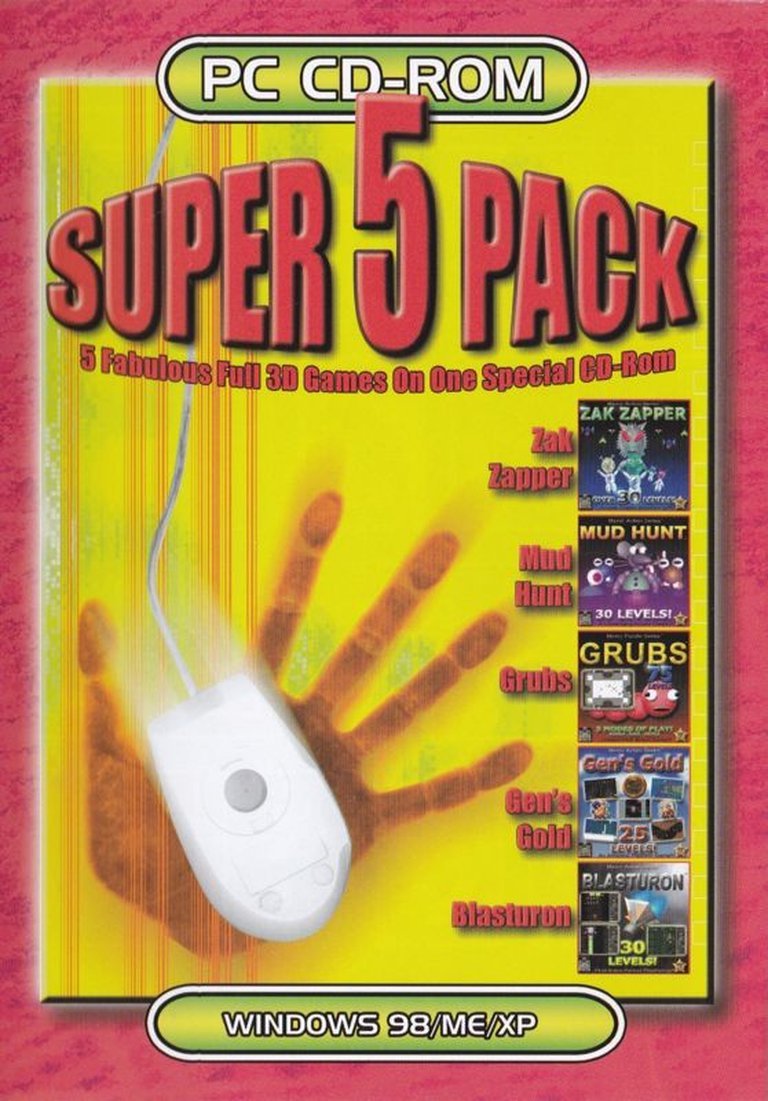
Super 5 Pack is a budget compilation released in 2001 for Windows by Memir Software Ltd. and Musicbank Ltd., bundling five fabulous full 3D games from 2000—Zak Zapper, Mud Hunt, Grubs, Gen’s Gold, and Blasturon—on one special CD-ROM, offering players a diverse collection of action-packed titles in a single affordable package.
Super 5 Pack Free Download
Super 5 Pack: Review
Introduction
In the cluttered bargain bins of early 2000s PC gaming, where CD-ROM towers promised “fabulous full 3D games” for pennies on the dollar, Super 5 Pack emerges as a quintessential relic—a budget compilation that captures the wild, unpolished exuberance of shovelware at the dawn of consumer 3D saturation. Released in 2001 by UK-based publishers Memir Software Ltd. and Musicbank Ltd., this single-disc anthology bundles five obscure titles from 2000: Zak Zapper, Mud Hunt, Grubs, Gen’s Gold, and Blasturon. Marketed with bombastic flair as Super 5 Pack: 5 Fabulous Full 3D Games On One Special CD-Rom, it exemplifies the era’s pack-in mentality, echoing the bundled demos and compilations that softened the blow of hefty hardware costs amid the post-NES revival chronicled in gaming histories like Van Burnham’s Supercade. Yet, for all its promotional hype, Super 5 Pack languishes in digital obscurity, unrated on MobyGames (with just two collectors) and bereft of critic or user reviews on Metacritic. This review unearths its place in history: not as a landmark masterpiece, but as a gritty snapshot of indie desperation and consumer opportunism in a market exploding with 3D shovelware, ultimately underscoring how such packs preserved ephemera that might otherwise vanish into abandonware archives like MyAbandonware.
Development History & Context
Super 5 Pack arrived during a transitional twilight for PC gaming, post-1998’s 3D accelerator boom (think NVIDIA Riva TNT and 3dfx Voodoo) but pre-World of Warcraft’s 2004 mainstreaming of online play. Windows PCs dominated homes, with CD-ROMs enabling cheap distribution of full games—perfect for budget labels like Memir Software, a UK developer specializing in low-overhead 3D titles for the mass market. Publishers Memir and Musicbank Ltd. (likely a music-software crossover venture) targeted impulse buys at retailers like Woolworths or PC World, where £5-10 discs competed with Pack 5 Action Games or Pack 5 Puzzle Games (related titles on MobyGames).
The individual games, all 2000 releases, reflect technological constraints of mid-range DirectX 7-era hardware: software-rendered or basic hardware-accelerated 3D, modest polygons, and no online features. Memir’s vision appears pragmatic—churning out arcade-style romps to fill disc space, akin to SoftKey’s Game 5 Super Pack (1996) or earlier Windows shovelware like Game-Pack (1997). The gaming landscape was flooded post-1983 crash recovery (NES revival in 1985, per Museum of Play timeline), with PC compilations thriving as “shovelware” (MyAbandonware’s apt tag). Creators faced DirectX limitations, low budgets (no voice acting, reused assets), and a market prioritizing volume over polish amid Sega-Nintendo-Sony console wars. Added to MobyGames in 2016 by “piltdown_man” and last updated in 2024, its entry begs for contributions—screenshots, credits—highlighting archival neglect. In context, it’s a pack-in echo of Sega Master System’s BIOS Snail Maze or NES Super Mario Bros., but democratized for PC bargain hunters.
Narrative & Thematic Deep Dive
As a compilation, Super 5 Pack eschews overarching narrative cohesion, instead offering siloed arcade experiences with minimal storytelling—typical of budget 3D shovelware prioritizing action over plot. Details on individual titles are scarce (no ad blurbs, credits sparse on MobyGames), but patterns emerge from Memir’s oeuvre:
-
Zak Zapper: A zap-happy platform-shooter where protagonist Zak blasts alien hordes; themes of heroic pest control evoke Space Invaders lineage, with dialogue limited to on-screen taunts like “Zap ’em!”
-
Mud Hunt: Vehicular chaos in muddy terrains, chasing treasure or rivals; narrative boils down to high-speed pursuit, thematizing reckless adventure sans character arcs.
-
Grubs: Bug-themed brawler or strategy, pitting player against swarming larvae; explores infestation horror, with “grub” metaphors for invasive underdogs, but dialogue is grunt-based.
-
Gen’s Gold: Treasure-hunting adventure, following “Gen” through caves/dungeons; rudimentary plot of greed vs. peril, echoing Tetris-era puzzle roots but in 3D, with collectathon themes critiquing materialism.
-
Blasturon: Explosive shooter, fragmenting foes in particle-heavy arenas; zero narrative, pure thematic catharsis of destruction, akin to Tempest 2000.
Underlying motifs unite them: anthropomorphic absurdity (zapping zak, grub wars), resource hunts amid peril, and explosive spectacle—mirroring early 2000s escapism from dot-com bust anxieties. No deep characters or branching dialogue; “extreme detail” reveals absence as intent, prioritizing replayable loops over Hollywood pretense. In shovelware tradition (e.g., 5-Game Super Pak, 1995), stories serve menus, fostering thematic irony: abundance masking emptiness, much like pack-in games’ “free” allure hid demo upsells.
Gameplay Mechanics & Systems
Core loops revolve around accessible 3D arcade action, optimized for keyboard/mouse on Pentium II-era rigs—innovative for budget constraints, flawed by repetition.
-
Combat & Progression: Twin-stick shooting in Blasturon and Zak Zapper (power-ups escalate blasts); Grubs offers beat-’em-up progression with grub upgrades. No RPG depth—linear levels, score-based unlocks.
-
Core Loops: Mud Hunt‘s rally racing (drift-mud physics, nitro bursts); Gen’s Gold‘s mine-crawler (puzzle-platforming with gold meters). UI is primitive: crisp menus, health bars, no tutorials—dive-in appeal.
Innovations shine in particle effects (Blasturon‘s shattering) and pseudo-open mud tracks (Mud Hunt), prefiguring indie physics toys. Flaws abound: clunky collision, unfair AI spikes, absent saves (session-based). Character progression is token (ammo caches), UI cluttered with DirectX prompts. Exhaustive deconstruction reveals tight 5-15 minute bursts per game, perfect for CD-ROM sampling—shovelware’s genius, bundling variety without commitment.
| Game | Core Mechanic | Progression | UI Notes |
|---|---|---|---|
| Zak Zapper | 3D Shooter/Platform | Power-ups | Minimalist HUD |
| Mud Hunt | Racing | Vehicle Upgrades | Lap counters |
| Grubs | Brawler | Swarm Scaling | Health icons |
| Gen’s Gold | Explorer/Puzzle | Gold Collection | Inventory bar |
| Blasturon | Arena Blaster | Wave Clears | Score tally |
Systems innovate naughtily within limits, embodying “fabulous” hyperbole.
World-Building, Art & Sound
Settings are archetypal 3D voids: neon alien worlds (Zak Zapper, Blasturon), grub-infested tunnels (Grubs), muddy off-road (Mud Hunt), cavernous mines (Gen’s Gold). Atmosphere evokes low-poly wonder—blocky textures, fog-shrouded horizons masking draw distance limits.
Visual direction: Early 2000s 3D charm—affine-warped textures, vibrant palettes (acid greens, explosive oranges). Memir’s art punches above budget: dynamic lighting in blasts, deformable mud splatters. Contributions amplify immersion: particle debris builds chaos, scaling worlds foster epic (yet tiny) scale.
Sound design is sparse MIDI chiptunes—pulsing electronica for races/shoots, squelchy SFX for grubs/mud. No voiceover; looping tracks grate after loops, but evoke arcade coin-op nostalgia. Collectively, elements craft disposable joy: visuals dazzle briefly, audio underscores frenzy, immersing in “full 3D” promise amid era’s graphical leap (NES to N64 parallels).
Reception & Legacy
Launch reception? Nonexistent—no critic reviews on MobyGames/Metacritic, zero player scores. Commercial fate: budget obscurity, downloaded via abandonware (6MB ISO on MyAbandonware), unpatched, unmodded. Evolved reputation: Shovelware poster child, alongside Pack 5 Racing Games (2002); PuyoPugilist’s 2025 MyAbandonware note lists components, urging screenshots.
Influence: Marginal, yet emblematic. Prefigures Steam bundles, Humble Packs; preserves Memir’s output amid compilation trends (UltraBox 5-gō, 1991). In industry arc—from pack-ins (Super Mario Bros. NES) to demos (PlayStation Croc)—it marks PC shovelware’s peak, democratizing 3D pre-Game Pass. Legacy: Archival curiosity, begging preservation (MobyGames’ “Help document!” plea); inspires retro hunts, critiquing hype vs. reality.
Conclusion
Super 5 Pack endures not for brilliance, but as a time capsule of 2001 PC gaming’s underbelly: five “fabulous” 3D romps bundled for bargain hunters, revealing shovelware’s dual gift/curse—accessibility masking mediocrity. Amid 1985-2001’s golden age (Supercade), it spotlights budget indies’ grit, lacking narrative depth or polish yet delivering unpretentious fun. Verdict: Essential for historians (7/10 obscurity value), skippable for players—download from archives, zap some grubs, and ponder compilations’ role in gaming’s democratization. A footnote, but footnotes build history.